Mortgage broker marketing: where the leads come from
About seven in ten loans come from past clients and their referrals. Here’s how to work that book, pay referral partners within the rules, run ads and test bought leads, with a cost-per-settlement calculator and a 90-day plan.
On This Page
Search for mortgage broker marketing and page one is lead sellers, software vendors and agencies, each recommending the thing it sells. I build websites for brokers and sell marketing too, so read me with that in mind. What I've tried to do here is start from the evidence on where brokers' business actually comes from, then go channel by channel through what works and what the rules allow, because broking has more marketing rules than most small businesses: who you can pay for a referral, what they must say, how fast you must call, and what you can email. Everything comes from the National Consumer Credit Protection Act and Regulations, ASIC's guides, the ACMA and the MFAA, read on 12 October 2026. It isn't legal advice, and your licensee's compliance team has the final say.
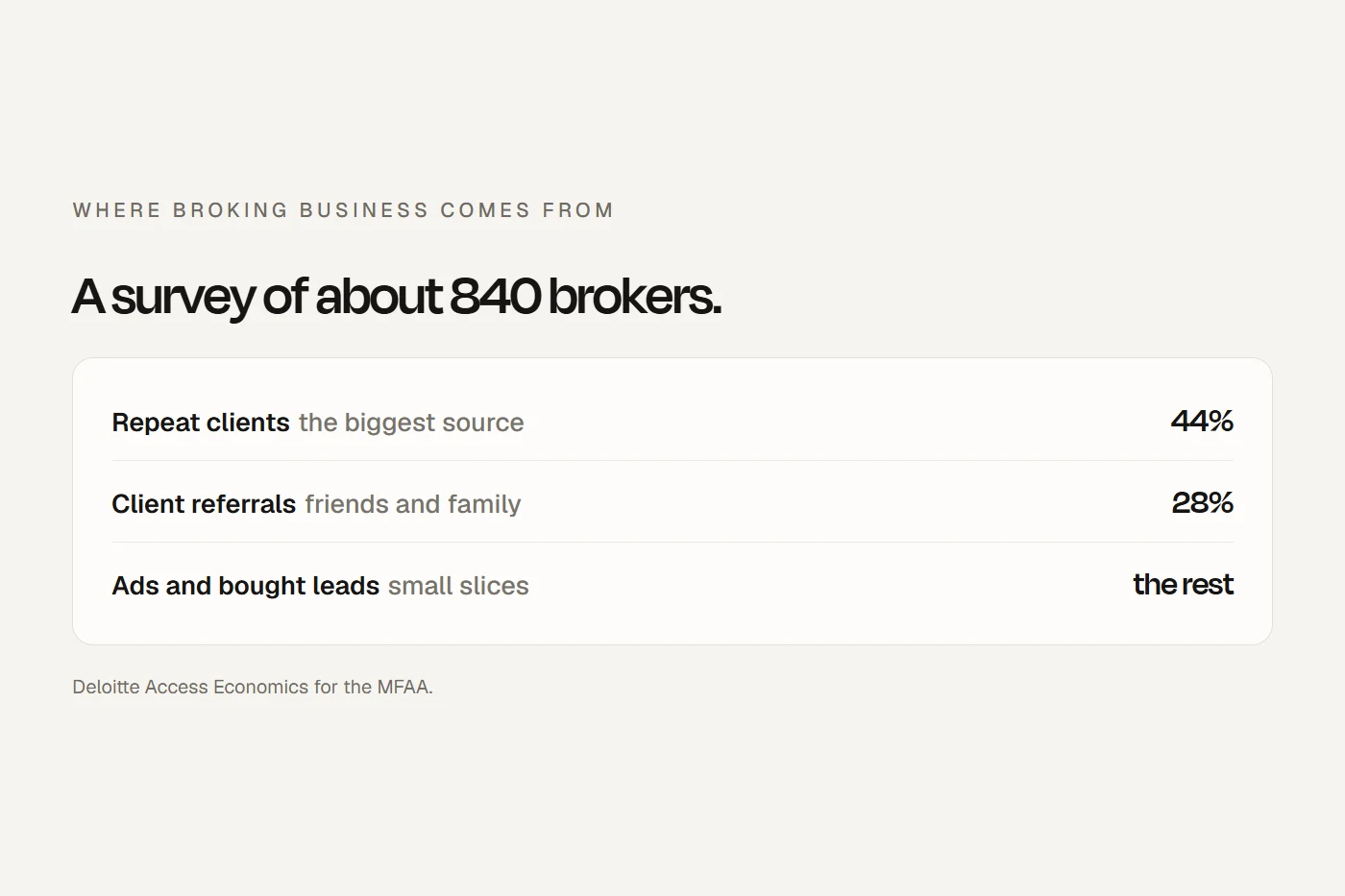
- Most business comes from people you already knowIn the broker survey Deloitte ran for the MFAA, about seven in ten loans came from repeat clients and their referrals. Ads and bought leads were small slices.
- Referral partners are next, and heavily regulatedA paid referrer must disclose the fee, can't collect payslips or help with the application, and you must call within 10 business days with a set opening.
- Paid leads need checking firstA business whose job is selling enquiries can't use the referrer exemption, and some sell the same lead to several brokers.
Where brokers' business comes from
More than eight in ten new home loans in Australia now go through a broker, according to the MFAA's quarterly market share data from Cotality. So the question isn't whether borrowers use brokers. It's how they pick one.
The best evidence is a survey of about 840 brokers that Deloitte Access Economics ran for the MFAA. In its words, "72% of a broker's business comes from existing customers or referrals from a customer": repeat clients were the biggest source, then clients referring friends. Professional referrers such as agents, accountants and planners came third. Advertising, and leads bought or supplied by an aggregator, were small slices. It's what brokers report rather than a survey of borrowers, and it's commissioned by the industry body, but it's the only split published.
That shapes where to spend. The cheapest marketing a broker can do is stay in touch with the book they already have, then look after the people who send them clients. Paid channels come after those, not instead of them.
Your own book: staying in touch
Your settled clients are your biggest source of new loans, and the Spam Act decides how you can contact them. The ACMA's rules, in short:
- You need consent for every marketing email or text, and it's up to you to prove it. Express consent is a ticked box, a form, or a yes on the phone or in person. Keep a record.
- Inferred consent is weaker. The ACMA's own example is a bank telling a savings customer about a better savings account: marketing directly related to an ongoing relationship. A rate-review email to a client whose loan you settled looks like that. An insurance pitch, or an email to someone who enquired once, is much less safe.
- You can't email someone to ask for consent. The ACMA treats that email as marketing.
- Bought lists don't come with consent. You're still responsible for every address.
- Every message must name your business and have an unsubscribe that works without a login, honoured within five working days.
The fix is simple: add a marketing consent tick box to your fact find, so every new client is express consent from day one.
Rate-change emails
The Reserve Bank board meets eight times a year and announces its decision at 2.30pm on the second day of each meeting. The dates are published well ahead, so you can write the email before the decision lands. Two rules shape what it says. ASIC's guide to the best interests duty says you must not suggest a client stay put without considering whether that's in their interests, and that you should weigh the costs of refinancing, because they can be more than the saving. And ASIC's advertising guide expects any savings figure to state its assumptions. So a rate-change email is an offer to review the loan, not a promise of savings. MFAA members also can't take a commission for a refinance that doesn't benefit the client, unless the client instructed it after advice.
Fixed-rate expiries are the other natural trigger. Set a reminder in your CRM a few months before each one.
Credit reports are off limits
Don't use anything from a client's credit report to target marketing. The Privacy Act's credit reporting rules stop credit reporting bodies using that information for direct marketing, and limit what credit providers can do with it. Credit reports are for assessing the loan.
Referral partners
ASIC lists the most common referrers as real estate agents, financial planners, accountants and lawyers, plus migration agents. A referrer is someone who passes a borrower to you and doesn't need a credit licence, as long as they stay inside an exemption in regulation 25. Step outside it and they're doing credit work unlicensed, and you can't deal with them: the Act bars a licensee from doing business with someone engaging in credit activity without a licence. ASIC's first case on that rule was against a major bank whose "introducers" supplied payslips, ID and completed applications.
There are two legal ways to receive a referral.
- They give the client your details. The agent tells the buyer to contact you, or links to your website. If they're paid, they must disclose it "in the same form" as the referral: said out loud if they told the buyer in person, or on their website next to the link.
- They give you the client's details. This needs a written agreement setting out what the referrer can do. They pass on only the client's name, contact details and a short description of what they want, within five business days, with the client's consent and the fee disclosed. And it only works if referring is incidental to their real business.
What a referrer can't do: suggest a particular loan or lender, help fill in the application, or collect payslips and documents. ASIC's guide gives the example of an agent who fails to disclose the commission or pass the details on within five business days: "the agent could be engaging in unlicensed conduct".
Your side: register, call within 10 business days, say the script
When a referrer gives you a client's details, your licence conditions add three things. Keep a register of your referrers (if you're a credit representative, your licensee usually holds it, so ask your aggregator). Contact the client within 10 business days of the referral. And open with statements set out in the Regulations, to this effect:
I am contacting you because we have been provided with your contact details by [name of referrer]. Can you confirm that you agreed with [name of referrer] to have us contact you? Before we continue, I would like to let you know that if you take up any of our products or services, [name of referrer] may receive the following financial benefits [brief description]. Are you happy to continue this discussion?
The middle sentence is only needed if the referrer may be paid. By email or letter, the start must say the details came from the named referrer and that they may receive a financial benefit. Your credit guide must also say that you pay referrers and which kinds of people they are, and your credit proposal document must state the amounts.
The referrer's own rules
Your referrer has rules of their own about taking your fee. In New South Wales, a real estate agent who refers a buyer or seller to a finance broker must disclose the relationship and any payment on a form approved by NSW Fair Trading, acknowledged in writing by the client, at the time of the referral. Accountants and financial planners have their own professional and legal rules on referral fees. Ask each partner to check theirs before you agree a fee.
Paying past clients for referrals, with a gift card for a friend's loan, follows the same logic: the past client is a referrer receiving a benefit, so they disclose it and the friend consents. There's no ASIC statement on refer-a-friend schemes specifically, so run it past your licensee.
Can I do this?
Tap a card to see the verdict. These are the rules as written; your licensee may be stricter.
Reviews and testimonials
No rule bans testimonials for brokers, but the ASIC Act treats a testimonial as misleading unless you can show it isn't, and ASIC's advertising guide expects them to be real and attributed. ASIC also says that if a misleading comment sits on your website or Facebook page and you leave it there, it becomes your message. So if a happy client writes "they got me the lowest rate in Australia" or "guaranteed approval", thank them without repeating the claim, and don't feature it.
For Google reviews, Google's own rules are stricter than the law: no incentives of any kind, no asking only the happy clients, and no quotas for staff. Send every settled client the same short message with your review link. A Google profile also needs a real office or a hidden home address for a service-area business. Lead generation companies aren't eligible for one at all. More in local SEO for small business.
Google and Meta ads
Paid ads work for brokers, but there's setup before the first dollar:
- Google requires Financial services verification in Australia, proving you're licensed by ASIC, before your ads run. If you're a credit representative, ask your licensee how its representatives get verified.
- Meta requires the beneficiary and payer of financial services ads to be verified, with a "Paid for by" disclaimer, and credit ads must target people 18 and over. Its instant lead forms can't ask about income, debts or credit scores. More in Meta ads for small business.
- Any rate in an ad needs the comparison rate, the product name, the $150,000 over 25 years basis and the required warning on the same screen.
- Many aggregators want to approve their credit representatives' ads first. Ask how long that takes before you plan a campaign.
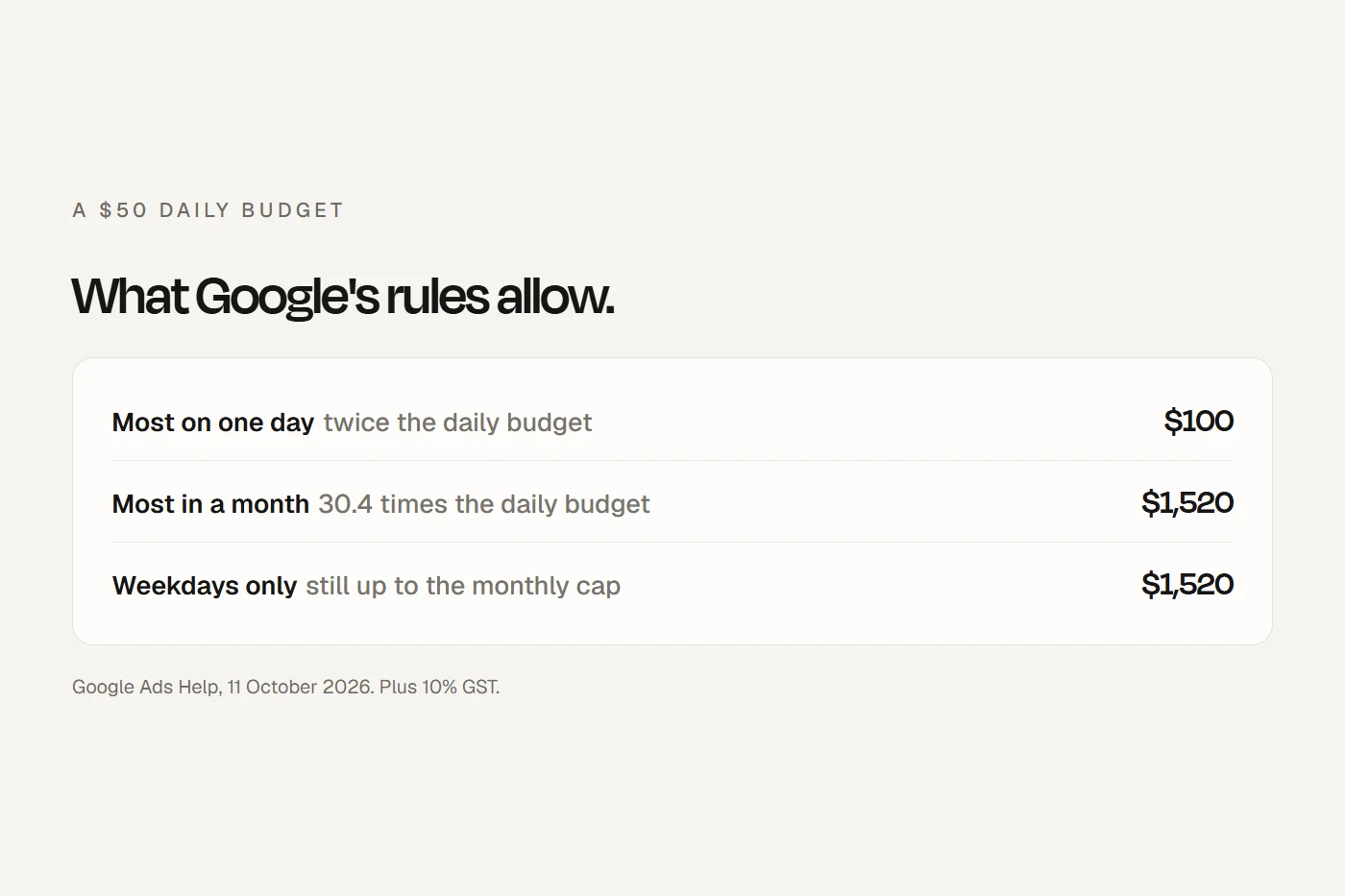
Search ads cost real money in this category, so start small: your suburb plus "mortgage broker", sending people to a page that answers what they searched for. My Google Ads cost guide covers how to work out a budget.
Bought leads and lead platforms
Lead selling comes in several models, and few sellers publish prices. Some sell each enquiry to one broker, matched by postcode, and quote a price by state and volume. Some run ad campaigns under your brand, which makes the ads legally your advertising. Some auction a lead or email it to several brokers at once, and the first to accept wins. One aggregator sells raw leads in batches and qualified leads by live transfer, with the fees deducted from your commissions.
Three things to check before you buy. First, how the borrower consented and what they were told: under the referrer exemption, the referrer must disclose what they're paid, and a business whose main job is collecting and passing on details can't use the upstream exemption at all. The broker industry body FBAA says the same in its submission to Treasury. Second, whether the lead is shared. Third, whether the seller collected more than name, contact details and a short purpose. Ask to see the exact screen the borrower saw. ASIC has also said it will look at how lenders use referrers and oversee brokers.
The MFAA's Find a Broker directory is the other platform worth a look if you're a member. The MFAA runs a national consumer campaign that sends people to it, and its own release quotes a broker who won a client because hers was the only fully completed profile in the area. Complete yours.
What your aggregator gives you
Many aggregators provide marketing and lead generation systems. AFG's SMART program includes a hosted website, automated email campaigns and newsletters. Connective's platform includes lead capture and an email hub where you either run your own campaigns or have Connective send them. LMG offers websites, email marketing and its own CRM. Use them, especially the automated emails to your book. The weakness is the website: an aggregator template looks like hundreds of others, which is my opinion as someone who builds broker sites. Ask who owns it, whether it moves with you if you change aggregator, and whether it can carry your own domain.
What a settlement costs you, by channel
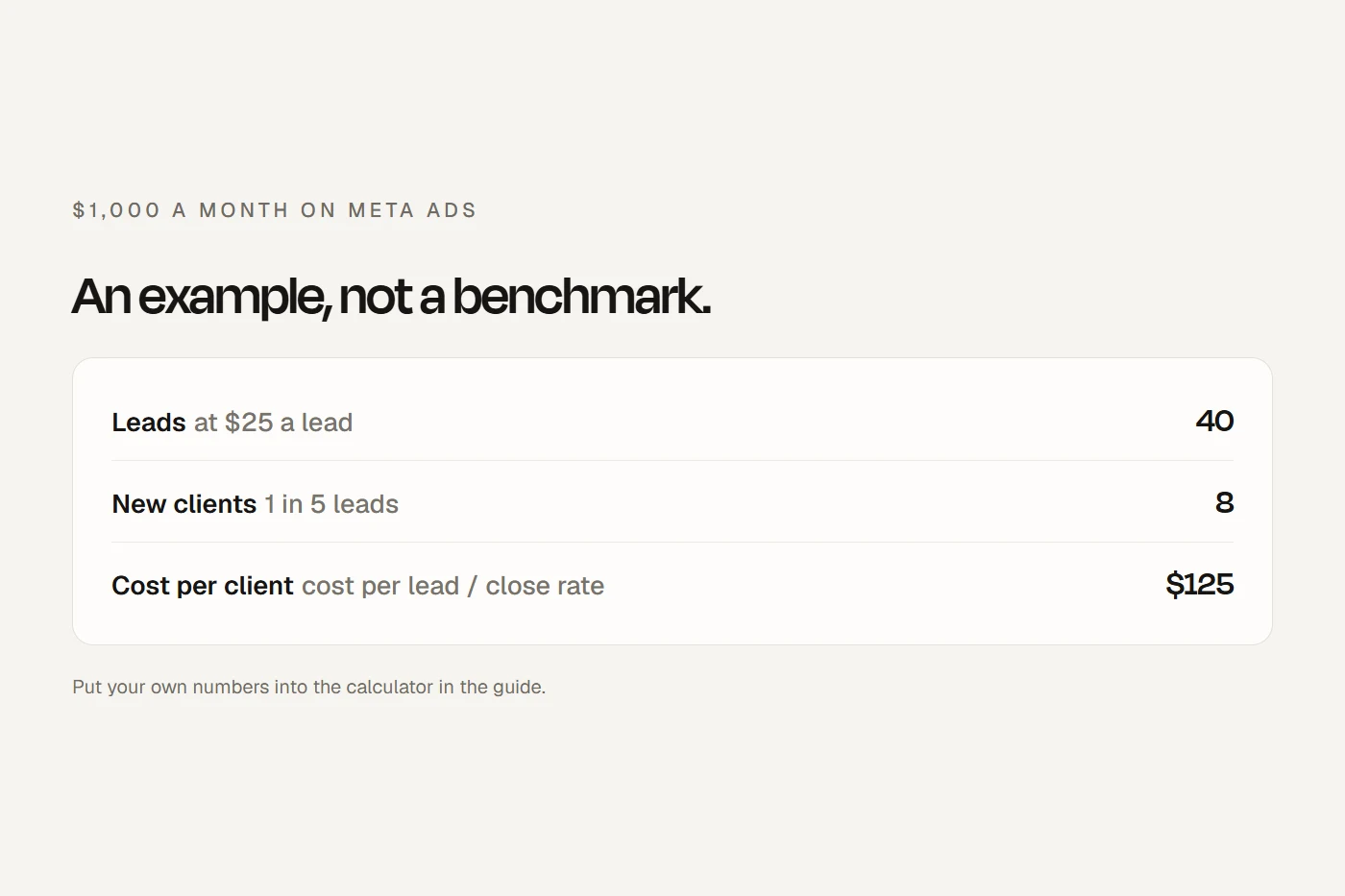
Put in one channel's numbers for a month, then the next. Enter your own commission figures after your aggregator's split; I've left them blank on purpose. The starting numbers are an example, not a benchmark.
Remember clawback. A lender can claw back the upfront commission if the loan is repaid or refinanced within a set period, up to two years, so a cheap channel that brings in short-lived loans costs more than it looks. Count every enquiry by channel, calls as well as forms, or none of this works.
A 90-day plan
If I were starting from scratch at a small brokerage, this is the order I'd go in. Your ticks save in this browser.
- Count where every enquiry comes from, calls and forms, by channel.
- Export your settled clients and mark who gave express marketing consent.
- Add a consent tick box to your fact find.
- Check your credit guide says you pay referrers and which kinds of people they are.
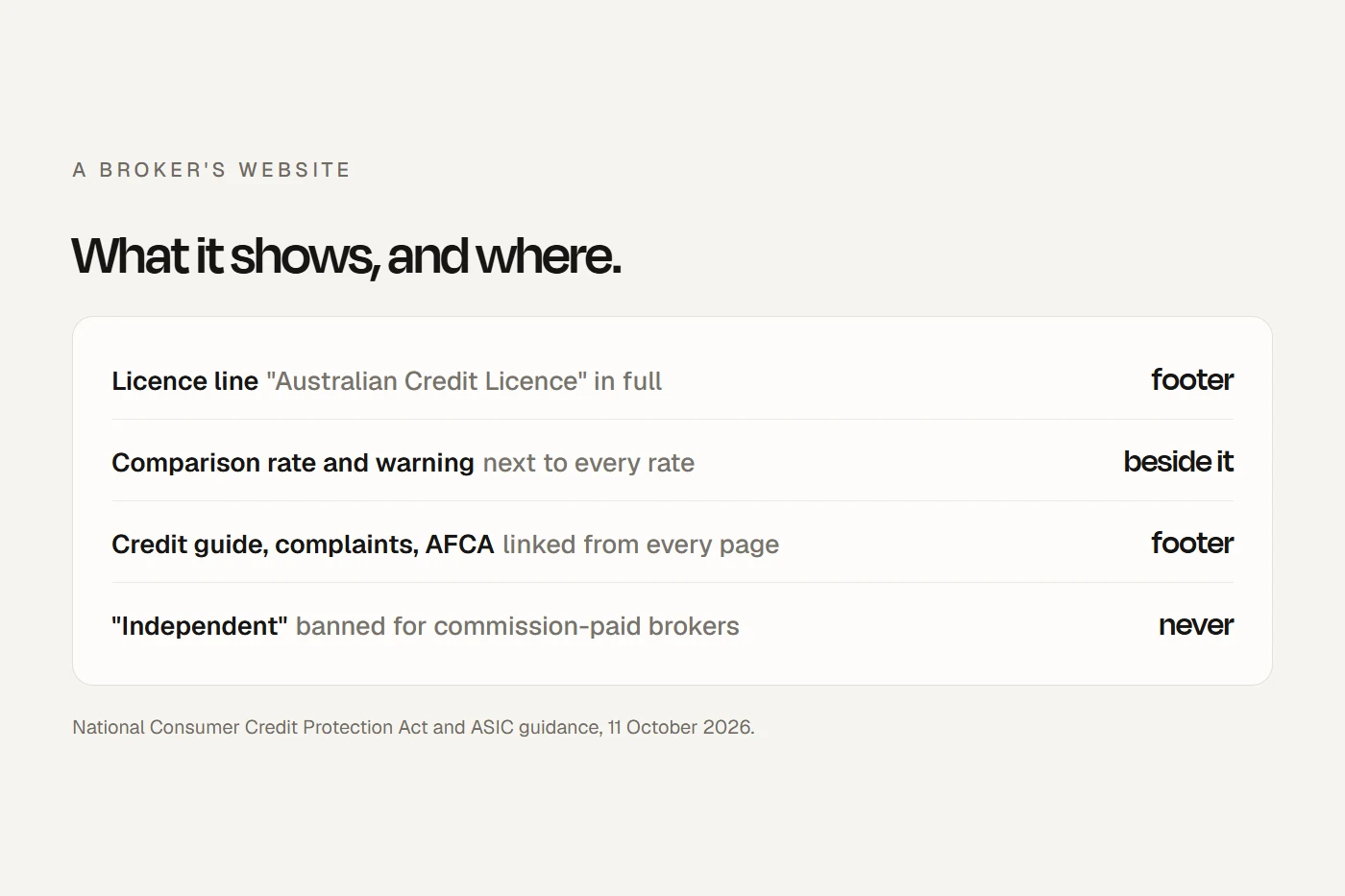
- Fix your website basics: licence line, credit guide, complaints and comparison rates. Use my broker website checklist.
- Complete your Google Business Profile and, if you're an MFAA member, your Find a Broker profile.
- List your top ten referral partners and sign a written agreement with any who send you clients' details.
- Get them on your licensee's referrer register.
- Give each partner a one-page note: what they can say, the fee disclosure, the consent line, and what they must not collect.
- Use the opening script on every referred call and email, within 10 business days.
- Remind NSW agents about the Fair Trading disclosure form.
- Ask every settled client for a Google review with the same message and no incentive.
- Write the email for the next Reserve Bank decision, framed as a review offer, with an unsubscribe.
- Set fixed-rate expiry reminders in your CRM.
- Run one small paid test, approved by your licensee, with no rates unless the comparison rate sits beside them.
- If you trial bought leads, get the seller's consumer screen and consent wording in writing first, and record the source of each lead.
- Run the calculator for each channel and cut the worst one.
Your website's job
Most of your clients come through someone they trust. As the MFAA puts it about its directory, a professional profile "helps build trust before a client even picks up the phone", and your website does the same job. Its job is to confirm the recommendation: who you are, how you work, how you're paid, and an easy way to book a call. It also has to carry the compliance basics every broker site needs, from the licence line to the credit guide. The full list is in what a mortgage broker website must show.
My view
Spend your first hours, not your first dollars, on the book you already have: consent, a useful email at each rate decision, and a reminder before every fixed rate ends. Then look after the five or ten people who send you clients, and do it by the rules, because the rules are specific and the risk lands on you. Paid ads and bought leads can work, but only once you're counting cost per settled loan, not cost per lead.
Questions I get asked
How do I get more leads as a mortgage broker?
Start with your past clients and the people they know: in the MFAA's broker survey, about seven in ten loans came from repeat clients and their referrals. Then build referral partners, by the rules, and test paid ads once you can count cost per settled loan.
Can a mortgage broker pay referral fees?
Yes, with conditions. The referrer must disclose the fee when they refer, can't help with the application, and for upstream referrals needs a written agreement. Your credit guide must say you pay referrers.
How much do mortgage leads cost?
Few sellers publish prices; most quote by state and volume. Ask whether the lead is exclusive, how the borrower consented, and what you get back for a bad lead.
Can I email my past clients?
Yes, if they gave consent or the email is directly related to your ongoing relationship, like a review of their loan. Every email needs your business name and a working unsubscribe.
Can a mortgage broker call themselves independent?
Not if you're paid commissions. The Act bans "independent", "impartial", "unbiased" and words of similar meaning, but you can say you're not independent.
About this guide
Written by Joseph Alzein, founder of bdog. bdog builds mortgage broker websites and sells marketing services, and has no arrangement with any aggregator, lender or lead seller named here. The rules come from the Act, the Regulations, ASIC, the ACMA and the MFAA, read on 12 October 2026. This is general information, not legal advice; your licensee's compliance team has the final say.
Main sources:
- MFAA and Deloitte Access Economics: The Value of Mortgage and Finance Broking
- MFAA: broker market share
- ASIC RG 203: Do I need a credit licence?
- ASIC Report 516: mortgage broker remuneration
- Property and Stock Agents Act 2002 (NSW), s 47
- ACMA: avoid sending spam
- Reserve Bank: about monetary policy decisions
- ASIC: supervisory letter, banking
- FBAA: submission on lead generation