Marketing a music school or teaching studio in Australia
How parents choose a music teacher, what you can claim about AMEB and your association, exam results, copyright and licences for lessons, recitals and social videos, vouchers by state, term fees and missed lessons, home studio rules, and the channels that work. With a capacity calculator, a wording sorter and a 90-day plan.
On This Page
- How parents choose a music teacher
- What you can claim
- Exam and eisteddfod results
- Copyright, licences and your social videos
- Government vouchers for music lessons
- Term fees, missed lessons and notice
- Home studio rules
- How full is your timetable?
- Channels that fill your timetable
- Can I say this?
- Your first 90 days
- Questions I get asked
"Music teaching is an unregulated industry," the West Australian Music Teachers' Association tells parents. "There is no required training to set oneself up as a music teacher in Australia." That's why a music teacher's website matters so much: parents can't check a licence, so they look at your qualifications, your memberships, your results and what other parents say. This guide covers what you can honestly claim, the exam results and copyright traps, which state vouchers cover music lessons, term fees and missed lessons, home studio rules, and the channels that fill your timetable. It draws on AMEB and the state music teachers' associations, the Australian Copyright Council, OneMusic and APRA AMCOS, the state voucher guidelines, the ACCC, the noise and planning rules, and Google's policies. It's general information, not legal advice.
- Say exactly what you hold"AMEB accredited teacher" isn't something AMEB grants. "I teach the AMEB syllabus", your actual diplomas, and your association's own accreditation wording are what you can say.
- Mind the music in your videosA student playing a pop cover in a reel that promotes your studio needs the rights holders' permission. Public-domain pieces and your own music are safe.
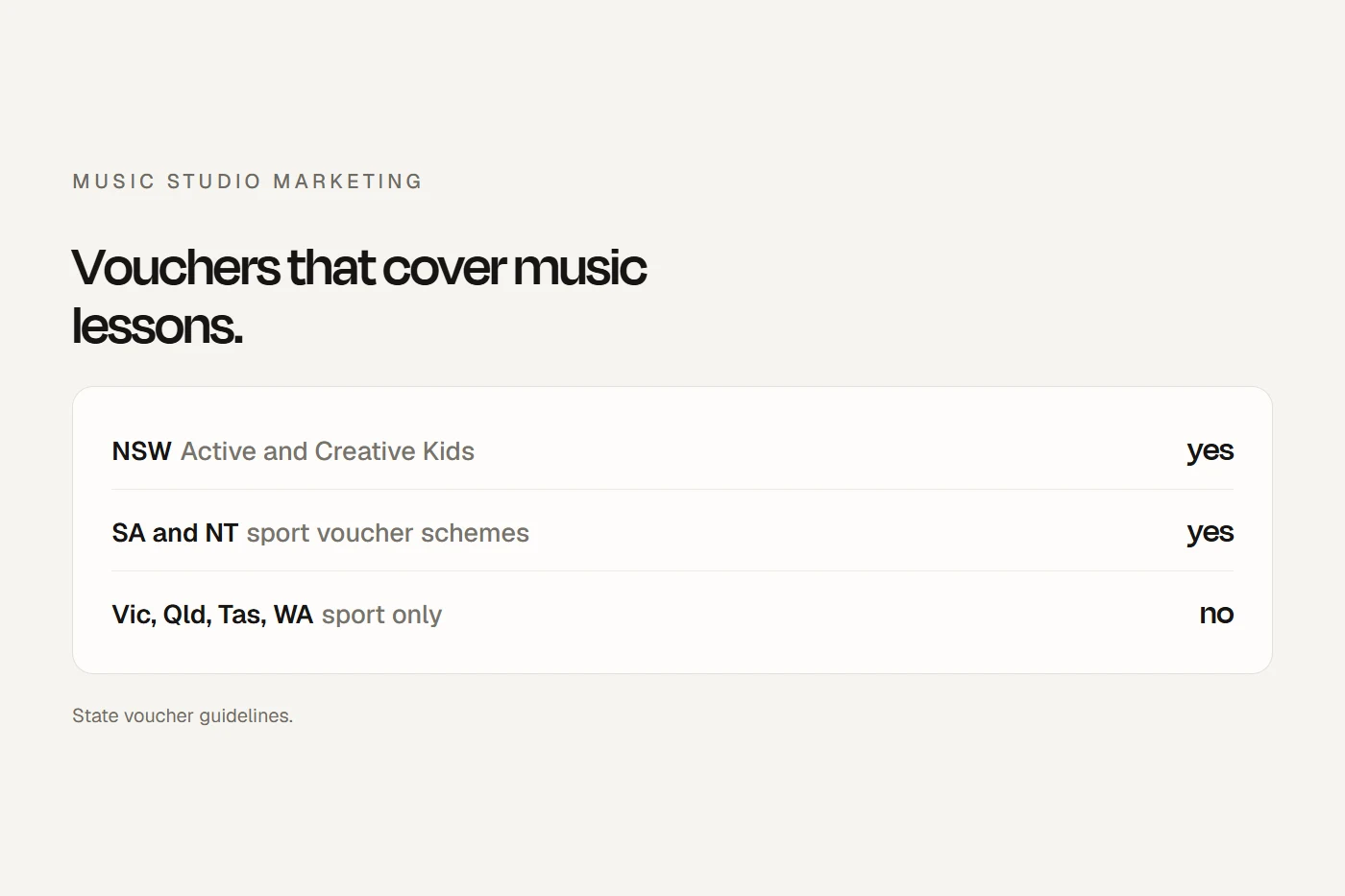
- Vouchers cover music only in NSW, SA and the NTVictoria's, Queensland's, Tasmania's and WA's programs are for sport.
How parents choose a music teacher
There's no Australian survey of how parents find or choose a music teacher. The ABS found singing or playing an instrument is one of the most common things children do outside school, peaking in the upper primary years. Creative Australia found a strong link between learning an art form at school age and engaging with the arts later on. Its survey also found music is one of the most common art forms Australians make themselves, so adult beginners are a real market too.
WAMTA gives parents a checklist, and it's the best content plan for your homepage. It asks what qualifications the teacher has, and whether they're for the instrument being taught. It asks how long they've taught, whether they hold a current Working With Children Check, which styles they teach, what books they use, what grades their students are at, whether theory is included, whether they favour exams, and what the fees are and how they're paid. It also reminds parents that "Teachers work in close proximity to Students, often in one-to-one situations." Answer every one of those questions on your site.
What you can claim
AMEB. AMEB's state offices run teacher lists, but they're self-nominated, and AMEB says it is "unable to offer endorsements of individuals or studios". AMEB WA adds that listed teachers "are not employees of, or recommended by AMEB WA". So "AMEB accredited teacher" or "AMEB approved" implies an approval AMEB doesn't give. What you can say:
- "I teach the AMEB syllabus and prepare students for AMEB exams."
- Your actual AMEB awards, with the instrument: AMusA or LMusA for performance, or the teaching awards CTMusA, ATMusA and LTMusA.
- AMEB's logo only with permission: AMEB Tasmania invites teachers to "ask us about putting an AMEB or AMEB Rockschool logo on your website".
Your state's music teachers' association. Accreditation comes from the associations, and it differs by state:
- NSW: the Music Teachers' Association of NSW accredits teachers, and accredited teachers are listed on its teacher search.
- Queensland: the association prescribes the wording: "Accredited as a Private Music Teacher, for (instrument) through the Association."
- SA: MTASA says there's "currently no formal accreditation of studio music teachers provided in South Australia". Members can apply to MTA NSW instead.
- WA: WAMTA vets its directory members as "suitably qualified".
"Accredited music teacher" with no body named invites the question "accredited by whom?" Use your association's own wording and name the instrument.
Singing and Suzuki. ANATS membership is open to "anyone with a passion for singing", so "member of ANATS" is accurate but it isn't a qualification. Don't write "ANATS accredited". The Suzuki name is licensed to members only: "Teachers who are not members of a member Association of the PPSA are not entitled to use the Suzuki name." If you use the Suzuki books without membership, say "I use the Suzuki repertoire books" at most.
The associations' own codes. Queensland's Code of Ethics says "It is unethical to advertise in a manner that may deceive or mislead prospective students", and that it's unethical to induce a student to study "with the hope of a career, if the student's talent does not warrant it". MTASA says to advertise only the instruments you're "fully qualified to teach. To do otherwise is false advertising".
Exam and eisteddfod results
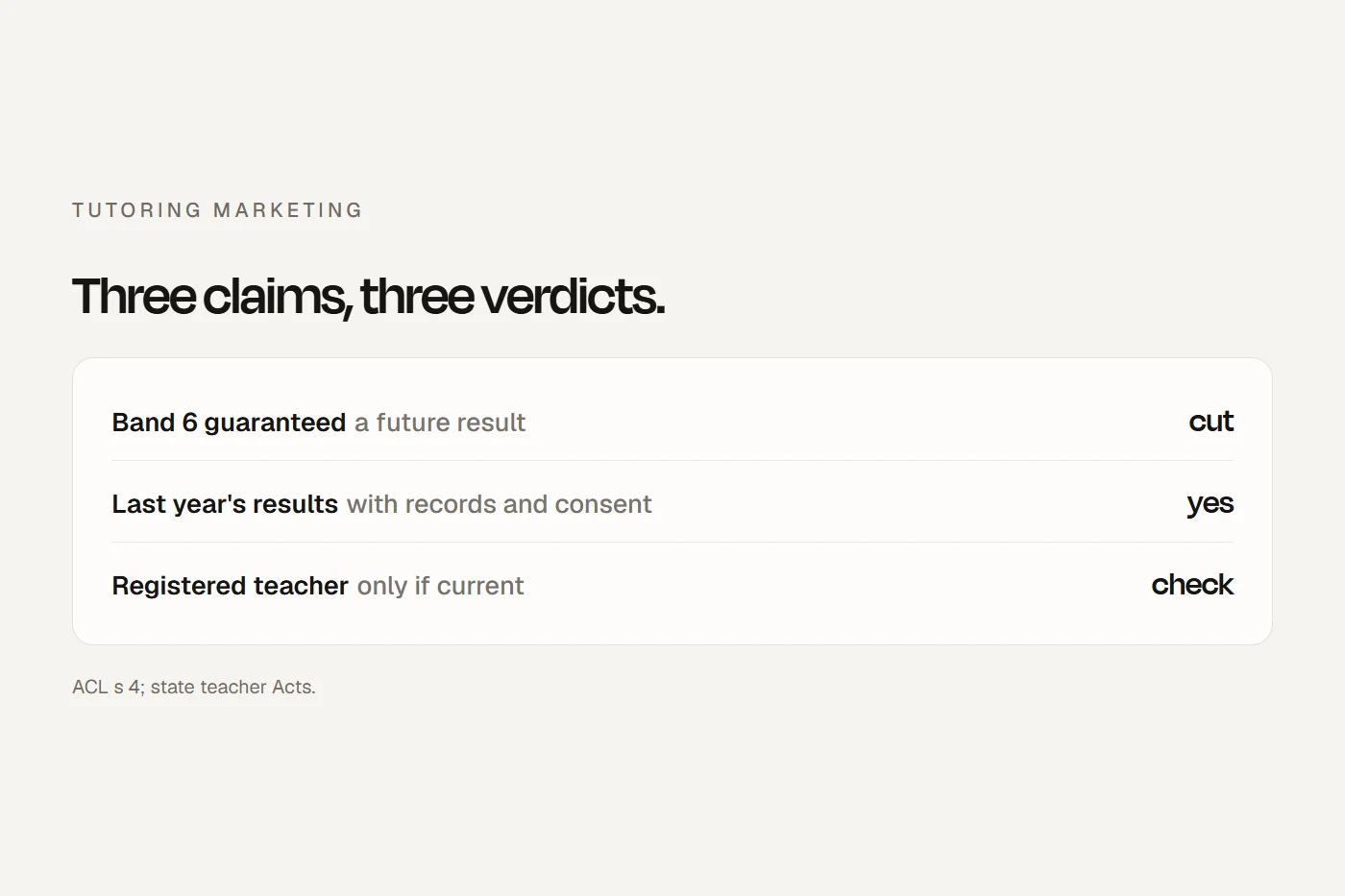
Past results are a fair claim if they're true, complete and consented. "All 23 students I entered for AMEB exams this year passed" works if it's accurate and recorded. "100% pass rate" when weaker students weren't entered doesn't, and "Guaranteed Grade 5 pass" or "get into the conservatorium" are promises about the future you can't back up.
AMEB treats results as confidential to the person who enrolled the student, so get written consent before naming anyone, from the student if they're old enough and from a parent if they're under 18. A name on a public eisteddfod list isn't consent for your advertising. Music teaching isn't a health service, so testimonials are allowed, as long as they're real.
Copyright, licences and your social videos
The Australian Copyright Council is blunt: "There are no special copyright provisions for ... private music teachers." The classroom exception that lets teachers play music in class only applies where the instruction is "not being given for profit", so a fee-charging studio can't rely on it.
Copying. A private teacher "will usually need to get permission from the music publisher to copy print music for students, unless the copyright has expired". Photocopying a book for a student is usually out.
Recitals. A free performance can still be a public performance, so a recital needs a licence even if it's free. In practice, "it is generally the venue that gets the relevant licences", so ask the hall whether its OneMusic licence covers hirers' concerts before you book.
Music licences. OneMusic has no licence category for music teachers as such. The nearest are its Education and Training Providers licence, which covers "other private education and training businesses" and student performances, and its Dance Schools and Performance Instructors licence, which names voice performance training. If you play recordings in lessons or run recitals, ask OneMusic which licence fits. A streaming subscription "doesn't automatically give you the legal right to play that music in your business".
Social videos. This is the trap. OneMusic says personal use of music in social videos is covered by its deals with the platforms, but "Non personal/commercial use of music in a social media or YouTube video will require direct permission from the rights holders". A reel of a student playing a current pop song to promote your studio is commercial use. What's safe:
- A student playing a piece whose composer died long enough ago for copyright to expire (generally before 1955), filmed by you, with the family's consent. Watch out for modern editions and arrangements, which can have their own copyright.
- You playing or teaching your own compositions.
- Music the platform clears for business use.
- Recital videos shared privately with families rather than posted publicly.
Government vouchers for music lessons
Only three schemes cover music lessons through registered providers:
- NSW, Active and Creative Kids: "music" and "singing" are listed creative activities. Lessons must be in person, with narrow exemptions for remote children or disability. Exam fees and instruments aren't covered. You need approval as a provider, a working with children check, and evidence of relevant qualifications or recognition. The guidelines prohibit "unjustly increasing prices" when accepting vouchers.
- SA, Sports Vouchers Plus: music is now included, and music providers "can operate as an individual/sole trader". Programs must run at least eight weeks, and exam fees and instruments aren't covered.
- NT, Sport Voucher Scheme: music is a listed cultural activity, for structured lessons.
Victoria's Get Active Kids, Queensland's sports vouchers, Tasmania's Ticket to Play and WA's KidSport are sport and active recreation programs, so don't say you accept them for music. The ACT pays low-income families directly, and they can use it for music lessons. Say "Registered Active and Creative Kids provider" only once you're approved, show the full term price, and let the voucher come off it. If your page still mentions the old separate Creative Kids voucher, update it.
Term fees, missed lessons and notice
Show the per-lesson price and the term total equally prominently, including any compulsory registration or materials fee. Common association terms charge for lessons the student misses, carry forward lessons the teacher cancels, and charge "half a term's fees" if notice to stop isn't given by the first lesson of a term. That last one is a one-sided termination penalty, the kind the unfair contract terms law targets. Make the notice rule mutual and proportionate, and say it before the first lesson.
If you cancel, make up the lesson or refund it: the ACCC says businesses should offer "a refund for the portion of time the consumer can't access the service, or a replacement service". Don't take a term's fees if you know you can't deliver. If fees roll automatically into the next term, that looks like a subscription; ask families to opt in to each term instead, or make cancelling as easy as enrolling. A free first lesson must be genuinely free.
Instrument hire. Never say "rent to buy" unless the contract gives a right to buy. ASIC has treated that wording as misleading where there was no such right. A longer paid hire can bring in credit law. Most studios are better off pointing families to a music retailer's hire program, or lending a studio instrument for a short trial.
Home studio rules
Noise. Normal after-school lessons are well inside the rules. In Victoria, musical instruments mustn't be heard in a neighbour's living areas Monday to Thursday before 7am or after 10pm, Friday before 7am or after 11pm, and weekends and public holidays before 9am or after 11pm on Saturday, 10pm on Sunday. NSW sets similar evening limits, with a warning before an offence. Drum kits, amplified bands and late adult lessons are where complaints come from. Queensland's association adds practical advice: don't put a piano against a shared wall.
Planning. In Victoria, a home business usually needs no permit if you live there, no more than two people who don't live there work at once, and it doesn't affect the neighbourhood's amenity, including through parking and hours. Elsewhere, check your council's rules before adding a second teacher, group classes or a sign.
How full is your timetable?
Put in your own numbers. The defaults are made up, not market rates.
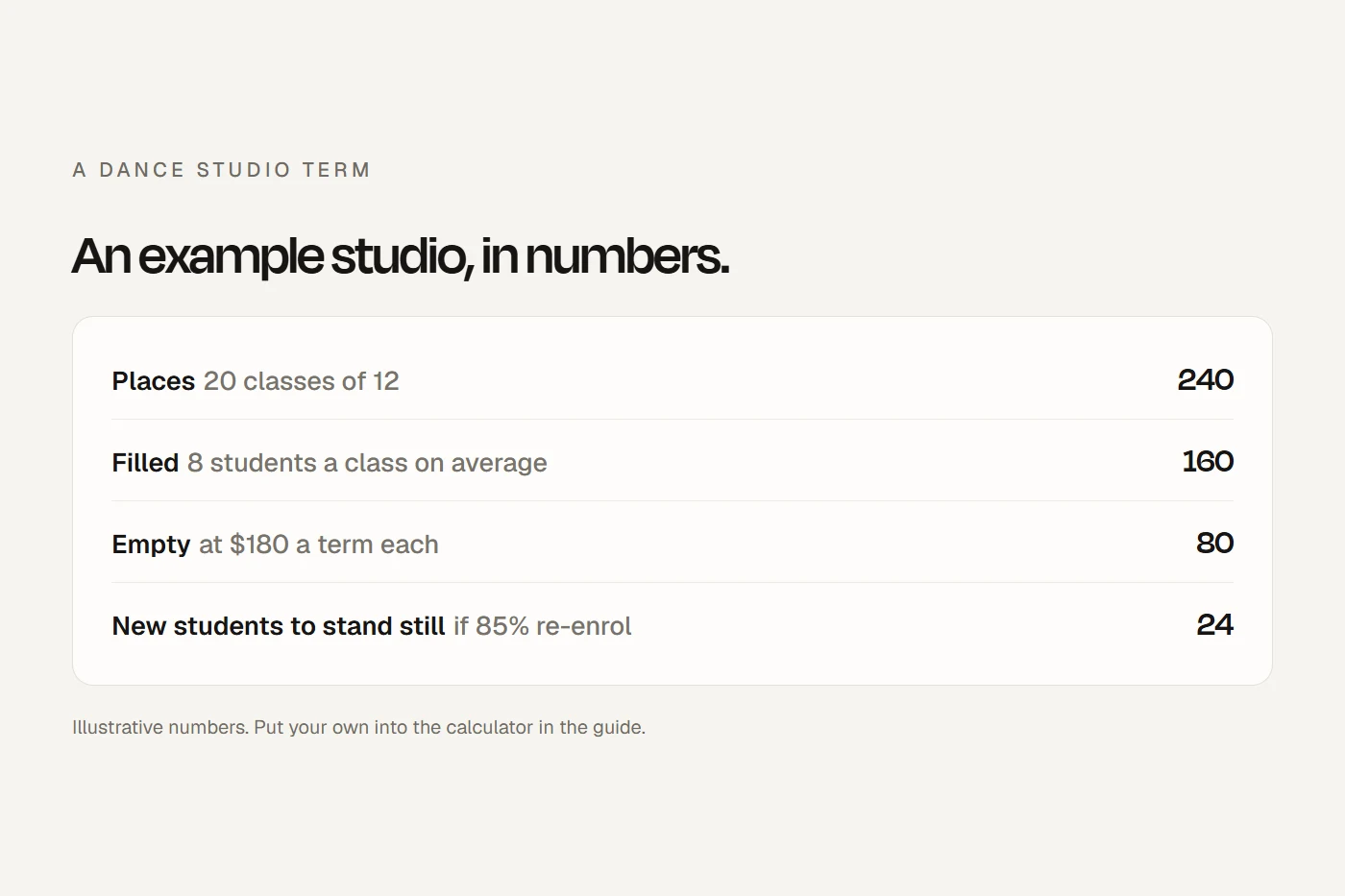
On the made-up numbers, 20 hours of 30-minute lessons gives 40 slots, 28 students fills 70%, and the 12 empty slots cost $4,800 a term. If 85% re-enrol each term, you need about 17 new students a year just to stay at 28. Lift re-enrolment to 90% and that drops to about 11, with the same marketing. Keeping students is the cheapest growth there is.
Channels that fill your timetable
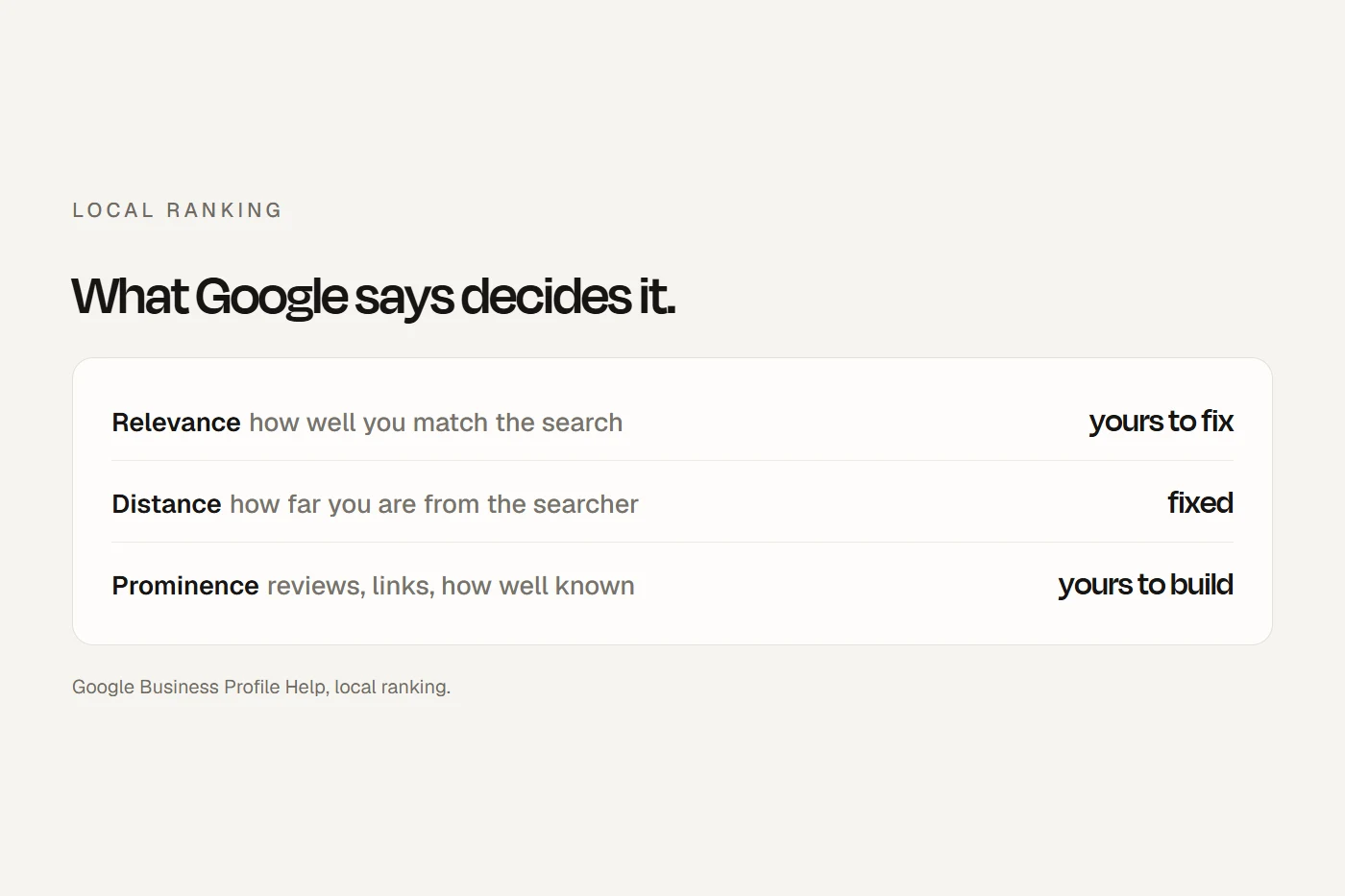
Google Business Profile. A home studio without a sign is a service-area business: Google says "If your business doesn't have permanent on-site signage, it's not eligible as a shop front", and service-area businesses "should hide your business address". A mobile teacher lists the suburbs they'll drive to. An online-only teacher isn't eligible. A music school with a sign and staffed hours shows its address. Use your real business name only, and ask every family for a review at the same point, such as the end of term, with no reward. My guide to local SEO for small businesses covers the setup.
Your website. Instruments, styles and levels, and who you teach. Your qualifications per instrument. Whether exams are optional. Where lessons happen and whether a parent can sit in. Your working with children check (no number). The term price and total, your policies in plain words, your hours, recitals with your photo consent explained, and how to book a first lesson. One page per instrument beats a page per suburb.
Directories. AMEB's state registers, your state association's directory, Suzuki and ANATS listings are free or come with membership. Keep them current and link each to your site, because a parent who finds you on a list will look you up.
Recitals and eisteddfods. Concerts are when parents bring grandparents and friends. Check the venue's licence, get consent before filming, and share videos privately unless the music is cleared. Entering students in association concerts and eisteddfods gives them performance experience without you running the event.
Word of mouth. Queensland's association calls private recommendation "the best and most satisfactory of all advertisements". A thank-you credit for a referral is fine, as long as nothing is tied to reviews. Siblings are your most natural new students.
Social media and ads. Market to parents and adult learners; under-16s can't hold accounts on the main platforms anyway. Run your studio page as a business page, and don't befriend students under 18. Short clips of you playing, tips for parents and concert announcements work. In Meta ads, use your own playing or the platform's business-cleared audio.
Term messages. Lesson reminders are factual. Re-enrolment and holiday workshop offers are marketing, so get consent at enrolment with a tick box. Group programs like ukulele or early childhood music are a lower-price way in, and they feed your private lessons.
Can I say this?
Tap a card to see the verdict.
Your first 90 days
Tick items off as you go; the list remembers your progress on this device.
- Month 1: every qualification written down exactly And "AMEB accredited" or vague "accredited" wording replaced.
- Month 1: your association's wording and listing checked Apply for accreditation if you're eligible.
- Month 1: AMEB register and logo Ask your state office.
- Month 1: working with children check current And a child safety statement if your state requires one.
- Month 1: studio policy written Term price and total, missed lessons, make-ups, teacher cancellations, mutual notice.
- Month 1: consent form Separate tick boxes for photos, video and results.
- Month 1: music licensing List what you play and ask OneMusic which licence fits.
- Month 2: Google Business Profile Service area or shop front, hours, studio photos.
- Month 2: website Answers to the parents' checklist, instrument pages, booking a first lesson.
- Month 2: free directories Registered and linked to your site.
- Month 2: vouchers Apply in NSW, SA or the NT; remove old voucher references elsewhere.
- Month 2: review requests Every family, at the same point, no rewards.
- Month 3: the calculator run Count empty slots and your re-enrolment rate.
- Month 3: re-enrolment message To families who've consented, with next term's total price.
- Month 3: an end-of-term concert Venue licence checked, consents in, friends invited.
- Month 3: a few short videos You playing or teaching, with public-domain or your own music.
Questions I get asked
How do I get more music students?
Answer the questions parents ask on your website: qualifications per instrument, working with children check, styles, exams, fees and policies. Set up your Google profile correctly, list on the free directories, ask every family for a review, run concerts parents can bring friends to, and focus on re-enrolment.
Can I call myself an AMEB accredited teacher?
No. AMEB says it can't endorse individuals or studios, and its teacher lists are self-nominated. Say you teach the AMEB syllabus, and list any AMEB awards you hold.
Can I post videos of my students playing?
With the family's consent, yes. But a promotional video of a student playing a copyright song needs the rights holders' permission. Pieces out of copyright, or your own music, are safe.
Can parents use vouchers for music lessons?
In NSW (Active and Creative Kids), SA (Sports Vouchers Plus) and the NT (Sport Voucher Scheme), if you're a registered provider. Victoria's, Queensland's, Tasmania's and WA's voucher programs are for sport.
Do I need a music licence as a private teacher?
Possibly. There's no special copyright exception for fee-charging private teachers. If you play recordings in lessons or hold recitals, ask OneMusic which licence fits, and check whether your recital venue's licence covers you.
Can I charge for missed lessons?
For lessons a student misses without notice, if your policy says so up front. If you cancel, make up the lesson or refund it. Make any notice rule fair to both sides.
About this guide
Written by Joseph Alzein, founder of bdog. I build websites for music teachers and education businesses. Sources were checked on 12 October 2026. This is general information, not legal advice. I've left out voucher amounts, licence fees and penalties.
Main sources:
- WAMTA: tips for selecting a teacher
- OneMusic Australia: licences
- OneMusic Australia: dance schools and performance instructors
- APRA AMCOS: licensing music online
- Service NSW: Active and Creative Kids guidelines
- SA Sports Vouchers Plus: provider eligibility
- NT Sport Voucher Scheme: activities
- ACCC: price displays
- EPA Victoria: residential noise
- Google: service-area businesses
- ABS: cultural and creative activities
- Creative Australia: national arts participation survey