NQS ratings: what they mean and how to show yours
For long day care, preschools, OSHC and family day care: the five ratings in plain words, why one quality area decides, how long a rating lasts, what must be on display, the logo terms, and how to word Working Towards, Meeting and Exceeding on your website. With a rating calculator, a can-I-say-this sorter and a checklist.
On This Page
- The five ratings, in plain words
- How the overall rating is worked out
- How long a rating lasts
- What you must display, and where
- The rules for showing it in marketing
- Can I say this?
- How to word each rating on your website
- What parents actually do with ratings
- After a new rating: the first 90 days
- Rating display checklist
- My view
- Questions I get asked
Search for NQS rating and page one is ACECQA, StartingBlocks and parenting sites explaining the levels to parents. That's useful if you're choosing a centre. If you run one, you have different questions: what your rating means to the families reading it, whether it has to be on your website, what you can and can't say about it, and how to talk about a Working Towards rating without losing enquiries. That's what this page covers, for long day care, preschools and kindergartens, OSHC and family day care. I build websites for early learning services, and everything below comes from the National Regulations, ACECQA, StartingBlocks and the state regulators.
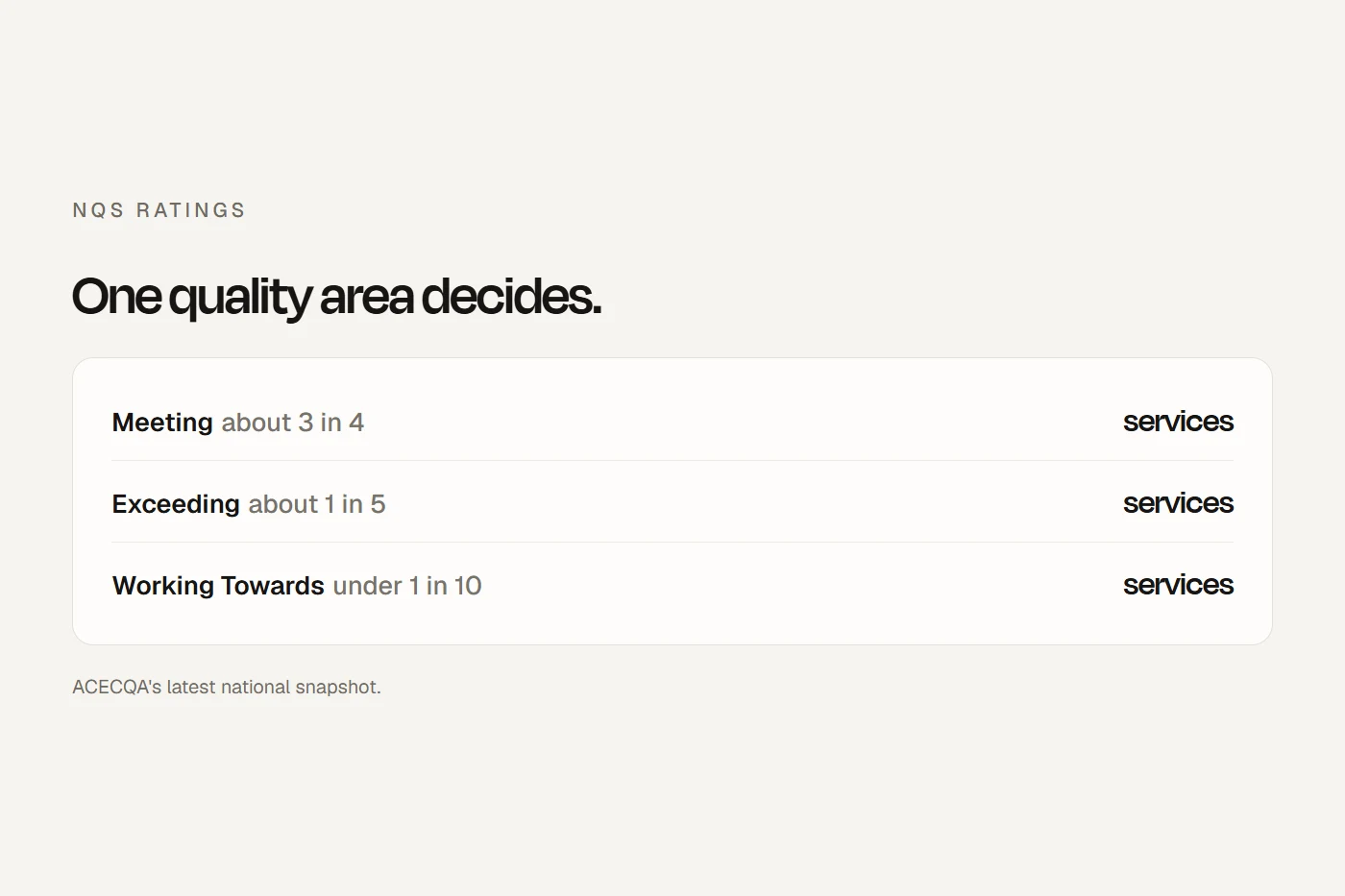
- One quality area decidesA single Working Towards quality area makes the whole service Working Towards, even if every other area is Meeting or Exceeding. Parents rarely know this, so tell them.
- The certificate must be at the door; the website is optionalNo national rule puts your rating online. But anything you say about it, anywhere, must match your current rating, including quality-area ratings.
- Meeting is a good resultAbout three in four rated services are Meeting. The NSW Department of Education calls an overall Meeting rating a great achievement.
The five ratings, in plain words
Every assessed service gets a rating for each of the seven quality areas and an overall rating. New services that haven't been assessed yet are Provisional, Not Yet Assessed.
| Rating | What ACECQA says it means | How common | What parents often assume |
|---|---|---|---|
| Excellent | Exceptional education and care, sector leadership and a commitment to improving. Only ACECQA awards it, and only to services rated Exceeding in all seven quality areas that apply for it. | A handful of services nationally | The best there is |
| Exceeding National Quality Standard | Goes beyond the standard in at least four of the seven quality areas, with at least two of those being quality areas 1, 5, 6 or 7. | About one in five | Above average |
| Meeting National Quality Standard | Quality education and care in all seven quality areas. | About three in four | "Average" or "the bare minimum", which is wrong |
| Working Towards National Quality Standard | A safe education and care program, with one or more areas identified for improvement. | Fewer than one in ten | Below the legal minimum, which is also wrong |
| Significant Improvement Required | A significant risk to children's safety, health and wellbeing. The regulator takes immediate action. | Very rare |
Scroll the table sideways to see every column.
Shares are rounded from ACECQA's latest national snapshot. They vary a lot by service type: about half of preschools and kindergartens are Exceeding, about one in six long day care services, and about one in twenty OSHC and family day care services. So a Meeting OSHC service is in very good company.
The two misreadings in the last column come from research done for the NSW Department of Education. Parents took Meeting to mean "doing the bare minimum" and assumed Working Towards meant falling below the minimum standards needed to operate. Neither is right. The minimum standards are set by the National Law and Regulations, and every rated service has to meet those to stay open. The National Quality Standard is a higher benchmark on top.
The seven quality areas
- Educational program and practice
- Children's health and safety
- Physical environment
- Staffing arrangements
- Relationships with children
- Collaborative partnerships with families and communities
- Governance and leadership
Under them sit 15 standards and 40 elements. The National Quality Framework (NQF) is the whole system: the law, the regulations, the learning frameworks and the rating process. The National Quality Standard (NQS) is the benchmark inside it that services are rated against.
How the overall rating is worked out
The rating is built from the bottom up, and the weakest part decides. Each of the 40 elements is either met or not met. One element not met makes that standard Working Towards. One Working Towards standard makes that quality area Working Towards. One Working Towards quality area makes the whole service Working Towards.
Exceeding works the other way. A quality area is Exceeding only if every standard in it is Exceeding. Overall Exceeding needs at least four quality areas Exceeding, at least two of them from areas 1, 5, 6 and 7, and every other area Meeting. So a service can be Exceeding in four quality areas and still be Meeting overall. Try it with your certificate:
This mirrors the National Regulations for the overall rating. One extra rule applies to quality area 1 for services with children in the preschool year, two years before grade 1: Exceeding there needs a preschool program at the service or a documented arrangement with another provider to deliver one.
How long a rating lasts
Working Towards, Meeting and Exceeding ratings don't expire. A rating stands until the regulator reassesses the service, and there's no fixed cycle. Reassessment is based on risk: services with lower ratings are re-rated more often, and higher-rated services generally wait longer. A change of provider or management, serious incidents, complaints and a compliance history that doesn't fit the rating can all bring a visit forward.
So a rating can be years old. When I counted the issue dates on ACECQA's national register, the typical current rating was about two years old. Exceeding services had waited longest, and some ratings still in force were issued about a decade ago. That matters for marketing, because the register and StartingBlocks show parents the month your rating was issued and your previous rating.
Excellent is the exception. It lasts five years for recent awards, or three for older ones (Western Australia may differ, so check). ACECQA must revoke it if any quality area is rated below Exceeding in that time, and if you don't reapply in the 90 days before it expires, you go back to Exceeding.
A new service is Provisional until its first assessment, which usually happens nine to 18 months after it opens.
What you must display, and where
- At the entrance: the rating certificate from your regulator, showing the overall rating and the rating for each quality area, clearly visible from the main entrance. Excellent services can also display ACECQA's certificate. Family day care services display it at every residence and venue. In NSW the certificate uses a coloured star for each level; use the rating's name in your marketing, not the number of stars.
- In Victoria, also at the premises: a quality and compliance history showing the current and previous overall rating with the dates they were issued, plus two years of compliance history and any prosecutions. It must be printed (a QR code doesn't count) and updated within seven days of a change.
- On request: your current quality improvement plan, to enrolled families and families seeking to enrol, and your record of compliance, to anyone who asks.
- Online: nothing is required. Your rating is already public on the national register and StartingBlocks, whether you mention it or not.
The certificate on the wall is easy to miss. In that NSW research, several parents shown example certificates said they'd never noticed one at their own service's entrance. Put it where families stand at sign-in, not behind the office door.
The rules for showing it in marketing
Three sets of rules apply to anything you say about your rating, on your website, Google profile, Facebook page, flyers, signs or ads.
- Regulation 72. You must not falsely represent your overall rating or the rating for any quality area. ACECQA describes giving a false or misleading statement about your rating as an offence. You also have to take reasonable steps to make sure anyone you employ or engage doesn't misstate it. That covers your staff, and in my reading it covers whoever runs your social media or builds your website, so brief them.
- Out-of-date ratings. South Australia's regulator has reminded services to update their rating on digital and print marketing so it reflects the current rating, citing regulation 72. A banner saying Exceeding after a reassessment rated you Meeting is the most common way to get this wrong.
- Australian Consumer Law. You must not make a false or misleading claim that a service is of a particular standard or quality, and the overall impression counts. "Exceeding" in large type over "overall Meeting" in small print can mislead even though each word is true.
The ACECQA rating logo
Services rated Working Towards, Meeting or Exceeding overall can request the NQS rating logo from ACECQA through the national registers. Using it is voluntary, and it comes with terms:
- Use only the logo that matches your current overall rating, and change it when the rating changes. ACECQA releases the new logo about two weeks after the final report.
- Don't modify it in any way, including recolouring it to match your brand.
- On a website listing several services, the logo must sit clearly with the one service that earned it, and only that service.
- Don't pass the files to any other provider. A web designer can't reuse them on another client's site.
- The logo doesn't replace the certificate at the entrance.
I couldn't find an Excellent logo in ACECQA's offer. Excellent services display ACECQA's certificate. ACECQA also offers a ratings chart that shows all seven quality areas, which is the more useful graphic for a website.
Can I say this?
Tap a card to see the verdict.
How to word each rating on your website
Working Towards
- Lead with
- The rating in full, then which quality areas were Working Towards and which were Meeting or Exceeding. More than half of Working Towards services fell short in only one or two areas, so the detail usually helps you.
- Then say
- What you're changing, in specifics: a new educational leader, a revised supervision plan, families invited to shape the program. Offer to show families your quality improvement plan.
- Worth knowing
- Most Working Towards services move up when they're reassessed, and lower-rated services are reassessed sooner. In the NSW research, parents with a child already enrolled said they'd ask the director about it, and none said they'd leave straight away.
- Avoid
- Hiding the rating behind "high standards" or "quality-focused" while the certificate says Working Towards, and any line suggesting you're about to be re-rated.
Meeting
- Lead with
- "Meeting National Quality Standard", with one plain line on what it means: quality education and care in all seven quality areas.
- Then say
- Any quality areas rated Exceeding, by name, and the practice behind them, ideally in the words of your assessment report.
- Worth knowing
- Parents tend to read Meeting as average. The NSW Department's own words help: an overall rating of Meeting is a great achievement, because the standard is a high benchmark.
- Avoid
- "Rated Exceeding" or an Exceeding logo when Exceeding is only some of your quality areas.
Exceeding
- Lead with
- "Exceeding National Quality Standard" in full, and the quality areas that were Exceeding.
- Then say
- What Exceeding looks like at your service. ACECQA assesses it against three themes: practice embedded across the whole team, informed by critical reflection, and shaped by families and the community. Give an example of each.
- Worth knowing
- Exceeding services tend to go longest between assessments, and Exceeding doesn't always survive a reassessment. Check any "since" date against the register.
- Avoid
- Comparative claims such as "the highest rated centre in the suburb" unless they're true and checkable on the register at the time.
Excellent
- Lead with
- "Excellent rating, awarded by ACECQA", while it's current.
- Then say
- That it came from a separate assessment by ACECQA, on top of Exceeding in all seven quality areas, and what you were recognised for.
- Worth knowing
- Put the expiry date and the 90-day reapplication window in your calendar. If any quality area drops below Exceeding, ACECQA revokes it.
- Avoid
- Leaving "Excellent" anywhere after it lapses or is revoked.
Provisional
- Lead with
- "Provisional, Not Yet Assessed under the National Quality Framework", the words you display at the service.
- Then say
- That the regulator approved the service to open, that services are usually assessed within 18 months, and how you'll review your own practice against the seven quality areas in the meantime.
- Worth knowing
- You can't advertise a service before it's approved or an application has been lodged.
- Avoid
- Anything that implies a rating you don't have yet.
What parents actually do with ratings
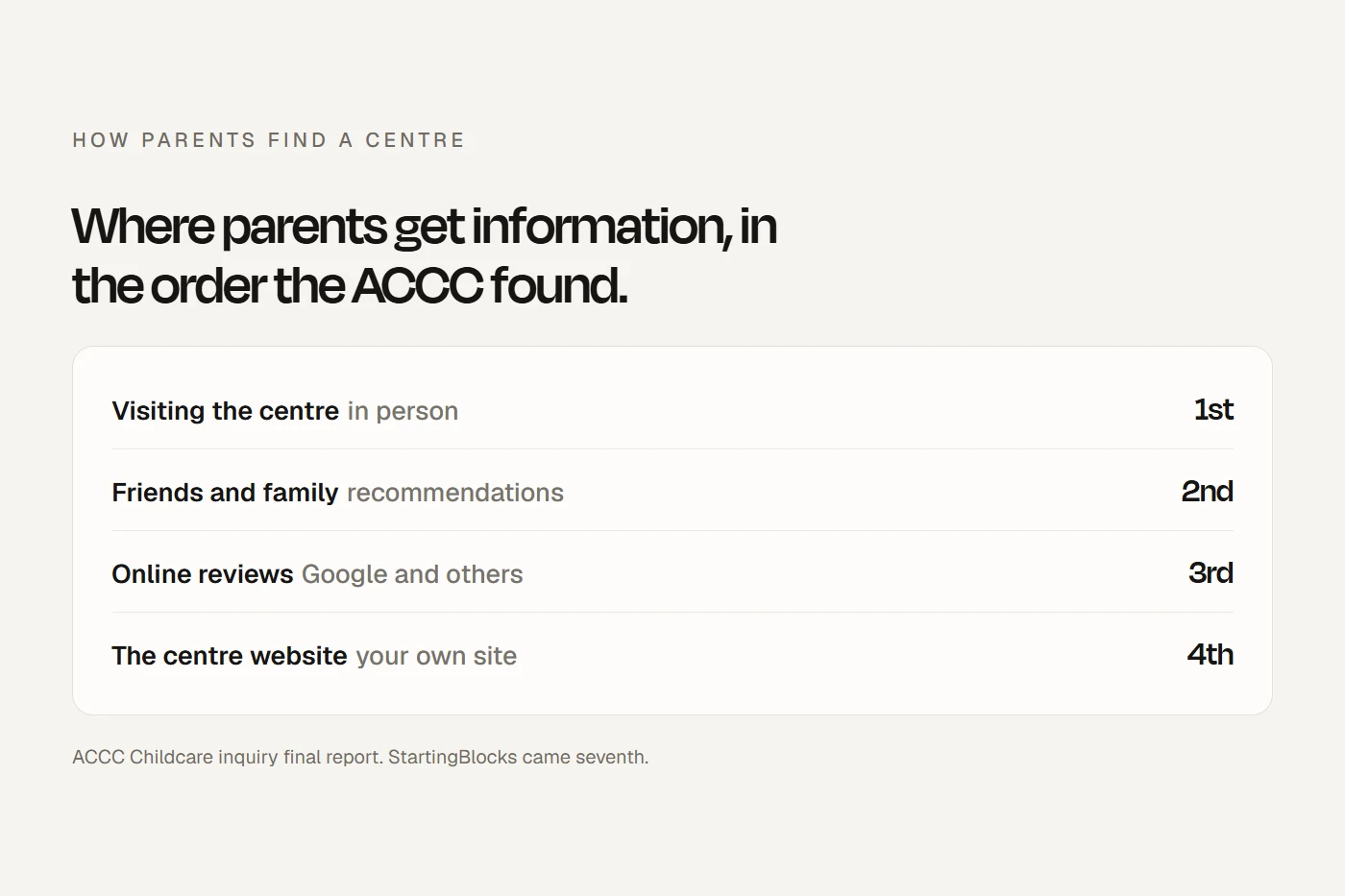
When the ACCC looked at childcare, it found many households weren't aware of StartingBlocks or NQS ratings, or didn't give them much weight when choosing. In-person visits and word of mouth, including online reviews, mattered more. For OSHC, families gave quality less weight again, because their child usually goes to the service at their school.
The NSW research adds the detail. Most parents had heard of quality ratings, but only about half knew more than the name. Ratings were never the only factor, but parents used them to make a shortlist of services to visit. Where they had a choice, they said they'd avoid Working Towards, with Meeting the lowest level they'd accept.
So your rating is a filter at the shortlist stage, and the shortlist is built on phones from StartingBlocks and your website. That's the case for a short, honest rating section on your site: the overall rating, all seven quality areas, a line on what the levels mean, and a link to your entry on StartingBlocks so parents can check it. After that, the tour does the work. For an OSHC service, lead with school pickup, hours and the program, and use the rating as supporting proof. I found no Australian data on whether showing a rating online lifts enquiries, so I won't pretend there is any.
After a new rating: the first 90 days
| When | What to do |
|---|---|
| Final report arrives | Read every element marked not met and every standard rated Exceeding. The report is your best source of honest marketing material. |
| First 14 days | Decide whether to ask the regulator for a review; the window is 14 days from the final report. Don't publish the new rating yet. |
| About two weeks in | The rating appears on the national register and StartingBlocks, and the matching logo becomes available. Request it. |
| Straight after | Swap the certificate at the entrance (in Victoria, update the history form within seven days). Update the website, Google profile, social bios, flyers, enrolment pack and signs. |
| First month | Write or update the rating section on your website. Tell current families first, then consider a local media release using ACECQA's template if the news is good, with parents' consent for any photos of children. |
| Second month | Update your quality improvement plan with the report's findings, and invite families to contribute. |
| Third month | Brief staff on how to answer "What's your rating?" at tours and on the phone, and add an offer to see the quality improvement plan to your tour booking page. |
Scroll the table sideways to see every column.
A provider can also apply for a reassessment, but only once every two years, it costs a fee, and the regulator can widen it beyond the areas you asked about.
Rating display checklist
Your ticks save in this browser.
- Current rating certificate visible from the main entrance, and at every family day care residence and venue.
- The rest of the prescribed information on display: provider and service details, nominated supervisors, hours, the educational leader, the complaints contact and the regulator's contact details.
- Victoria: the printed quality and compliance history, updated within seven days of any change.
- Quality improvement plan ready to show enrolled and prospective families.
- Rating stated in the official words everywhere, with quality-area ratings matching the certificate.
- Logo, if used: requested from ACECQA, matching the overall rating, unmodified, on that service's page only.
- A list of every place the rating appears: website, Google profile, social bios and pinned posts, email signature, enrolment pack, fence banner, car signs, listing sites.
- Everyone who markets the service briefed on the current rating and how to word it.
- Excellent: expiry date and the 90-day reapplication window in the calendar.
- A link to your StartingBlocks entry next to the rating on your website.
My view
Show the rating, all seven quality areas and what they mean, whatever the result. Parents can look it up anyway, and the date is right there on the register, so the only thing you control is whether they read it with your explanation or without it. A Meeting service that names its Exceeding areas and shows the practice behind them reads better than an Exceeding badge with nothing under it. A Working Towards service that names the one area and the plan reads better than silence. Then keep a list of every place the rating appears, because the day it changes, all of them have to change too.
Questions I get asked
What are the five NQS rating levels?
Significant Improvement Required, Working Towards National Quality Standard, Meeting National Quality Standard, Exceeding National Quality Standard, and the Excellent rating, which only ACECQA awards. New services are Provisional, Not Yet Assessed until their first assessment.
What are the seven NQS quality areas?
Educational program and practice; children's health and safety; physical environment; staffing arrangements; relationships with children; collaborative partnerships with families and communities; and governance and leadership.
Are the NQF and the NQS the same thing?
No. The National Quality Framework is the whole system: the law, regulations, learning frameworks and rating process. The National Quality Standard is the benchmark within it that services are rated against.
Does an NQS rating expire?
Working Towards, Meeting and Exceeding ratings last until the regulator reassesses the service, with no fixed cycle. The Excellent rating lasts five years for recent awards, or three for older ones, and reverts to Exceeding if it isn't renewed.
Do I have to show my NQS rating on my website?
No national rule requires it. You must display the rating certificate at your entrance, and anything you say about your rating anywhere, including your website, must be accurate and current.
About this guide
Written by Joseph Alzein, founder of bdog. bdog builds websites for early learning services. The rules come from the Education and Care Services National Law and Regulations, ACECQA, StartingBlocks and the state regulators, and the rating shares from ACECQA's latest national snapshot. Sources were checked on 12 October 2026. This is general information, not legal advice; your regulator has the final word.
Main sources:
- ACECQA: promote your rating
- ACECQA: assessment and rating process
- ACECQA Guide to the NQF: the rating system
- ACECQA: National Quality Standard
- ACECQA: Exceeding NQS
- ACECQA: the Excellent rating
- ACECQA: NQS rating logo terms
- ACECQA: national registers
- ACECQA: NQF snapshots
- ACECQA: quality improvement plans
- ACECQA: reviews of ratings
- StartingBlocks: service quality ratings
- Education Standards Board (SA): displaying quality ratings
- VECRA: displaying quality and compliance history
- NSW Department of Education: quality ratings
- Quality Rating Terminology Initiative Research