Preschool and kindergarten marketing: filling places within the rules
How families choose a preschool, what free means in each state, priority of access, the enrolment dates that matter, what your website must show, and the claims to avoid. With a places calculator, a claims sorter and a term-by-term checklist.
On This Page
- How families choose a preschool
- How many enquiries do you need?
- What “free” means in your state
- Priority of access comes first
- What your website needs
- The enrolment year, term by term
- Where the enrolments come from
- Can I say this?
- If you’re long day care with a kinder program
- Opening a new preschool
- Questions I get asked
Marketing a preschool or kindergarten isn't the same as marketing a long day care centre. The program is often free or close to it, a government priority list decides who gets a place first, and in Victoria the council often takes the registrations instead of you. In some states the funding rules even say what your website has to show. This guide covers how families choose, what "free" can mean in your state, the enrolment dates that matter, what to put on your website, and the claims to steer clear of. It draws on the state education departments' funding rules, Victoria's kindergarten parent survey, ACECQA's family survey, the ACCC's childcare inquiry and the Australian Consumer Law. It's general information, not legal advice; your department and your funding agreement have the final say.
- Lead with what it costsSay plainly what families pay after Free Kinder, Free Kindy or Start Strong fee relief, by age group. It's the first thing a parent wants to know.
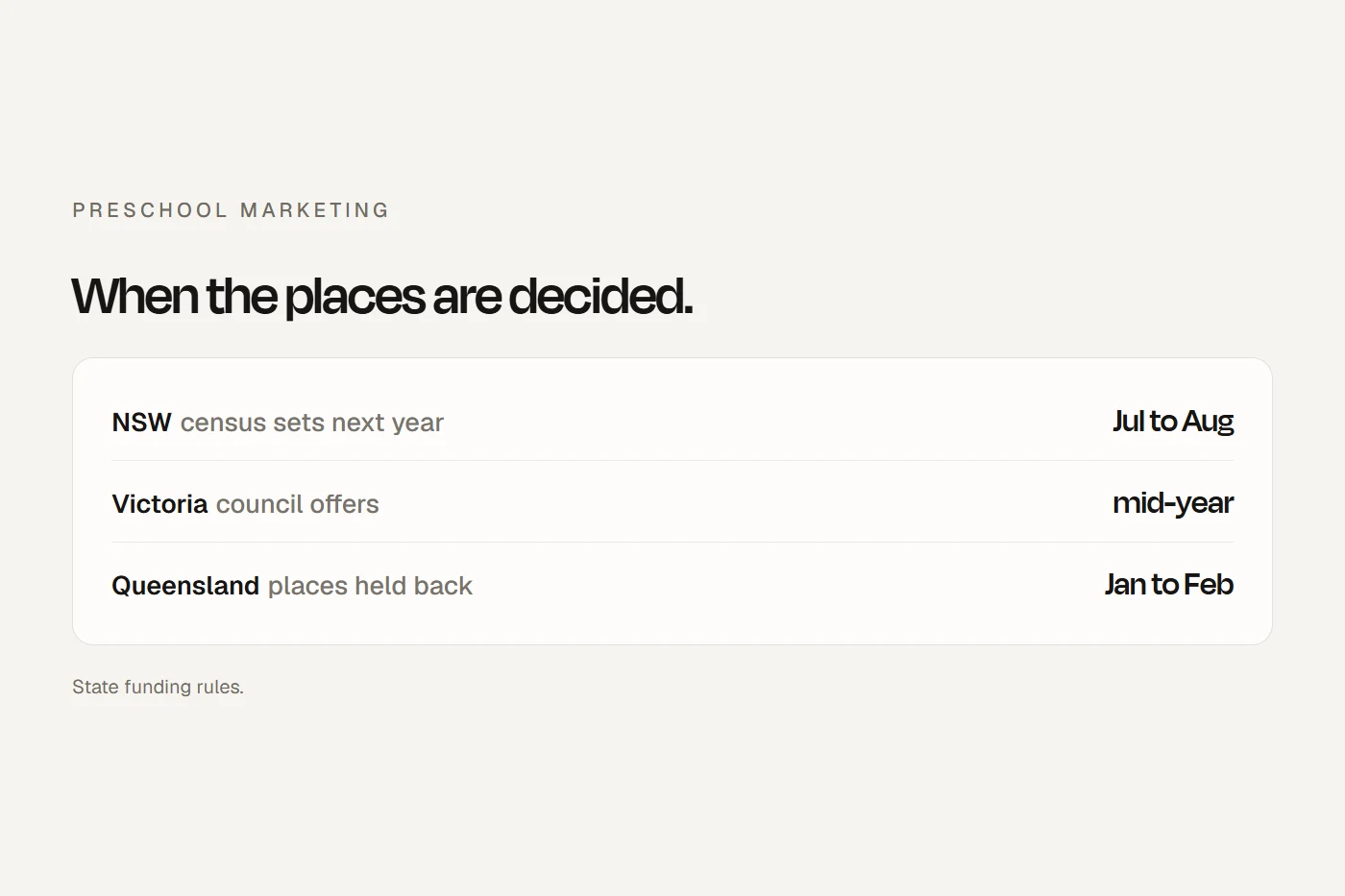
- Market before your state's key dateNSW funding follows the census in July and August. Victorian councils often make offers mid-year. Queensland holds places in January and February.
- Priority of access comes firstMarketing fills the places left after priority groups. Never suggest that enrolling early or buying extra hours moves a family up the list.
How families choose a preschool
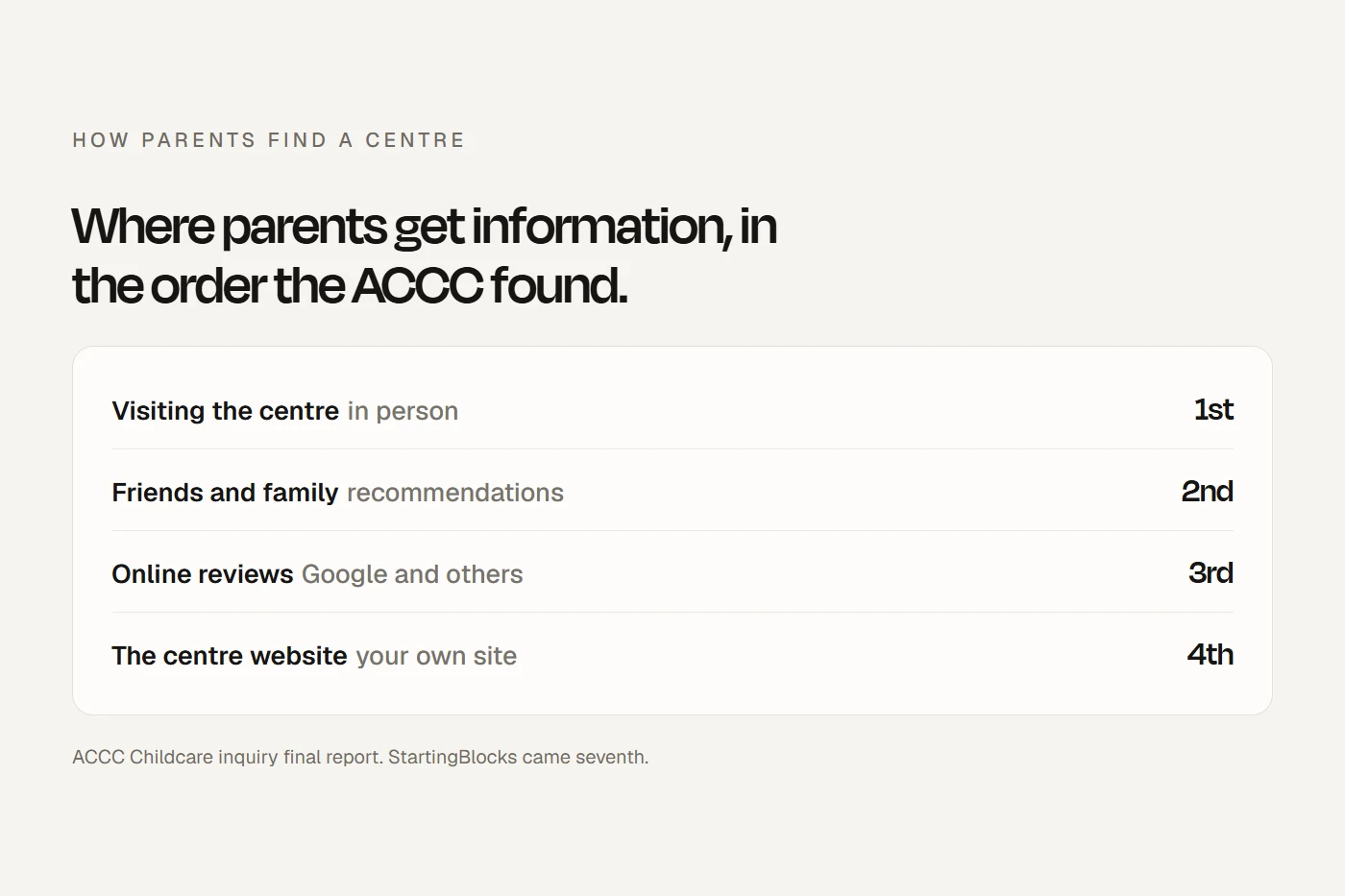
There's no national survey of how parents pick a preschool, but Victoria asks every year. In the Department of Education's kindergarten parent survey, parents pick their three most important factors. Location and the service's reputation tie at the top. Then come session days and times, then whether their child will go on to the same school as the other children, then Free Kinder. Whether long day care is offered and the quality rating come next. Cost sits near the bottom, which makes sense when most programs are free. The older surveys show the same order, so it isn't a one-year blip.
ACECQA's national family survey found that preschool families put "a high quality early learning program" first, then location, then cost. In every setting, the quality rating was the least important factor. Word of mouth was the source families used most: friends and family, then educators at the service, other parents, and teachers at the school where a service may be located.
A national study from Macquarie University adds one difference: preschool parents feel more pressure about educational outcomes than long day care parents, though both put their child's needs first overall. Put together, a preschool's marketing comes down to four things. Be easy to find locally, have families who speak well of you, make session times obvious, and explain the program and the teacher clearly.
The ACCC's childcare inquiry shows the other side. Long day care providers told it they struggle to fill places for children over 3 "due to a preference from parents and guardians to use standalone preschool/kindergarten (which is often free or at least significantly cheaper than centre based day care)". A sessional preschool's strengths are price and the program. Its weakness is hours, so say clearly how families can cover the rest of the day.
How many enquiries do you need?
Start with the places you actually have to fill. Put in your own numbers. The rates are examples only; I found no Australian benchmark for preschool conversion, so use what you saw last year.
On the example figures, two groups of 22 with 14 children continuing leaves 30 places. That takes about 38 offers, 55 visits and 92 enquiries. Two reminders before you spend anything. Priority groups fill first, so some of those places may go before your marketing does anything. And the number that matters is the one on the books at your state's key date, which is the next section.
What "free" means in your state
Every state funds the year before school differently, and the money usually flows through the service. Families don't know the scheme names, so your website has to translate. Here is the short version, without dollar amounts or roll-out years, which change.
| State | What families hear | Who mostly runs it | Fees message | Who takes enrolments |
|---|---|---|---|---|
| NSW | Start Strong fee relief; public preschools | Community preschools, long day care, public preschools on school sites | Community: lower fees with fee relief passed on, free only where fees reach zero. Long day care: fee relief after the Child Care Subsidy. Public preschools: free | The service, or the school |
| Vic | Free Kinder; 3-Year-Old and 4-Year-Old Kinder (Pre-Prep) | Sessional kinders, often run by parent committees or councils, and long day care | Sessional: a free program, extra hours optional. Long day care: a Free Kinder offset on the invoice | Often the council's central registration, otherwise the service |
| Qld | Free Kindy | Sessional kindergartens through a central governing body, and long day care | Free at programs that have opted in; extra care may cost | The service |
| SA | Preschool; 3-year-old preschool rolling out | Government preschools; long day care partners for 3-year-olds | Government preschool for the year before school | Government preschool by catchment |
| WA | Kindergarten | Public schools, community kindergartens, non-government schools | Free of compulsory charges at public schools | The school |
| Tas | Kindergarten | Government schools | Part of the first year of school | The school |
| ACT | 4-year-old preschool | Preschools attached to public schools | Up to 15 free hours a week at public preschools | Online, with a guaranteed offer |
| NT | Preschool | Government schools, some long day care | Free in government schools | The school |
Scroll the table sideways to see every column.
New South Wales. There's no blanket free preschool any more. Start Strong fee relief is paid to community and mobile preschools, which "must use all of the fee relief payment per child to reduce the daily fees as much as possible" for 600 hours a year, and must not raise fees to swallow it. The Department says services set their own fees. So "free" is only true for the children whose fees, after fee relief, actually reach zero. Otherwise say that fee relief comes off your fees and link to the Department's page instead of printing amounts. Where you don't send invoices, the guidelines list your website as one of the places to explain the fee reduction. Public preschools on school sites are free, and if one opens near you, lead on what it can't match: your hours, places for 3-year-olds, and your fees after fee relief.
Victoria. Free Kinder covers funded 3-year-old and 4-year-old programs, and families don't need a concession card to get it. For sessional services in Free Kinder, the funding rules are specific: "Free Kinder must be well-promoted and explained through the service's communication channels, including their website." Families must be told that the free program is available without buying extra hours, that priority of access applies, that donations are voluntary, that enrolment deposits are refundable, and which families don't pay deposits or waitlist fees. Compulsory levies are out. Long day care centres get an offset on the family's invoice instead, and most of those families still pay something, so a centre should say "Free Kinder offset applied", not "free kinder". The Department supplies ready-made website copy, social tiles and postcards in many languages.
Queensland. Free Kindy is 15 hours a week for 40 weeks at approved programs that have opted in. Sessional kindergartens "must not promote their Approved Kindergarten Programs as free, or use the 'kindy tick' identifier, until the service has opted in." Once they have, they must show the kindy tick on their signage and promotional material, and they "must clearly document, display and publish their fee information on their website", using the Department's statement of fees template. A kindergarten without its own website publishes its fees on its central governing body's website.
The other states and territories. In SA, WA, Tasmania, the ACT and the NT, the year-before-school program is mostly run by government schools or government preschools. If that's you, families will come through the school. If you're a long day care centre or a non-government service in those places, you're competing with a free program, so make your case on hours, continuity from the younger rooms, and care around the program.
Priority of access comes first
Funded preschool places aren't first in, first served. In NSW, community preschools must give "equal priority of access" to children in the year before school and to 3-year-olds from low-income families, Aboriginal and Torres Strait Islander children, children with disability or additional needs, children with English language needs, and children at risk of significant harm. In Victoria, priority of access applies to every funded program, including places given through a council's central registration, "whether they live inside or outside the local government area". Any local criteria, such as distance or a family's connection to the service, come after it and "must be documented and shared with families". Queensland sessional kindergartens must enrol eligible 4-year-olds before anyone else and hold 10% of places in January and February for children who haven't enrolled yet.
So marketing fills the places left over, and two things follow. First, explain the order honestly on your website: who gets priority, then how other places are offered. Victoria's guidance asks services to write the criteria in "clear, accessible and family-friendly language" and not to ask families directly whether a child is at risk. Second, never say that enrolling early, paying for extra hours or living close by jumps the queue where priority of access applies. Victoria's rules say families who opt for longer hours "should not be prioritised over families that fall within the department's PoA criteria".
What your website needs
Some of this is required by funding rules. The rest answers the questions governments tell parents to ask. Victoria's factsheet for families suggests asking what the program includes, whether a qualified teacher leads it, how children with additional needs are supported, which days and hours are available, whether it runs in school terms only, what fees or waitlist charges apply, and whether there's care before and after. Answer all of that before anyone has to ring.
- What it costs, by age group. One plain sentence each for 3-year-olds and 4-year-olds after the state program, and what any optional extra hours cost. In Queensland, the published statement of fees. In Victoria, the Free Kinder explanation and your fee policy.
- Session days and times for each group, and whether you follow school terms.
- The teacher. Name and qualification. It's required on display in Queensland sessional kindergartens and it's what families ask about everywhere.
- How enrolment works. The steps, the priority order, the dates, and if you're in a Victorian council scheme, a clear link to the council's registration instead of a rival form.
- Where children go next. The schools your children move on to and how you handle the move. In Victoria, children going to the same school is one of the top reasons families choose a kinder.
- What children learn. The Early Years Learning Framework's five outcomes, about identity, connection, wellbeing, learning and communication, make honest headings. Victoria uses its own framework, and Queensland its kindergarten learning guideline.
- Care around the program, or a straight answer that there isn't any.
- Your rating, stated exactly, and the Kinder Tick or kindy tick if you're approved, unaltered.
- A way to book a visit. Victoria's factsheet tells parents to visit if they can.
Keep online forms short. Victoria's guidance says to collect only what's "reasonably necessary to determine eligibility", and the sensitive details families give for priority of access shouldn't end up on a marketing list. If your families speak other languages, link to the translated material the Victorian and Queensland departments publish. My childcare website checklist covers the rest of the page in detail.
The enrolment year, term by term
Most preschool marketing fails on timing: the push happens in January, when the places that matter were settled months earlier. Here's the year as the state rules set it. Tick items off as you go; the list remembers your progress on this device.
- All year: fees, times and teacher on the website By age group, after the state program, with enrolment steps and the priority order.
- All year: rating and tick shown correctly Update every profile the day your rating changes.
- Term 1, Queensland: hold places for eligible children 10% of places through January and February, then fill.
- Term 1, NSW: fee relief declarations collected Before children start.
- Term 1: ask leaving families for reviews Families whose children have just started school, with no incentive attached.
- Term 2: open mornings for next year's intake Before the registration window in your state closes.
- Term 2, SA: registrations of interest The Department asks families to register by 30 June the year before.
- Term 2, Victoria: "register from age two" messages Check your council's registration timing and use the Department's "Know someone with a 2-year-old" material.
- Term 3, NSW: enrolments on the books for the census The census in July and August sets next year's funding.
- Term 3, WA: kindergarten applications close Public school applications close on the first Friday of Term 3.
- Term 3, Victoria: follow up council offers Contact the families who named your service.
- Term 4: transition statements done Use the contact with local schools to leave your enrolment details there too.
- Term 4: next year's fees on the website Queensland statement of fees, NSW fees within the CPI rule, Victoria's fee policy.
Where the enrolments come from
Your Google Business Profile. Location ties for first in Victoria's survey, so the profile matters: the right address, session hours that show you follow school terms, and photos taken on service devices with consent. My guide to local SEO for small businesses covers the setup.
Government finders and ticks. Victoria has its Find a Kinder Program map and the Kinder Tick, Queensland its Free Kindy finder and kindy tick, and South Australia lists its 3-year-old preschool partners in its Preschool Finder. StartingBlocks covers every approved service. Families see these listings next to your website, so the hours, fees and details must match. The Kinder Tick can go on your website, fence and marketing, but its guidelines say not to recolour it, add text, rotate, skew or add effects.
Open mornings and visits. A free visit or trial session is allowed even for services under the Commonwealth inducement rules. Hold them before the window that matters in your state, and put the times on your website and Google profile.
Feeder schools and local health services. Transition statements are a funding requirement in NSW and Victoria, and Queensland requires a transition statement too, so you're already talking to local schools. Ask them, and the local maternal and child health service, to keep your enrolment details. ACECQA found that teachers at the school where a service is located are one of the sources families trust.
Word of mouth and reviews. Reputation ties for first in Victoria, and word of mouth is the most used source nationally. Ask families for a Google review at a natural point, with no reward; Google bans incentives for reviews. My guide to getting more Google reviews has the wording.
Social media. Both Victoria and Queensland supply ready-made social tiles and postcards. Use them, and post photos only with written consent for that use, taken on a service device.
Can I say this?
Tap a card to see the verdict. "Free", "school ready" and "guaranteed" are where preschool advertising goes wrong.
If you're long day care with a kinder program
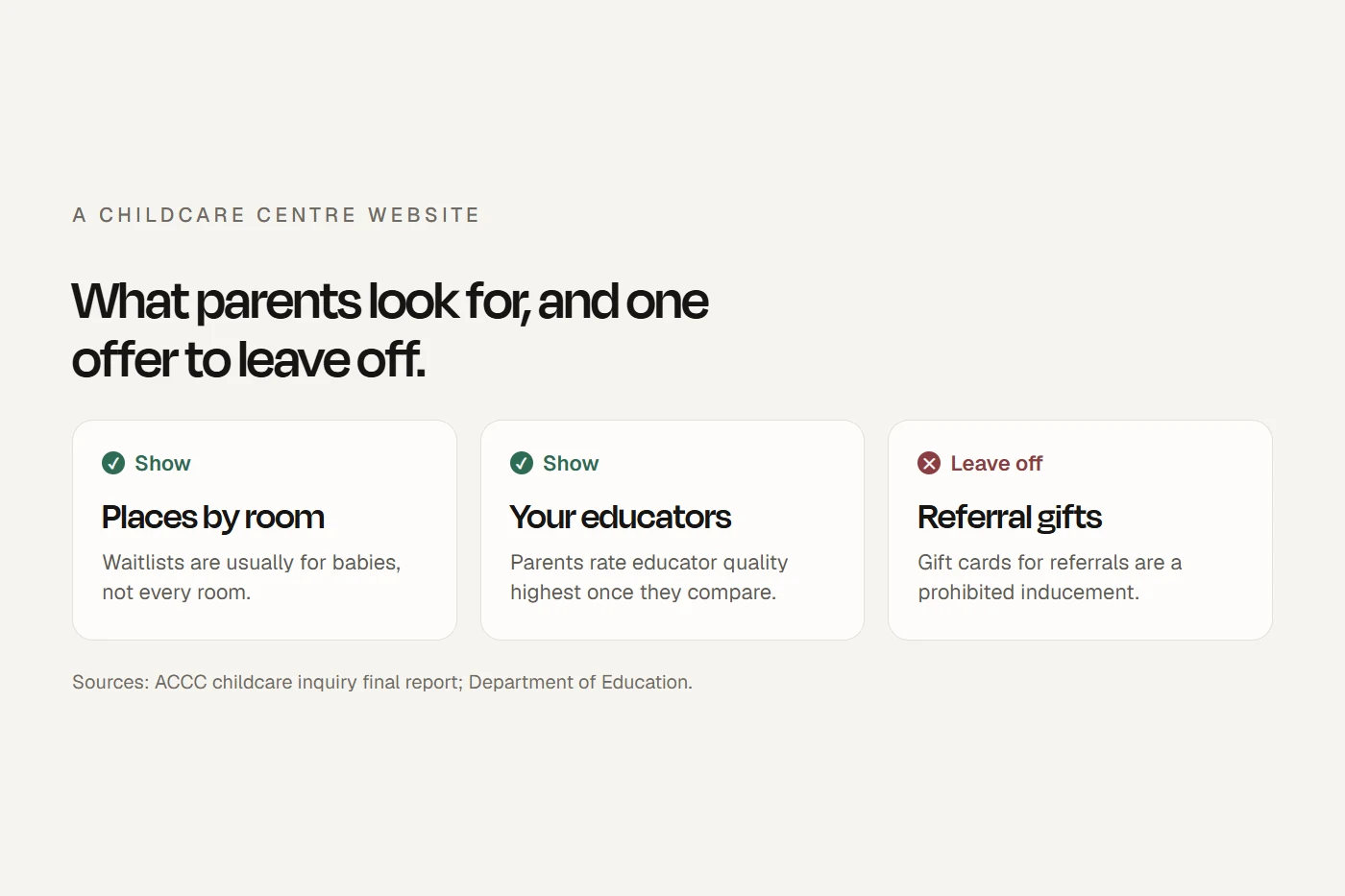
The Commonwealth inducement rule is a condition of approval for the Child Care Subsidy. It bans offering a benefit likely to get a family to enrol or book more care. The ACCC notes that standalone preschools and kindergartens aren't eligible for the subsidy, and NSW won't fund preschool hours that are subsidy-approved, so the rule mainly reaches long day care centres. If that's you, the rule itself carves out what you'd want to advertise anyway: the quality of your program, "including the availability of pre-school programs", your fees, your session days and times, food and nappies, and transport. Gifts, vouchers and referral rewards are out. A standalone preschool outside the subsidy isn't bound by that rule, but I'd still avoid cash rewards; they sit badly with voluntary donations and fee rules, and the consumer law still applies. My childcare marketing guide covers long day care marketing in full.
Opening a new preschool
The National Law makes it an offence to knowingly publish an advertisement for an education and care service unless it's approved, or an application for approval has been made and not yet decided. Lodge the application before the marketing starts. Until you're approved and opted in, don't use the Kinder Tick, the kindy tick or the word "free".
Questions I get asked
How do I increase enrolments at my preschool?
Show what families pay after the state program, the session times and the teacher on your website, hold open mornings before your state's key enrolment date, keep your Google profile and government listings accurate, and ask local schools and families to pass your details on. Remember that priority groups fill first.
Can a preschool advertise as free?
It depends on the state and the program. A Victorian sessional kinder in Free Kinder must promote it. A Queensland kindergarten can't say free until it has opted in to Free Kindy. A NSW community preschool can say free only where its fees after fee relief are zero.
When should a preschool start marketing for next year?
Before your state's key date, not in January. In NSW, enrolments at the census in July and August set next year's funding. Victorian councils often take registrations from age two and make offers mid-year. SA asks for registrations of interest by 30 June, and WA public school applications close early in Term 3.
Can we offer a discount or referral reward?
Not if you're a long day care centre approved for the Child Care Subsidy: rewards for enrolling or referring are prohibited inducements. Free visits and trial sessions are fine. A standalone preschool isn't covered by that rule, but state fee rules and the consumer law still apply.
Can we say our program makes children school ready?
Describe what you do, such as play-based learning led by a qualified teacher and your transition program with local schools. Don't promise outcomes for a particular child, like reading before school or a place at a school.
Do we have to show our fees on the website?
In Queensland, sessional kindergartens must publish a written statement of fees on their website, or on their central governing body's. Victorian sessional services in Free Kinder must explain Free Kinder on their website. Everywhere else, it's the first question families ask, so answer it.
About this guide
Written by Joseph Alzein, founder of bdog. I build websites for childcare and early learning services. Sources were checked on 12 October 2026. This is general information, not legal advice. For your service, check your funding agreement, your state education department and your regulatory authority. I've left out fee relief rates, subsidy amounts, penalties and roll-out years, which change.
Main sources:
- Victorian Government: Free Kinder
- Victorian Government: Free Kinder funding requirements for sessional services
- Victorian Government: kindergarten sector guide, Free Kinder
- Victorian Government: priority of access criteria
- Victorian Government: Kinder Tick
- Victorian Government: communicating about kindergarten to your community
- Victorian Government: more hours of 4-Year-Old Kinder
- NSW Department of Education: Start Strong overview
- NSW Department of Education: Start Strong for community preschools
- NSW Department of Education: Start Strong for families
- Queensland Government: Free Kindy
- Queensland Government: funding essentials for sessional kindergartens
- Queensland Government: about kindergarten programs
- SA Department for Education: register and enrol in preschool
- WA Department of Education: how to enrol
- ACT Government: 4-year-old preschool
- NT Government: your child goes to preschool
- Department of Education: preschool
- Department of Education: how to advertise your service
- The Sector: ACECQA's survey of how families choose
- ACCC Childcare inquiry, final report