Optometry practice software in Australia, compared
What Optomate, Sunix, Acuitas 3 and Oculo each do, the only published prices, how Medicare and health fund claims get to the payer, the contract terms that matter when you leave, and the rules on recalls, prescriptions and records. With a cost calculator, a shortlist quiz, a sorter and a switching checklist.
On This Page
Optometry software is a small market. Optometry Australia calls Sunix and Optomate "the most-used community optometry practice software systems", and both now sell a version installed on your own server and a newer cloud version. This guide is for independent practice owners choosing a system or thinking about switching. It covers what each one does, the only published prices, how Medicare and health fund claims get from the software to the payer, the contract terms that matter when you leave, and the rules your recalls, prescriptions and records have to follow. Prices are from each vendor's own pages, read on 12 October 2026, excluding GST as shown. Prices change, so check before you sign.
- Two incumbents, each moving to the cloudOptomate (Touch on your server, Optomate.Net in the cloud) and Sunix (Vision Elite on your server, Vision NEXT in the cloud). Acuitas 3 is the main newer option.
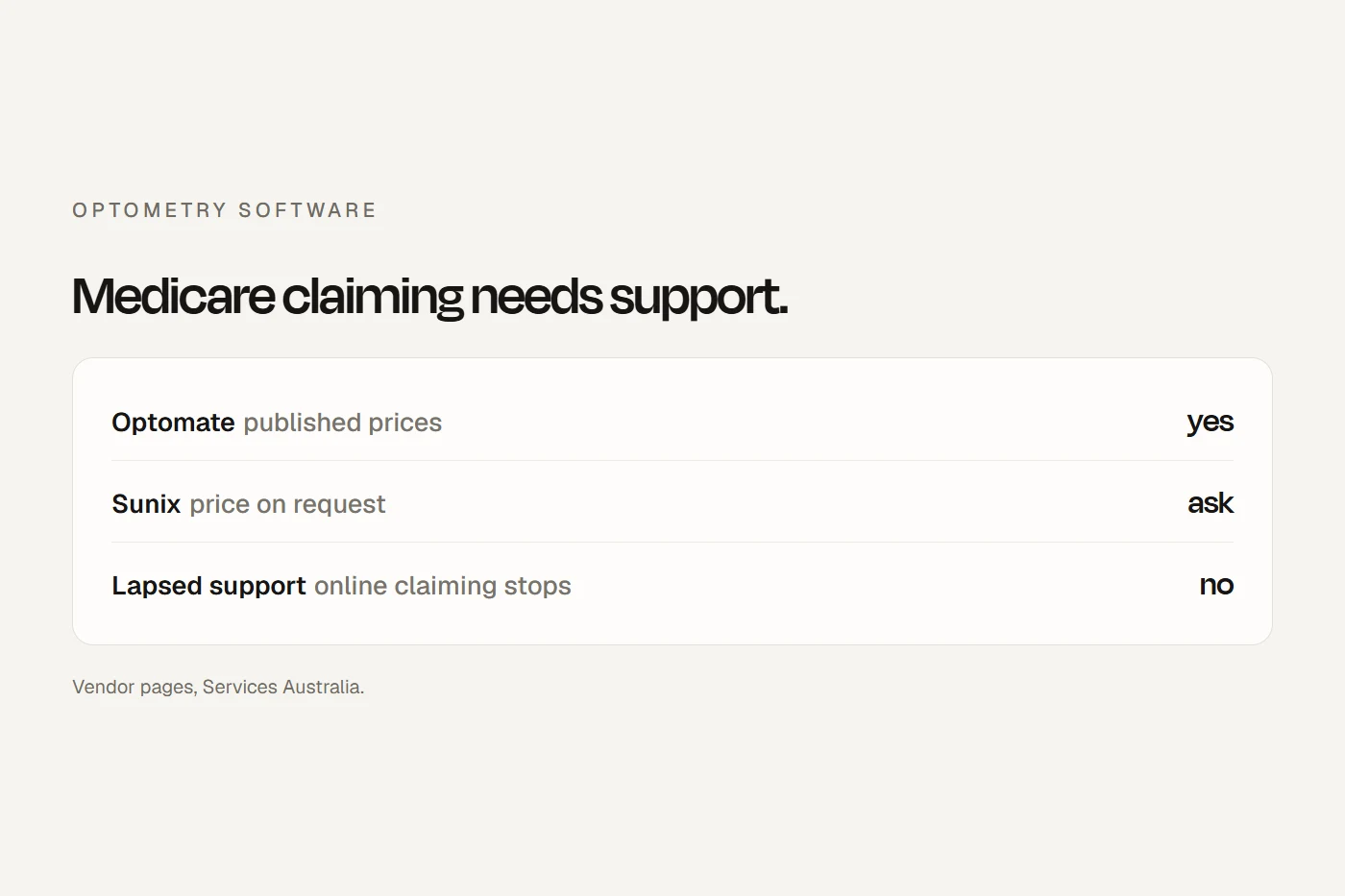
- Medicare claiming depends on supportWith both incumbents, online Medicare claiming stops if you stop paying for support. Ask what support costs before you compare licences.
- Only Optomate publishes pricesSunix, Acuitas and Oculo quote on request. Get the term, the notice date and the exit format in writing.
The systems
| System | Where it runs | Published price, excluding GST | Medicare and DVA | Health fund claiming | Data |
|---|---|---|---|---|---|
| Optomate Touch | Your Windows server | Licence $4,000 to $8,000 (one location), plus support $500 to $900 a year; or $150 a month subscription (Comprehensive) | Built in, through a PRODA account Monkey Software manages | HICAPS, Tyro and CommBank Smart Health terminals | Your server |
| Optomate.Net | Cloud | $300 a month per location, plus add-ons | $25 a month add-on, same PRODA arrangement | $25 a month add-on, through CommBank Smart Health | Microsoft Azure, Australia and NZ |
| Sunix Vision Elite | Your server | On request | Built in; you link PRODA yourself; needs an active support agreement | HICAPS | Your server |
| Sunix Vision NEXT | Cloud | On request | Released in modules; check what's live | Check | Australia |
| Acuitas 3 (Ocuco) | Cloud | On request | Not mentioned on its Australian page | Private health claims mentioned | "Full data hosting flexibility": ask |
| Oculo | Cloud, referrals only | On request; 30-day free trial | Not a practice system | n/a | Not stated |
Scroll the table sideways to see every column.
A few notes the table can't hold:
- Optomate is made by Monkey Software in Melbourne. Touch comes in Consulting Only, Consulting + Contact Lens, Dispensing Only, Comprehensive and Enterprise editions, and reads data from a range of Topcon, Nidek and Tomey devices and imaging platforms such as Medmont, FORUM, IMAGEnet, Optos and Heidelberg. Touch means you own the server, its backups and its security.
- Optomate.Net bundles bookings, exams, recalls, Rx, lab orders, stock and reporting into the $300, with voice-to-text and letter writing included. Its add-ons are online Medicare and DVA claiming ($25), online health fund claiming ($25), web bookings ($10) and frame trace storage ($10). SMS is 8 cents a message. Its AI features use OpenAI components, so ask where that processing happens.
- Sunix is owned by SUNIX Computer Consultants and insured under the Essilor group's policy. Its own availability table still says the cloud version's Dispensing, Medicare and Financial modules were "due for release during 2024", so ask exactly which modules are live before you plan a move.
- Oculo is a referral layer, not a practice system: it shares clinical correspondence between optometrists, ophthalmologists and GPs. Optomate.Net lists it as its eReferral integration, and it works on its own in a browser.
- General allied health systems such as Cliniko and Halaxy don't market to optometry and don't do frames, lenses, lab orders or Rx printouts. On my reading, they only suit a practice that consults and doesn't dispense, such as a mobile optometrist.
What it would cost you
Optomate is the only one with published prices, so this compares its options. Add-ons are assumed to be charged per location, which its pricing page doesn't confirm.
Over five years, the outright licence looks cheaper than the cloud subscription until you price the server, its backups and the IT support to keep it secure. Fund terminals are on top: Tyro Health, HICAPS and CommBank Smart Health each charge a monthly rental.
How claims get to Medicare and the funds
Medicare online claiming from practice software now runs through PRODA and a registered "B2B device", not the old PKI certificates. With Optomate, Monkey Software manages the PRODA account and processing for you. With Sunix, the practice links Medicare Online to its PRODA organisation and renews the device every six months. Either way, MBS changes arrive as software updates, so if you're not on support, you don't get them. Sunix says practices need an active support agreement for Medicare Web Services, and Monkey says customers without a maintenance agreement lose its cloud services, which include online Medicare claiming.
For health funds, choose the terminal after the software. Optomate Touch works with HICAPS, Tyro and CommBank Smart Health terminals; Optomate.Net's fund claiming runs through CommBank Smart Health; Sunix lists HICAPS. HICAPS's own list of integration partners names no optometry system, so ask the vendor exactly which HICAPS integration it uses.
Assignment of benefit has changed
Services Australia has changed the rules for bulk billing. An assignment of benefit agreement can now be made before or after the service, on paper or electronically, including inside booking software when the patient books. No approved form is needed, but the agreement must contain the particulars the Regulations set. You keep a copy for 2 years, and "Patient unable to sign" is no longer acceptable. During a transition period, a verbal agreement is allowed if you record it. Sunix has released updated forms and electronic signatures; I found nothing from Optomate on it yet, so ask.
The rules your software has to follow
Prescriptions. The Optometry Board's guideline says every prescription must show the patient's name, whether it's for spectacles or contact lenses, the prescribing optometrist and practice address, and the issue and expiry dates. Spectacle prescriptions include the lens powers and prism; contact lens prescriptions include power, base curve, diameter, material and enough to identify the lens. Patients get a copy "at no additional fee" at the end of a paid consultation; later copies can carry a fee "proportionate to the costs involved"; and a copy given after expiry should be "clearly marked 'expired'". Don't send a prescription to another store without the patient's permission. Check that your Rx printout template does all this.
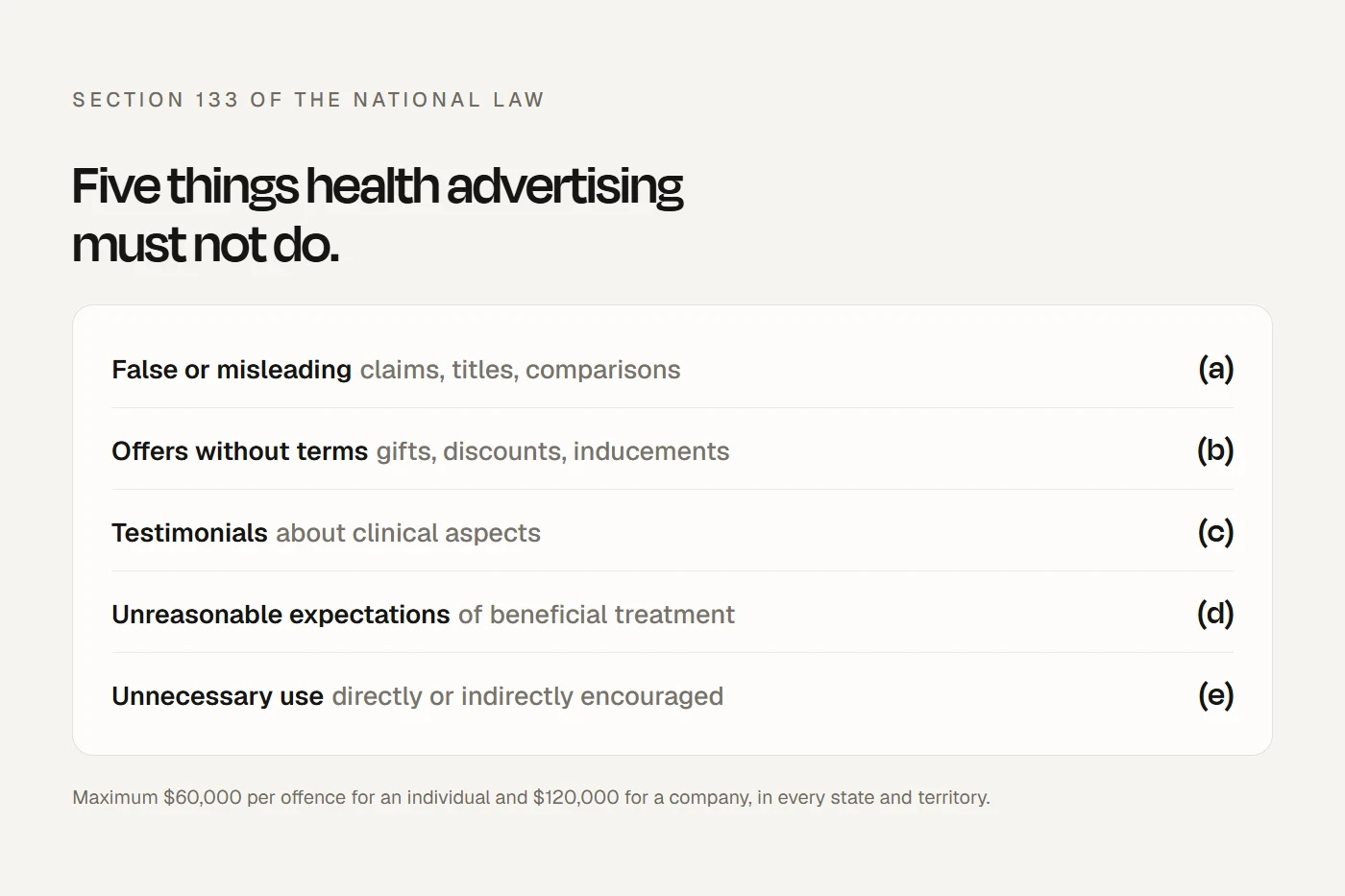
Recalls are advertising. Ahpra's advertising guidelines list "patient recall notices" in the definition of advertising. They say advertising may be unlawful if it encourages people to attend regular appointments where there's no clinical indication, or creates urgency with lines like "don't miss out". An offer such as "second pair half price" must state its terms. A recall that tells a patient they're due, based on the optometrist's recall interval, is the safe pattern. Sending a promotion to your whole database needs express consent and a working unsubscribe. Both incumbents sell recall and marketing SMS tools, so set them up this way.
Feedback and testimonials. Both systems collect patient feedback. Use it to improve, but don't put clinical comments on your website: testimonials about clinical care are banned in health advertising, and you're responsible for reviews you republish.
Records and privacy. The Privacy Act covers every health service provider, whatever its turnover. In NSW, Victoria and the ACT, health records are kept for 7 years from the last service, or until 25 for information collected from a child. Installed systems keep data on your own server, and Sunix says plainly that the security of locally hosted data is the practice's responsibility. No optical system is on the Australian Digital Health Agency's My Health Record conformance lists, so don't choose on that.
Which should you shortlist?
Contracts and leaving
| System | Term | Leaving |
|---|---|---|
| Optomate Touch | One year, renews yearly; 30 days' notice of non-renewal; fees non-cancellable and non-refundable | At least six months of help moving your data, at current fees, if you ask in writing 30 days before expiry. The data is on your server |
| Optomate.Net | No separate terms found | Monkey says you keep ownership of your data; ask for the exit format |
| Sunix | The agreed term; support runs 12 months | Ending early means paying the rest of the term. Cloud data is deleted within 90 days of termination, after a chance to extract it |
| Oculo | 12 months, rolling; 60 days' notice | Transition help is paid and only during the term |
Scroll the table sideways to see every column.
Can I do this?
Tap a card to see the verdict.
Switching systems
Your ticks save in this browser.
- Find your renewal date and notice period before anything else.
- Ask for the data handover in writing before you give notice, including its format and cost.
- Keep support paid until cut-over, or online Medicare claiming stops.
- Re-link Medicare in PRODA and register the new device, or confirm the vendor does it.
- Check assignment of benefit capture: verbal, paper or electronic, with the required particulars, kept for 2 years.
- Rebuild your payers: Medicare, DVA, each health fund route and any state spectacle scheme, each with its own price list.
- Rebuild the recall list and its wording, based on clinical intervals, with no urgency lines.
- Check the Rx printout has every required field and an "expired" stamp for late copies.
- Move stock and supplier catalogues, lab ordering and barcode labels.
- Test every equipment and imaging link with your exact devices.
- Swap every booking link on cut-over day: website, Google Business Profile, booking directories and SMS templates.
- Keep old records readable for the retention period, with a read-only copy if the old system was on your server.
- Check your SMS sender ID is registered and names the practice.
- Turn off any card surcharge setting.
- Ask where AI features send data, and tell patients if an AI scribe is used.
My view
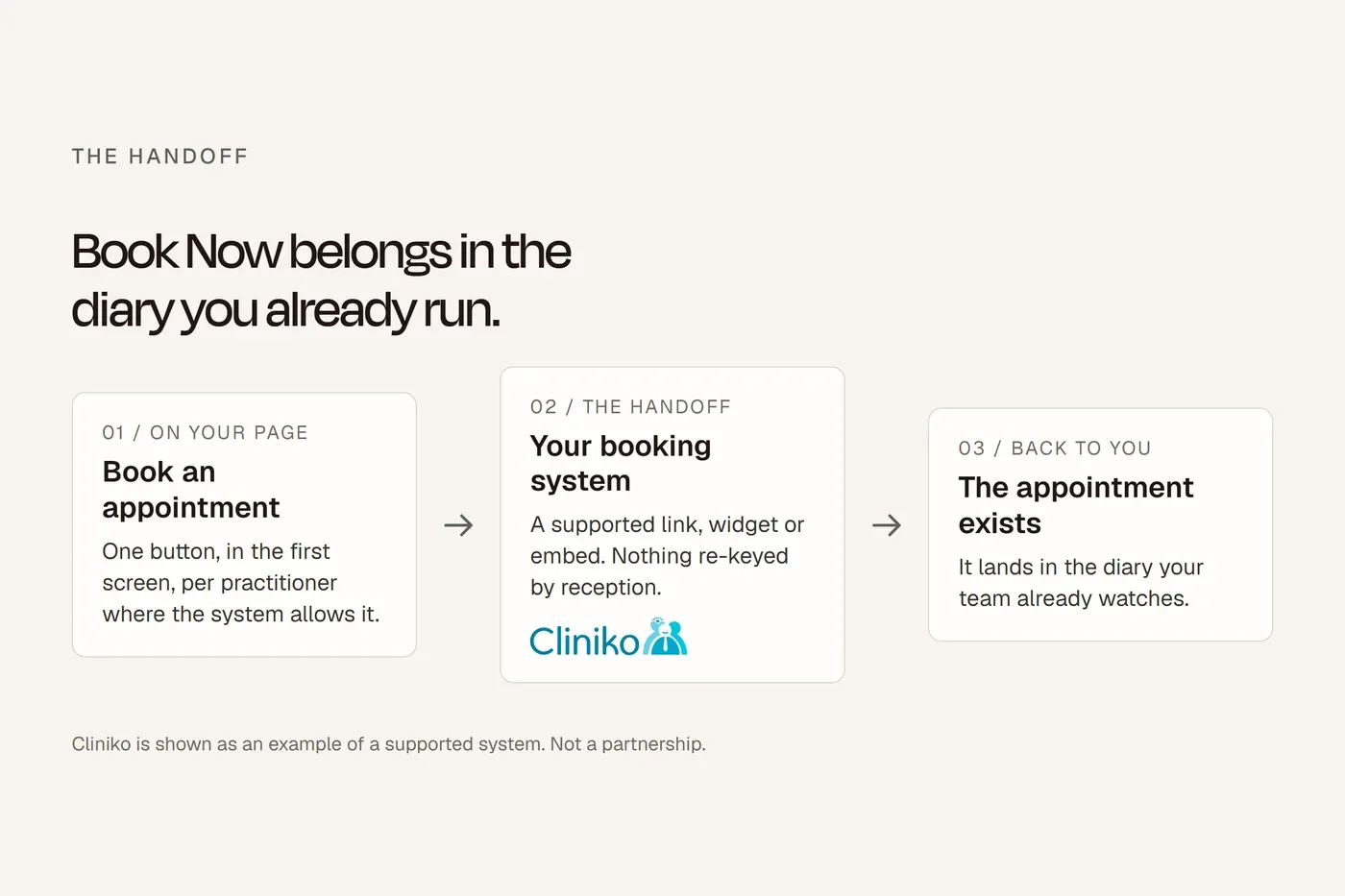
Compare the support terms before the features. With both incumbents, support is what keeps Medicare claiming and MBS updates flowing, so an outright licence with lapsed support isn't really cheaper. Then decide server or cloud on who you want responsible for backups and security, test your exact equipment, and get the term, notice date and exit format in writing. Whatever you choose, link the booking system to your website so patients can book from their phone.
Questions I get asked
What software do optometrists use in Australia?
Mostly Optomate or Sunix: Optometry Australia calls them the most-used community optometry systems. Acuitas 3 is a newer cloud option, and Oculo handles referrals alongside them.
How much does Optomate cost?
As published, excluding GST: Optomate.Net is $300 a month per location plus add-ons; Optomate Touch is a $4,000 to $8,000 licence plus $500 to $900 a year in support, or $150 a month on subscription. Check the current prices with Monkey Software.
Does optometry software do Medicare claiming?
Optomate and Sunix both claim online through Medicare Web Services, but only while you're on support.
Is Sunix cloud-based?
Sunix Vision Elite is installed on your server; Sunix Vision NEXT is its cloud version, released in modules. Ask which modules are live.
Are recall reminders advertising?
Yes. Ahpra's guidelines list patient recall notices as advertising, so base recalls on clinical need, avoid urgency, and state the terms of any offer.
About this guide
Written by Joseph Alzein, founder of bdog. bdog builds websites for optometry practices and has no arrangement with any vendor named here. Prices and features come from each vendor's own pages, read on 12 October 2026, excluding GST as shown; prices change, so check before you sign. The rules come from Services Australia, the Optometry Board of Australia, Ahpra, the OAIC and state health records law. This is general information, not legal advice.
Main sources: