Orthodontic marketing: the specialist title and before-and-after photos
For specialist orthodontists and general dentists who offer braces or aligners: how patients find you, the titles each of you can use, Invisalign tiers, reviews, before-and-after photos, offers, payment plans, super, health funds, children and referrers. With a title checker, a wording sorter, a treatment start calculator and a 90-day checklist.
On This Page
- How patients and parents find an orthodontic provider
- The title rules
- Invisalign tiers and brand claims
- Testimonials and reviews
- Before-and-after photos
- Offers, payment plans, super and health funds
- Timeframes, comfort and mail-order aligners
- Children, schools and sport
- Referring dentists and vendor incentives
- Channels that work
- What is a new patient worth?
- Can I say this?
- Your first 90 days
- Questions I get asked
Orthodontic marketing has two readers with different rules: the registered specialist orthodontist, and the general dentist who offers braces or clear aligners. The words that separate them are protected by law, most patients don't know the difference, and the most persuasive things in this field, before-and-after smiles and happy patients, are exactly what the advertising rules restrict. This guide covers how patients and parents find a provider, the titles each of you can use, Invisalign tiers and brand claims, reviews, before-and-after photos, offers, payment plans, health funds, children, referrers, and the channels that work. It's built with Ahpra's advertising guidelines in mind, draws on the National Law, the Dental Board, the TGA, health funds' own pages and the consumer pages patients read, and it's general information, not legal advice.
- "Orthodontist" is the protected titleNot just "specialist orthodontist". A general dentist can offer braces and aligners but can't be an orthodontist in any wording.
- Show the result honestly, without patients' wordsTestimonials are banned. Before-and-after photos need the same framing, consent and the treatment as the only visible change.
- Money claims need the full pictureA weekly price needs the total cost, "free" must be free, and health fund claims depend on the patient's own cover.
How patients and parents find an orthodontic provider
I couldn't find any Australian data on how many orthodontic patients come through a dentist's referral and how many find a provider themselves. What the consumer pages say matters more. Healthdirect tells people they don't need a referral to see an orthodontist, that they can ask their dentist, family or friends for a recommendation, that they can search the Australian Society of Orthodontists' Orthodontics Australia directory, and that they can check registration on the Ahpra register. Victoria's Better Health Channel says the same. So there are two doors: the family dentist's recommendation, and the parent or adult who searches. Whatever they find, your register entry and your website should say the same thing.
The one Australian study on how people choose, a survey of about 2,000 adults by orthodontic researchers, found most people thought any dentist offering orthodontics had to be an orthodontist, and most rated a specialist as the most qualified. Whether the provider was a specialist was the biggest factor in their choice, followed closely by cost. That confusion is why the law protects the title, and why both specialists and general dentists have to word their marketing carefully.
The title rules
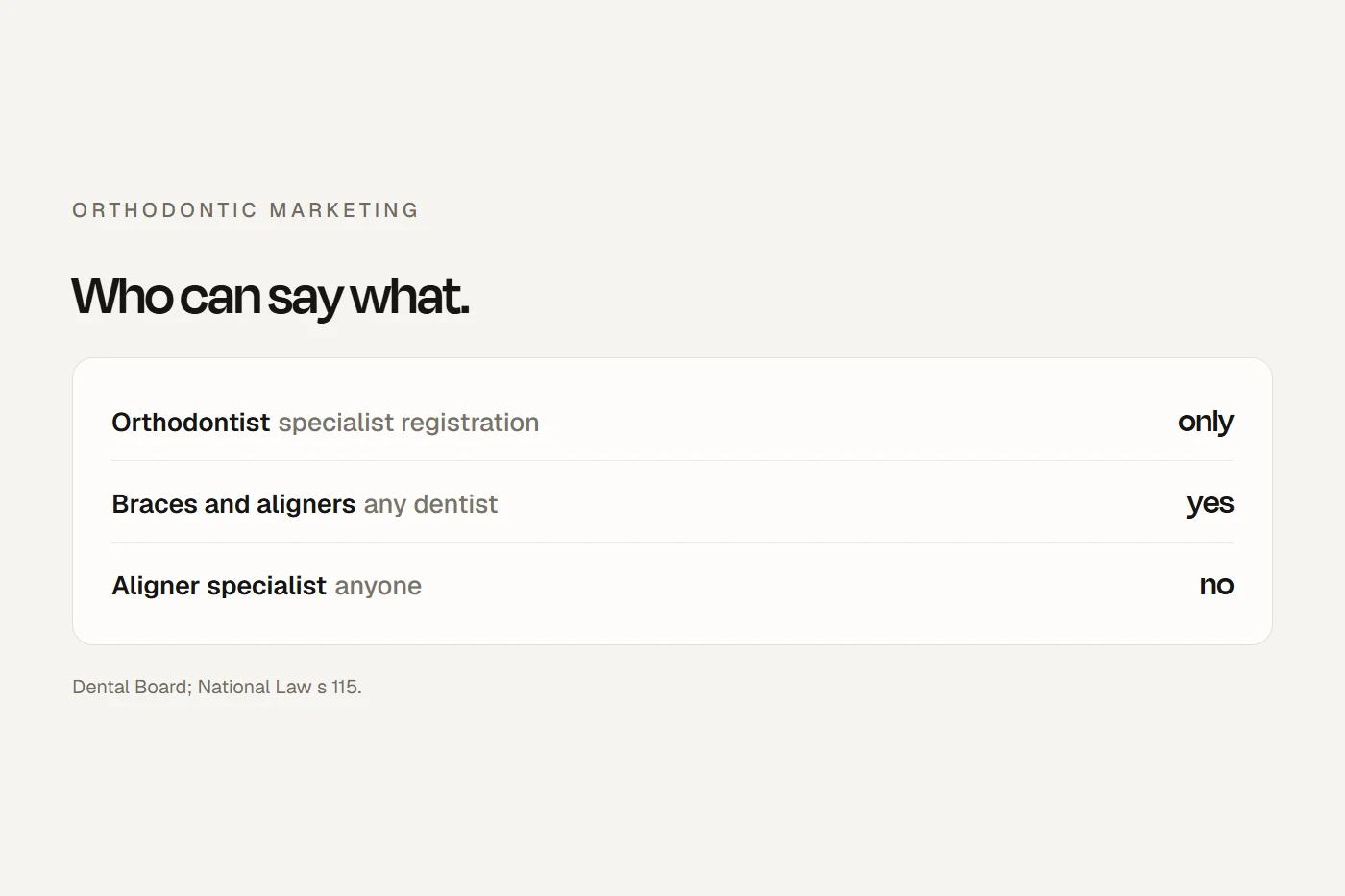
The Dental Board's list of recognised specialties gives "Orthodontist" as the specialist title for orthodontics, and the National Law (section 115) makes it an offence to use a specialist title without specialist registration in that field, "with or without any other words". "Dental specialist" is protected too, and section 118 catches anything that "could be reasonably understood to indicate" specialist status. That includes the name of the business: Ahpra's guidelines say the title rules cover "the name of the business or other advertising to the public".
For a general dentist, straightening teeth is lawful. It's a restricted dental act any registered dentist may perform within their own education, training and competence. So "we offer braces and clear aligners" is fine, and so is stating a course you've completed, accurately. "Orthodontist" in any form isn't: not "our orthodontist", "kids' orthodontist" or "aligner specialist", and not "specialises in orthodontics". Ahpra says words like "working primarily in" are less likely to mislead, if true. "X Orthodontics" as a general practice's trading name and the "Orthodontist" category on your Google profile both put the title in front of the public, so I'd avoid both. A page that also says when you refer to a specialist orthodontist reads as honest.
"Dr" needs the profession beside it. Ahpra's own corrected example for a specialist dentist is "Dr Jeffries (Dentist) Specialist Endodontist", so an orthodontist would be "Dr Lee (Dentist) Specialist Orthodontist", and a general dentist "Dr Lee (Dentist)". A specialist's use of "specialist" should stay within orthodontics: "Invisalign specialist" overstates even for an orthodontist. "Paediatric dentist" is its own specialist title, so "paediatric dentist and orthodontist" is only for someone registered in both.
The Dental Board's own audit found the two most common problems in dental advertising were specialist wording and specials without terms, and it said more audits would follow. Ahpra has prosecuted an unregistered person for using a dental specialist title.
Invisalign tiers and brand claims
Align's Australian locator explains its tiers itself: they "reflect the number of Invisalign aligner treatments prescribed by a doctor", ranked on the previous 12 months, and "are not intended to reflect the quality or skill level of the provider". So "Invisalign Diamond Provider" is a statement about volume. It's fine if it's current, but not with "so you get the best results" beside it, and never as "Invisalign Diamond specialist". The tier moves with a rolling 12 months, so an old badge can quietly become untrue. Use only the badges and wording Align gives you in your provider account.
Naming a device brand also brings in the TGA. Aligners are medical devices that can be advertised to the public if the ad meets the Therapeutic Goods Advertising Code, and the Code bans endorsements by health practitioners. The TGA's examples of an endorsement include an image of the endorser holding the product. "We offer Invisalign" is information; a dentist holding an aligner tray in a brand ad, or "our dentists recommend it because it's the best aligner", is an endorsement. Never write "TGA approved".
Testimonials and reviews
The National Law bans testimonials in health advertising. Ahpra defines them as positive statements about clinical aspects: symptoms, treatment, outcomes, or the practitioner's skill. "My teeth are finally straight", "Dr Lee fixed my daughter's overbite" and a patient talking through their smile reveal are all testimonials. Comments about parking or the front desk aren't. Reposting a patient's "braces off" story to your account is using a testimonial, even though their own post on their own account is fine.
Asking for reviews isn't banned. Ahpra's rule is about using clinical reviews in your own advertising, and it warns that engaging with them can count as using them. Google's rules add no incentives and no asking only happy patients. So ask every patient the same neutral way at the same point, such as after debond or at the retainer check. Don't reply "So happy with your new smile" to a clinical review, never confirm someone is a patient, and keep review feeds and star widgets off your site.
Before-and-after photos
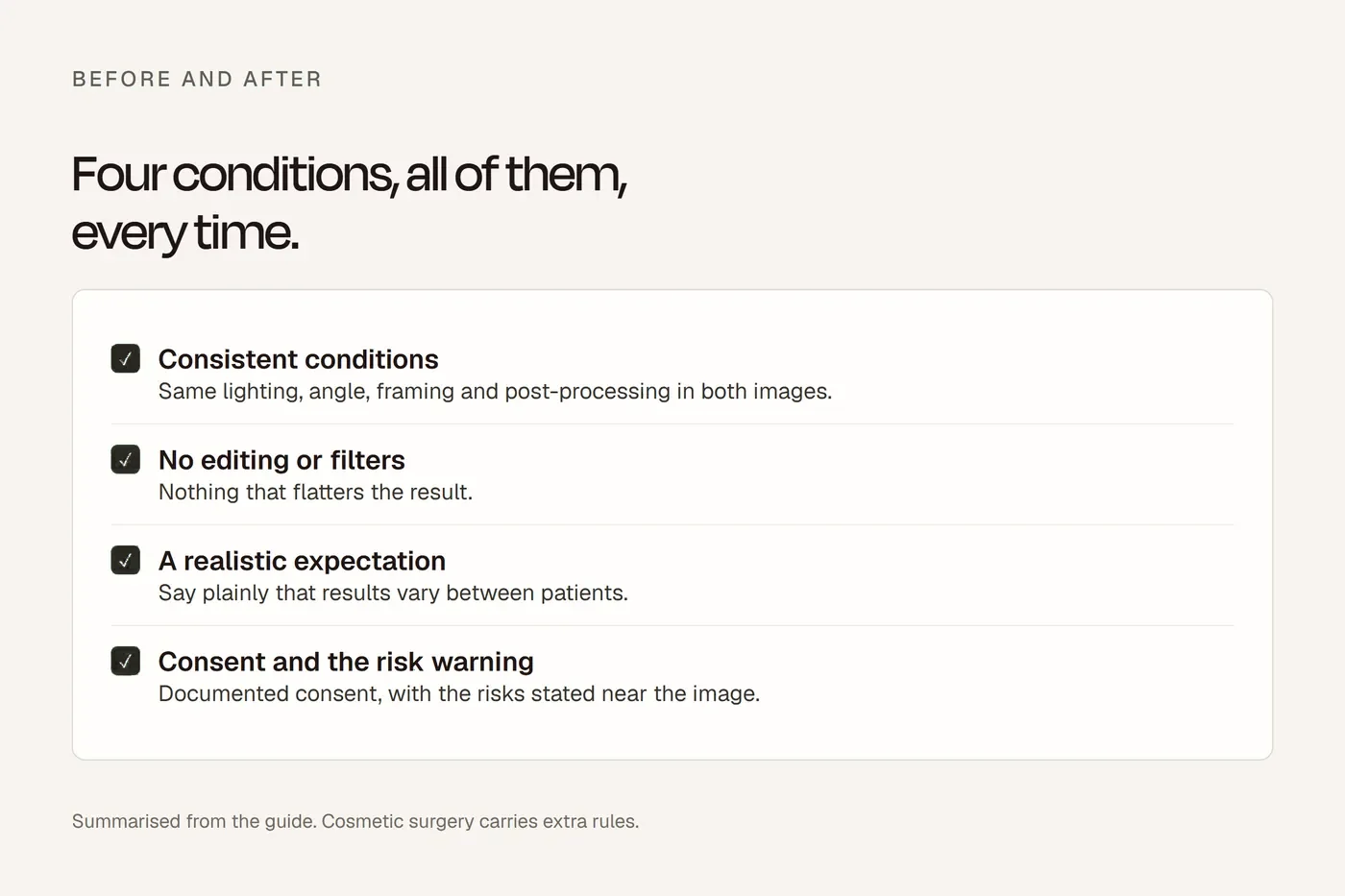
Ahpra's guidelines don't ban before-and-after photos, but they set conditions: the images should be as similar as possible in angle, background, framing, lighting and posture, any editing explained, and "the referenced treatment or procedure is the only visible change". You need written, informed consent to use anyone's image, and for a child you should consider a parent's consent as well.
In orthodontics, that points one way. Intraoral photos from records appointments, with the same retractors, angle and lighting, are the format most likely to meet the conditions. Face and smile photos of a growing child taken two years apart almost never do, because hair, face, weight and lighting all change. My rules for any gallery: intraoral pairs only, the treatment type and length in the caption with "results vary", no names or tags, no reaction videos, and consent on file. My guide to before-and-after photos under Ahpra's rules covers the general conditions.
One open question: the 2025 guidelines for higher-risk cosmetic procedures name dental veneers but not orthodontics, and Ahpra hasn't said whether purely cosmetic aligner treatment counts. If your ads sell a look, such as a "smile makeover", I'd assume the stricter rules could apply: no images of under-18s, no targeting under-18s, no emotional reveals, and no finance in the headline.
Offers, payment plans, super and health funds
"Free consultation" is fine if it's absolutely free and the terms say what's included, such as the exam, photos or x-rays, and who's eligible. Ahpra says the public takes "free" to mean absolutely free, so a consult fee recouped in the treatment price isn't free. A refer-a-friend discount passes Ahpra's own example once the terms say who it's for. A competition to "win free Invisalign" encourages treatment regardless of need, so skip it.
Payment plans are normal in orthodontics, and healthdirect tells patients some orthodontists offer interest-free plans. Ahpra's rule is that an ad stating an instalment amount must also state the total cost, so "from $X a week" never appears alone. If you add any fee for paying by instalments, check with your accountant or lawyer first, because a charge for credit can bring credit law into play.
Super. The Dental Board lists "Advertising or marketing compassionate release of super as an easy way to 'help' fund treatment" as a red flag, and says super can't pay for purely cosmetic procedures. "Use your super for braces" is a line not to run.
Health funds. Fund benefits depend on the patient's extras cover, waiting periods and lifetime limits, and funds pay only for treatment given in person by a recognised provider. Bupa says it doesn't pay for online orthodontic courses that aren't provided in a dental practice. Some funds, HCF among them, set a higher orthodontic limit when a registered orthodontist does the work, so an orthodontist can say "some funds pay more when a registered orthodontist treats you; check your cover". "No gap orthodontics" is almost never true. The ACCC took action against a mail-order aligner company that told consumers they might get money back from their fund when most funds didn't cover its treatment. Point patients to their own fund, with the item numbers on their treatment plan.
Timeframes, comfort and mail-order aligners
Healthdirect says treatment "can take 18 months or more", and the specialists' own consumer site says most aligner treatment takes 12 to 24 months, with some cases finishing in as little as six. So "straight teeth in 6 months" turns the exception into a promise, which Ahpra treats as an unreasonable expectation. "Some simple cases finish in months; most take one to two years, and you'll get your estimate at your first visit" is balanced. "Painless", "guaranteed" and "invisible" are the minimising and certainty words Ahpra names, so leave them out.
Against mail-order aligners, describe your own process: "every patient has an in-person exam and x-rays before we plan treatment", if it's true. Lines about mail-order aligners wrecking teeth, or crooked teeth ruining a child's confidence, are fear lines. They don't belong in a health practice's ads.
Children, schools and sport
Most orthodontic patients are children or teens, so consent runs through the parent: for treatment, for fees and for any image. Under-16s can't hold accounts on the major social platforms, so social ads reach parents and older teens, and Meta's rules bar questions that imply a health attribute, such as "Does your child have crooked teeth?". "Braces and clear aligners for teens in [suburb]" is the allowed pattern.
A free screening at a school needs parent consent before any examination, real terms, and no push towards treatment. NSW public schools also can't endorse the practice. A neutral oral health talk, or a sponsorship line like "official orthodontist of [club]" for a registered orthodontist, is the lower-risk version. Player or student quotes about their braces are testimonials.
Referring dentists and vendor incentives
For a specialist, the family dentist is a main channel. The shared Code of conduct says don't offer inducements to colleagues, so per-referral hampers, dinners or gift cards are out. What works is clinical: a clear referral form, fast written reports with the plan and timeline, patients sent back to their dentist for check-ups, and case-based study evenings without lavish hospitality.
For a dentist offering aligners, Ahpra's conflicts of interest guidance names the risks: a financial benefit "may be free training or education, travel or similar benefits", business models that tie incentives to clinical activity, and only recommending the devices you supply. Volume discounts and staff targets for aligner starts are the kind of thing to disclose to the patient in the consult. Ahpra says a website disclosure on its own isn't enough.
Channels that work
Google Business Profile. "Orthodontist" as the primary category only where a registered orthodontist practises; a general practice uses "Dentist" and lists braces and clear aligners as services. Practitioner profiles follow the same "Dr" rule. My guide to local SEO for dentists covers the setup.
Your website. A team page with register-matched titles and a link to the Ahpra register; a plain "orthodontist or dentist?" explainer without fear; a fees page showing what's included and the total beside any instalment; a health funds page on waiting periods and limits, without amounts; a first-visit page; and, for specialists, a page for referring dentists. Booking can be linked to your practice software.
Instagram and Meta. Education is the low-risk content: how elastics work, cleaning aligners, what an expander does. Before-and-afters only in the compliant format above. Ads go to parents and adults, with terms one click away.
Directories. The Orthodontics Australia finder lists registered specialists who are members of the society, so it's a channel for specialists only. Healthdirect points patients to it.
What is a new patient worth?
Put in your own numbers. The fee fields start at zero; the rest are made-up placeholders, not industry figures.
On the placeholders, 40 enquiries become 20 first visits and 8 starts, so $2,000 of marketing costs $250 a start. Add your fee to see what a start earns. Count only treatment that's clinically indicated, and don't count super-funded starts as a channel.
Can I say this?
Tap a card to see the verdict.
Your first 90 days
Tick items off as you go; the list remembers your progress on this device.
- Month 1: register check Every clinician's name and specialist status matched on the site, Google profile, Instagram, ads and signage.
- Month 1: every "Dr" fixed "Dr [Name] (Dentist)" or "Dr [Name] (Dentist) Specialist Orthodontist".
- Month 1: general practices "Orthodontist", "specialist" and "specialises" removed; trading name and Google category reviewed.
- Month 1: badges Current vendor badges only, with no skill claims or "specialist".
- Month 1: testimonials out Quotes, review feeds, reposted patient stories and reaction videos removed.
- Month 1: gallery cleaned Intraoral pairs that meet the conditions, with written consent on file. The rest deleted.
- Month 1: words fixed No "in 6 months", "painless", "invisible" or "guaranteed".
- Month 2: fees page What's included, total cost beside any instalment, no super promotion.
- Month 2: health funds page In-person rule, waiting periods, lifetime limits, item numbers on the plan. No amounts.
- Month 2: offers Every "free" or discount has terms one click away.
- Month 2: referrers Referral form and report-back standard, no gifts per referral; vendor incentives disclosed in the consult.
- Month 2: review requests The same neutral ask to every patient, no replies to clinical praise.
- Month 3: Google profile Correct category, services listed, posts checked against the sorter.
- Month 3: website pages Team, orthodontist or dentist, fees, funds, first visit, and for dentists.
- Month 3: social Education posts, compliant pairs only, parent-targeted ads without health-attribute questions.
- Month 3: the calculator run with real numbers Cut the channel that costs more than it returns.
Questions I get asked
Can a general dentist call themselves an orthodontist?
No. "Orthodontist" is the specialist title, and only dentists with specialist registration in orthodontics can use it, with or without "specialist". A general dentist can offer braces and aligners and say so.
Can orthodontists use before-and-after photos?
Yes, if the images meet Ahpra's conditions: same angle, framing and lighting, any editing explained, the treatment as the only visible change, and written consent, from a parent too for a child. Intraoral photos meet them most easily.
Can I ask patients for Google reviews?
Yes. Ahpra bans using clinical reviews in your advertising, not asking for them. Ask everyone the same way, offer nothing in return, and don't reply to clinical praise.
Can I say I'm an Invisalign Diamond Provider?
If it's current. Align says its tiers reflect the number of treatments prescribed, not skill, so don't pair the badge with claims about results.
Can I advertise payment plans for braces?
Yes, but any instalment amount must sit with the total cost. Don't promote using super to pay.
Do health funds pay more for an orthodontist?
Some do. HCF, for example, sets a higher orthodontic limit when an orthodontist provides the treatment. Benefits depend on the patient's cover, and funds pay only for treatment given in person.
About this guide
Written by Joseph Alzein, founder of bdog. I build websites for dental and health practices, built with Ahpra's advertising guidelines in mind. Sources were checked on 12 October 2026. This is general information, not legal advice; check anything that matters with your indemnity insurer, professional association or a lawyer. I've left out penalties, fees and fund amounts.
Main sources:
- Dental Board of Australia: specialist registration
- Dental Board of Australia: registration standards and the list of specialties
- Health Practitioner Regulation National Law
- Ahpra: advertising guidelines
- Ahpra: advertising examples for all professions
- Ahpra: advertising FAQ
- Ahpra: managing financial or commercial conflicts of interest
- Dental Board: using your superannuation for dental treatment
- TGA: testimonials and endorsements in advertising
- Invisalign Australia: find a doctor
- Healthdirect: what is an orthodontist?
- Better Health Channel: orthodontist
- Orthodontics Australia: how to find an orthodontist
- Bupa: orthodontic claims
- HCF: extras cover