Marketing a physio clinic: how to get more patients
Agencies say “Ahpra-compliant” without showing what it means. Here are the channels that bring a physio clinic its patients, and the rules on testimonials, specialist, Dr, offers and claims, with a wording checker.
On This Page
Most physio marketing advice online comes from agencies, booking platforms and American physical therapy software companies. The agencies say "Ahpra-compliant" without showing what that means. This guide does: the channels that bring a small Australian clinic its patients, and the advertising rules that apply to each, in the words of Ahpra and the Physiotherapy Board.
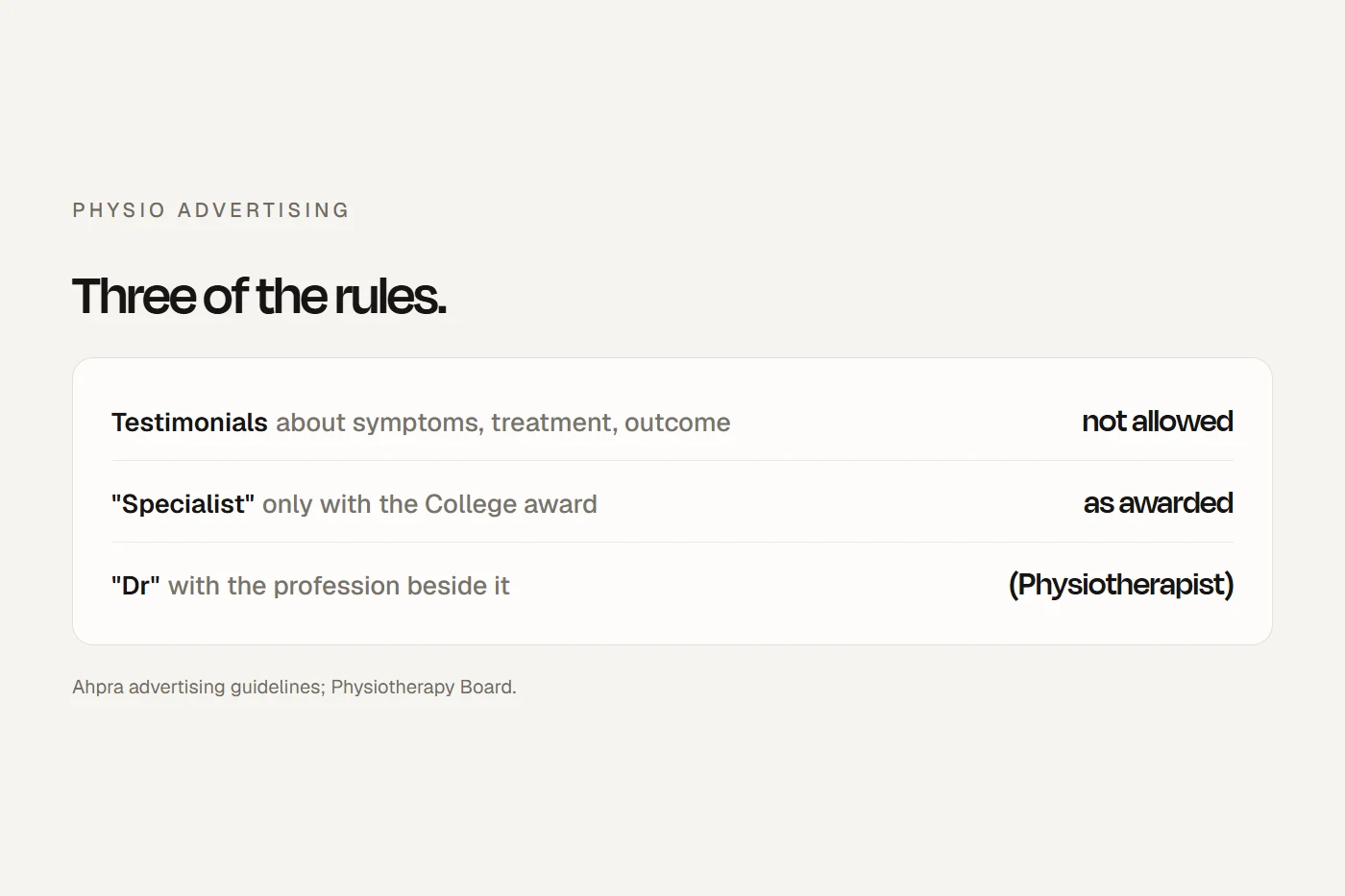
The short version of the rules: no testimonials, no "specialist" unless you hold the College's award and say so in the right format, "Dr" only with "Physiotherapist" next to it, terms on every offer, and no claims you can't back with proper evidence. Inside those lines there's plenty of room to market well. This is general information, not legal advice; Ahpra won't pre-check an ad, but the APA, your insurer or a lawyer can.
- Be close, easy to book and easy to recommendPeople choose health providers mostly on convenience and a friend's recommendation. Your Google profile, booking link and website carry most of that.
- Build the referral channelsGPs, health fund networks, WorkCover and CTP registration, and local clubs, each within the rules.
- Check every wordRun your ads, Google description and website through the wording checker below.
How patients choose a physio
Patients don't need a GP referral to see a physio. When they do come through a GP, under Medicare's chronic condition pathway, the referral letter can now just say "physiotherapist", so the patient or GP still picks the clinic. Either way, the choice is often made on Google.
There's little physio-specific research on how that choice is made. The closest is a 2024 NAB survey of about 1,000 Australians about health professionals in general: six in ten put convenience first, one in four said a recommendation from family or friends topped their list, and only one in ten said reviews influenced them. Being nearby, easy to book and easy to recommend matters more than anything clever.
The rules, applied to physio marketing
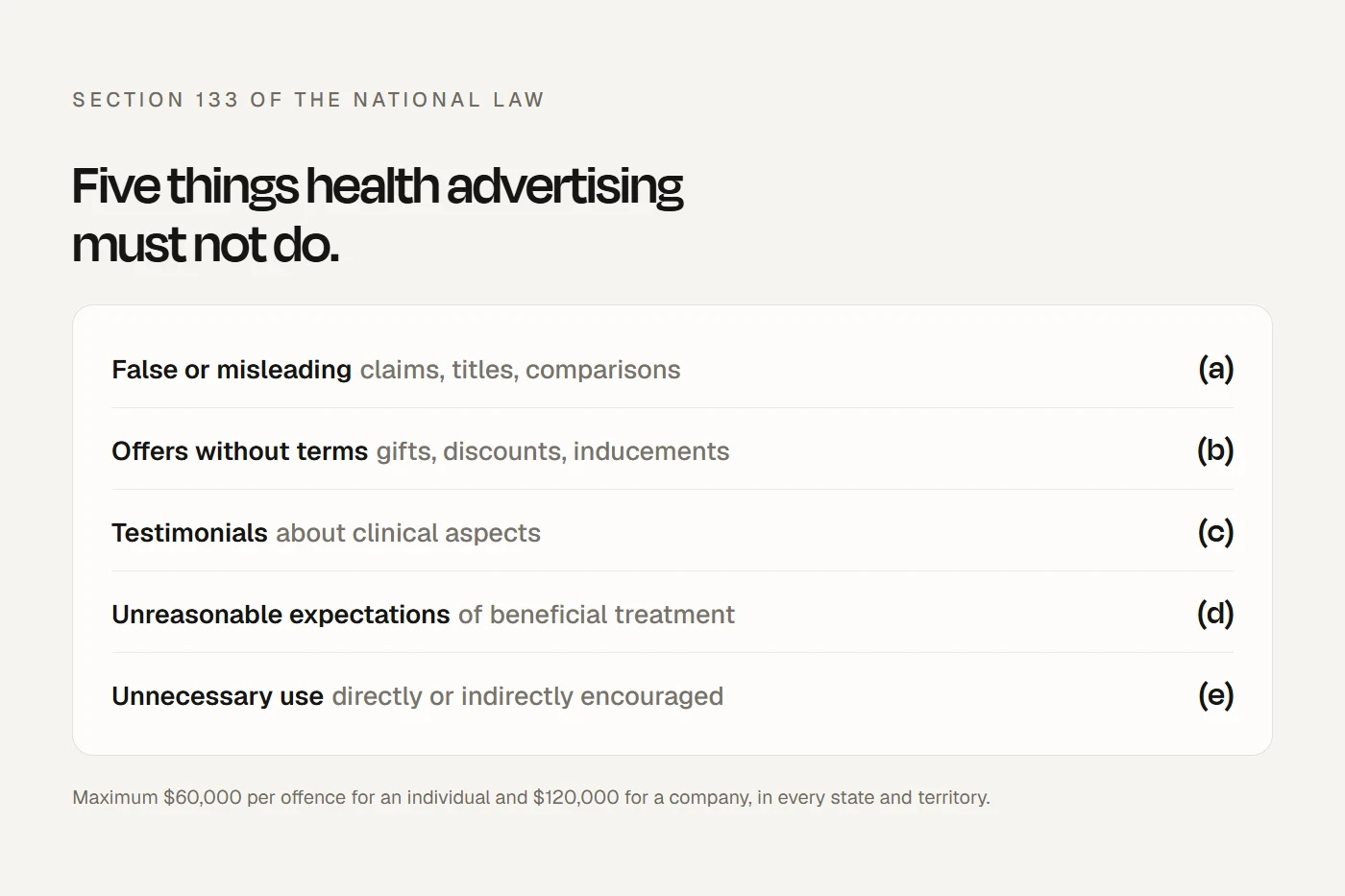
Section 133 of the National Law says you must not advertise in a way that is false or misleading, offers a gift or discount without stating the terms, uses testimonials, creates an unreasonable expectation of beneficial treatment, or encourages unnecessary use of health services. Ahpra's advertising guidelines explain each. Advertising includes your website, social media, Google profile, directory listings, signs and even patient recall notices. And the clinic owner is responsible for ads written by an agency or staff: "Advertisers are responsible for their advertising, so they need to check any content produced by others on their behalf."
Testimonials, including Google reviews
Testimonials are positive statements about the clinical side of your service: the symptom, the treatment, or the outcome. Ahpra's own example of a banned one is a patient saying their back pain disappeared after three sessions. Comments about parking, the waiting room or friendly staff aren't testimonials.
- You're not responsible for reviews on platforms you don't control, like Google. "The Boards do not expect you to monitor the internet".
- You can't copy clinical reviews onto your website, ads or social posts, embed a feed of them, or reshare a patient's post about their recovery.
- If your Facebook page has reviews switched on, you're responsible for them. Switch them off or moderate them.
- Ahpra's FAQ says showing a rating or award symbol "is not likely to breach" the ban, as long as you don't republish the reviews behind it. On the health sites I build, I leave review feeds off altogether.
Asking patients for reviews isn't covered by Ahpra's guidance at all. Google allows it, as long as you ask everyone the same way and offer nothing. Don't suggest what to write: "mention how your knee is going" is both against Google's rules and a nudge toward a clinical testimonial. When you reply, don't confirm the person was a patient or mention their care.
"Specialist"
Physiotherapy has no specialist registration, so "specialist", "specialises in" and "specialised" are likely to mislead. The Board suggests wording like "substantial experience in" or "working primarily in". The exception is the Australian College of Physiotherapists' awards, which must be stated in the Board's format:
| Format | The Board's example |
|---|---|
| Titled (Milestone 3) | J Brown MACP, APA Titled Sports and Exercise Physiotherapist |
| Specialist (Milestone 4) | Dr P Smith FACP, Specialist Musculoskeletal Physiotherapist, (as awarded by the Australian College of Physiotherapists in 2023) |
| Not acceptable | Mr R Jones, specialist sports physiotherapist |
Scroll the table sideways to see every column.
"Specialist" also can't go in your business name unless you hold the award. "Sports physiotherapist" as a plain description is different from "specialist sports physio"; it's the word "specialist" that causes the trouble.
"Dr"
A physio with a PhD or a Doctor of Physiotherapy, or a College Fellow, can use "Dr" in advertising, but the profession must be clear: "Dr Lee (Physiotherapist)", not "Dr Lee". That goes for your website header, Google profile and ads.
Treatment claims
Claims about how well a treatment works need "acceptable evidence", which mostly means peer-reviewed research, not anecdotes or your own outcome audits. Ahpra warns against long lists of conditions you "help with", comparisons with other treatments, and words that play down risk, like "safe", "pain-free" or "risk-free", without acknowledging possible side effects. Its own corrected example is a manual therapy page that lists back pain and neck pain, and "managing symptoms such as muscular tension often associated with asthma" rather than asthma itself.
Nothing in Ahpra's guidance names dry needling, shockwave or clinical Pilates, so the general rules apply. Two specifics:
- "Acupuncturist" is a protected title, and the Physiotherapy Board has no pathway to the acupuncture endorsement. "Dry needling" as a service description is fine; "acupuncturist" as your title usually isn't.
- Shockwave, laser and other devices: the TGA says an ad for a health service that also promotes a therapeutic good is regulated by the TGA too. Promote the consultation and the condition, and keep device claims modest.
Offers
Any gift, discount or offer must state its terms in plain language, or link to them. "The public generally consider the word 'free' to mean 'absolutely' free", so a free first consult can't be paid for by a higher price elsewhere. Ahpra's own example shows a refer-a-friend discount is fine once it says who it's for. Discounts for pensioners or concession card holders are allowed, with terms.
What crosses the line: urgency like "don't miss out" or "limited time only" tied to health, packs of more sessions than a patient needs, prizes for attendance, and recall messages that push regular check-ups without a clinical reason. Ahpra's examples include "we recommend that you come in for regular check-ups, ideally every month" as non-compliant.
Before-and-after images
Allowed with care: the images must be as similar as possible in angle, lighting and clothing, with the treatment the only change, and unedited. Posture photos and recovery videos also need the patient's written consent. On the sites I build, I leave them out.
Check your wording
Paste an ad, your Google profile description, a web page or an Instagram caption, and I'll flag phrases that cross Ahpra's lines.
It catches common phrasing, not every way of saying something. "Built with Ahpra's advertising guidelines in mind" means you still read every line yourself.
The channels
Google and online booking
Your Google Business Profile is the first thing most new patients see. Use your name as it appears on your sign and the "Physiotherapist" category. Then add your own online booking page, from Cliniko, Nookal or whatever you use, as the booking link and mark it "Business preferred", so it sits above any third-party link.
One thing worth knowing: Google's in-search "Book" button only works with Google's Reserve with Google partners, and when I checked the partner list, none of the main Australian physio booking systems was on it. Your booking link is the way in. And Google's own "Calls" figure counts taps on the call button, not calls answered, so your practice software, and counted calls on your website, give you the real number of new patients by channel. My guide to local SEO covers the profile in detail.
Health fund networks
Each of the big funds runs a network of physios who agree to a maximum fee for its members in return for being listed in the fund's provider search and app. The trade is fee control for visibility to that fund's members.
| Network | What you agree to | What you get |
|---|---|---|
| Bupa Members First | Charge members at or below Bupa's agreed fees; all physios in the clinic join; apply per location | A listing in Bupa's Find a provider tool and the myBupa app |
| Medibank Members' Choice | A maximum agreed price for eligible members | A listing in Medibank's Find a Provider tool, and you can promote yourself as a Members' Choice practice |
| HCF More for Muscles | Provide eligible members a fully covered initial consultation each year, for a new episode of care | Inclusion in HCF's More for you programs |
Scroll the table sideways to see every column.
If you advertise a fund offer, like a covered first visit for eligible members, it's an offer under Ahpra's rules: say eligible cover and limits apply, or link to the terms. Don't call it free without that context.
GPs
Among patients whose care is coordinated, most say a GP does it, and GP referral letters can now name the profession rather than a clinic. So the GPs near you are worth knowing. Send a one-page introduction: who you see, your hours, how quickly you can see someone and how you report back. Keep it to information. The Code of conduct says "do not offer inducements to colleagues", so no gifts or payments for referrals.
WorkCover and CTP
Work injury and car accident patients come through state schemes, and you need to be registered or approved with each before you can say you take those claims. WorkSafe Victoria has a registration form for physios; in NSW, physios need SIRA approval for workers compensation; in Queensland, you register with WorkCover. Once you are, a page for each scheme you're registered with answers a common local search. Say "registered" or "approved" only if you are.
Clubs and the community
"Official physio of [club]" is a fact and fine if it's true. A player or club post saying you "fixed my hamstring" is a testimonial if you share it or use it in sponsorship material. A free injury screening day is a "free" offer: it has to be genuinely free, with terms, and not a funnel into treatment people don't need.
The APA's Find a Physio
The APA's public directory, choose.physio, lets people search by location and by Titled or Specialist area of practice, and healthdirect sends the public there. I couldn't find how a clinic gets listed or what it costs; if you're an APA member, check your entry and that any College credentials show in the Board's format.
Facebook and Instagram ads
Meta's rules bar ads that assert or imply a personal health condition, so "Got back pain?" is out; "Physio for back pain in [suburb]" is fine. A lead form can't ask about someone's injury. My guide to Facebook and Instagram ads explains the rest.
Can I do this?
Tap a tactic to see the answer and the rule behind it.
What a new patient costs you, by channel
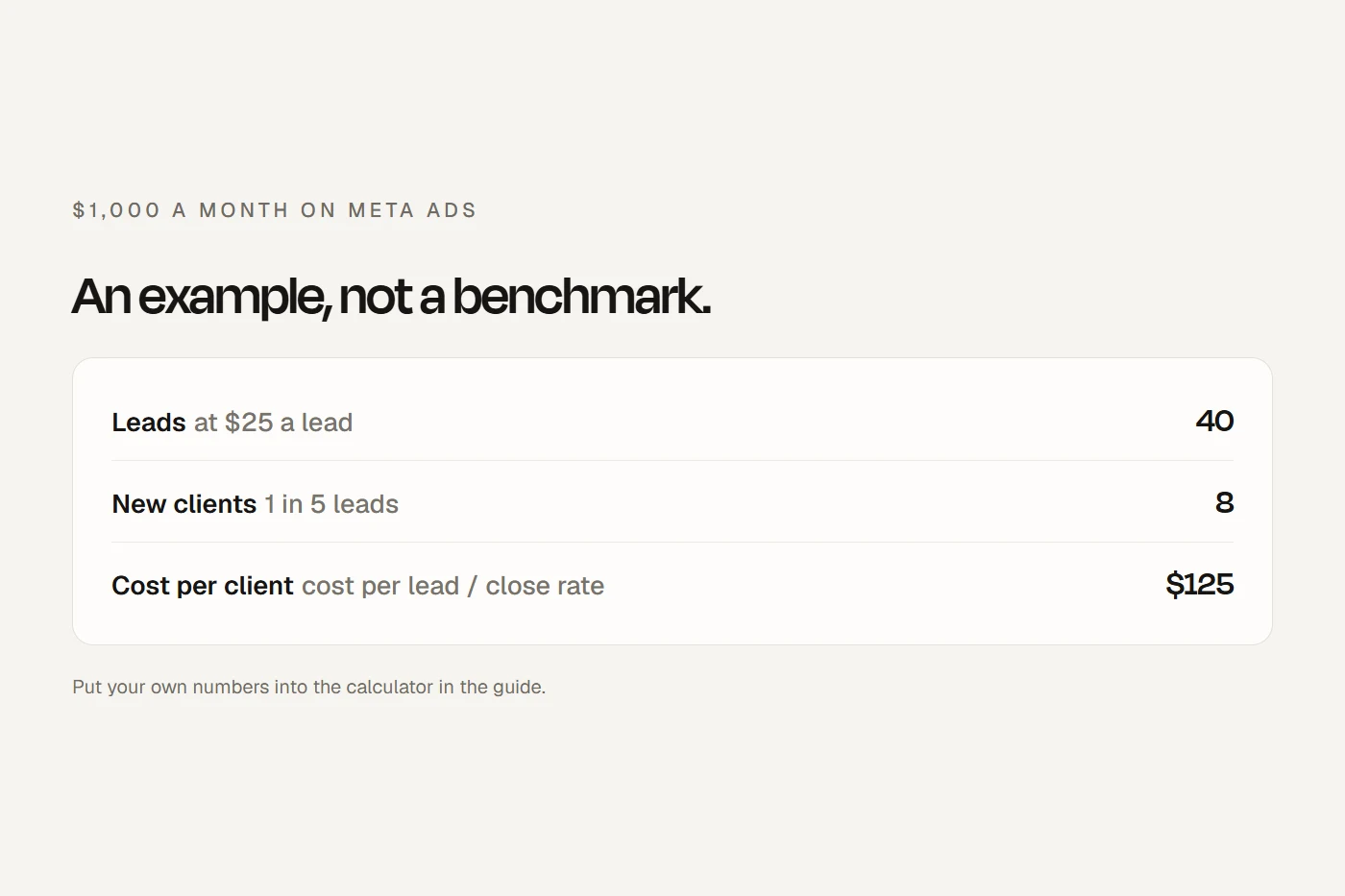
Put in one channel's numbers for a month, then the next. You'll need enquiries counted by channel: calls, forms and online bookings. Use your own fees; the starting numbers are an example, not a benchmark.
A 90-day plan
Your ticks save in this browser.
- Google Business Profile: your real name, the "Physiotherapist" category, profiles only for public-facing physios.
- Your own booking link on Google, marked "Business preferred".
- A wording sweep with the checker above: website, Google description, Instagram bio, ads.
- Remove testimonials, review feeds and patient stories from your site, and switch off or moderate Facebook reviews.
- Count calls and bookings by channel.
- A standard review request to every patient after the visit, and a reply that never confirms anyone is a patient.
- Decide on fund networks: Bupa, Medibank, HCF. Weigh the fee cap against the listing.
- Register with WorkCover and CTP schemes if you want those patients, then add a page for each.
- Introduce yourself to the nearest GPs with a one-page sheet. No gifts.
- Check your Find a Physio entry and credentials, if you're an APA member.
- A small Google Ads test on "physio [suburb]" searches, with ad text through the checker and offer terms one click away.
- One condition page a fortnight, like "Physio for knee pain in [suburb]", with symptom-management wording and claims you can back.
- A club or community tie-in with factual signage and no athlete testimonials.
- Compare cost per new patient by channel and drop the worst.
My view
A physio clinic's best marketing is a good Google profile, a booking link that works, a website that explains what you treat in plain words, and relationships with the GPs, funds and schemes that send patients your way. The rules rule out the tactics that look good in an agency's case study, testimonials and miracle claims, and that's no bad thing: the clinics that do well are the ones patients recommend.
Questions I get asked
How do I market a physiotherapy clinic?
Start with your Google profile and booking link, a clear website, reviews asked for the right way, and relationships with GPs, health funds and WorkCover and CTP schemes. Check all advertising against Ahpra's guidelines.
Can physios use testimonials?
Not in advertising, if they're about the clinical side: symptoms, treatment or outcomes. Comments about service, like friendly staff or easy parking, aren't testimonials.
Can a physio call themselves a specialist?
Only a Fellow of the Australian College of Physiotherapists, and only with "(as awarded by the Australian College of Physiotherapists in [year])". Physiotherapy has no specialist registration.
Can a physio use the title "Dr"?
Yes, with a doctorate or as a College Fellow, but the profession must be clear, for example "Dr Lee (Physiotherapist)".
Can I offer a free first physio consult?
Yes, if it's genuinely free, not recovered through higher prices elsewhere, and the terms are stated or linked.
Do patients need a referral to see a physio?
No. Patients can book directly. A GP referral is only needed for some funded pathways, such as Medicare's chronic condition plans and some workers compensation schemes.
About this guide
Written by Joseph Alzein, founder of bdog. bdog builds websites for Australian clinics, including physios, built with Ahpra's advertising guidelines in mind. I'm not a lawyer, and this is general information, not legal advice. The rules were read from Sydney on 11 October 2026 on Ahpra, Physiotherapy Board, TGA and health fund pages.
Main sources:
- Ahpra: Guidelines for advertising a regulated health service
- Physiotherapy Board: statement on the use of titles
- Ahpra: testimonial tool
- Ahpra: all professions examples
- Ahpra: advertising FAQ
- Ahpra: shared Code of conduct
- TGA: advertising health services that involve therapeutic goods
- Bupa: Members First for providers
- Medibank: Members' Choice
- HCF: More for you programs
- WorkSafe Victoria: register as a physiotherapy provider
- healthdirect: physiotherapy