Marketing a podiatry clinic: titles, claims and what works
How patients find a podiatrist, specialist and surgical podiatrist titles and Dr, treatment and laser claims, testimonials and offers, orthotics and shoes under the TGA and the Code, Medicare, DVA and funds, and diabetes, aged care and sport referrals. With a patient value calculator, a wording sorter and a 90-day checklist.
On This Page
- How patients find a podiatrist
- Titles: specialist, surgical podiatrist and Dr
- Treatment claims
- Testimonials, before-and-after photos and offers
- Orthotics, insoles and shoes
- Medicare, DVA and health funds
- Diabetes, aged care and sport referrals
- What is a new patient worth?
- Your website, Google profile and ads
- Can I say this?
- Your first 90 days
- Questions I get asked
When the Podiatry Board audited podiatrists' advertising, the most common problem it found was one word: specialist. Podiatry marketing has its own traps. The specialist title has changed, "Dr" needs the profession beside it, orthotics count as medical devices, and the evidence for laser nail treatment is thin. This guide covers the titles and claims you can use, how the TGA treats orthotics and insoles, selling shoes and products, Medicare, DVA and health funds, the diabetes and aged care referral pathways, and what to put on your website and Google profile. It draws on the Podiatry Board and Ahpra, the National Law, the TGA, the MBS, DVA, the health funds' provider pages and Australia's diabetes foot guidelines. It's general information, not legal advice.
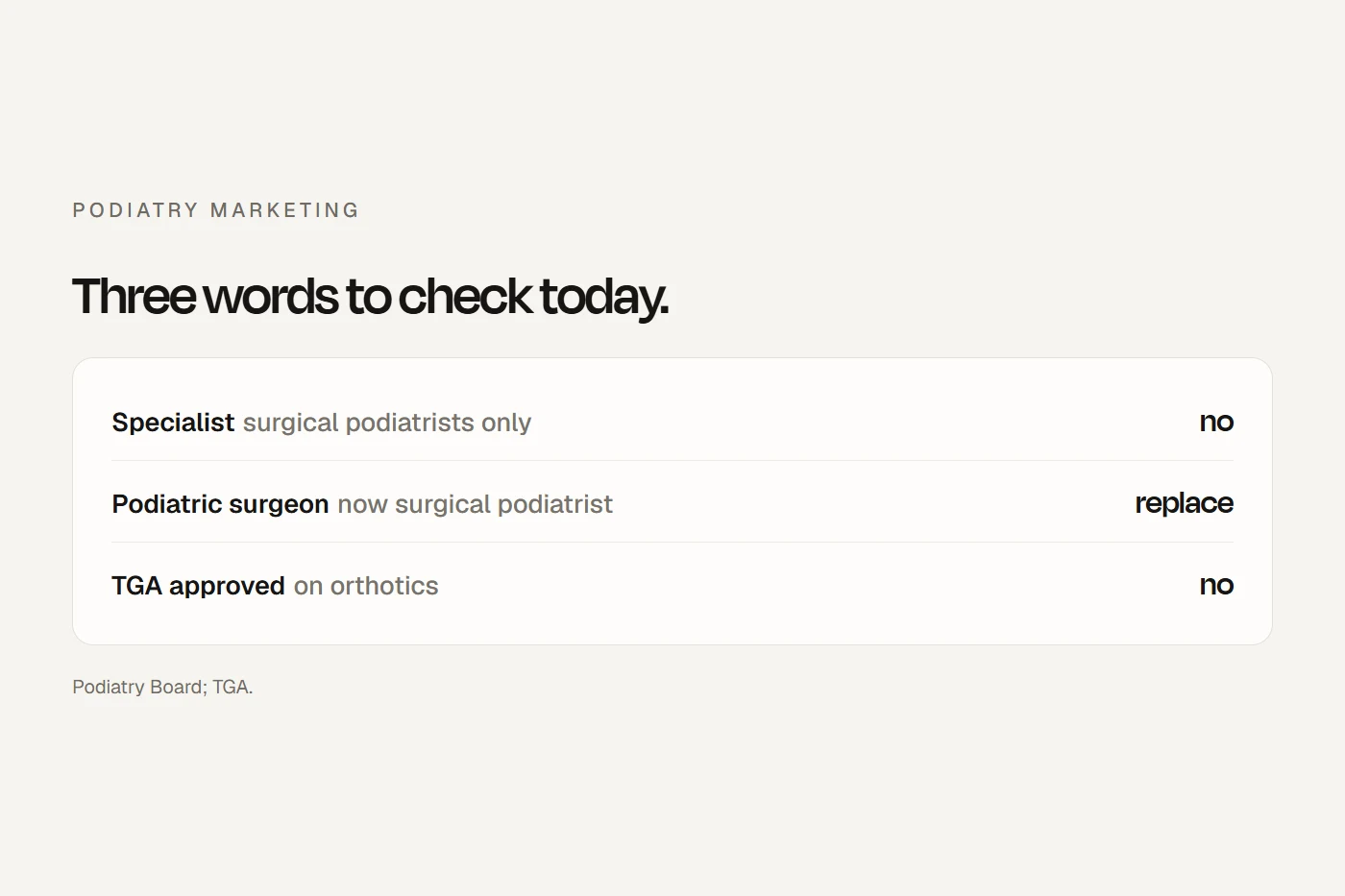
- Never "specialist" unless you're a surgical podiatristSay "special interest in heel pain". The protected title "podiatric surgeon" has been replaced by "surgical podiatrist".
- Orthotics are medical devices"Custom-made" is fine. "TGA approved", "designed by podiatrists" and "guaranteed pain relief" are not.
- Most patients refer themselvesSo search, Maps and word of mouth decide most first visits. GPs matter for chronic conditions, diabetes and aged care.
How patients find a podiatrist
There's no Australian survey of how people choose a podiatrist. Government health sites tell people "You don't need a referral from a doctor to see a podiatrist", and send them to the Australian Podiatry Association's Find a Podiatrist directory, which can be filtered by "special interest". So most first visits are decided by search, Google Maps and word of mouth. The GP route matters for patients with a chronic condition, diabetes or in aged care, and for DVA patients.
When the Board reviewed the surgical title, consumers "did not understand the term 'podiatric'" and thought "surgeon" meant a medical practitioner. People don't know podiatry titles, so plain words win: "a podiatrist who performs foot surgery" says more than a title.
Titles: specialist, surgical podiatrist and Dr
The title change. The Board announced that from 5 October 2026, "podiatrists who perform surgical procedures will be known as 'surgical podiatrists'", and "Practitioners will be unable to use the title 'podiatric surgeon'" after that date. Any website, Google profile, bio, letterhead or ad still saying "podiatric surgeon" needs changing now.
"Specialist" and "specialises in". The Board's audit said podiatrists "can advertise a 'special interest in' or 'substantial experience in' an area", but not that they "specialise in a specific area of practice unless you hold specialist registration in that specialty. The only specialty for podiatry is podiatric surgery." Its examples of false and misleading claims were "podiatrist specialising in pain", "specialising in foot care/foot health", "specialising in nail surgery" and "specialising in dry needling". "Foot specialist" isn't named by the Board, but the National Law bans any word that "could be reasonably understood to indicate" specialist registration, and that's what it does. The same goes for a business name like "The Foot Specialists". "Sports podiatrist" as a description is fine; "specialist sports podiatrist" isn't.
Other titles. "Podiatrist" and "chiropodist" are protected titles. Podiatrists can do dry needling, but "acupuncturist" needs registration with the Chinese Medicine Board.
"Dr". If you use "Dr", the profession must be clear every time: "Dr John Citizen (Podiatrist)", or the Board's own example, "Dr Ali (surgical podiatrist)". A bare "Dr Lee" in a header, Google profile name or ad is the breach pattern. List qualifications accurately, such as "Doctor of Podiatric Medicine", and memberships too, as long as the letters don't imply more qualifications than you hold.
Treatment claims
The one podiatry case on Ahpra's list of court cases was a clinic offering a "permanent long term cure" for plantar fasciitis, heel spurs and Achilles tendonitis. Ahpra had raised it years earlier and the clinic didn't fix it. So write condition pages as assessment and options: "Heel pain: we assess the cause and talk you through options such as footwear advice, load management, taping and orthoses", not "We fix plantar fasciitis". The Board's audit also flagged comparisons with other clinics' fees or outcomes.
Laser for fungal nails. A Cochrane review of the laser trials found there "may be little or no difference in mycological cure", and complete cure wasn't measured. DVA needs prior approval for "laser therapy for fungal nails". So no "laser cures nail fungus", "clears your nails" or "painless". Describe it as one option, say results vary and nails take months to grow out, mention other options, and promote the consultation. A page that promotes the laser machine itself is a device ad too.
Medicines. Prescription medicines can't be advertised to the public, so don't name a prescription antifungal. Say "Our podiatrist can prescribe" only for a named podiatrist whose register entry shows the endorsement for scheduled medicines, and state law authorises prescribing too.
Fear. "Diabetes can cost you your foot. Book now." breaks Ahpra's rule against making people believe their health may suffer, and the TGA's ban on causing "undue alarm, fear or distress". No amputation statistics or wound photos in ads.
Testimonials, before-and-after photos and offers
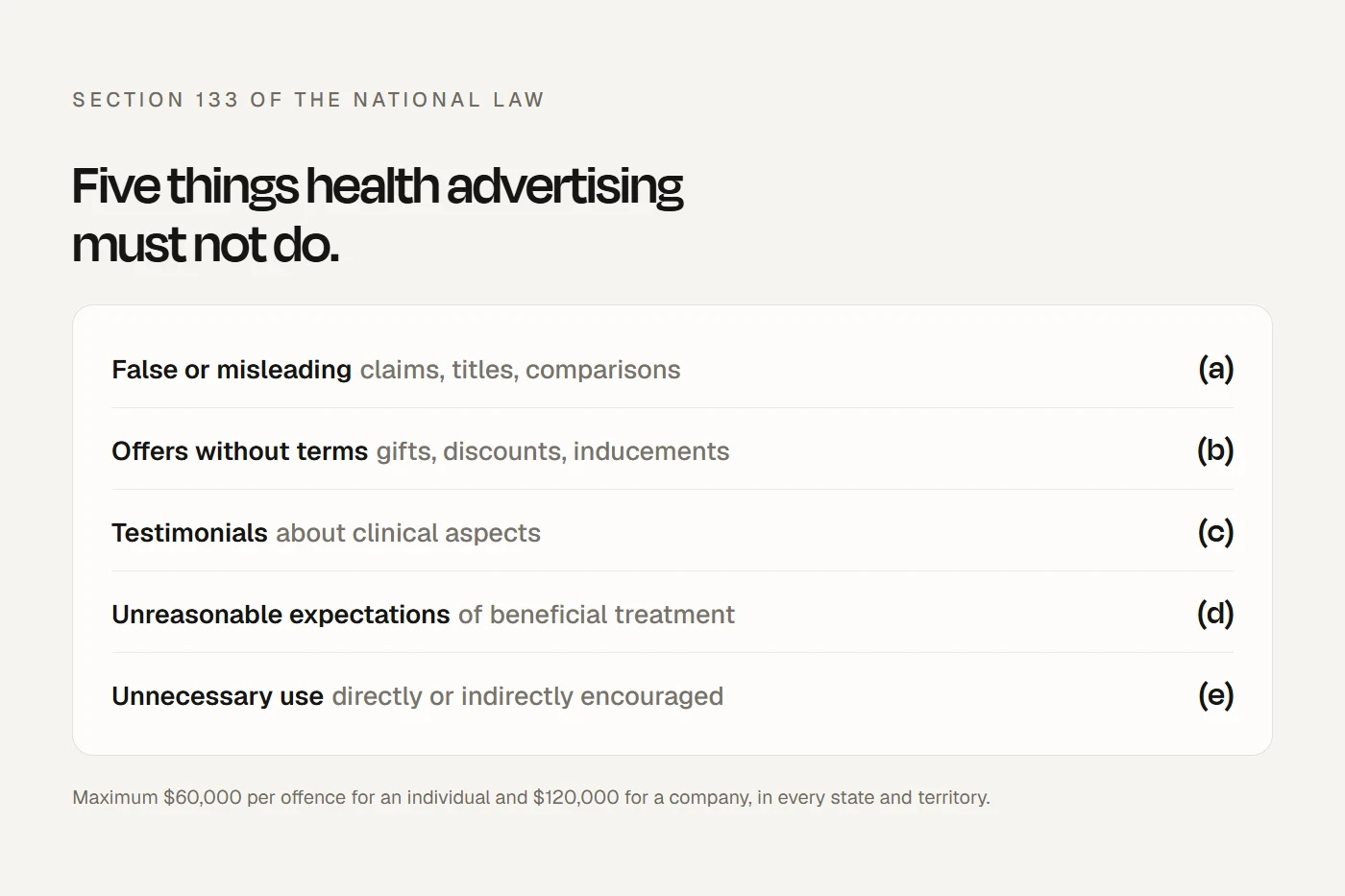
Testimonials. A patient quote like "my heel pain is gone" on your site is a clinical testimonial, which the National Law bans. Google reviews on your profile aren't your responsibility, but don't copy, embed or share them. I leave review widgets off health websites.
Before-and-after photos. Ahpra allows them only under strict conditions: the same angle, lighting and background, the treatment the only visible change, and written consent. For nails and warts, causation is hard to show, because months of regrowth, the patient's own topical treatment and clipping all change the picture. I'd use a plain "what to expect" timeline instead.
Offers. A "free foot check" must be absolutely free, with terms stated or one click away, and mustn't push people into treatment they don't need. A "free assessment" that ends in an orthotics sale is exactly the pattern Ahpra targets. A health fund offer like HCF's More for Feet program, which "fully covers a comprehensive service for a new episode of care" for eligible members at participating podiatrists, is fine to mention with its eligibility: "eligible extras cover, limits and waiting periods apply".
Recalls. Ahpra's non-compliant examples include "come in for regular check-ups, ideally every month". Podiatry has a clear contrast: Australia's diabetes foot guideline sets screening intervals by the patient's risk level, from annual for the lowest risk to every one to three months for the highest. A recall tied to a patient's documented risk is clinically indicated. A blanket "come every six weeks" text to every patient isn't.
Orthotics, insoles and shoes
Orthoses you make in the clinic from ARTG-listed materials don't need their own ARTG listing, but the TGA is clear: "They are not exempt from regulation." That includes the advertising rules. The TGA's own example of a non-compliant ad is an insole ad: "Optimal arch support guaranteed to reduce pain for life", "Relief from pain associated with arthritis", "Effective pain relief, unlike other devices that may cause harm", "Designed by podiatrists" and "TGA approved". Every one of those fails. What you can say:
- "Custom-made": the TGA says it "has a recognised meaning in everyday language".
- A balanced, factual description, with "Always follow the directions for use" where a device is promoted.
- No claims to prevent or treat serious conditions without TGA approval, so not "our insoles prevent diabetic foot ulcers".
- No "podiatrist recommended" on a product ad: health professionals can't endorse devices in advertising. Describing what happens in the consultation is fine.
Selling shoes and products. The shared Code of Conduct says to "declare to patients any professional and financial interest in any product or service you might endorse or sell from your practice, and do not make an unjustifiable profit". It also warns against accepting inducements from product companies, and against staff sales targets. A line at the counter and on your site saying you sell footwear and patients are free to buy elsewhere meets the intent. "No refunds" signs can't remove consumer guarantee rights, though "no refunds for change of mind" is allowed. Gift vouchers must last at least three years unless sold at a genuine discount. If you sell orthotics in a resident's aged care room after approaching them, that can be an unsolicited consumer agreement with a cooling-off period.
Medicare, DVA and health funds
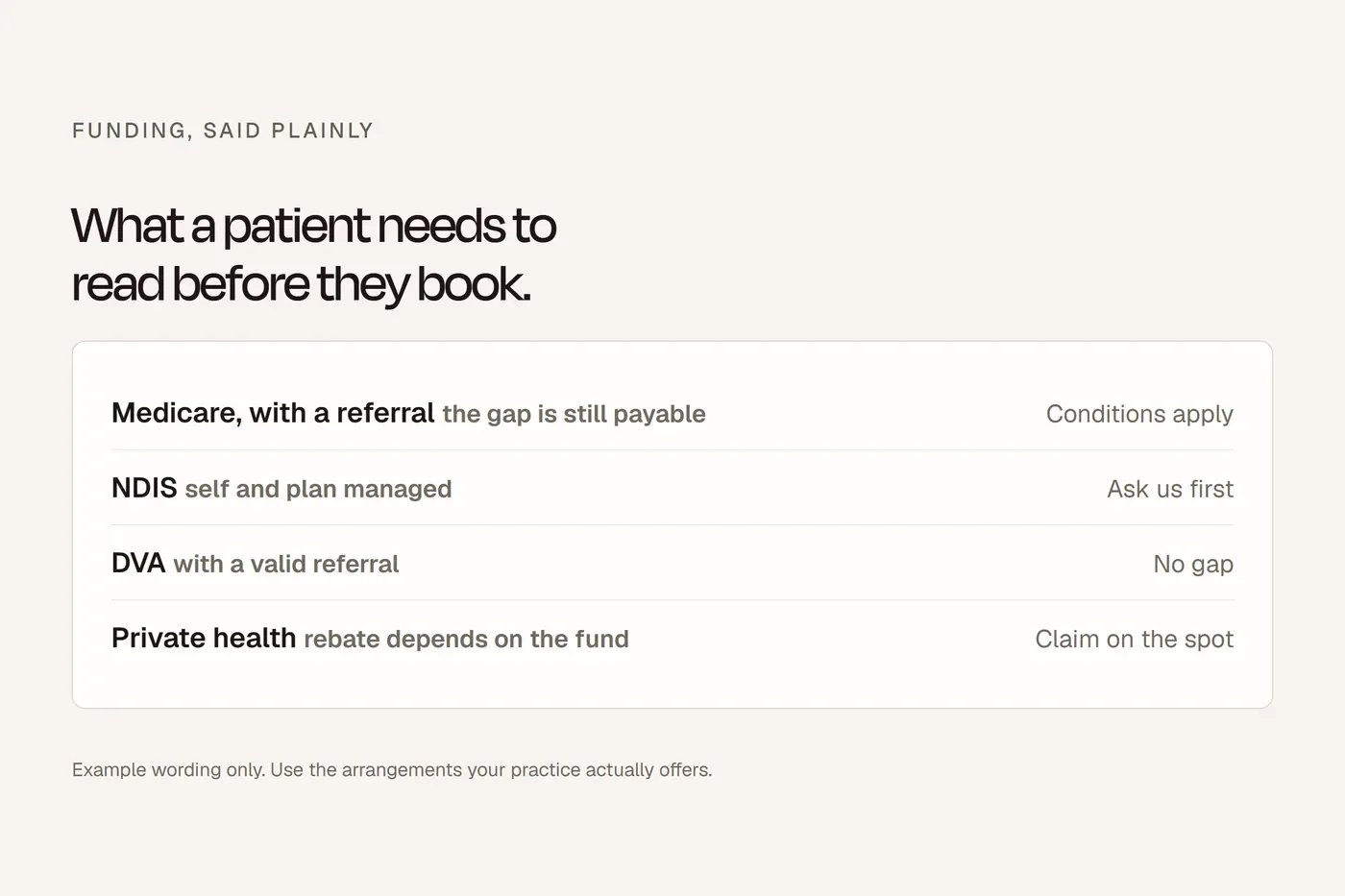
Medicare. Podiatry is billed under the chronic condition item for patients on a GP chronic condition management plan, plus the Aboriginal and Torres Strait Islander item and telehealth items. There's no type 2 diabetes group item for podiatry; diabetes patients reach you through the chronic condition item. The GP's referral doesn't need to name you: "The patient can take the referral to any eligible health professional of the same profession/type". After the first and last service, you must send the GP a written report covering assessments, treatment and future management. That report is your best GP marketing. On your site: "Medicare rebates may apply with a GP referral under a chronic condition management plan". Never "free with Medicare".
DVA. Veterans need a GP referral, or for a first cycle a specialist, hospital doctor or discharge planner. By accepting a Veteran Card "you agree to accept the DVA fee as full payment. You cannot charge the Veteran Card holder any 'gap' fee". So "We see DVA patients, no gap with a valid referral" is accurate if you accept the cards. Podiatrists "can prescribe (but not supply)" medical grade footwear for DVA clients, so never "DVA footwear supplied here".
Health funds. HCF's More for Feet, Bupa Members First and Medibank Members' Choice all take podiatrists. You get listed in the fund's search and can promote yourself as a network practice, in exchange for agreed fees. Bupa's network benefit excludes orthotics. "Health fund rebates depend on your extras cover" is accurate; "orthotics fully covered by your fund" generally isn't. Never print rebate amounts.
NDIS. If you're unregistered, you can see self-managed and plan-managed participants only; don't say "NDIS registered" or use NDIS logos.
My guide to showing Medicare, NDIS and DVA on a clinic website has more on the wording.
Diabetes, aged care and sport referrals
Diabetes. High-risk foot services in public hospitals treat active ulcers, Charcot foot and infections. Private podiatrists do the screening and routine care before and after. That gives you a two-way pathway. Make a one-pager for GPs and endocrinologists covering how to refer, how quickly you see a new ulcer, and your report letter. Build a relationship with the local high-risk foot service for step-down patients. And publish a plain "Diabetes foot checks" page with recall intervals set by risk and no fear lines.
Aged care. Medicare podiatry in aged care homes runs on GP referral letters, and DVA covers allied health for eligible veterans in residential care. Under Support at Home, podiatry is a clinical support, and you usually work as a subcontractor to the participant's registered provider. Market to their care managers as well as families.
Sport and schools. "Official podiatrist of [club]" is factual and fine. Player quotes about getting back on the field are testimonials. A "free kids' foot screen" at a school or club needs terms and mustn't push treatment.
What is a new patient worth?
Put in your own fees and patterns. Fees start at zero, so the calculator never suggests a price.
Once your fees are in, the biggest lever is usually routine visits over the years a patient stays, which is why recalls set by clinical need, and good care, matter more than any single ad. Count only visits you'd book for a clinical reason, and orthotics only where they're clinically indicated.
Your website, Google profile and ads
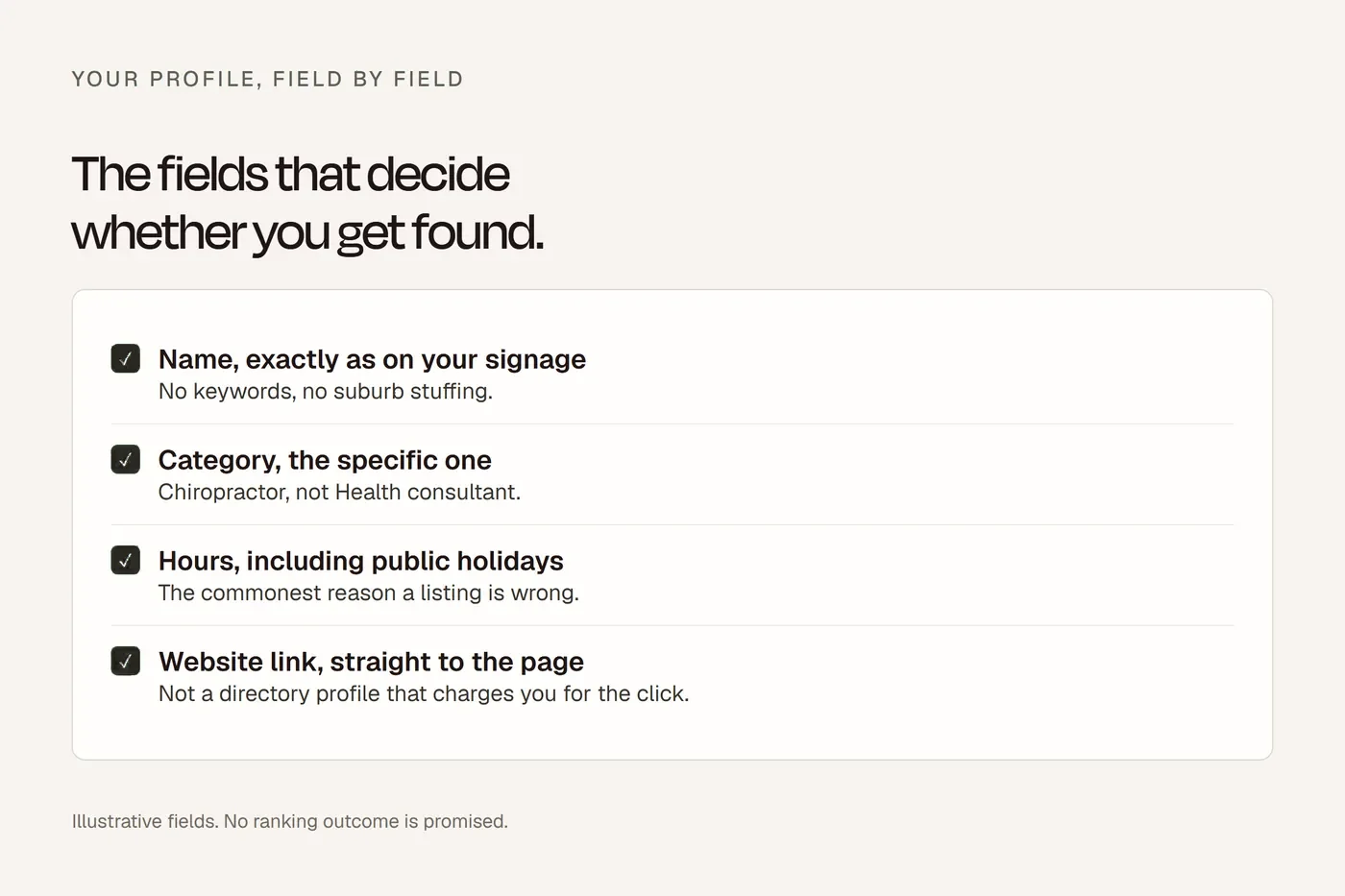
Your Google profile name, description and posts are advertising, so the same rules apply: no "specialist", no bare "Dr", no "podiatric surgeon". "Podiatrist" is the expected primary category. Name practitioner profiles "Dr Sam Lee (Podiatrist)" if you use "Dr". None of the main Australian practice booking systems is a Reserve with Google partner, so add your own booking page as the booking link. My Google Business Profile checklist for clinics covers the setup.
Pages the rules point to: fees and health funds with no rebate figures, GP referrals, diabetes foot care, orthotics (custom-made, no endorsement lines), your team with "special interest" wording, a surgical podiatrist page using the new title, and a footwear disclosure if you sell shoes. Link your booking system, and count calls and bookings by channel.
On Meta, "Struggling with heel pain?" asserts a personal attribute and gets rejected. "Heel pain assessment in [suburb]" doesn't. Meta also bans claims to cure diabetes.
Can I say this?
Tap a card to see the verdict.
Your first 90 days
Tick items off as you go; the list remembers your progress on this device.
- Month 1: "podiatric surgeon" replaced everywhere Site, Google profiles, bios, ads, letterhead, directories.
- Month 1: every "Dr" with the profession beside it
- Month 1: "specialist" wording replaced With "special interest in" or "substantial experience in".
- Month 1: cure, permanent, guaranteed, painless and "TGA approved" removed Condition pages rewritten as assessment and options.
- Month 1: testimonials, review feeds and before-and-after galleries down
- Month 1: orthotics page fixed "Custom-made", the mandatory statement, no endorsement lines.
- Month 1: counting calls and bookings by channel
- Month 2: fund networks decided HCF, Bupa and Medibank, noting Bupa excludes orthotics.
- Month 2: GP one-pager sent Who you see, how to refer, your report-back promise. No gifts.
- Month 2: endocrinologists and the high-risk foot service How you take step-down patients.
- Month 2: recalls set by risk Not a blanket interval.
- Month 2: neutral review requests To every patient, with a reply template that confirms nothing.
- Month 2: product disclosure At the counter and on the site, with no staff sales targets.
- Month 3: Google Business Profile Category, services, booking link, posts checked.
- Month 3: patient group pages Diabetes foot checks, DVA, aged care visits, kids' feet, sport.
- Month 3: the calculator run with your figures And cost per new patient compared with lifetime margin.
Questions I get asked
Can a podiatrist call themselves a foot specialist?
No, unless they hold specialist registration as a surgical podiatrist. The Board says podiatrists can advertise a "special interest in" or "substantial experience in" an area, but not that they specialise in it.
Is it still "podiatric surgeon"?
No. The protected title is now "surgical podiatrist", and the Board said "podiatric surgeon" can't be used after 5 October 2026. Update your website, Google profile and bios.
Can podiatrists use "Dr"?
Yes, if the profession is made clear every time, such as "Dr John Citizen (Podiatrist)" or "Dr Ali (surgical podiatrist)".
Do orthotics ads have to follow TGA rules?
Yes. Even custom orthoses made in the clinic aren't exempt from the TGA's advertising rules. "Custom-made" is fine; "TGA approved", "designed by podiatrists" and guaranteed pain relief are not.
Can I advertise laser treatment for fungal nails?
As one option, with balanced wording: results vary and nails take months to grow out. Don't claim it cures or clears fungal nails; the evidence is uncertain.
Do patients need a referral to see a podiatrist?
No. A GP referral under a chronic condition management plan is only needed to claim Medicare, and DVA patients need one too.
About this guide
Written by Joseph Alzein, founder of bdog. I build websites for podiatry clinics and allied health practices, with Ahpra's advertising guidelines in mind. Sources were checked on 12 October 2026. This is general information, not legal advice. I've left out Medicare, DVA, NDIS and fund amounts and penalties.
Main sources:
- Podiatry Board: advertising a regulated health service
- Podiatry Board: podiatry advertising examples
- Podiatry Board: newsletter on the advertising audit
- Podiatry Board: title change
- Podiatry Board: podiatrist and surgical podiatrist
- Ahpra: titles in health advertising
- Ahpra: advertising cases heard by courts and tribunals
- TGA: personalised medical devices
- TGA: advertising personalised medical devices
- MBS: item 10962
- DVA: podiatrists
- HCF: More for You programs
- Diabetes Feet Australia: guidelines
- Australian Podiatry Association: Find a Podiatrist