The Solicitors’ Conduct Rules: a plain-English map for law firm owners
Every part of the Australian Solicitors’ Conduct Rules in one line each, which version applies in each state, what the latest amendments to rules 8 and 13 changed, and the rules a small firm’s enquiry form, referral deals, case studies and social media run into. With a which-rule-applies sorter and a principal’s checklist.
On This Page
The Australian Solicitors' Conduct Rules are 43 rules most principals last read properly for their practice management course. This guide is a plain-English map of all of them, followed by the dozen rules that a small firm's website, enquiry form, referral deals and social media actually run into. It covers which version applies in your state, what the latest amendments to rules 8 and 13 changed, and where to ring when you're not sure. I build law firm websites, so I see these rules from the marketing and intake side. Everything here comes from the rules themselves and the Law Council's own commentary. If you're after the advertising rule specifically, my law firm website checklist covers rule 36 in detail.
- One national set, adopted state by stateThe Law Council wrote the rules; every state and territory runs a version. Tasmania numbers them differently.
- Six parts, 43 rulesFundamental duties, clients, advocacy, other people, practice management, plus a glossary. A breach can be unsatisfactory professional conduct or professional misconduct (rule 2.3).
- Your enquiry form is a conduct rules issueSomeone who tells you confidential details can become a "former client" you can't act against, even if you never took them on.
Which version applies where
The Law Council of Australia wrote the rules, and each jurisdiction adopts them under its own law. The text is close to identical everywhere, with a few local differences.
| Where | Instrument | Worth knowing |
|---|---|---|
| NSW, Victoria, WA | Legal Profession Uniform Law Australian Solicitors' Conduct Rules 2015 | The version most people quote, and the numbering this guide uses |
| Queensland | Australian Solicitors' Conduct Rules 2023 | Has its own rule 41: no mortgage financing as part of a law practice |
| South Australia | South Australian Legal Practitioners Conduct Rules, Part A | Says "legal practitioner", not "solicitor", and adds rule 16A |
| ACT | Legal Profession (Solicitors) Conduct Rules 2026 | A new instrument replaced the earlier ACT rules |
| Northern Territory | Australian Solicitors Conduct Rules (NT) | Adopted the latest amendments |
| Tasmania | Legal Profession (Solicitors' Conduct) Rules 2020 | Different numbering (advertising is rule 42). When I checked, rules 8 and 13 hadn't been updated |
Scroll the table sideways to see every column.
One trap: the Law Council's own compiled PDF numbers a few subrules differently from the NSW instrument. Its commentary uses the NSW numbers, so do the same when you look something up.
The whole map, in plain English
Pick a part. The headings are the rules' own; the one-line summaries are mine.
Nature and purpose, and fundamental duties (rules 1 to 6)
- 1 and 2
- Who the rules cover and what they're for. They sit on top of the common law, and a breach can be unsatisfactory professional conduct or professional misconduct
- 3
- Your duty to the court comes first and wins any clash
- 4
- Act in the client's best interests; be honest and courteous; be competent, diligent and prompt; keep your integrity and independence; follow the rules and the law
- 5
- No conduct, "in the course of legal practice or otherwise", showing you're not fit and proper or bringing the profession into disrepute
- 6
- Honour undertakings on time
Relations with clients (rules 7 to 16)
- 7
- Clear, timely advice so the client can make informed choices, including alternatives to a contested hearing
- 8
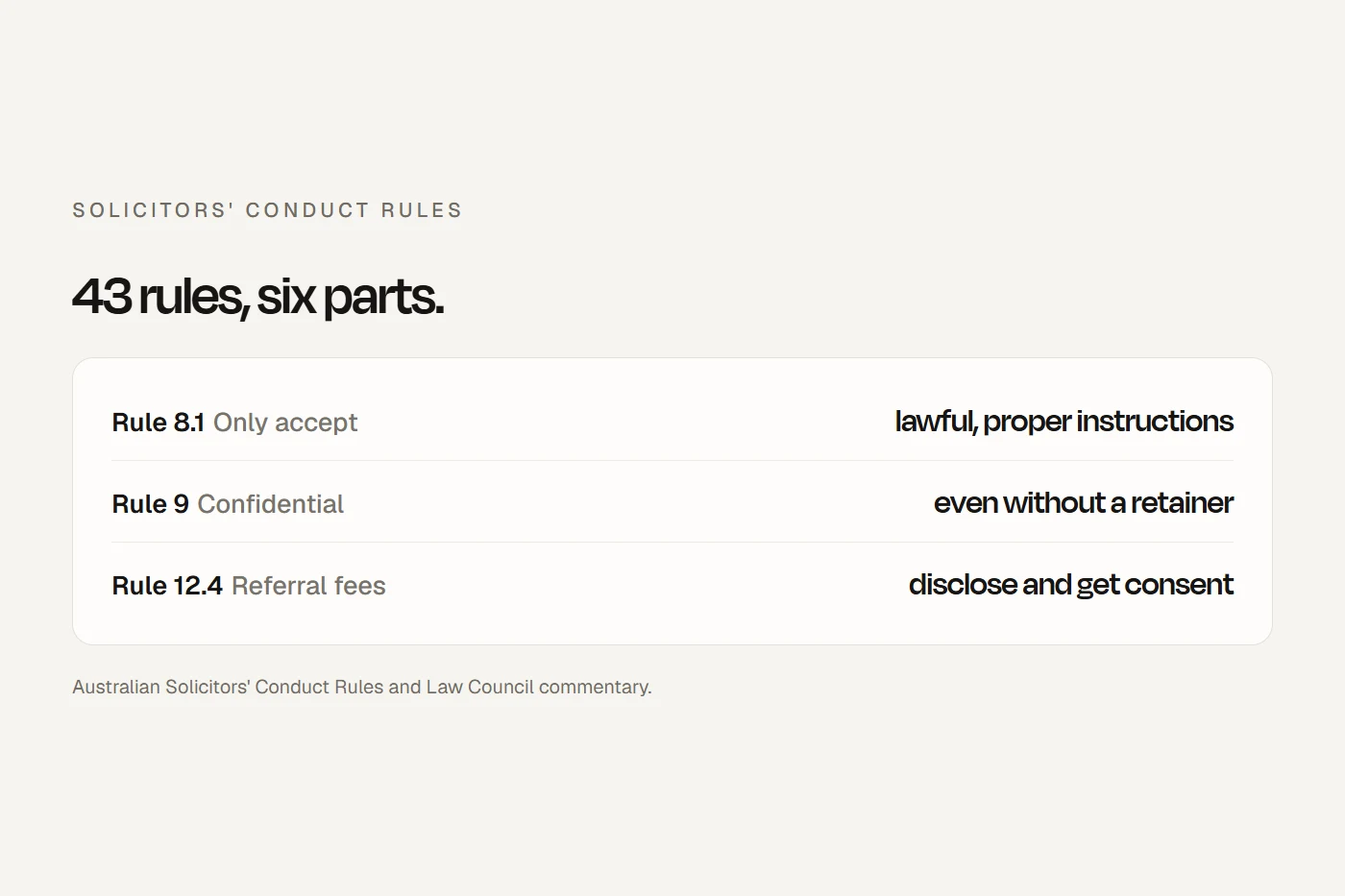
- Only accept and follow instructions that are lawful, proper and competent
- 9
- Keep client information confidential, with six listed exceptions
- 10
- Don't act against a former client whose confidential information you hold, unless they consent or there's an effective information barrier
- 11
- Acting for two clients whose interests conflict needs both to know and consent
- 11A
- Short-term legal assistance, such as one-off pro bono help, where a full conflict check isn't practical
- 12
- Your own interests: no benefits beyond fair fees, no borrowing from clients, and disclosure and consent for commissions and referral fees
- 13
- Finish the job unless the client agrees, discharges you, the law ends it, or you end it for just cause on reasonable notice
- 14 to 16
- Client documents: hand them over at the end, keep them seven years before destroying, liens, and no storage charges without consent
Advocacy and litigation (rules 17 to 29)
- 17 and 18
- Independent judgment, not the client's "mere mouthpiece"; no informal familiarity with the court
- 19 and 20
- Never mislead the court; what to do when a client lies or confesses
- 21 and 22
- Allegations need a proper basis; nothing misleading to an opponent
- 23 to 27
- Witnesses: access, coaching, conferring and being a witness yourself
- 28
- Don't publish anything about current proceedings that may prejudice a fair trial
- 29
- Prosecutors' duties
Relations with other persons (rules 30 to 35)
- 30 and 31
- No advantage from someone else's obvious error; return material sent to you by mistake
- 32
- No misconduct allegations against another lawyer without a proper basis
- 33
- Don't contact someone you know is represented, except in the listed cases
- 34
- No intimidating overstatement, no threats of criminal or disciplinary complaints to get a debt paid, and no touting people after trauma
- 35
- Tell third parties in advance if you're not personally liable for their fees
Law practice management (rules 36 to 43)
- 36
- Advertising that isn't false, misleading, offensive or unlawful; "accredited specialist" only if accredited
- 37
- The responsible solicitor supervises everyone working on the matter
- 38
- Returning judicial officers can't appear in their old court for a period without leave
- 39
- If you share an office or brand with a non-legal business, clients must know which services aren't legal services
- 40
- No sharing fees with disqualified people
- 41
- Repealed in the Uniform Law rules (Queensland has its own)
- 42
- No discrimination, harassment or bullying in connection with practice, including at work functions
- 43
- Be timely, open and frank with the regulator
What the latest amendments changed
The two changes came with the anti-money laundering rules that now cover many law practices. The Law Council says they don't create new ethical duties; they spell out what the rules already required.
- Rule 8.1 used to say a solicitor "must follow" lawful, proper and competent instructions. It now says "must only accept and follow" them. The Law Council's commentary says this applies before you accept instructions from a prospective client, not just once you're acting.
- Rule 13.4 now defines "just cause" for ending an engagement. It includes instructions that would make you breach your duties, any situation where you can no longer act in the client's best interests, and a client not providing information you need to meet your statutory obligations.
- Retainer agreements in NSW, Victoria and WA should now tell clients you have statutory obligations that can include reporting, that you may end the retainer if continuing would breach your duties, and that the law may stop you giving reasons. This is a new rule in the separate Legal Practice (Solicitors) Rules, not the conduct rules.
Rule 36 on advertising didn't change. The commentary's examples of what isn't just cause are worth knowing: "administrative convenience, loss of interest in the matter, or an offer for more remunerative work".
The rules your marketing and intake touch
Your enquiry form (rules 9 and 10)
The commentary says information from a prospective client "remains confidential" even if no retainer follows. The glossary's definition of "former client" includes someone who "has provided confidential information to a solicitor, notwithstanding that the solicitor was not formally retained". Under rule 10.2, that can stop you acting against them later. The usual way out is an information barrier, but the commentary says it's "likely to be only larger law practices" that can run one. For a small firm, the practical fix is collecting less. Ask for name, contact details, the other party's name for a conflict check and the type of matter, and ask people not to send the details yet.
Taking the client on (rules 8 and 13)
You can "only accept" lawful, proper and competent instructions. "Competent" includes the client's capacity: the commentary says you must not act if you're not reasonably satisfied they have it. If you're a reporting entity under the anti-money laundering rules and a client won't give you what your checks need, rule 13.4 now lists that as just cause to end the engagement on reasonable notice.
Advice and updates (rule 7)
Communication is one of the three most common kinds of complaint the NSW regulator receives about solicitors. Rule 7 asks for "clear and timely advice" so the client can make informed choices, and for telling them about alternatives to a fully contested hearing. Your website's "we'll fight it all the way" copy sits awkwardly next to that.
Referral partners (rule 12)
- Receiving a commission from a financial planner, real estate agent or anyone you refer clients to (rule 12.4.3): tell the client a commission or benefit may be payable and what it is, that they can refuse the referral, and get their informed consent. The commentary strongly urges doing it in writing and suggesting independent advice.
- Paying a referral fee (rule 12.4.4): disclose it to the client first. The commentary urges writing here too.
- Statutes go further. The commentary lists bans on personal injury referral fees in Queensland, WA and the NT, and an effective ban on conveyancing referral fees in South Australia.
Case studies, client names and reviews (rules 9 and 28)
Confidentiality survives the retainer and covers facts that are already public. The commentary cites a practitioner who was struck off after giving a media interview about a former client's publicly known criminal matters. For case studies, it says to remove anything that could identify the client and get their consent "wherever reasonably possible". I found no Australian guidance on client logo walls, so treat a client's name as confidential unless they agree. Replies to online reviews should contain no matter details at all.
Rule 28 adds a timing point: proceedings stay "current" while there's "still the real possibility of an appeal". A "we won" post the day after judgment can be too early.
The other side, and people in trouble (rules 33 and 34)
Don't contact a represented person about the matter, by any channel, unless their lawyer consents, it's genuinely urgent and not unfair, you're only asking whether they're represented, or their lawyer hasn't replied to notice in a reasonable time. Letters of demand can't threaten a criminal or disciplinary complaint to get a civil debt paid. And rule 34.2 is a marketing rule outside rule 36: no seeking instructions in a way likely to oppress or harass someone at a disadvantage because of recent trauma or injury.
Staff and tools (rule 37)
The solicitor responsible for a matter must reasonably supervise "solicitors and all other employees" providing the legal services, and the glossary's "employee" includes contractors and casuals. The commentary also warns you can't contract out of your obligations to a technology provider. If a receptionist or a chat tool answers enquiries, someone has to own what it says.
Which rule applies?
Tap each card for my reading of the rule. These are everyday situations, not advice on a live matter.
A principal's checklist
Each item comes from the rule named. Your ticks save in this browser.
- The enquiry form asks only the basics and tells people not to send details yet (rules 9, 10).
- Every enquiry is conflict checked and recorded, including the ones you decline (rules 10, 11).
- A solicitor decides whether to accept instructions, not the front desk (rules 8.1, 37).
- Capacity doubts are raised before you act (rule 8.1).
- Client due diligence is done before you start, if you're a reporting entity (rules 8, 13.4).
- Retainer agreements say when you can end the engagement, with the new statutory obligations wording in NSW, Victoria and WA.
- Advice letters mention alternatives to a contested hearing where relevant (rule 7.2).
- Every referral arrangement is listed, with written disclosure and consent for commissions you receive (rule 12.4.3).
- Referral fees you pay are disclosed first, in writing (rule 12.4.4).
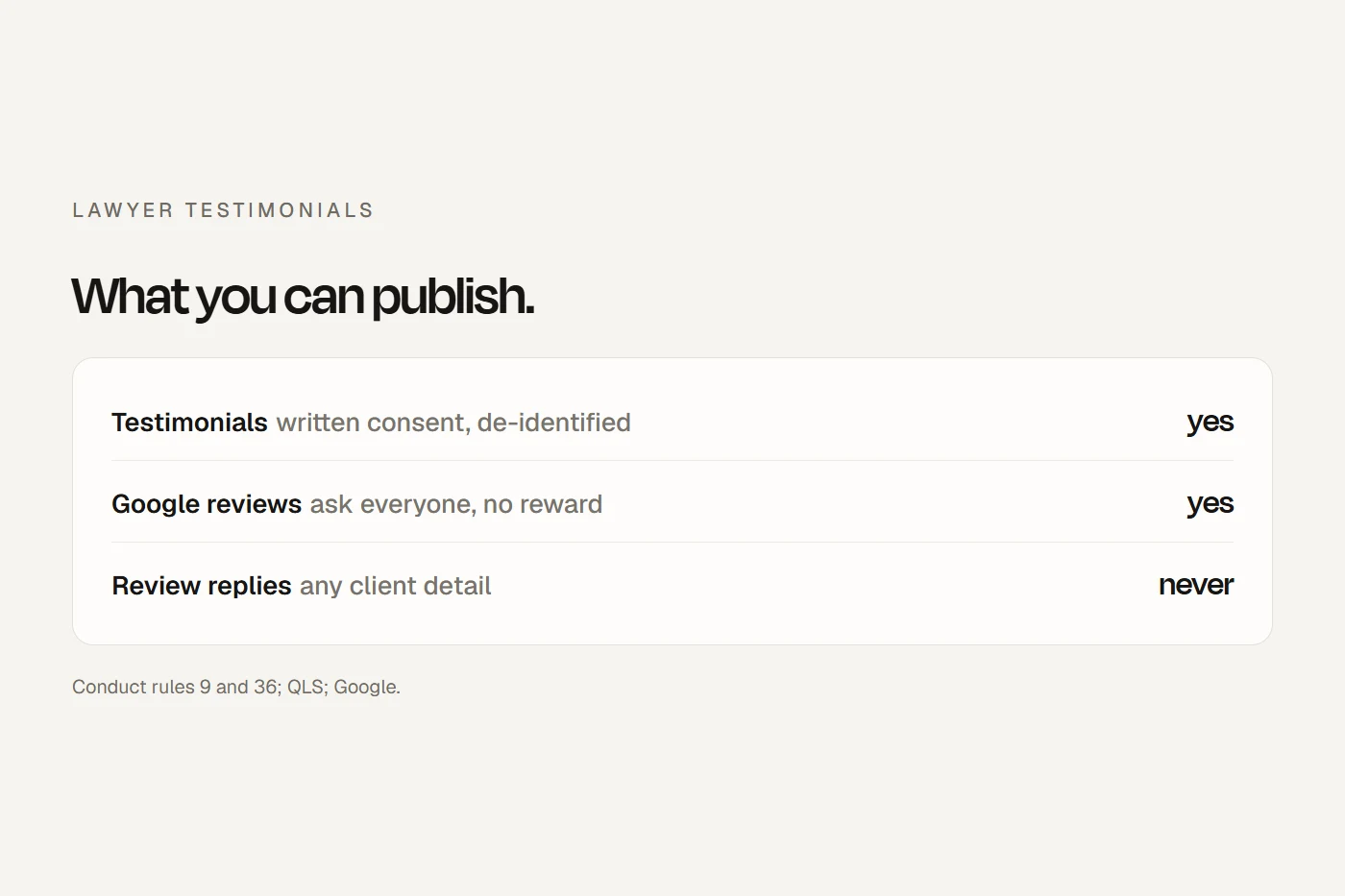
- No client information on the website or social media without written consent; case studies de-identified (rule 9).
- No posts about matters that are still current (rule 28).
- Review replies contain no matter details (rule 9).
- Template letters of demand contain no threats of criminal or disciplinary complaints (rule 34.1.2).
- Clients know which services are not legal services, if you share an office or brand with another business (rule 39).
- Someone supervises intake staff and any tool that answers enquiries (rule 37).
- Your advertising is checked against rule 36; my website checklist goes through it.
Where to get a ruling
The Law Council publishes a commentary on the rules. It's long, it's the best plain explanation of each rule, and it says it isn't part of the rules. Each law society runs an ethics service: the Law Society of NSW Professional Support Unit, the LIV's ethics team, the QLS Ethics and Practice Centre, and equivalents in WA, SA, the ACT, Tasmania and the NT. Rule 9.2.3 lets you discuss a real matter with them in confidence.
My view
Most of these rules don't care what your website looks like. The ones that do are about what you collect, what you say about clients and who you pay. The changes I'd make on most small firm websites are a shorter enquiry form with a "don't send details yet" line, case studies with consent, and a written referral disclosure. None of them cost much, and each one heads off a problem before it starts.
Questions I get asked
What are the Australian Solicitors' Conduct Rules?
The national professional conduct rules for solicitors, written by the Law Council of Australia and adopted in every state and territory. A breach can be unsatisfactory professional conduct or professional misconduct.
What changed in the latest amendments?
Rule 8.1 now says solicitors must "only accept and follow" lawful, proper and competent instructions, and rule 13.4 defines "just cause" for ending an engagement. Rule 36 on advertising didn't change.
Can a solicitor act against a former client?
Not if they hold confidential information of the former client that's material to the new matter, unless the former client gives informed consent or there's an effective information barrier (rule 10.2).
What are the exceptions to confidentiality under rule 9?
Six: the client authorises it, the law permits or compels it, getting confidential ethics advice, avoiding a probable serious criminal offence, preventing imminent serious physical harm, and disclosure to your insurer.
Can a solicitor receive referral fees?
Yes, with disclosure and the client's informed consent under rule 12.4.3. Some statutes ban them, for example personal injury referral fees in Queensland, WA and the NT.
About this guide
Written by Joseph Alzein, founder of bdog. bdog builds law firm websites. The rules are quoted from the NSW Legislation version of the Australian Solicitors' Conduct Rules, with the Law Council's commentary, the state instruments, the Legal Practice (Solicitors) Rules and the NSW Legal Services Commissioner's annual report. Sources were checked on 13 October 2026. This is general information, not legal advice; for a live matter, ring your law society's ethics service.
Main sources:
- Australian Solicitors' Conduct Rules 2015 (NSW Legislation)
- Law Council of Australia: the rules
- Law Council: commentary on the rules
- Queensland Law Society: the rules in Queensland
- Tasmania: Legal Profession (Solicitors' Conduct) Rules 2020
- ACT: Legal Profession (Solicitors) Conduct Rules 2026
- Law Society NT: the rules in the Territory
- NSW Legal Services Commissioner: annual report