A website for a medical specialist practice in Australia
Who reads a specialist’s website, titles exactly as registered (including “surgeon” and sub-specialty wording), post-nominals, conditions pages that don’t overclaim, a fees page built on what patients are told to ask, referrals, telehealth, privacy and the pages a national standard lists. With a profile wording check, a sorter and a launch checklist.
On This Page
A specialist's website is rarely how a patient finds the doctor. The GP suggests a name and the patient looks it up. Then the GP's practice nurse checks the same site for the sub-specialty, the wait and how to send the referral. This guide is for a medical specialist in private practice, or the practice manager of small specialist rooms, working out what the website needs: titles exactly as registered, conditions pages that don't overclaim, a fees page that answers what patients are told to ask, referrals, telehealth, privacy, and the pages a national standard lists. I build specialist practice websites, built with Ahpra's advertising guidelines in mind. The rules come from the National Law, the Medical Board, Ahpra, the Commonwealth Ombudsman, Medicare and the Australian Commission on Safety and Quality in Health Care.
- Two readers, both checkingThe patient holding a referral checks who you are, the cost and how soon. The GP checks your sub-specialty, the wait and how to refer.
- Titles are where specialists slipThe Board's own advertising audit found specialist-title claims and testimonials were the most common problems. Use the title on your register entry, then describe your focus.
- Fees, in wordsPatients are told to ask about your fees, gap schemes and who else will bill. A fees page that answers those questions saves your rooms the phone calls.
Who reads a specialist's website
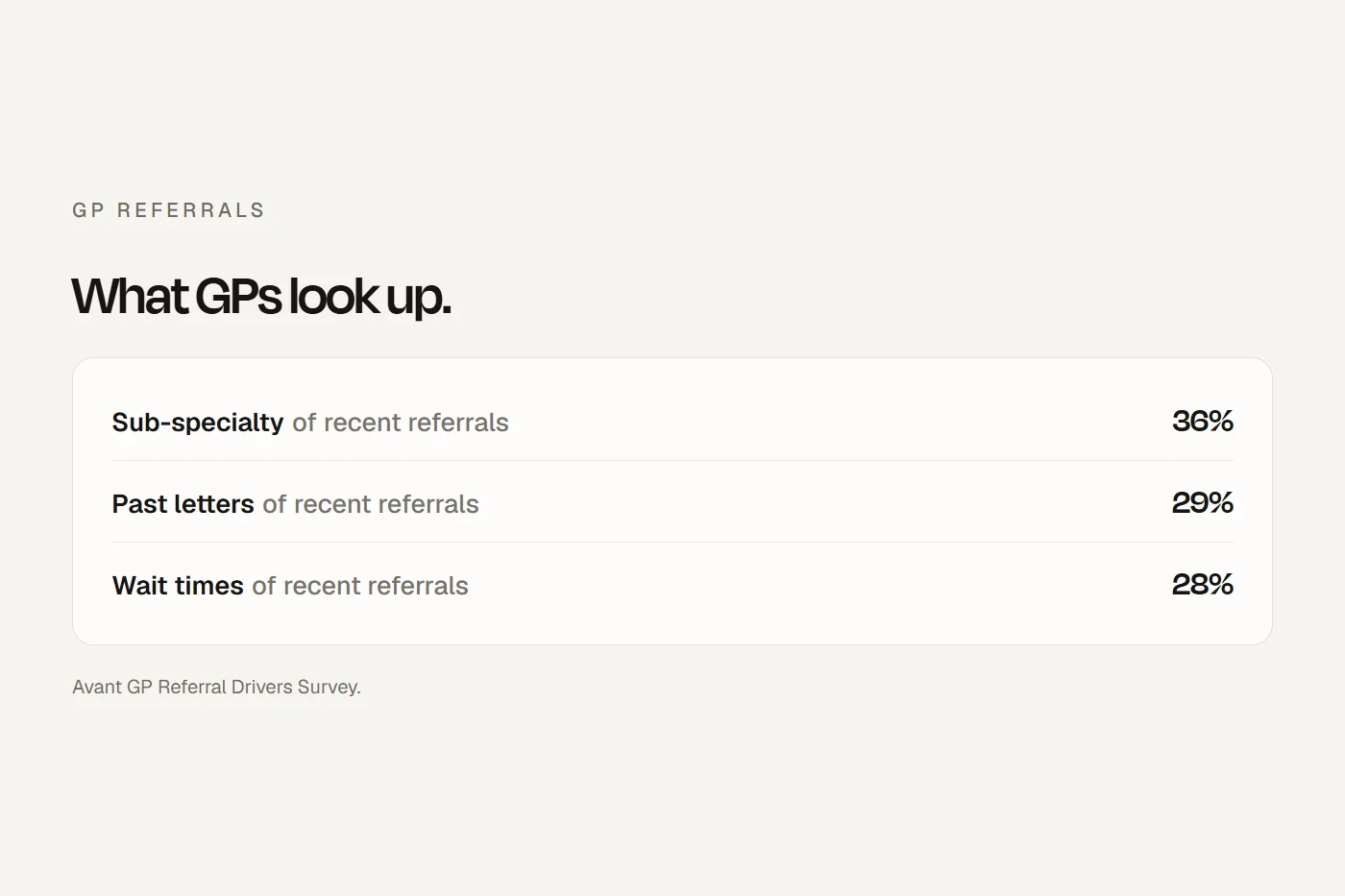
There's no Australian survey of how people use specialists' own websites, but a recent Avant survey of GPs and referred patients shows what each wants. GPs who looked something up before referring most often checked the specialist's sub-specialty, their previous letters and the wait. Only 17% of patients chose the specialist themselves, and most named location, the GP's recommendation and how soon they could be seen. Nearly three in four expected out-of-pocket costs, but only 40% felt they knew much about them.
The government points patients your way too. healthdirect tells patients to check the location, services, hours, the doctor's gender, languages, how to pay, and Ahpra registration. The government's Medical Costs Finder lists participating specialists with a link to their own website, whether they offer telehealth and their gap arrangements. It tells patients "There should be no extra administrative, booking, or hidden costs applied."
Titles, exactly as registered
- Use the title on your register entry. The Medical Board's list of specialties sets the exact titles, such as "Specialist orthopaedic surgeon", "Specialist dermatologist" or "Specialist gastroenterologist and hepatologist". Your register entry shows your specialty and field.
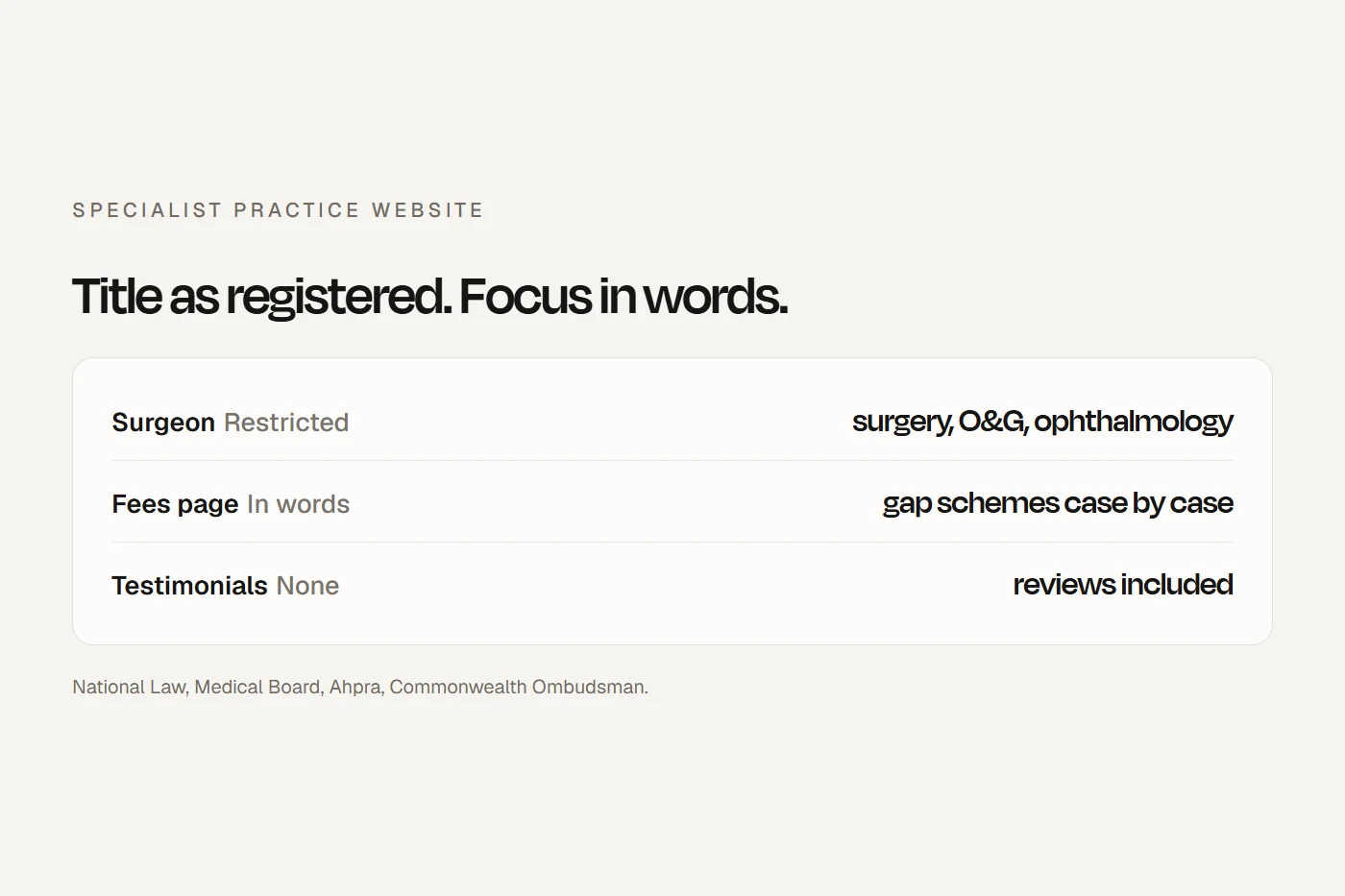
- "Surgeon" is restricted in every state. Only specialists registered in surgery, obstetrics and gynaecology, or ophthalmology can use it. A dermatologist or GP who operates can say what they do ("performs skin cancer excisions"), but not "surgeon". A cosmetic surgery endorsement doesn't allow "cosmetic surgeon".
- A qualifier doesn't save a title. Ahpra's advice, published by the surgeons' college, is that adding "facial" to "plastic surgeon" doesn't avoid the law. The pattern Ahpra gives is: "Specialist Otolaryngologist who has substantial experience in facial plastic surgery". So: registered title first, then "with substantial experience in", "working primarily in" or "practice focused on".
- "Specialist" in the practice name only works if everyone listed holds specialist registration. Ahpra says the title rules include "the name of the business".
- The risk is often other people on the site. A GP with an interest, a registrar, a fellow not yet registered as a specialist, a nurse: each needs a title that matches their own registration.
Post-nominals and academic titles
Fellowship and specialist registration are separate facts, and both must be true. The physicians' and surgeons' colleges both tie FRACP and FRACS to current membership. Spell them out: "FRACS (Fellow of the Royal Australasian College of Surgeons)". For academic titles, keep the exact title and the institution: "Clinical Associate Professor, [University]", with "Adjunct" or "Conjoint" left in. The Medical Board's code asks for "accurate, truthful and verifiable information" about qualifications.
Check your profile wording
Paste a profile or a page. It flags common patterns, not everything.
Conditions and procedures pages
A condition page that works describes the condition in plain words, what the first visit involves, the tests and options you offer (including non-surgical ones and watching and waiting where that's relevant), recovery in general terms with "everyone's recovery is different", and when to go back to the GP or to emergency. The Medical Board's code asks for "only justifiable claims about the quality or outcomes of your services" and no "unrealistic expectations".
- No outcome promises and no "pain-free", "safe", "best" or "advanced" without evidence.
- Your own results: Ahpra treats outcome audits as weak evidence unless bias is carefully controlled, and a comparison with others needs acceptable evidence. Share detailed results with GPs privately; keep them off the public site unless you show full method, numbers and period.
- No patient stories, videos or review widgets.
- No fear lines like "Don't ignore that mole". "We assess and treat moles and skin lesions" says the same thing safely.
- Cosmetic procedures carry extra rules: registration numbers, total cost, risk and recovery information, referral and cooling-off. See my cosmetic advertising rules guide.
The fees page
The Medical Board's code asks you to tell patients about fees in time for them to decide, and to warn them about other costs when referring on. The Commonwealth Ombudsman's patient fact sheet tells patients to ask for an estimate, preferably in writing, and whether you'll use their fund's gap scheme. Its consumer site lists the questions patients should ask, which make a ready-made fees FAQ:
- What will each service cost, and will I be out of pocket?
- Does the doctor use my health fund's gap scheme?
- Who else will treat me in hospital, such as the anaesthetist or assistant, and how do I get their estimates?
- Will I get a written estimate before I agree?
- Which hospital, and does it have an agreement with my fund?
- How and when will I be billed?
Write the answers in plain words, without Medicare amounts. Some wording models:
- "We set our own fees. Medicare pays part of the consultation fee when you have a valid referral. You pay the difference on the day."
- "Dr [Name] decides case by case whether to use a health fund's gap arrangement. Ask us, and check with your fund." The Ombudsman's site says no doctor has to take part in a gap scheme.
- "The anaesthetist and any assistant surgeon bill separately. We'll give you their details so you can ask for their estimates."
- "There's no booking or administration fee," if that's true.
Publishing your consultation fee is your choice. If you co-own the day hospital or imaging service you use, the Board's code says to tell patients, so say so on the site.
Referrals and telehealth
- Referrals: a GP referral with no stated period lasts 12 months from the first consultation, and the GP can make it indefinite. It doesn't have to be addressed to you by name: "Dear Cardiologist" is fine. Without one a patient can still be seen, but Medicare pays less. So say "With a valid referral, Medicare pays part of the fee", not "You need a referral to see us".
- Online booking for specialists is usually a request-and-triage flow, not a live calendar. HotDoc's specialist product works with Genie, Gentu books through Healthengine, and Clinic to Cloud has a portal for uploading referrals. Label the button "Request an appointment", and give GPs your secure messaging details separately.
- Telehealth: Medicare's specialist telehealth rules don't need an existing relationship the way GP rules do, but they do need a valid referral, and both doctor and patient must be in Australia. The Medical Board prefers telehealth within an ongoing relationship that also includes in-person visits. On the site, say who can have telehealth, video or phone, the fees, and that an in-person visit may still be needed.
Privacy and forms
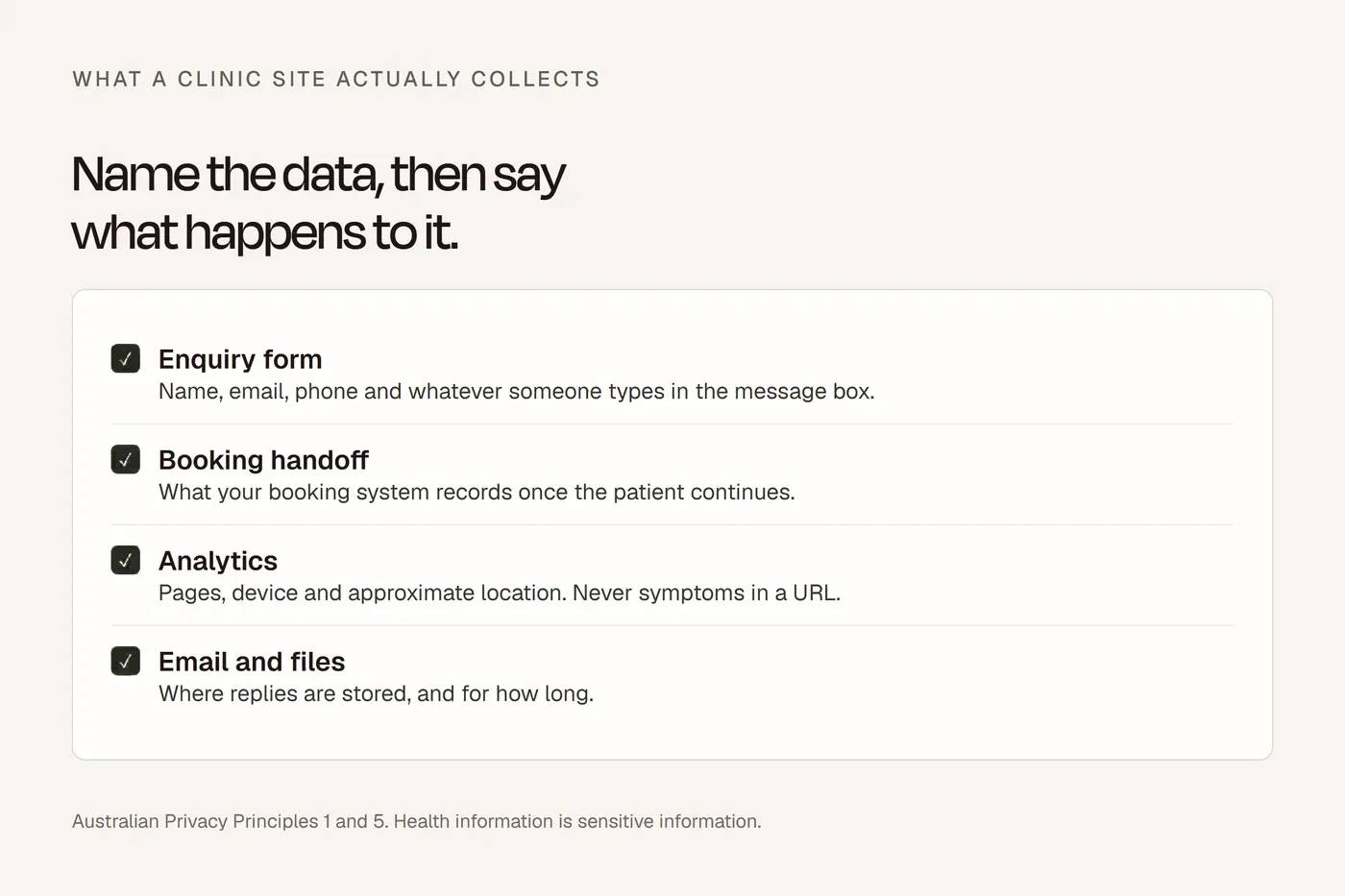
A specialist practice is covered by the Privacy Act whatever its size, and health providers report more data breaches than any other sector. Take referrals and new-patient forms through your practice software's portal or your booking platform, not a website form that emails an inbox. Put "Please don't include medical details" on the general contact form, name every third party in your privacy policy, and keep advertising pixels off condition pages. My health privacy policy guide goes through it.
The pages a national standard lists
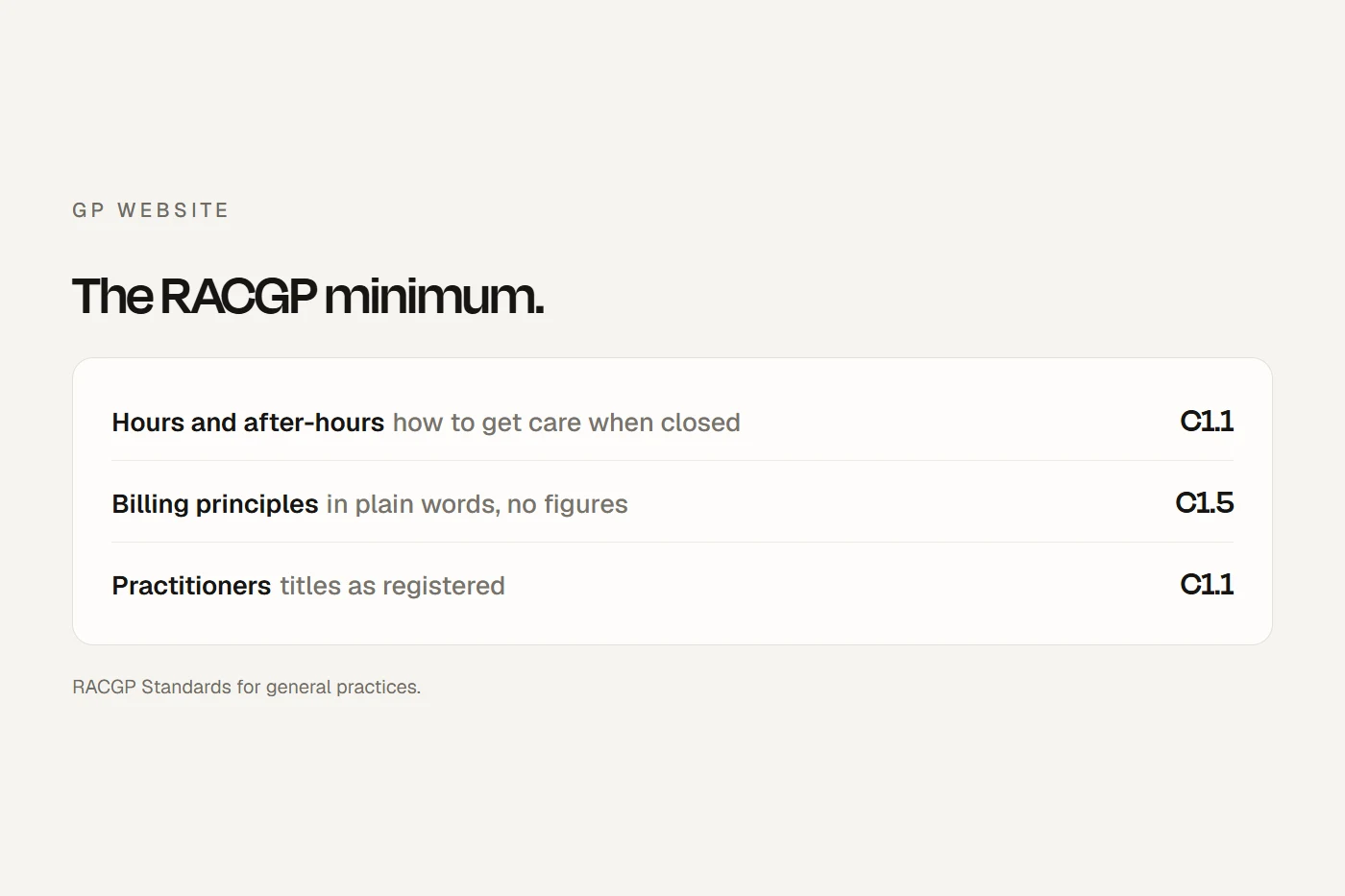
Specialists have no accreditation checklist like the GP standards, but the national primary and community healthcare standards cover "clinicians' rooms" and list seven things to publish: services, hours and how to get an appointment, who can access them, estimated costs, after-hours and emergency alternatives, locations with access details, and how to give feedback, including the state health complaints body. It's voluntary, but it's a sound page list, and few specialist sites link to the complaints body.
Can my site say this?
Tap each card.
Launch checklist
Your ticks save in this browser.
- Every doctor's title matches their register entry and the current list.
- No "surgeon" without registration in surgery, O&G or ophthalmology.
- Focus described in "substantial experience in" words, with no invented titles.
- "Specialist" in the practice name only if every listed doctor holds it.
- No testimonials, patient stories or review widgets.
- No outcome promises, superlatives, comparisons or fear lines.
- Post-nominals current and spelled out.
- A fees page covering billing, gap schemes, other doctors who bill and the written estimate.
- No booking or admin fee.
- Referral information in plain words, without Medicare amounts.
- Referrals and health details collected through a secure portal.
- A privacy policy and a collection notice beside every form.
- Every location with access details, parking and transport.
- After-hours and emergency information, and a link to the state health complaints body.
- A telehealth section, and a page for GPs.
- Languages, interpreters and the National Relay Service mentioned.
- Google profiles set up per Google's practitioner rules, linking to each doctor's page.
- Directory listings use the same wording as the site.
My view
A specialist's website doesn't need to win strangers on Google; it needs to pass two checks quickly. The patient with a referral wants to know who you are, where, how soon and what it will cost. The GP wants your exact focus, the wait and how to refer. Get the title exactly right, describe your focus in Ahpra's words, write a fees page that answers the Ombudsman's questions, and make referring easy. That's a site a GP is comfortable sending patients to.
Questions I get asked
What should a medical specialist's website include?
Your title exactly as registered, your focus, locations, how to get an appointment, a fees page, referral and telehealth information, a page for GPs, after-hours advice, a complaints link and a privacy policy.
Can a specialist call themselves a "knee specialist"?
Not as a title. Use your registered title, such as "Specialist orthopaedic surgeon", then "practice focused on knee surgery".
Who can use the title "surgeon"?
Only medical practitioners with specialist registration in surgery, obstetrics and gynaecology, or ophthalmology.
Can you see a specialist without a GP referral?
Yes, but Medicare pays less without a valid referral. A GP referral usually lasts 12 months from the first consultation.
Can I put patient reviews on my specialist website?
No. Testimonials are banned in health advertising, and that includes reviews you republish on your own site.
About this guide
Written by Joseph Alzein, founder of bdog. bdog builds specialist and clinic websites. The rules come from the Health Practitioner Regulation National Law, the Medical Board of Australia, Ahpra, the Commonwealth Ombudsman, Medicare and the Australian Commission on Safety and Quality in Health Care; survey findings from Avant and healthdirect. Sources were checked on 13 October 2026. This is general information, not legal advice.
Main sources:
- Medical Board: list of specialties and titles
- Medical Board: protection of the title surgeon
- RACS: Ahpra advice on specialty titling
- RACP: fellowship and post-nominals
- Commonwealth Ombudsman: informed financial consent
- healthdirect: finding the right health professional
- National Safety and Quality Primary and Community Healthcare Standards
- OAIC: guide to health privacy