What a GP clinic website needs
The RACGP Standards’ list of practice information, page by page, with billing wording that needs no dollar figures, after-hours lines you can source, doctor profiles that get titles right, and what Best Practice, MedicalDirector and Zedmed can do for booking. With a sorter and a weighted checklist.
On This Page
Search for "medical practice website" and Google shows you clinics and booking apps; search "medical centre website design" and you get agencies and lists of pretty examples. None of them mention the closest thing a GP site has to a specification: the RACGP Standards' list of information a practice must give patients. This guide is for the owner or practice manager of an Australian general practice or medical centre. It covers what a GP website needs page by page, how to word billing without dollar figures, after-hours and emergency lines you can source, doctor profiles that get titles right, and what Best Practice, MedicalDirector and Zedmed can do for online booking. It's from the RACGP Standards and billing guidance, the Privacy Act, Ahpra, the Medical Board, the Department of Health, healthdirect and the software companies' own help pages, read on 12 October 2026. Built with Ahpra's advertising guidelines in mind; it's general information, not legal advice.
- Start from the RACGP listAddress, phones, hours, after-hours arrangements, appointment types, billing principles, practitioners, communication and privacy policies, complaints and services.
- Lead with what patients choose onLocation, bulk billing, how soon they can be seen and your hours, on the first screen.
- Keep it cleanNo testimonials, no medicine names, titles exactly as registered, and no booking fee on bulk billed appointments.
What patients look for first
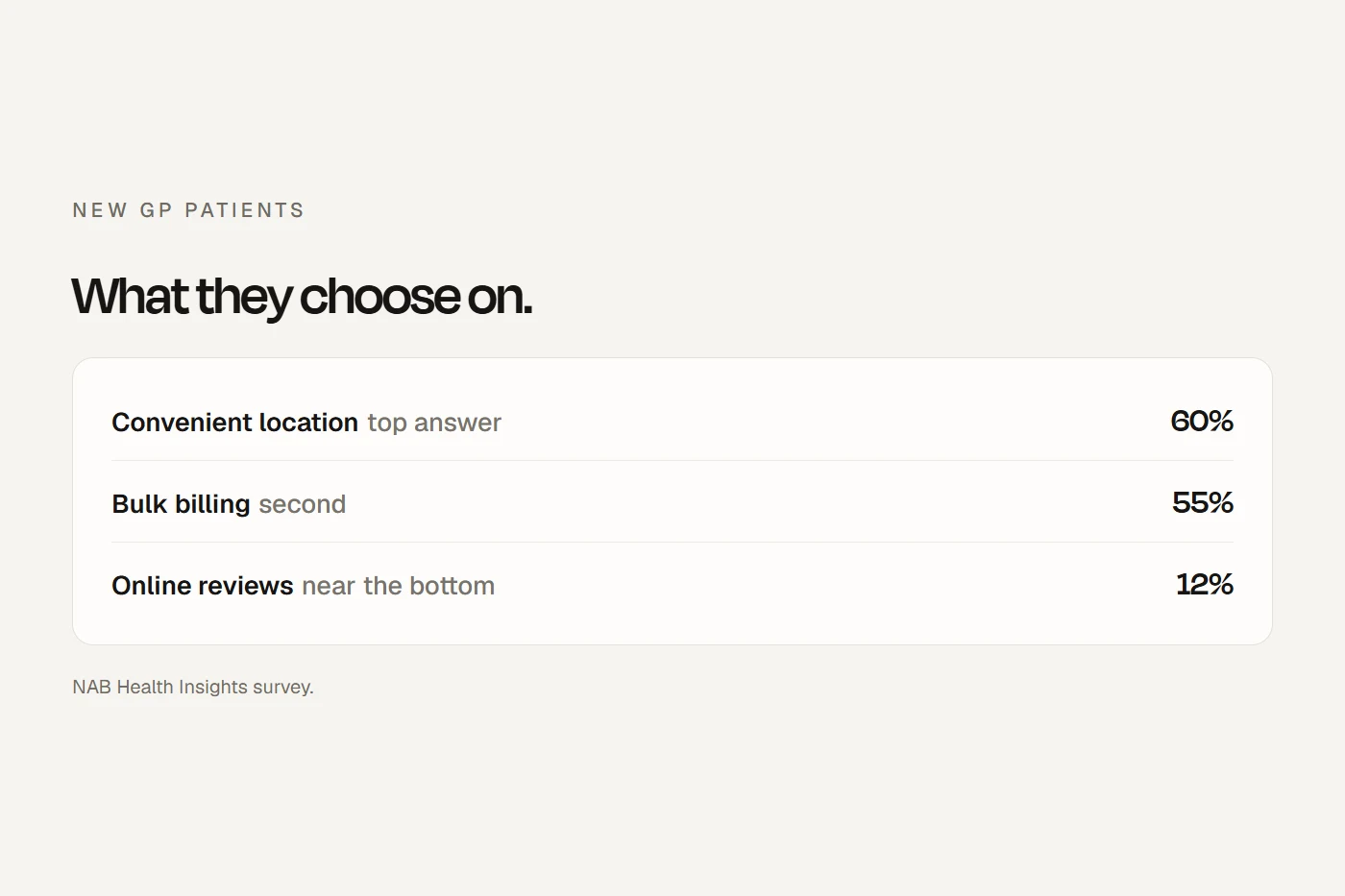
In NAB's survey of what matters when choosing a new doctor, the top answers were a convenient location, bulk billing, ease of getting an appointment, convenient hours and out-of-pocket cost. Each is a website element: the address and map, the billing line, the booking button, the hours. Online reviews came near the bottom, which suits a GP site, since Ahpra rules out testimonials anyway. CommBank's survey found about half of patients use practice websites when looking for a provider, and GP patients use them most.
So the home page's first screen should carry the address, today's hours, your billing position in one plain sentence, a Book button, and a line for after-hours. Some clinics already lead with "We are a mixed billing practice"; it's the right instinct.
The RACGP list
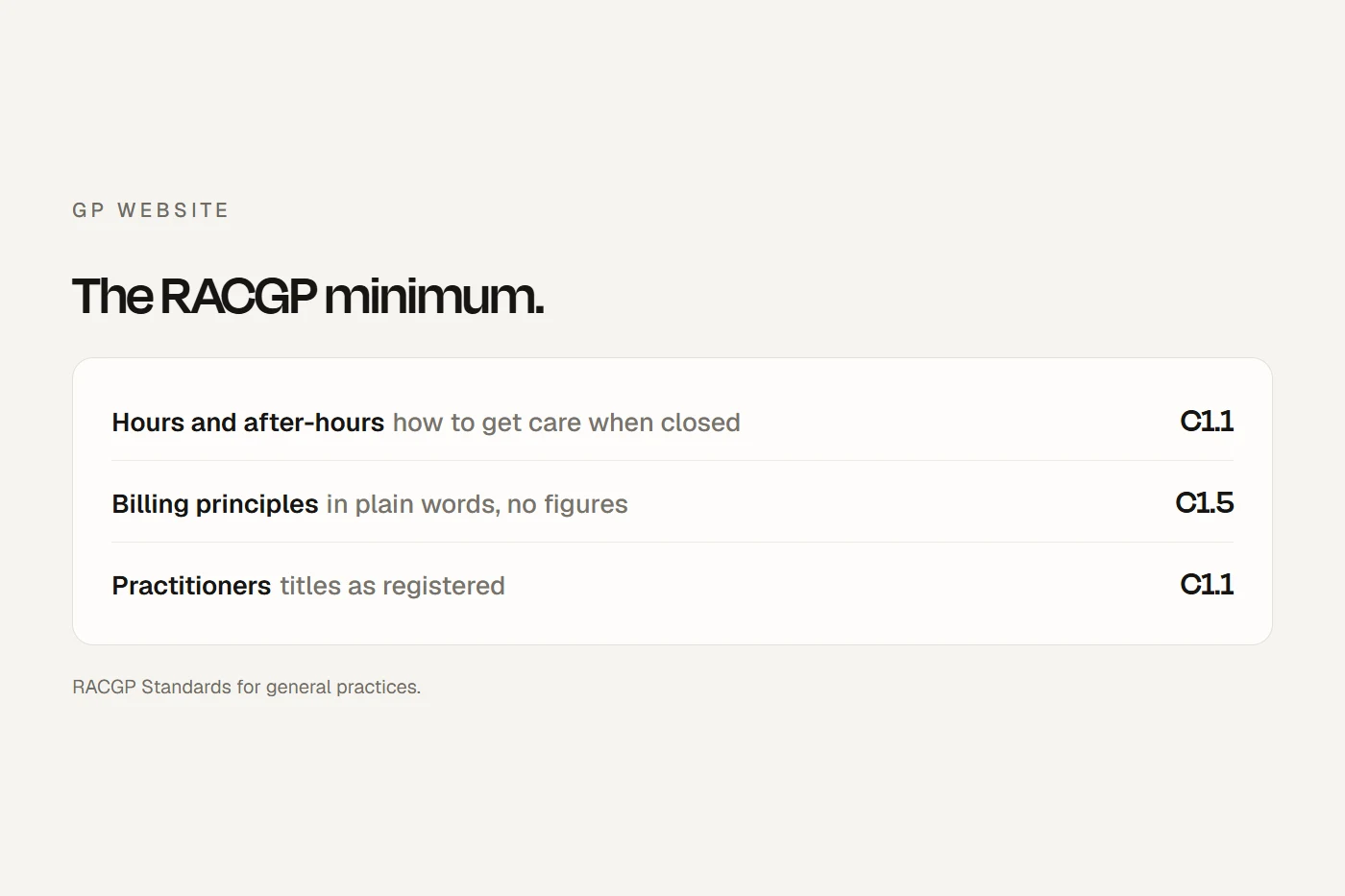
Criterion C1.1 of the RACGP Standards says patients must be able to get up-to-date information about the practice that, at minimum, contains:
- your address and telephone numbers;
- consulting hours and arrangements for care outside normal opening hours;
- appointment types, including whether in-person and telehealth appointments are available and when;
- your billing principles;
- a list of your practitioners;
- your communication policy, including when and how you return calls and electronic messages;
- your policy for managing patient health information;
- how to give feedback or complain;
- the range of services you provide.
The Standards don't require a website, but they suggest one "that contains all the required information about the practice in clear, simple language", updated as soon as anything changes. A website is the obvious place for every item, and a surveyor can check it. Other criteria land on the site too: show the languages your team speaks and translated information if you serve particular communities; tell patients email isn't for emergencies and how long replies take; explain how patients get results; publish your email and social media policies if you use them; and, if any patient information carries local ads, add a line that they aren't an endorsement.
The page list
| Page | What goes on it |
|---|---|
| Home | Address, phone, today's hours, billing in one line, Book button, after-hours line, emergency line in the footer. |
| Book online | The booking widget or link, which appointments can be booked online, and what to do if none suit. |
| Our doctors | Each doctor's title as registered, qualifications, interests worded carefully, languages, gender, days, whether taking new patients, telehealth. |
| Services | Consult types: long and short consults, procedures, health assessments, skin checks, travel health, women's, men's and children's health, vaccines in the form the TGA allows. |
| Fees and billing | Billing approach, who is bulk billed and for what, how private fees are paid and claimed, longer consults, telehealth, services Medicare doesn't cover, cancellations. |
| Hours and after-hours | Hours, public holidays, who provides after-hours care and how to reach them, healthdirect or 13 HEALTH, Medicare Urgent Care Clinics, closure notices. |
| New patients | How to register, a secure form, what to bring, billing and consent explained in plain words, message preferences. |
| Telehealth | Who can book it, video or phone, billing, how scripts and referrals are sent, what happens if the call drops. |
| Results and recalls | How patients get results and how you'll contact them. |
| Contact and location | Map, parking, accessible parking, public transport, phone, email with reply times and "not for emergencies". |
| Policies | Communication, email and social media policies; privacy policy; feedback and complaints; accessibility, the National Relay Service and free interpreters through TIS National. |
Scroll the table sideways to see every column.
The fees and billing page
The RACGP's informed financial consent guide says patients should know your billing approach (bulk, private or mixed), when different fees apply for longer consults or particular services, whether telehealth fees differ, any policies for concession card holders, pensioners or children, and when a service isn't eligible for a Medicare rebate. It wants billing information on your website, in the practice and on your booking platforms, and asks practices to avoid "rebate" and "item number" without explaining them. Its own sample wording is a good model: "This appointment will be bulk billed, so you won't have to pay anything today."
Three rules on top of that:
- No extra fees on bulk billed services. The Department of Health says booking, admin, record-keeping and annual registration or membership fees can't be charged on a bulk billed service, however they're described. If your booking platform adds a patient fee, check it doesn't apply to bulk billed appointments.
- The Medicare Bulk Billing Practice web tile is only for practices in the incentive program, only for participating locations, and never in a branded header. The Medicare logo stays in the Department's own materials.
- Leave Medicare figures off. Rebates and incentives change, and a dollar figure on your page will date. Describe the process in words, and keep "free" out of it: bulk billing is Medicare-funded, which isn't free in Ahpra's sense.
After-hours and emergency lines
The RACGP's after-hours criterion asks practices to tell patients how to get after-hours care, using the website among other channels, and to point them to providers staffed by Ahpra-registered doctors or nurses if the practice has no arrangement of its own. These lines come straight from the sources, so you can use them as written:
- "In an emergency, call triple zero (000)."
- "When we're closed, call healthdirect on 1800 022 222 for advice on where to get help." In Queensland, 13 HEALTH (13 43 25 84) is the state line.
- "Medicare Urgent Care Clinics offer bulk billed urgent care. For a life-threatening injury or illness, call triple zero (000) or go to your nearest emergency department."
Leave symptom lists and warnings out. The Medical Board's code bars exploiting "fears about their future health", and a calm footer does the job.
Doctor profiles
- Titles exactly as registered. "Specialist general practitioner" only for doctors with specialist registration in general practice. Never "specialist" with another field, and never "surgeon". Registrars as general practice registrars.
- Interests worded Ahpra's way: "has substantial experience in" or "works primarily in", not "specialises in".
- Qualifications factual, post-nominals current. The Medical Board's code bars misrepresenting experience or qualifications "by misstatement or omission".
- The facts patients use: languages, gender, days worked, whether taking new patients, telehealth. Training and qualifications mattered to about three in ten people in NAB's survey.
- No patient quotes, and update the list the day someone joins or leaves. Patients complain about not being told when their GP goes.
Online booking with your practice software
| Software | Its own website booking | Booking partners |
|---|---|---|
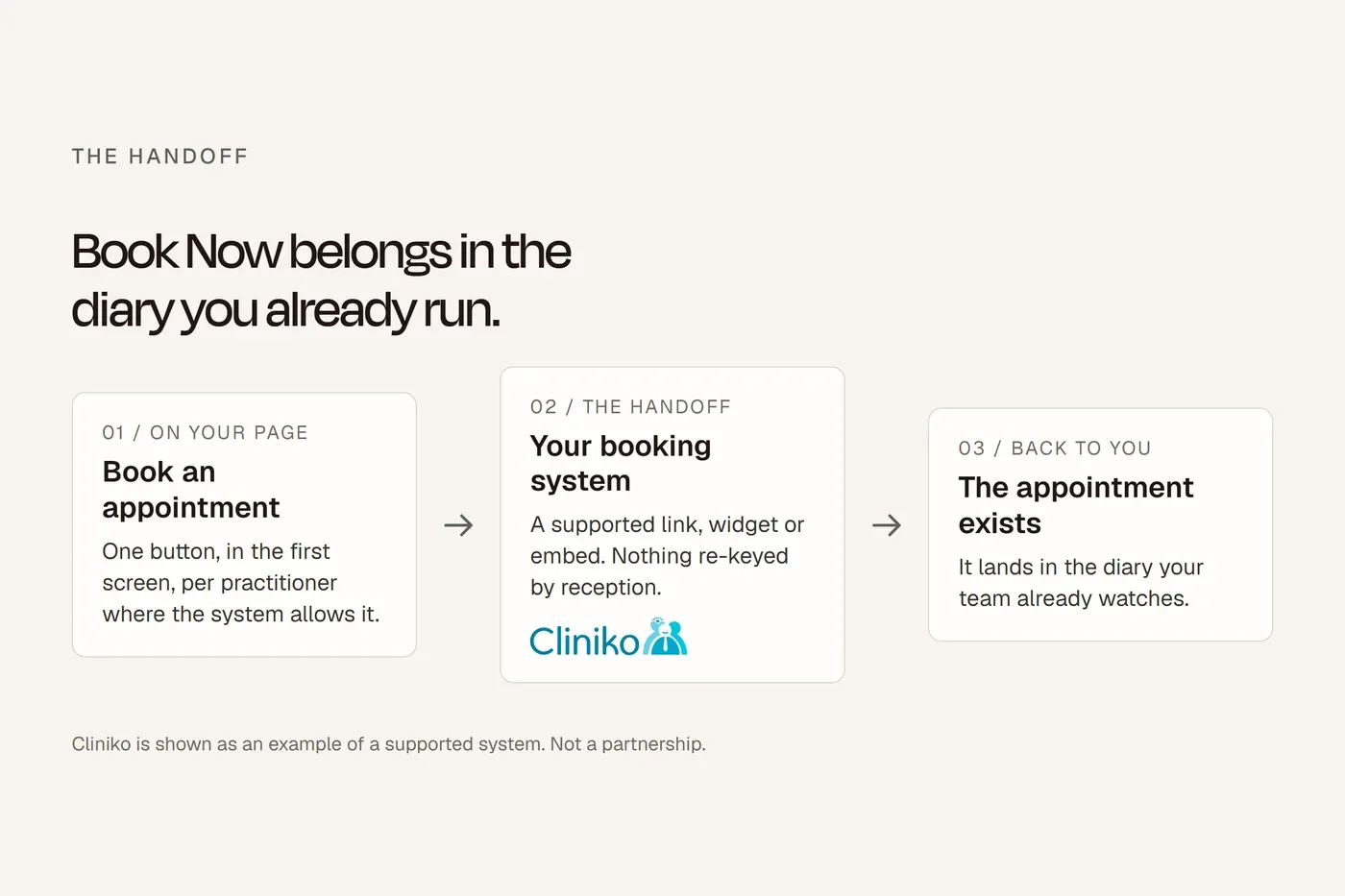
| Best Practice | Best Health Booking: code on your website or a booking link for your Google profile and social. Needs the Bp Premier server on a stable internet connection. | HotDoc, HealthEngine, AutoMed, HealthShare and others. |
| MedicalDirector | None found for a public booking page. | HotDoc, HealthEngine, MyHealth1st and AutoMed. |
| Zedmed | Online Appointments, branded as your own. | Zedmed's cloud version lists HotDoc, HealthEngine and several others as not supported. |
Scroll the table sideways to see every column.
The RACGP suggests choosing which appointment types can be booked online, such as routine, non-urgent appointments. HotDoc, HealthEngine or your own booking compares the directories, and adding online bookings to a clinic website covers embedding them.
Privacy, forms and email
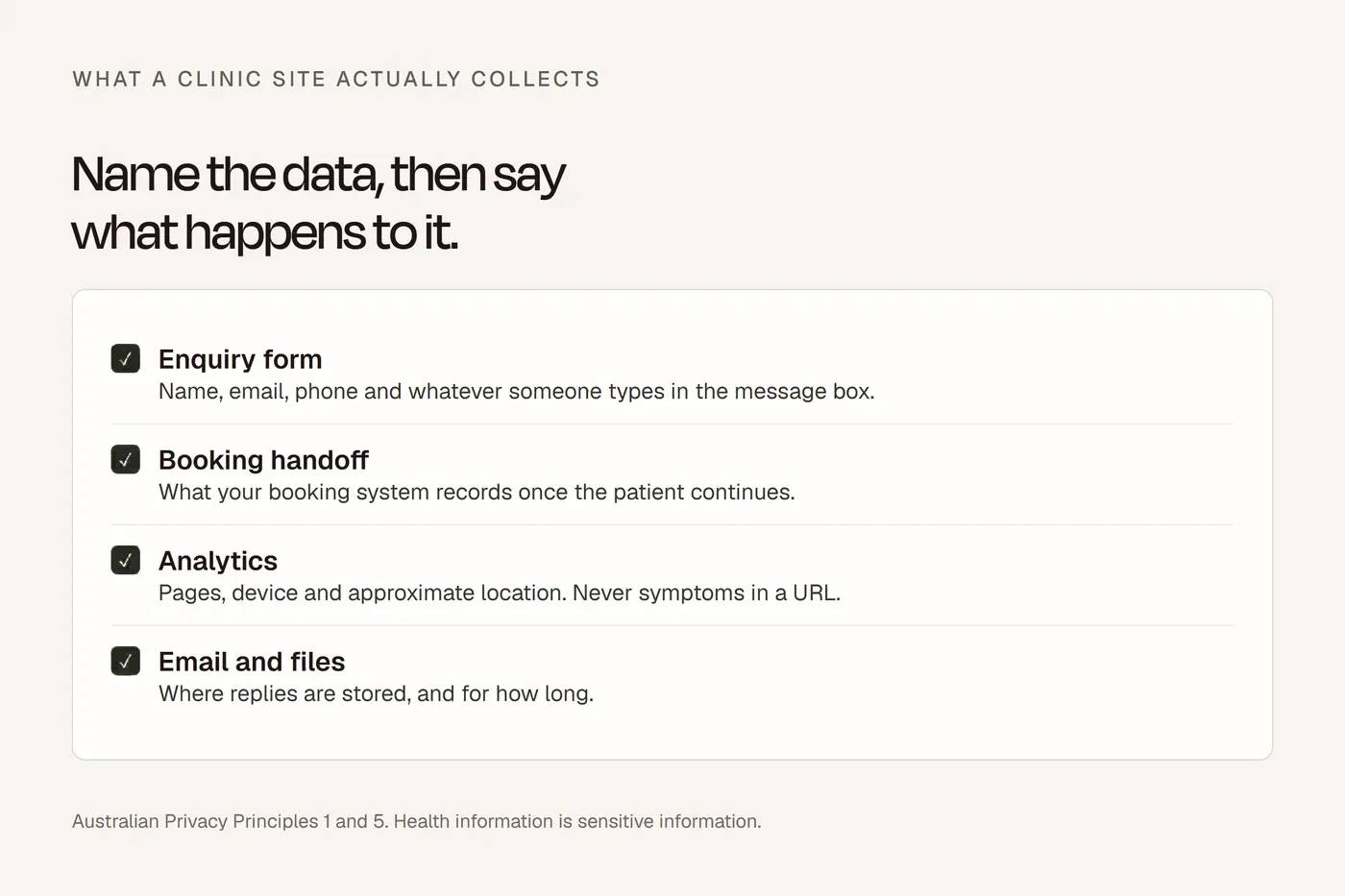
Every GP clinic is covered by the Privacy Act whatever its size, because it provides a health service and holds health information. Your privacy policy must say what you collect and why, how people can access and correct it, how to complain, and whether information goes overseas; the RACGP adds plain English, a review date, anonymous contact and how you handle third parties. Name your booking platform if its terms require it. Put a short collection notice beside every form. Keep registration on your software's or booking platform's secure form rather than a plain email form, and tell people not to send medical details through the general contact form. The RACGP rates unencrypted email without recorded consent as high risk. My guide to a privacy policy for a health website covers the policy in full, and clinic website accessibility covers WCAG 2.2.
Can my site say this?
Tap a card to see the verdict.
How does your website score?
Tick what your site already does, and tick anything that doesn't apply to you. The first items come from the law and count for more; the next come from the RACGP Standards. Your ticks save in this browser.
- A privacy policy with everything the Privacy Act requires.
- A collection notice beside every form.
- No testimonials, patient stories or review quotes.
- Every title matches Ahpra registration, and no "surgeon".
- No prescription medicine names or class terms; vaccines only as the TGA allows.
- No booking, admin or membership fee on bulk billed services.
- The site and booking work by keyboard and screen reader.
- Address and phone numbers.
- Hours and after-hours arrangements.
- Appointment types, including telehealth and when.
- Billing principles.
- A current list of practitioners.
- A communication policy: calls, messages, email reply times, not for emergencies.
- How to give feedback or complain.
- The range of services.
- The web tile only on participating locations and not in the header, if you're in the incentive program.
- A non-endorsement line on any patient information that carries local ads.
- Email and social media policies, if you use them.
- Sourced emergency and after-hours lines.
- Languages spoken and translated key information.
- Interpreters and the National Relay Service mentioned.
- Billing in plain words, including telehealth.
- Online booking linked, with the right appointment types.
- How results and recalls work.
- Parking and access information.
- Forms that say not to send medical details by email.
- Your healthdirect listing matches the site.
My view
A GP website doesn't need to be clever. It needs to answer the five things patients choose on in the first screen, carry the RACGP list in plain language, and stay out of the handful of traps: testimonials, titles, medicine names, booking fees on bulk billed appointments and dated Medicare figures. The after-hours page and the billing page are the two that save your front desk the most calls.
Questions I get asked
What should a medical practice website include?
The RACGP's list: address and phones, hours and after-hours arrangements, appointment types, billing principles, practitioners, communication and privacy policies, feedback and complaints, and services. Plus online booking and a privacy policy.
Does a GP practice need a website for accreditation?
The RACGP Standards don't require a website, but they require the practice information above, and suggest a website as one way to provide it.
Can a GP website show prices?
Yes, your own fees, and the RACGP wants billing information on the website. Leave out Medicare rebate and incentive figures, which change.
Can a medical centre put Google reviews on its website?
Not review text: republished reviews are testimonials under Ahpra's guidelines.
What after-hours information should a GP website have?
Who provides after-hours care and how to reach them, healthdirect on 1800 022 222 (13 HEALTH in Queensland), and triple zero (000) for emergencies.
About this guide
Written by Joseph Alzein, founder of bdog. bdog builds websites for GP clinics and medical centres. The requirements come from the RACGP Standards for general practices and its informed financial consent guide, the Privacy Act, Ahpra's titles guidance, the Medical Board's code and telehealth guidelines, the Department of Health, healthdirect and Queensland Health, and the booking details from Best Practice, MedicalDirector and Zedmed's own pages, read on 12 October 2026. Built with Ahpra's advertising guidelines in mind. This is general information, not legal advice.
Main sources: