Starting a tutoring business in Australia
The setup, why private tutoring isn’t GST-free, the Working with Children Check in each state (and online across states), child safe standards, fair pricing and finding students. With a check quiz, an earnings calculator and an ad checker.
On This Page
Most guides to starting a tutoring business in Australia cover the same list: get an ABN, register a name, get a Working with Children Check, buy insurance. All true, and all incomplete. They don't mention that private tutoring isn't GST-free, that registered teachers aren't automatically exempt from checks, that child safe standards now reach tutoring businesses in most states, or what to do when your students live interstate and you teach them online. This guide is for a teacher, uni student or parent starting private tutoring: on your own, at home, in students' homes, online or in a small centre. It's from the ATO, the state screening agencies and child safe regulators, the NSW Department of Education, the Australian Consumer Law, Google's rules and the Australian Tutoring Association's code, read on 12 October 2026. It's general information, not legal or tax advice.
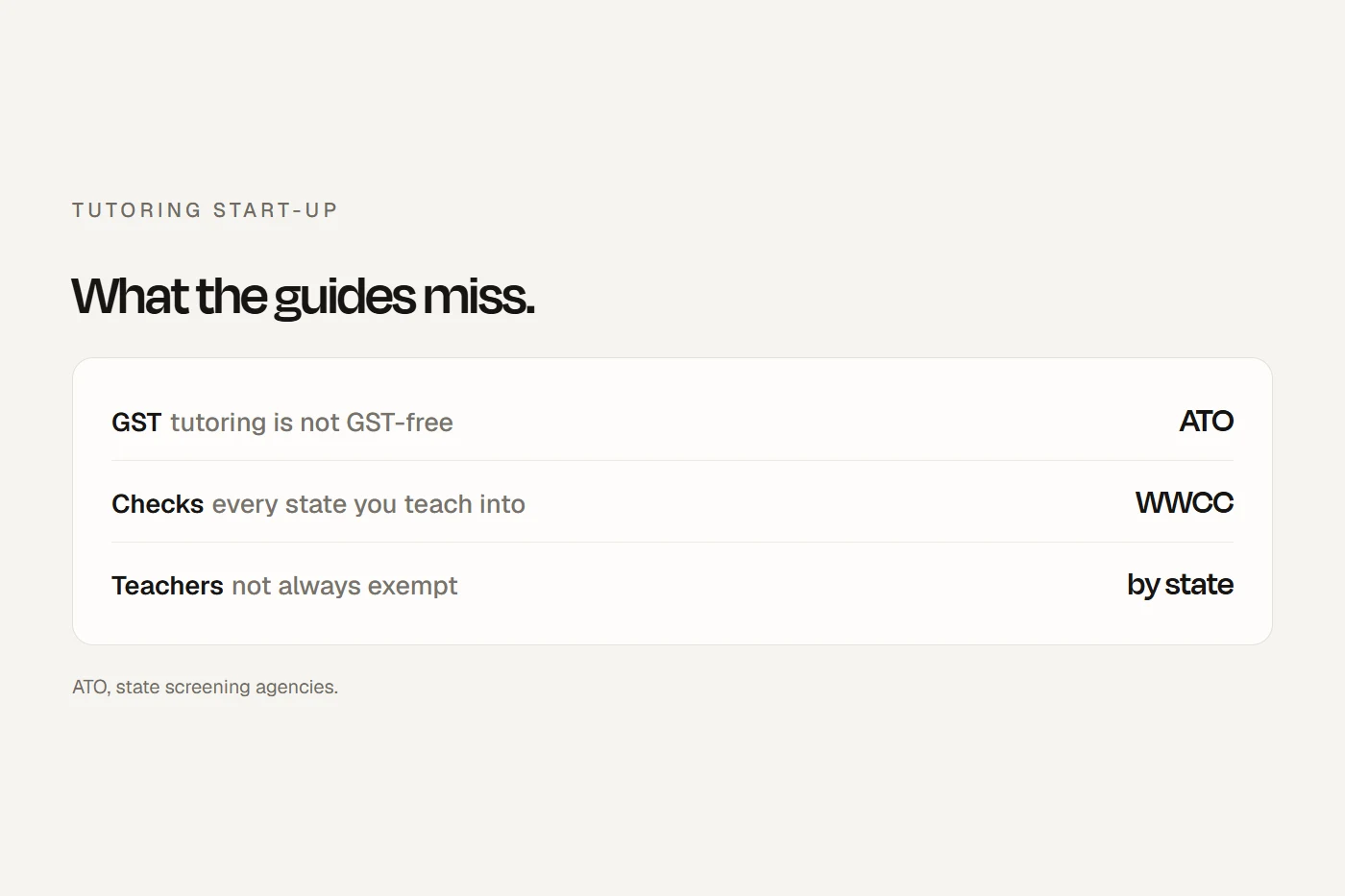
- PaperworkAn ABN if it's a business, a registered name unless you trade under your own first and last name, and GST registration once you reach the threshold. Tutoring isn't GST-free.
- A check in every state you teach intoEvery state treats paid tutoring as child-related work. Teachers aren't always exempt, and online students in another state may need that state's check.
- Honest marketingNo guaranteed results, prices shown in full, no card surcharges, and a Google profile that hides your home address.
Setting up
- ABN: you're entitled to one if you're carrying on a business, which the Australian Business Register describes as repeated, organised activity with an intention to make a profit. If a tutoring company employs you, you're an employee and shouldn't be asked to get an ABN.
- Business name: you must register one unless you trade under your own first name and surname and nothing else. "Jane Citizen" doesn't need registering; "Jane Citizen Tutoring" does. Registering a name doesn't give you exclusive rights to it.
- Sole trader or company: most solo tutors start as sole traders. A company makes sense for a centre with staff, and in Queensland a company's executive officers need blue cards too.
- Insurance: no rule makes it compulsory for a private tutor, but public liability covers injury or damage, professional indemnity covers claims about your advice, and standard home insurance often doesn't cover business activity. Tell your insurer if students come to your home.
- Working from home: a single student at the kitchen table is different from group classes in a converted garage with a sign out the front. Ring your council before you run groups at home or put up a sign.
Tutoring isn't GST-free
This is the one the start-up guides miss. GST-free education covers courses run by recognised schools, tertiary courses and a few listed types. The ATO's ruling on schools gives the example of a private tutor engaged by a school who "charges the school a GST inclusive fee", and says instruction paid for directly by students to an outside provider "is not GST-free". Its adult and community education rules exclude "private or individual tuition". So once you're registered for GST, your fees include GST. Registration is compulsory once your turnover reaches the GST threshold (check the ATO's page for the current figure), within 21 days. Once your business income passes the ATO's thresholds, you'll also be asked to pay tax in quarterly instalments.
If you're a teacher
Check your employer's rules before you take a student. NSW public school teachers need written approval for private tutoring every year, and the Department lists tutoring your own students, referring them to a colleague's tutoring, preparing students for the selective schools test while working at a selective school, and promoting your tutoring with your HSC marker role as conflicts of interest. I didn't check other states' or Catholic and independent schools' rules; ask yours.
Working with Children Checks
Every state and territory treats paid private tutoring of children as child-related work:
| Where | Check | What to know |
|---|---|---|
| NSW | Working with Children Check | "Tutors" are named. So is distance education "online or phone" to children in NSW. You can start once you have an application number. |
| Victoria | Working with Children Clearance | Covers "coaching or private tuition services of any kind specifically for children", including electronic contact. VIT-registered teachers are exempt but must notify the regulator of tutoring. Victoria now requires applicants to complete child safety training. |
| Queensland | Blue card | Needed by private tutors and by anyone who runs a tutoring business, and by a tutoring company's executive officers wherever they live. Registered teachers are exempt only for their school role. |
| WA | Working with Children Check | Covers private tuition, with contact including electronic communication. A "child-related business" includes self-employed people and company directors. |
| SA | Working with Children Check | Tutors are named, and sole traders are organisations with a duty of care. |
| Tasmania | Registration to Work with Vulnerable People | "Coaching and tutoring" is a regulated activity. |
| ACT | Working with Vulnerable People | "Coaching and tuition, provided by a commercial entity". Teachers aren't exempt. |
| NT | Ochre Card | Covers private tuition services for children. |
Scroll the table sideways to see every column.
Most checks last five years. Under-18s are exempt in NSW and Victoria but not in Queensland if they're paid, and the ACT's exemption stops at 16.
Tutoring online across state lines
No regulator page I read says which state's check covers an interstate online tutor. NSW says people who don't deliver services to children in NSW don't need its check, but names online distance education as covered. Victoria and WA count electronic contact. The safe course: hold the check for the state you live in, and call the screening agency in each state your students live in.
Child safe standards
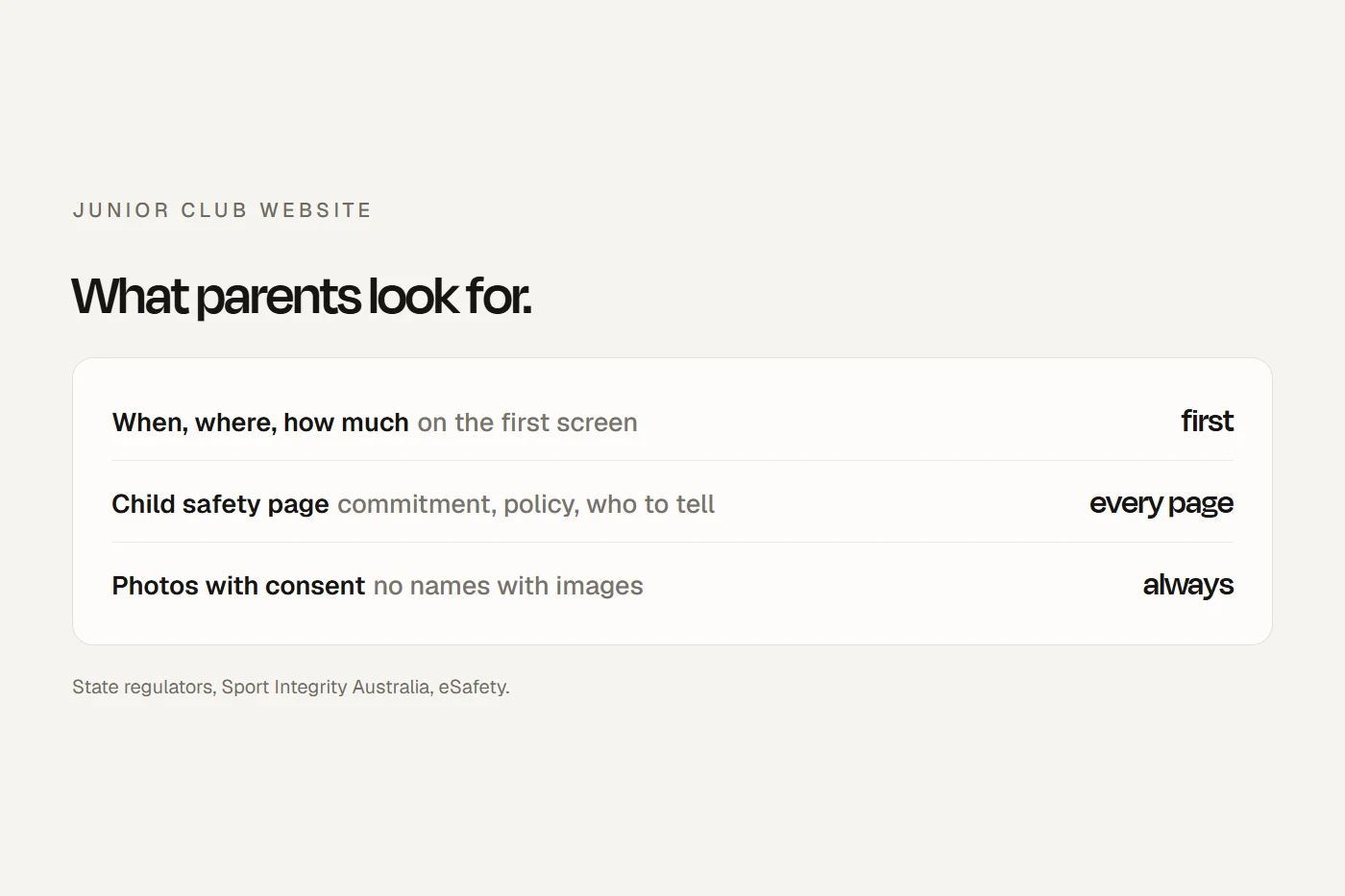
Child safe standards now reach tutoring businesses in Victoria, Queensland, South Australia, Tasmania and the ACT, and South Australia and Queensland include sole traders. NSW's mandatory list doesn't name tutoring, and WA and the NT have no mandatory scheme. For a one-person tutor, compliance looks like a short public commitment to child safety, a code of conduct, a way for parents and children to raise a concern, a photo policy, and safe sessions: the Tutoring Association's code says home sessions should have "a responsible supervising adult present" in an open part of the home, and "Tutoring is NOT allowed to take place in a bedroom."
Pricing, payments and refunds
- Show the full price. If an enrolment or materials fee is compulsory, it belongs in the advertised price. If parents must buy a whole term, show the term total as clearly as the per-lesson price.
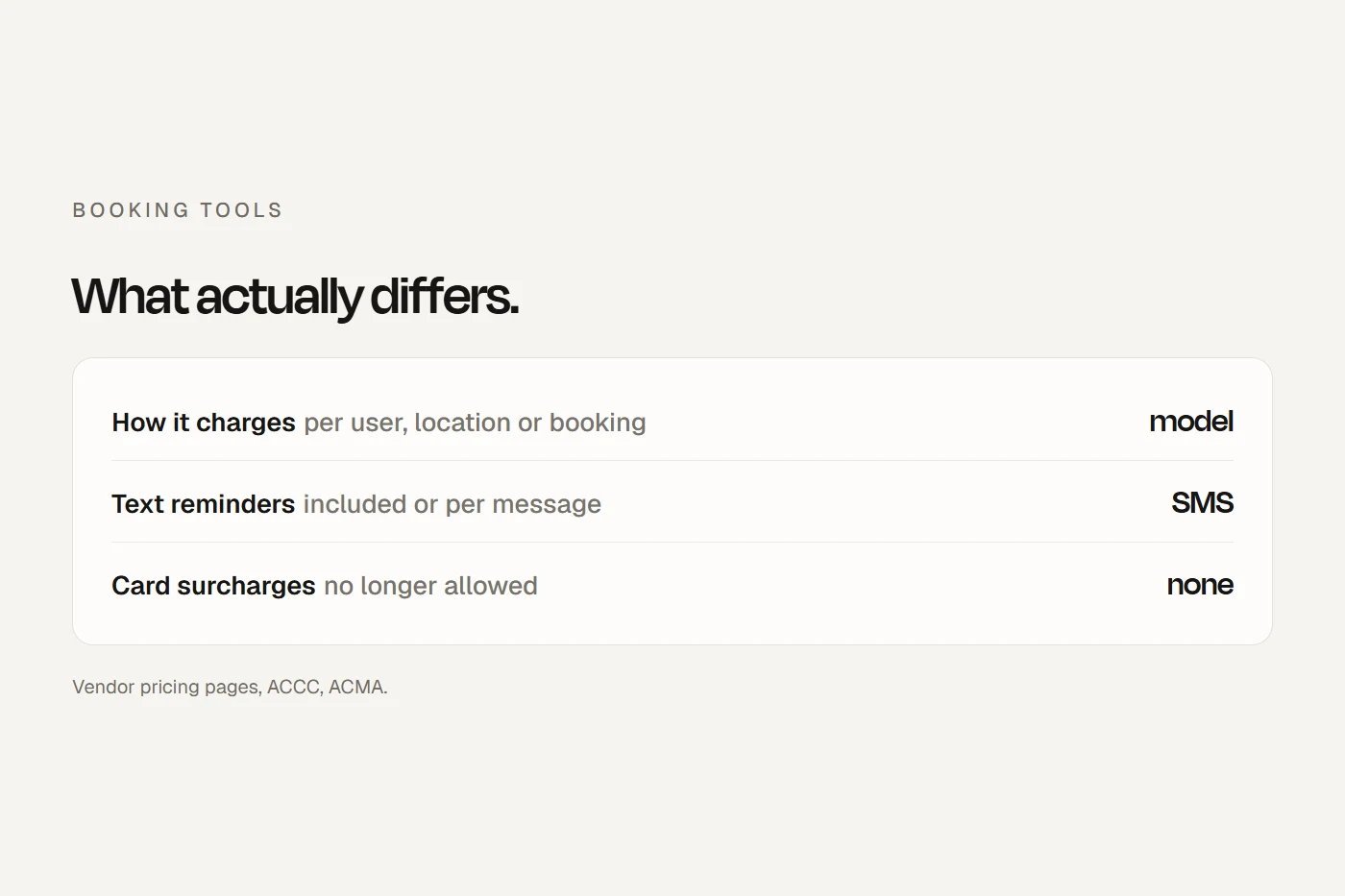
- No card surcharges. They're now banned on Visa, Mastercard, American Express and eftpos. Build the card cost into your price, or offer a discount for PayID or bank transfer.
- Fair cancellation terms. A 24-hour cancellation fee shown before booking, sized to the lost lesson, and matched by a credit when you cancel, is on firmer ground than "term fees non-refundable in all circumstances". Terms that let only you cancel, or penalise only the parent, risk being unfair under consumer law.
- No "no refunds". The ACCC says policies like that can't take away consumer rights, and the Tutoring Association's code says such a sign is misleading.
- "First lesson free" must actually be free, with no hidden fee or lock-in.
What you actually earn an hour
Travel and admin time, more than the hourly price, decide what a tutor earns. Use your own numbers; the defaults are examples only.
Try setting travel to zero, or a platform commission: a platform can bring students and handle admin, but its cut works like a lower hourly price.
Finding students
- Other parents. In one study of parents who used tutoring, most found tutors through other parents, plus school newsletters, parent Facebook groups and noticeboards. Ask every family to tell a friend.
- Google Business Profile. Online-only tutors aren't eligible. If you travel to students, or teach at home without a permanent sign, Google says to list as a service-area business, which keeps your home address off Google. Choose "Tutoring service" as your category and list the suburbs you serve. Ask every family for a review, with no incentive.
- School newsletters. Many public schools won't run tutoring ads. Ask the office for its advertising policy before you design anything.
- Platforms. Tutoring marketplaces charge a commission or charge families to contact you. Run the calculator with the commission before you sign up.
- A simple website. Subjects and year levels, suburbs, prices with totals, your check held and verified (without the number), your terms, and an enquiry form that asks parents, not children, for details.
- Vouchers won't help. NSW's Active and Creative Kids lists academic tutoring as ineligible, and the other states' vouchers are for sport. A music or drama tutor may be able to register as a Creative provider in NSW.
Can I say this?
Paste an ad, a profile or your website copy, and I'll flag the risky claims.
It catches common patterns, not everything.
Your first 90 days
Your ticks save in this browser.
- Get an ABN, if it's a business.
- Register a business name, unless you trade under your own first and last name.
- If you teach in a school, get your employer's approval first.
- Apply for your state's check, and ask about each state your students live in.
- Decide where you'll teach, and call your council before running groups at home.
- Get public liability insurance, and tell your home insurer.
- Write fair terms: prices with totals, cancellations both ways, refunds.
- Set up payments by bank transfer or PayID, with no card surcharge.
- Write a one-page child safety commitment, code of conduct and photo consent form.
- Collect only what you need, from parents, and store it securely.
- Set up a Google Business Profile as a service-area business, if you teach in person.
- Publish a simple website or page with subjects, suburbs, prices and your terms.
- Ask families for referrals and reviews, without incentives.
- Watch your turnover against the GST threshold.
My view
A tutoring business lives on word of mouth, so the setup that matters is the one parents notice: a current check, clear prices, fair cancellation terms and honest claims. Get the GST and check questions right before you grow, because they're the ones that get harder to fix later. And keep the marketing to what you can show: the subjects you teach, how you work and what families say, rather than promises about marks.
Questions I get asked
Is private tutoring legal in Australia?
Yes. You need a Working with Children Check (or your state's equivalent), and the usual business setup. No teaching qualification is required, but only claim one if you hold it.
Do I need an ABN for private tutoring?
If you're running it as a business, yes. If a tutoring company employs you, no.
Do tutors charge GST?
Once registered for GST, yes. Private tutoring isn't GST-free. Registration is compulsory once your turnover reaches the GST threshold.
Do teachers need a Working with Children Check to tutor?
It depends on the state. Victoria exempts registered teachers who notify the regulator; Queensland and the ACT don't exempt them for private tutoring.
Is a tutoring business profitable?
It can be. What you keep depends less on your hourly price than on travel time, admin, cancellations and any platform commission. The calculator above works it out.
About this guide
Written by Joseph Alzein, founder of bdog. bdog builds websites for tutors and education businesses. The rules come from the ATO and ABR, ASIC, the state screening agencies and child safe regulators, the NSW Department of Education, the ACCC and the Australian Consumer Law, Google's Business Profile rules and the Australian Tutoring Association's Code of Conduct, read on 12 October 2026. This is general information, not legal or tax advice.
Main sources: