The TGA Advertising Code, explained for practitioners who sell product
When a post or page becomes an ad for the product, why the clinic is the advertiser, why practitioners can’t endorse products in public, what you can claim, the statements every product ad must carry, goods you can’t advertise at all, and samples and giveaways. With an ad quiz, mandatory statements by product type, a sorter and a 30-day clean-up.
On This Page
- When is it an ad for the product?
- The clinic is the advertiser
- Why practitioners can’t recommend products in public
- What you can claim
- What every product ad must show
- Goods you can’t advertise at all
- Offers, samples and giveaways
- How the TGA enforces it
- Can I say this?
- Your 30-day clean-up
- Questions I get asked
If your clinic sells or recommends supplements, braces, orthotics, TENS units, creams or any other product, there's a second set of advertising rules on top of Ahpra's: the Therapeutic Goods Advertising Code, enforced by the TGA. The TGA's own pages explain it across a dozen separate guidance documents. This guide pulls together what a clinic owner needs: when a post or page becomes an ad for the product, what you can and can't claim, why practitioners can't recommend products in public, the statements every product ad must carry, and what to fix first. It's general information, not legal advice.
- Name a product and the Code appliesPromoting your consults isn't a product ad. A post that names, shows or links to a product is, whatever you meant by it.
- Practitioners can't endorse products"Physio approved", "designed by podiatrists" and "my favourite magnesium" are out in any public ad. Your advice in the consult is fine.
- Claims stop at the product's ARTG entrySay only what the product is approved or listed for, add the mandatory statement, and never "TGA approved".
When is it an ad for the product?
The Therapeutic Goods Act says advertising includes any statement, picture or design intended to promote the use or supply of the goods. The TGA judges that intent by whether the content "on its face appears to be designed or calculated to promote" the goods, not by what you actually meant. So a product page on your site, a reel of you fitting a brace, a shelf talker, an email to past buyers, an affiliate link or a hashtag can each be an ad. A product page counts with or without a buy button.
The line a clinic walks is between the service and the goods. The TGA's guidance says promoting the consultations you offer, or the conditions you see, without referring to products "is unlikely to constitute advertising of therapeutic goods". Its example: "Call our clinic for a consultation to discuss treatment options for migraine" doesn't refer to any product. Name a TENS unit, an orthotic, a probiotic, or a class like "weight loss injections", and the Code applies. Blog posts about a condition on a site that sells products for it can be read as part of the product ads, so keep condition articles product-free or away from the shop.
The clinic is the advertiser
The TGA lists "a health practitioner or health service advertising therapeutic goods or promoting the use of specific goods in promoting its services" as an advertiser. Retailers "are responsible for the material they publish, regardless of whether they have copied that material from product packaging or other websites". So pasting the supplier's description onto your product page makes it your claim. If you pay a content creator or agency, responsibility can sit with both of you, and you're responsible for AI-written content too. Each day a non-compliant ad stays up can count as a new breach, and old posts are covered as well as new ones.
For registered practitioners there's a second layer. Ahpra's guidelines say it doesn't enforce therapeutic goods law, but a breach of it "may form the basis for disciplinary action". The shared code of conduct also asks you to tell patients about any financial interest in products you sell and not to make an unjustifiable profit from them.
Why practitioners can't recommend products in public
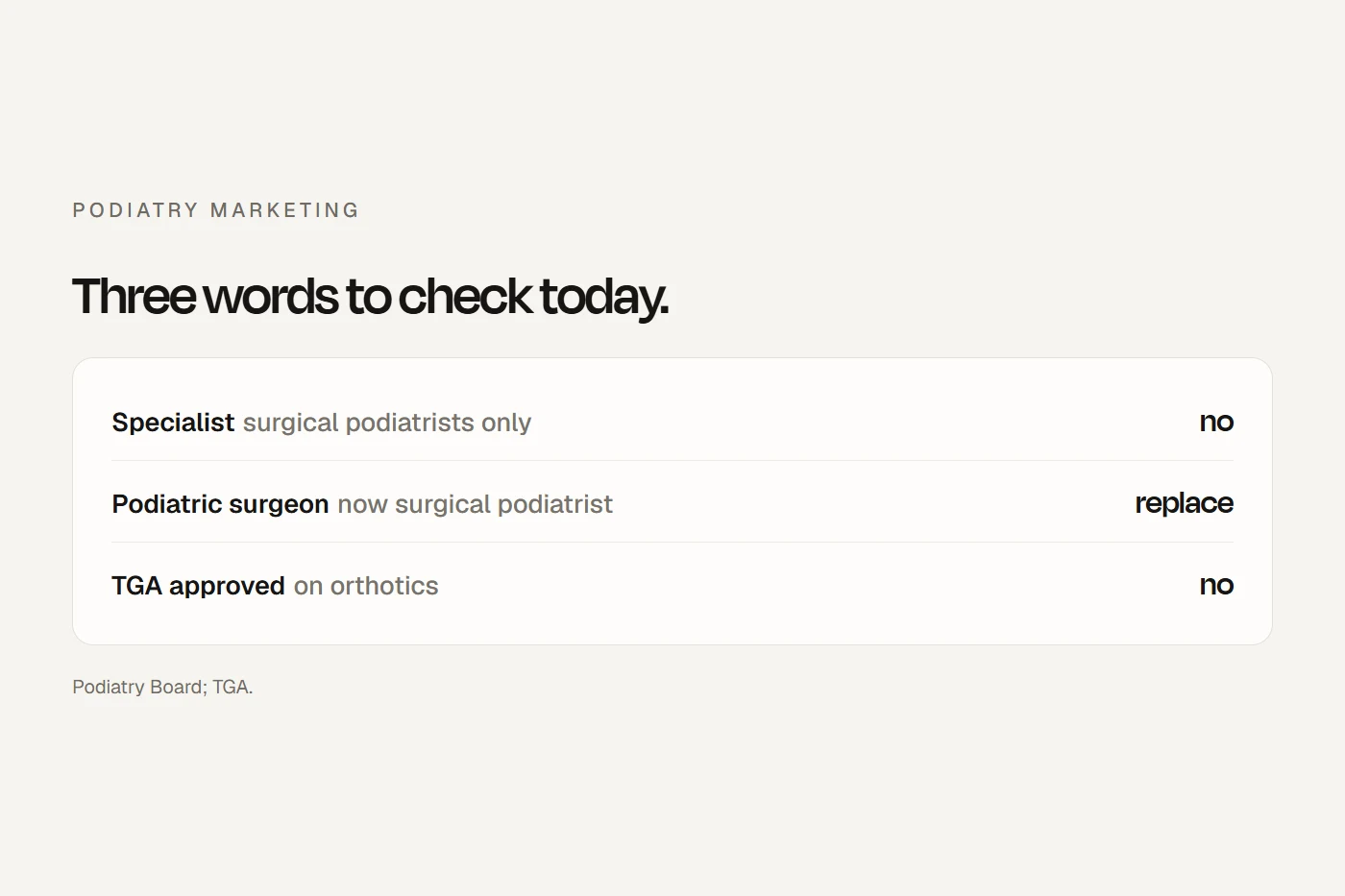
The Code bans endorsements by a current or former health practitioner or health professional, and by anyone who "represents themselves as being qualified or trained to diagnose, treat or prevent" disease or injury. The TGA's own non-compliant insole ad says "Designed by podiatrists", and its example of a personal trainer who says they treat injuries "can neither endorse nor provide a testimonial" about a TENS machine. Healthcare facilities other than community pharmacies can't endorse either. So:
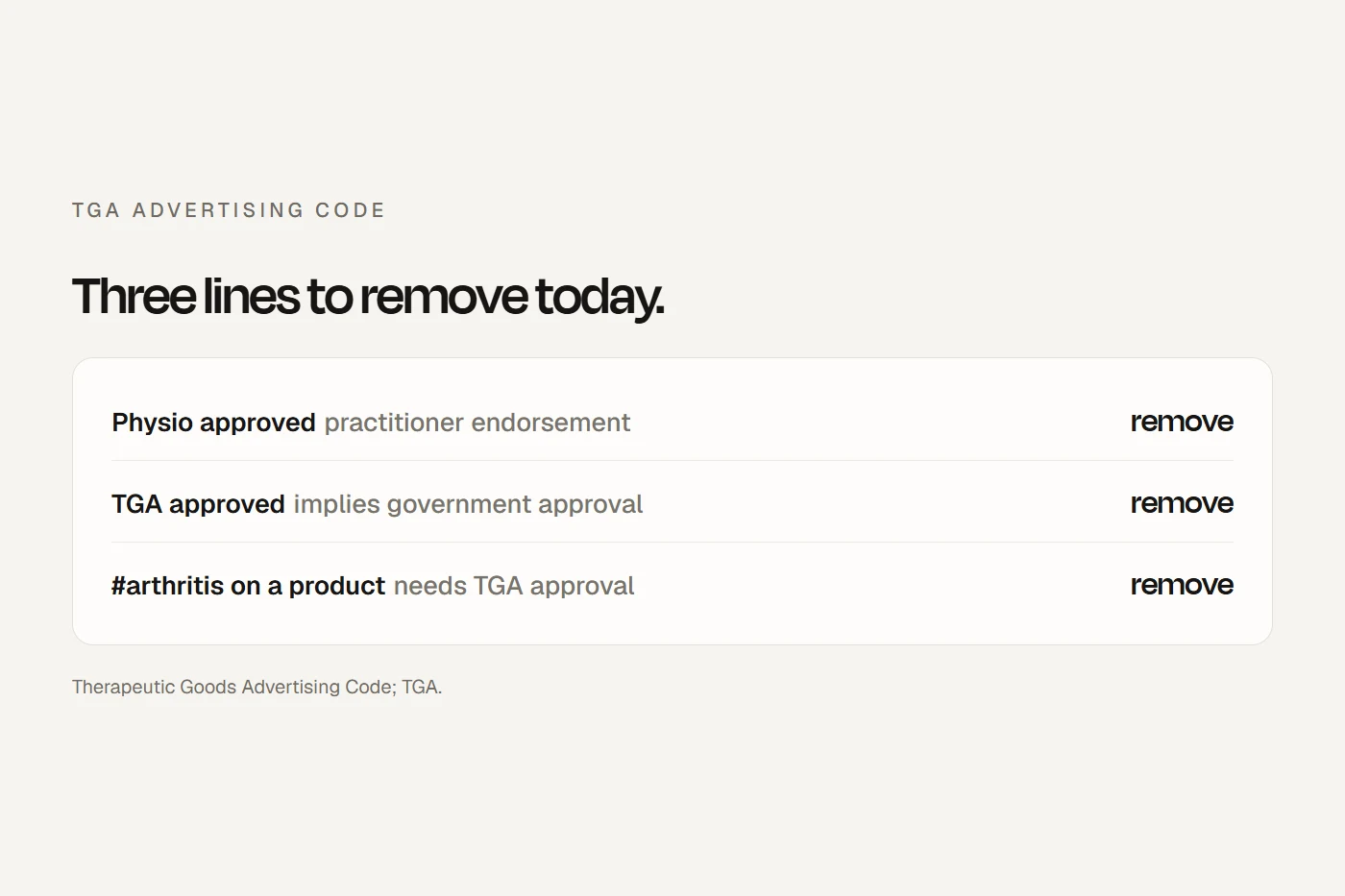
- "Practitioner recommended", "physio approved", "used in our clinic" and staff picks are out.
- A photo or video of a practitioner holding or fitting a product with a recommendation is an endorsement.
- Affiliate links and discount codes from brands are out for practitioners, paid or not, and a "paid partnership" label doesn't fix it.
- Staff testimonials ("I wear these every day") are out, because the clinic supplies the product.
Customer testimonials about a product are only allowed if the person got nothing for them (no discount, voucher, free product or competition entry), the result is typical, the claim is within the product's ARTG entry, and you've verified who said it. Comments under your product posts become part of the ad, so moderate them. For registered practitioners, Ahpra's testimonial ban covers the service as well. My rule for health sites is no testimonials at all.
The consult is the safe place. The Act says the advertising rules don't apply to advice or information given directly to a patient during their treatment, by practitioners it lists. The TGA says that doesn't cover content that's publicly accessible, mass emails to prospective customers, or anyone without an established practitioner relationship. Samples handed to a patient during a consultation are also outside the samples rule.
What you can claim
Stay within the ARTG entry. An ad must not be inconsistent with the indications or intended purpose accepted for the product on the Australian Register of Therapeutic Goods. Advertising a product for something it isn't approved or listed for is a separate offence, and anyone can commit it, not just the sponsor. Look up the product's AUST L, AUST R or ARTG number before you write a word about it. Listed medicines can only use pre-approved claims.
Banned words. No "safe", "no side effects", "works for everyone", "guaranteed", "miracle" or "magic". Nothing that causes fear or suggests harm from not using the product; the TGA's example is a diabetic footwear ad about amputation risk, which it says plays "on the vulnerability of people with diabetes". Nothing that discourages seeing a doctor or taking prescribed treatment ("ditch the painkillers your GP gave you"), and no comparison suggesting other treatments are harmful or ineffectual. A factual comparison is fine: the TGA allows "Unlike braces, aligners allow you to enjoy your favourite crunchy foods" but not "Aligners are better than braces". "Natural" needs care, and never implies safe.
Serious conditions need approval. References to a serious form of a disease are restricted representations that need TGA approval or a permission. The TGA's examples include "May help relieve pain associated with arthritis", "Do not use this product if you have diabetes" and even "We proudly support Osteoporosis Australia"; it says "mild arthritis" may not be a serious form. Claims about cancer, mental illness, sexually transmitted diseases, HIV and hepatitis C are prohibited for any product, so "magnesium for anxiety" is out. Hashtags count: #arthritis on a product post advertises the product for arthritis.
Research claims like "clinically proven" or "studies show" need the researcher, who funded it and a citation a consumer can find, and they must fit the wider evidence.
Never "TGA approved". Being on the ARTG isn't an endorsement. "TGA approved", "TGA registered", a TGA logo or the Coat of Arms are all out, and so is "TGA listed" without the number. The wording the TGA accepts is, for example, "listed in the ARTG, AUST L [number]".
What every product ad must show
The statements depend on the product type. On social media they must be visible at all times, in the caption's first lines or on the image, not hidden behind "see more"; on video, as an overlay repeated often enough to be noticed. Social posts are never "short form" ads. Hashtags can sit below the fold.
Medicines, including listed vitamins and herbal products
- Every ad
- The product name, at least one accepted indication from its ARTG entry, and "ALWAYS READ THE LABEL AND FOLLOW THE DIRECTIONS FOR USE"
- If people can buy without seeing it
- Add the dosage form, quantity, each active ingredient, and the health warnings or a direct link to them. An image of the label isn't enough
- Traditional-use claims
- A statement such as "ECHINACEA IS TRADITIONALLY USED IN WESTERN HERBAL MEDICINE"
- Weight products
- The healthy diet and activity statement, and no results beyond what's typical
Medical devices: TENS units, insoles, supports
- Every ad
- The trade name, an accurate description, at least one accepted intended purpose, and "ALWAYS FOLLOW THE DIRECTIONS FOR USE" or "ALWAYS READ THE LABEL AND FOLLOW THE DIRECTIONS FOR USE"
- If people can buy without seeing it
- Add any health warnings, or a direct link to them
- Custom-made devices
- "Custom-made" can be used for personalised devices like orthotics
Practitioner-only products shown in public
- Every ad
- "THIS PRODUCT IS NOT AVAILABLE FOR PURCHASE BY THE GENERAL PUBLIC", plus the name and at least one accepted indication or purpose
- The alternative
- Recommend it in the consult only, or leave its marketing to the supplier's locked practitioner portal. A patient "members' area" isn't a practitioner portal
A listing with only name, picture and price
- Mandatory statement
- Not needed, if the ad is only the name, a picture, the price and where to buy, with no therapeutic claim and no buy button
- Still applies
- Every other Code rule, including no endorsements
If you take a product order over the phone or by Instagram message, give the health warnings before the sale; the TGA has called a phone sale without them non-compliant.
Goods you can't advertise at all
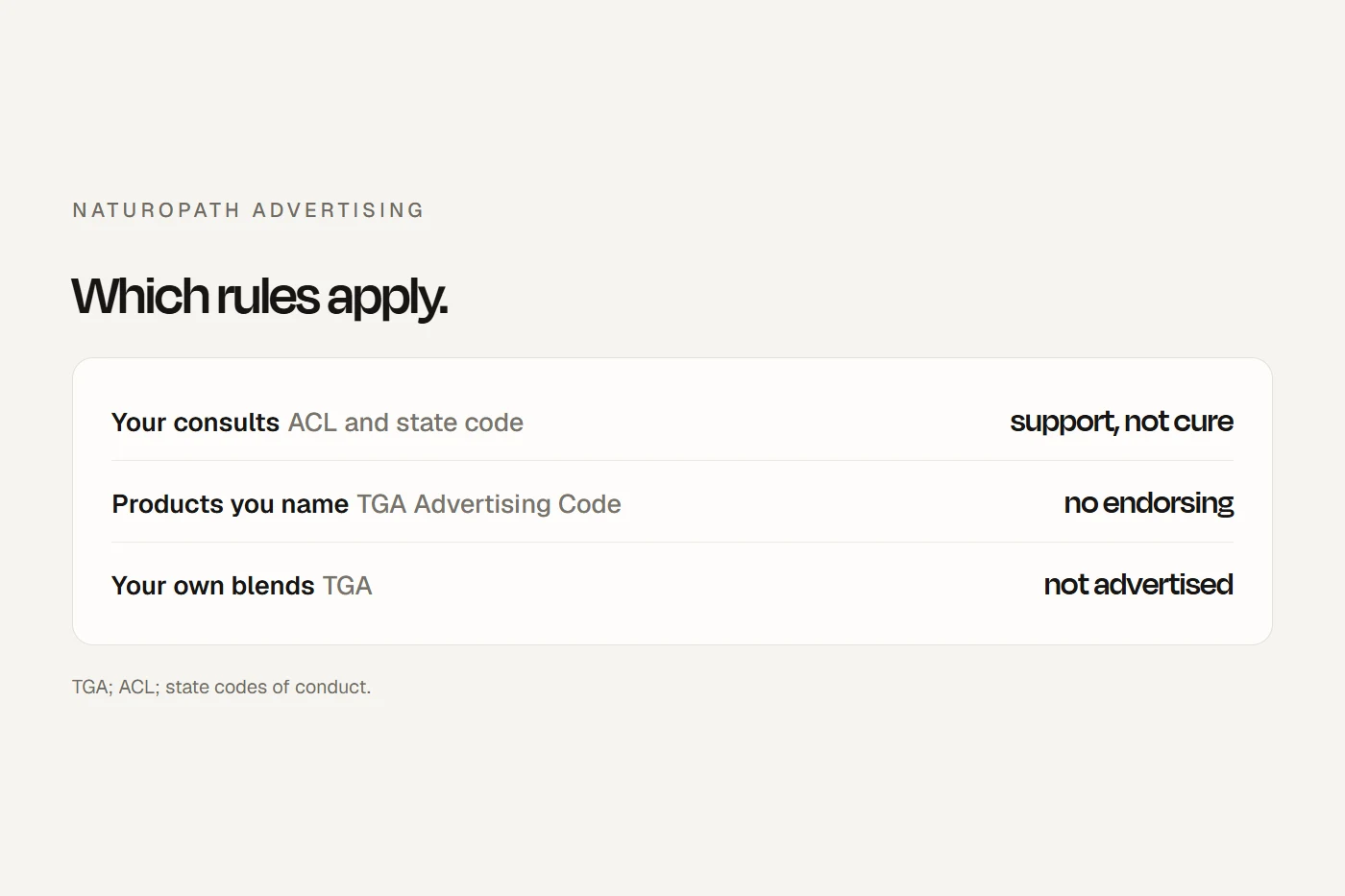
Prescription-only medicines, pharmacist-only medicines outside a short list, compounded medicines, unapproved goods and most biologicals can't be advertised to the public. The TGA says indirect references count too: nicknames like "anti-wrinkle", "weight-loss shots" or "plant-based medicine", hashtags, business names and logos, booking menus, price lists, waiting room displays, and before-and-after photos that imply the medicine's effect. Its examples include a wellness centre promoting a hair-loss service that named a prescription medicine, and a pain clinic with a window sign inviting people to ask about medicinal cannabis. You can still advertise the service, such as a consultation, without naming the medicine. A naturopath can advertise "custom formulas made after your consult", but not the blends.
Offers, samples and giveaways
A sale offered to everyone equally is fine, though the product ad still needs its statements. A free product is a "sample", and samples are banned except for a short list of goods like sunscreen, condoms and wound dressings; supplements, braces and TENS units aren't on it. "Buy one, get one free" of the same product isn't a sample; a free different product is. A giveaway of supplements or a TENS unit is likely a sample, and asking people to share their story with your product to enter makes their posts paid testimonials. Front-desk staff who aren't health professionals can't be paid commission to recommend products.
How the TGA enforces it
Most matters start with a warning letter and end when the ad is fixed. The TGA sends many thousands of warning letters a year, asks platforms to take down ads, and uses infringement notices, published directions, enforceable undertakings and court action for repeat or serious cases. Anyone can report an ad, anonymously. Its recent priorities include listed medicine advertising and products used in cosmetic procedures, with a focus on digital channels and influencers. Cases relevant to clinics include a compounding pharmacy that referred to serious conditions on its website alongside a wellness centre that advertised a prescription infusion product, a TENS company that claimed its device treated endometriosis and called it safe, and a hyperbaric device company whose pseudo-scientific articles the Federal Court said were aimed at a vulnerable audience.
Can I say this?
Tap a card to see the verdict.
Your 30-day clean-up
Tick items off as you go; the list remembers your progress on this device.
- Week 1: list every place a product appears Shop and product pages, blog posts, old social posts and highlights, link-in-bio pages, Google profile, emails, SMS, shelves and signs.
- Week 1: look up each product's ARTG entry Note what it's approved or listed for. If it isn't on the ARTG or exempt, stop advertising it.
- Week 1: remove anything you can't advertise Prescription-only, compounded or unapproved goods, including nicknames, hashtags and prices.
- Week 2: rewrite claims to match the ARTG entry No safe, guaranteed, miracle, "better than" or uncited "clinically proven".
- Week 2: remove serious-condition and prohibited words From product copy and hashtags, unless the product holds an approval.
- Week 2: remove endorsements Practitioner and clinic recommendations, staff picks, practitioner photos with products, affiliate links.
- Week 2: remove "TGA approved" and government logos
- Week 3: add mandatory statements By product type, visible in captions or on images, as overlays on video.
- Week 3: complete buy pages Dosage form, quantity, active ingredients and health warnings or a direct link.
- Week 3: practitioner-only products Add the statement, or move them to the consult.
- Week 4: testimonials removed Paid, gifted or unverified ones at minimum; on a health site, all of them.
- Week 4: comments moderated On product posts, checked weekly.
- Week 4: samples and giveaways stopped Outside the consult.
- Week 4: anyone who posts for you briefed in writing Staff, agencies and creators, with drafts reviewed.
- Week 4: a substantiation file per product The ARTG summary, the label and the evidence behind any claim.
Questions I get asked
Does the TGA Advertising Code apply to my clinic?
Yes, whenever you advertise a product: naming, showing, linking to or selling it. Advertising only your consultations and the conditions you see generally isn't a product ad.
Can a practitioner recommend products on social media?
Not in public. The Code bans endorsements by health practitioners and anyone who claims to treat. You can recommend products to your own patients during their treatment.
What mandatory statement do I need?
For medicines, "Always read the label and follow the directions for use"; for devices, that or "Always follow the directions for use", with the product name and an accepted indication or purpose. On social media the statement must be visible without tapping "see more".
Can I say a product is TGA approved?
No. Use "listed in the ARTG" or "registered in the ARTG" with its AUST L, AUST R or ARTG number.
Can I post customer reviews of products I sell?
Only if the person got nothing for it, the result is typical and within the product's approved use, and you've verified it. Registered practitioners also face Ahpra's testimonial ban, and I leave reviews off health sites.
Can I run a giveaway of products?
Usually not. A free therapeutic product is a sample, and samples are banned for most goods outside the consult.
About this guide
Written by Joseph Alzein, founder of bdog. I build websites for clinics, built with Ahpra's advertising guidelines and the TGA's rules in mind. Sources were checked on 12 October 2026. This is general information, not legal advice. I've left out penalties.
Main sources:
- Therapeutic Goods Advertising Code
- TGA: determining if your content is advertising
- TGA: advertising health services that involve therapeutic goods
- TGA: testimonials and endorsements
- TGA: prominently displayed information and mandatory statements
- TGA: "TGA approved" must not be used
- TGA: cosmetic or therapeutic good
- TGA: compounded medicines
- TGA: compliance and enforcement
- Ahpra: shared code of conduct