How town planners and surveyors win work in Australia
How clients find a planner or surveyor, the surveyor titles each state protects, the planner credentials that are current, approval promises and success rates, referral money, council panels and the channels worth your time. With a channel value calculator, a wording sorter and a 90-day checklist.
On This Page
- How clients find a planner or surveyor
- Surveyors: what your state protects
- What a surveyor’s website should show
- Planners: the credential to use, and the one to drop
- Approval promises, success rates and speed
- What is each channel worth?
- Channels that bring the work in
- Can I say this?
- Your first 90 days
- Questions I get asked
Surveyors and town planners mostly win work through other people: the architect who needs a survey before drawing, the builder who needs set-out, the homeowner whose council checklist asks for a plan "prepared by a registered surveyor". Very little marketing advice is written for either profession, and most of it ignores the rules that decide what you can claim. This guide covers how clients find you, the surveyor titles each state protects, the planner credentials that are current and the ones that aren't, approval promises, referral money, panels, and the channels worth your time. It draws on each state's surveying Act and board, the Planning Institute of Australia's by-laws and code, South Australia's accredited professionals scheme, NSW certifier guidance and the Australian Consumer Law. It's general information, not legal advice.
- Name the person who signsClients are told to check the surveyor defining their boundaries is licensed. Give the registered surveyor's name, state title and number, linked to the register.
- Never promise an approvalCouncil or the panel decides. "Guaranteed DA approval" and "approved in 10 days" are promises about the future you can't back up.
- Win the referrersArchitects, designers, builders and conveyancers send most jobs. Make their work easier, and don't pay per referral.
How clients find a planner or surveyor
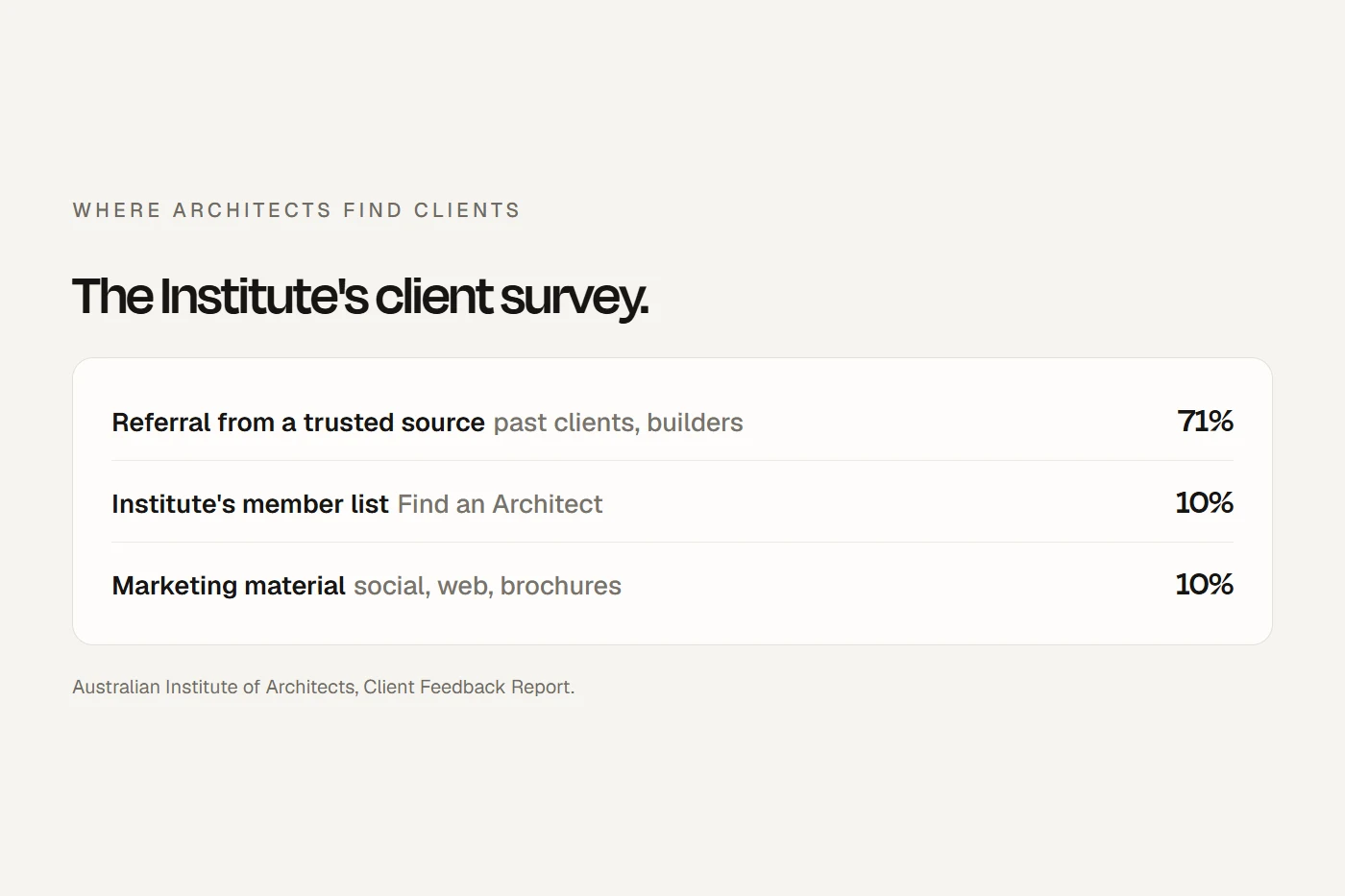
I couldn't find an Australian survey of how homeowners, builders, architects or developers choose a town planner or a land surveyor. The nearest is the architects' institute's client research, where most clients came through a referral from someone they trusted. That's a different profession, but it matches how this work moves.
The regulators give a clue too. Victoria's surveyors board tells the public where to look for a licensed surveyor: the consulting surveyors association's Find a Surveyor directory, Yellow Pages under "Land Surveyors", and the state registers. It also tells owners to "Always check that the surveyor defining any boundaries of your property is licensed", and, when hiring a firm, to confirm it uses a practising licensed surveyor. Your website should make that check easy.
Often the job starts with a council checklist. The City of Sydney, for example, asks for a contour and detail survey with most development applications, and says it "must be prepared by a registered surveyor and show their name and Surveyors ID number". It suggests applicants give the requirements to their surveyor when they instruct them. Other councils publish their own lists. So the homeowner arrives with a document in hand, often passed on by their architect, designer or builder, asking "what survey does council want?" A page that answers that in the council's own terms meets them at that moment.
One client is usually several jobs. The survey comes before the design and the DA, the planner handles the application and council's requests, and set-out by a registered surveyor follows once the construction certificate is issued. A subdivision adds more steps. Firms that show the whole sequence get asked back for the next stage.
Councils are clients as well as assessors. The Planning Institute's report on the profession found more planners work in local government than in private practice, that most planner owner-managers have no employees, and that many smaller and regional councils contract work out to planners elsewhere.
Surveyors: what your state protects
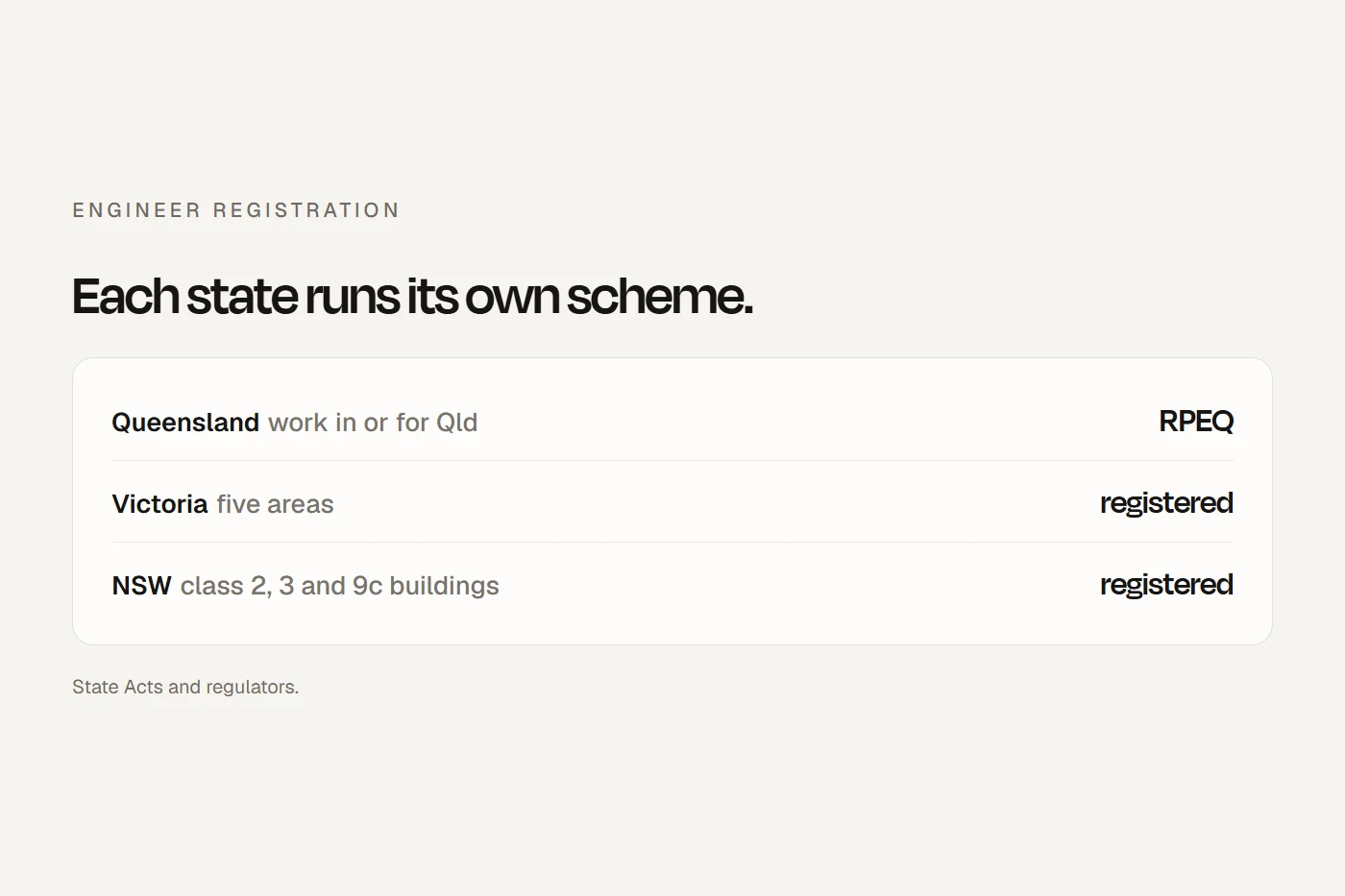
Every state and territory reserves boundary surveying for a registered or licensed surveyor, or someone under their supervision, and makes it an offence to claim that status when you don't hold it. The title and what's protected differ:
| State | Title | What the law protects | Regulator |
|---|---|---|---|
| NSW | Registered land surveyor | Doing land surveys for a fee, and advertising that you will, unless registered. A firm may advertise if a registered land surveyor does or supervises every survey | Board of Surveying and Spatial Information |
| Vic | Licensed surveyor | The title, the letters "L.S." and any claim to be registered. Only practising licensed surveyors may do title surveys | Surveyors Registration Board of Victoria |
| Qld | Registered surveyor, with a cadastral endorsement for boundary work | Claiming a registration you don't hold, holding out staff as registered, and running a cadastral surveying business without a consulting cadastral surveyor | Surveyors Board of Queensland |
| WA | Licensed surveyor | The title and anything implying it. Authorised surveys need a practising certificate | Land Surveyors Licensing Board |
| SA | Licensed surveyor or registered surveyor | The reserved titles, including describing unlicensed staff with them "in the course of advertising" | Surveyors Board of South Australia |
| Tas | Registered land surveyor or land surveyor | Both titles. "Land Surveyor" on its own is reserved for the Land competency | Surveyor-General's register |
| ACT | Registered surveyor | Pretending to be a surveyor. The Act's own example is "registered surveyor" on a letterhead or in an advertisement | ACT Registrar of Surveyors |
| NT | Licensed surveyor | The title and any initials or description implying it. A company may offer boundary surveys through a licensed officer or employee | Surveyors Board of the NT |
Scroll the table sideways to see every column.
Queensland's regulation lets a cadastral surveyor use the title "registered surveyor" with the word "land" after it. In the ACT, the government's guidance says you must always identify in advertising that you're registered, and you may call yourself a "consulting surveyor" or "land surveyor" only if you're registered and qualified for boundary surveys.
What a surveyor's website should show
- The surveyor who signs. Their name, the exact state title and their registration or licence number as it appears on the register, with a link to it. In Victoria, the register shows whether a surveyor is practising or non-practising, and only practising surveyors may do cadastral surveys.
- "Our team of registered surveyors" only if it's true of everyone. Queensland makes it an offence to hold out an employee as registered when they aren't, and South Australia bans describing unlicensed staff with a reserved title when advertising.
- Which work is reserved. Boundary, identification, subdivision and title work needs a registered or licensed surveyor in that state. Detail, contour and construction set-out surveys generally don't, so staff can advertise them, but never attach a reserved title to someone who doesn't hold it. Victoria's board warns that unlicensed people "have been known to advertise title (cadastral) survey services on their business websites".
- Each state you work in. Before you advertise boundary surveys across a border, you need a surveyor registered there, or covered by mutual recognition with any notice the board requires. Queensland surveyors can't use automatic mutual recognition in WA, Tasmania or the ACT.
- Insurance, stated plainly. Professional indemnity cover is compulsory in WA, for Queensland consulting surveyors and in South Australia, and Victoria's board tells consumers to ask about it. "Professional indemnity insured" is a fair line where it's true.
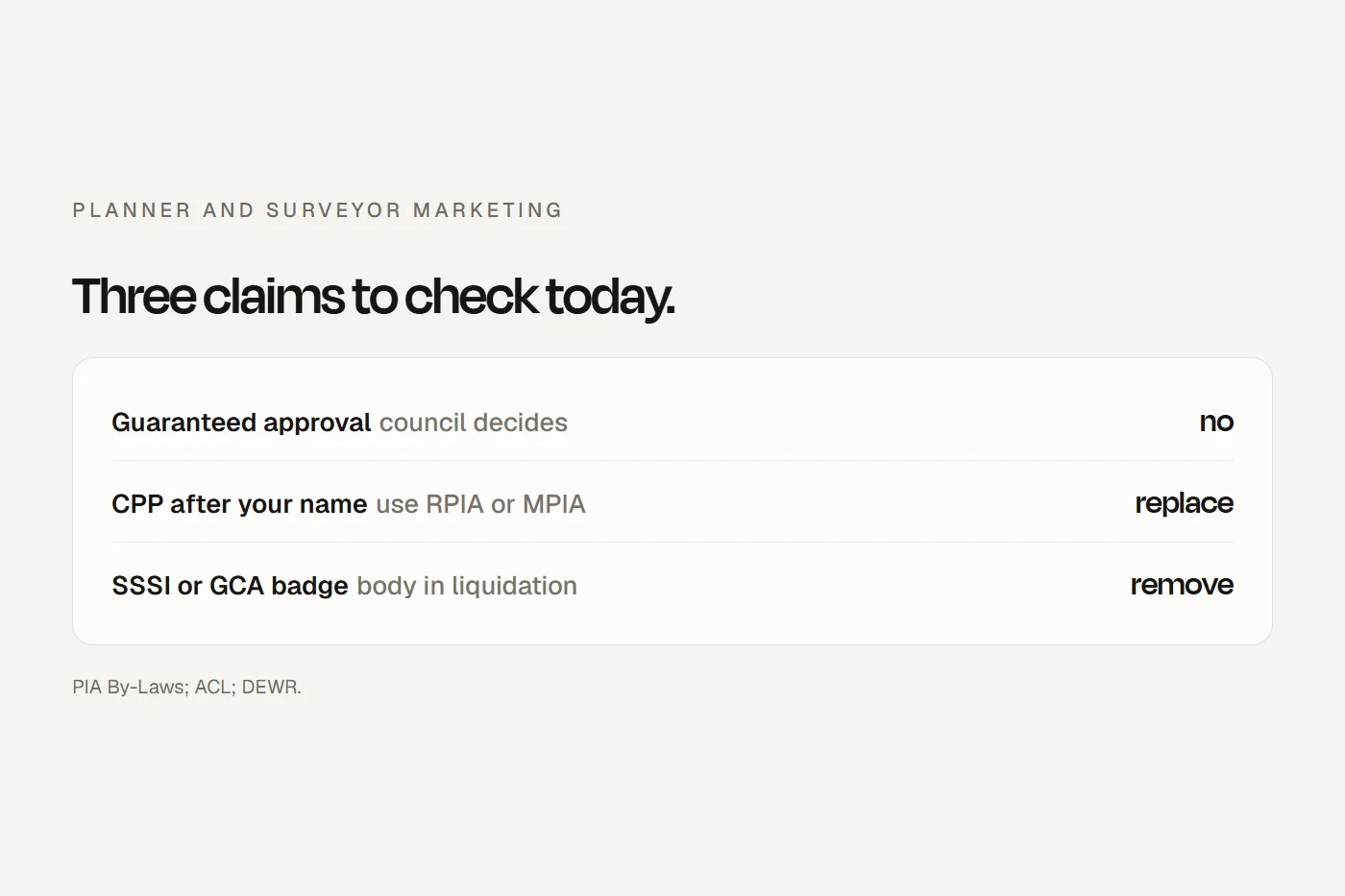
- Current memberships only. SSSI merged into the Geospatial Council of Australia, which went into liquidation in August 2025, and the NSW board no longer recognises it for professional development. Take down any SSSI or GCA badge. Membership of your state's institution or consulting surveyors association is worth showing while it's current.
The codes of conduct in Queensland, the NT, WA and South Australia ban false or misleading advertising, and several states ban running down other surveyors or trying to take over a job another surveyor already holds. South Australia's advertising policy goes further: your ads must not "belittle, compare or claim superiority over other surveyors". The WA and SA codes ban "offering inducements to secure work", and in the NT, paying someone to secure work is a ground for removal from the register. NSW and WA expect you to tell the client the approximate cost and duration before you start, so a clear quote process is something to show on your site.
Planners: the credential to use, and the one to drop
No state licenses the title "town planner". What exists instead is your Planning Institute membership grade and, in some states, a statutory role.
Registered Planner (RPIA). The Institute's top grade, for Full Members with at least five years' experience who pass a competency assessment. Registered Planners keep it through yearly professional development and a code of conduct quiz, or they go back to Full Member. Under the Institute's by-laws, members "must only use the honorific relevant to their grade", and can't use it while suspended, resigned or in arrears. So "[Name] RPIA" belongs to a person, and "a firm of Registered Planners" is only true if every planner holds the grade. Link to the Institute's public Members Register so clients can check.
Drop "CPP". The Certified Practising Planner suffix was phased out and has been invalid since 30 June 2018. If it's still in your bio, email signature or LinkedIn headline, replace it with your current grade.
The Institute's code. It has no clause about advertising or outcome claims, but several clauses shape your marketing. You must "accurately represent their qualifications, work experience and prior responsibilities", which covers lines like "former council assessment manager". You need a written fee agreement before you start, professional indemnity cover, and you must not try to supplant another member already engaged on a job. You must not offer inducements to influence a planning decision, and you must tell clients about any commissions you receive from third parties. Success fees are allowed, but the Institute warns they can become an inducement, so "no approval, no fee" needs care.
South Australia's accredited professionals. Planners who assess applications there must be accredited, at Planning Level 1 to 4, and the scheme's logo may be used on websites only if "clearly linked to the individual Accredited Professional". An accredited professional must not assess a development they helped plan or design, so "we prepare and approve your application" is out. Preparing applications is fine, and assessing other people's is fine; one firm can't do both for the same development.
NSW certificates. Complying development and subdivision certificates are issued by registered certifiers or councils, not by a planner who isn't registered as a certifier. A certifier also can't certify a strata plan they or someone related to them prepared. Building Commission NSW puts it plainly: "Receiving a certificate is not guaranteed".
Approval promises, success rates and speed
Under the Australian Consumer Law, a statement about the future, like an approval or a timeframe, is taken to be misleading unless you had reasonable grounds for it, and it's up to you to show them. An approval is a decision council or a panel makes, not you, so "guaranteed DA approval" is very hard to back up. The ACCC says businesses shouldn't "make promises they can't keep".
A success rate is a factual claim. "98% of our DAs approved" needs records behind it and a stated base: every application you lodged, not just the ones you chose to take on. "Approved in 10 days" is a promise about timing council controls. Even NSW's own complying development page says approvals "can be issued in as little as" a set number of days, which is a best case, not a promise.
What you can say is what you control: you lodge complete applications, you know the controls that apply in each council, and you answer council's requests quickly, if you do. Every state's planning system has an assessment clock, and the clock usually stops when council asks for more information, so a complete application is the honest version of "fast".
What is each channel worth?
Run this once for each referrer type or channel. The defaults are made up, not industry figures.
On the made-up figures, 20 architect referrals become 18 proposals and 9 jobs. At $3,000 plus one $1,500 follow-on, each client is worth $4,500, so the channel brings in $40,500. Valuing 30 hours of your time at $100 an hour, it costs $3,000: about $333 a job and $1,350 back for every $100. Try $400 a month of Google Ads plus 10 hours of your time ($5,800), 40 enquiries, 60% proposals and 25% wins: 6 jobs, $27,000, about $967 a job and about $466 back for every $100. Ads can still be worth running; the point is to know which channel to feed first.
Channels that bring the work in
Architects, building designers and builders. They meet the council checklist first and name a surveyor and a planner. Win them with turnaround and clean files: the format, datum and detail the council's survey requirements ask for, delivered when promised. Credit each other on project pages, with the client's consent.
Conveyancers, solicitors and real estate agents. They bring identification surveys and boundary questions at sale. Give them a one-page explanation of when a client needs a surveyor and a fast way to get a quote. Don't offer them money: NSW conveyancers who refer to a surveyor must disclose any benefit they get, agents have their own disclosure duties, and some states ban those payments outright. The WA and SA surveyors' codes ban inducements to secure work, the NT treats paying for work as a ground for removal, and the Planning Institute's code requires you to tell clients about third-party commissions. A referral swap with no money is the clean version.
Council and state panels. Councils and state agencies run panels for planning assessment and for surveying, often for a fixed term. The NSW Consultants in Construction scheme has categories for town planning and land surveying, and Queensland's prequalification system lists consulting surveyors. You'll need referee reports and insurance certificates. Name the scheme and category exactly on your site, and remove it if it lapses. Watch your councils' tender pages.
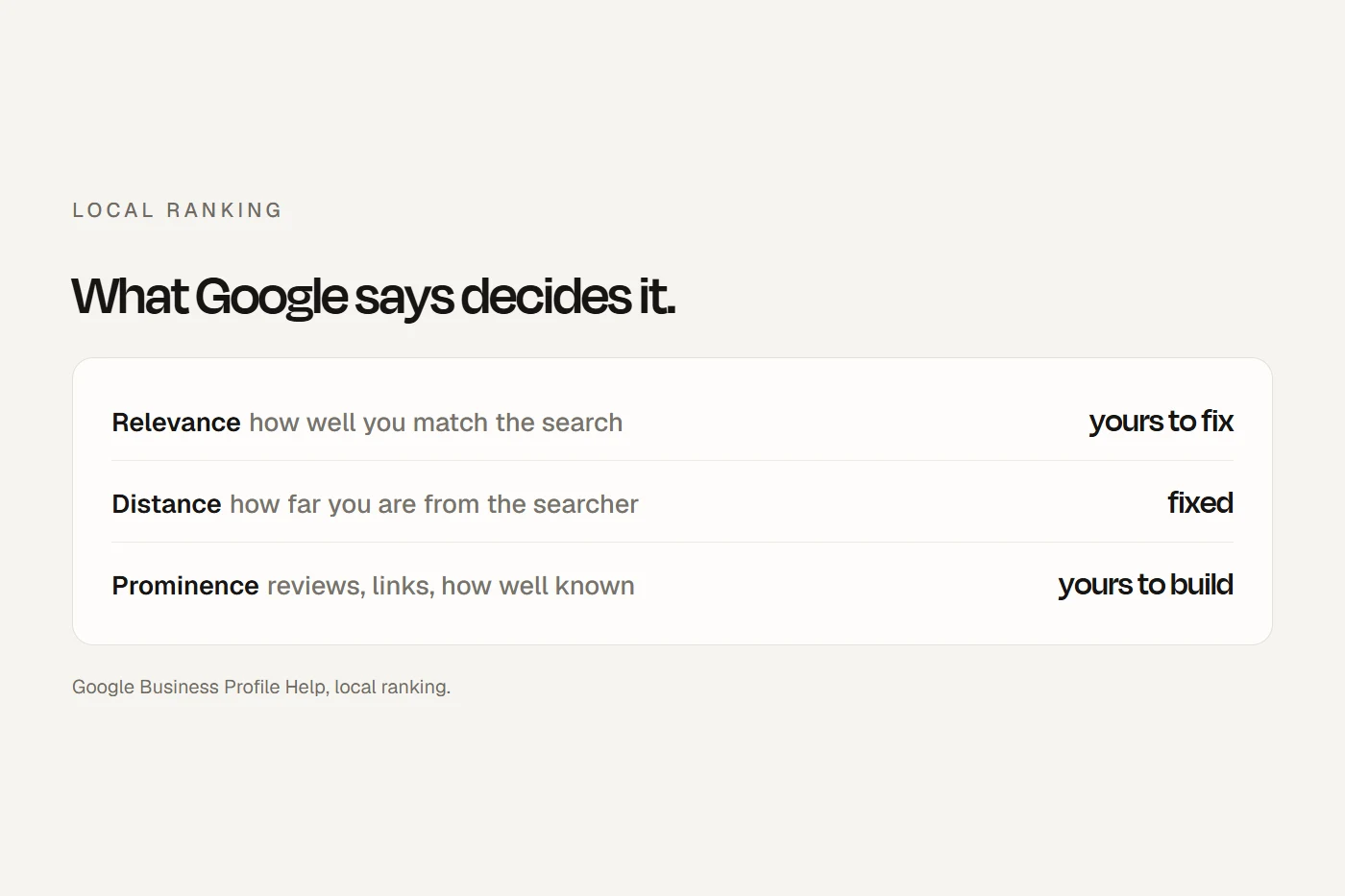
Google Business Profile. Surveyors can choose "Surveyor" or "Land surveyor" as their category. I couldn't find a "Town planner" category in the lists I checked, so open the live category picker and choose what describes your business. Avoid government categories like "Urban planning department", which describe a council, not a consultancy. If you work from home, set up as a service-area business with your address hidden. My guide to local SEO for small businesses covers the setup.
Your website, one page per council. A page for each council you actually lodge with is useful: that council's lodgement checklist and survey requirements in plain English, the planning controls that apply, the approval pathways available there, and real projects in the area. Forty suburb pages with the name swapped is the pattern Google's spam policies call doorway abuse, and the ACCC has acted against a business that claimed to be local in towns where it had no presence.
Case studies and testimonials. Planners and surveyors aren't under the health rules, so genuine testimonials are fine. Get written consent before you name a client or show their address, even though DA records are often public. Naming the council in the text ("approved by council after a review") is a fact. A strip of council logos can suggest an endorsement or a panel spot you don't hold, so name councils in words instead.
Directories and registers. Join your state association's directory, keep your register entry matching the name on your website, and link to it. Clients are told to check the register.
LinkedIn. It's where you can reach council officers, developers' project managers and architects by name. Posts about a council's changed controls or a site problem you solved suit it. Title rules apply to your profile headline too.
Google Ads. They suit homeowner jobs with a clear trigger, like a DA survey, a granny flat or a subdivision, more than developer or council work.
Can I say this?
Tap a card to see the verdict.
Your first 90 days
Tick items off as you go; the list remembers your progress on this device.
- Month 1: name the person who signs State title, number and a link to the register. Planners: each person's grade.
- Month 1: old badges removed CPP, SSSI and GCA.
- Month 1: claims rewritten No approval guarantees or timeframes; success rates only with a stated base.
- Month 1: Google Business Profile Category from the live picker, service areas, home address hidden.
- Month 1: enquiries counted by source Every call and form, so the calculator has real numbers.
- Month 2: one page per council you lodge with Its checklist and survey requirements in plain English, with real projects.
- Month 2: three case studies Client consent, council named in words, no logos.
- Month 2: three referrers met Architects, designers or builders. Agree turnaround and file format, no referral payments.
- Month 2: a one-page guide for conveyancers and agents When a client needs a survey, and how to get a quote fast.
- Month 3: panels checked NSW Consultants in Construction, Queensland prequalification or your councils' panels, with referees and insurance certificates ready.
- Month 3: directories updated Your association's directory and register entry match your site.
- Month 3: review requests To every finished client, with no reward.
Questions I get asked
How do surveyors get more clients?
Mostly through architects, designers, builders and conveyancers, so make their work easier with fast turnaround and the files council asks for. Name your registered or licensed surveyor on your site with a link to the register, build a page for each council you work with, and keep your association directory listing current.
Do town planners need a licence?
No state licenses the title "town planner". The Planning Institute's Registered Planner grade is the main credential, and some roles, like South Australia's accredited professionals or NSW registered certifiers, need their own accreditation.
Can I still call myself a Certified Practising Planner?
No. The CPP suffix has been invalid since 30 June 2018. Use the honorific for your current Planning Institute grade, such as RPIA for a Registered Planner.
Can I advertise guaranteed DA approval?
No. Council or a panel makes the decision, and a promise about the future is misleading unless you had reasonable grounds for it. Describe what you control instead, like complete applications and quick answers to council's requests.
Can a surveying firm advertise boundary surveys?
Yes, if a registered or licensed surveyor in that state does or supervises every boundary survey. In Queensland, the business must work through a consulting cadastral surveyor.
Should I still show an SSSI badge?
No. SSSI became the Geospatial Council of Australia, which went into liquidation in August 2025. Show the memberships you currently hold.
About this guide
Written by Joseph Alzein, founder of bdog. I build websites for planners, surveyors and other professional firms. Sources were checked on 12 October 2026. This is general information, not legal advice. Rules differ by state and change, so check your board's and the Institute's pages. I've left out fees and penalties.
Main sources:
- Surveyors Registration Board of Victoria: ways of finding a licensed surveyor
- Surveyors Registration Board of Victoria: protect your property
- City of Sydney: survey plan requirements for DAs
- Surveying and Spatial Information Act 2002 (NSW)
- Verify NSW: registered surveyors
- Surveyors Act 2003 (Qld)
- Surveyors Board of Queensland: code of practice
- Land Surveyors Licensing Board WA: for consumers
- Surveyors Board of South Australia: standing operating procedures and advertising policy
- Surveyors Act 2002 (Tas)
- ACT Government: surveyors registration
- Licensed Surveyors Act 1983 (NT)
- Department of Employment and Workplace Relations: new assessing authority for surveyors
- Planning Institute of Australia: grades and eligibility
- Planning Institute of Australia: Members Register
- PlanSA: accredited professionals scheme
- Building Commission NSW: certifier conflicts of interest
- Google Search: spam policies