What a tutoring website needs
Page by page for a solo tutor or small centre: the checklist parents are given, how to show your Working with Children Check, teacher and exam-name claims by state, a pricing page that meets the ACCC rules, reviews, photos and online lessons. With a page checklist, a can-I-say-this sorter, a trust-line builder and an enquiry calculator.
On This Page
A tutoring website has one job: get a parent who has never met you to book a first meeting. To do that it has to answer what parents are told to check, in the order they check it, without promising things the law and the exam bodies say you can't. This guide goes page by page, for a solo tutor or a small tutoring centre anywhere in Australia. It's about the site itself; my guide to marketing a tutoring business covers getting found. I build tutoring websites, and the rules here come from the ACCC, the Working with Children Check regulators, the state teacher registration laws and the exam bodies.
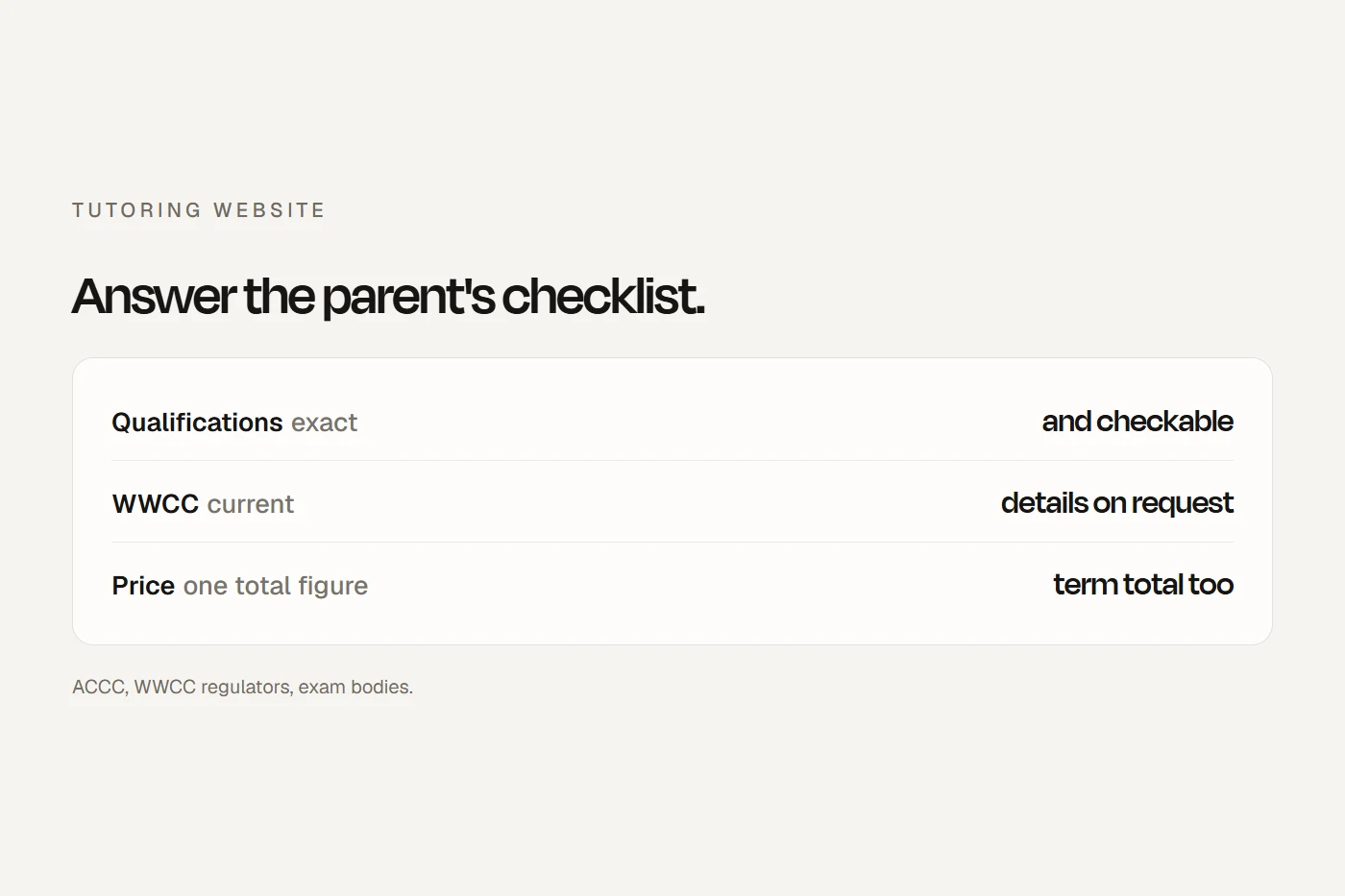
- Answer the parent's checklistParents are told to check your qualifications and Working with Children Check, meet you free first, and watch for guaranteed results and big up-front payments. Put each answer on the site.
- Show a real priceOne total figure per lesson, the term total just as clear, and your cancellation rule beside it. The big brands often hide their prices, so yours is a difference.
- Say what you do, not what they'll getNo guaranteed bands, ATARs or selective entry. The NAPLAN owners themselves say coaching isn't needed.
What parents are told to check
I found no Australian survey of how parents choose a tutor. The clearest guidance comes from University of Sydney maths education lecturers writing in The Conversation, who point out that "anyone can call themselves a 'tutor' in Australia". Their advice to parents reads like a brief for your homepage:
- ask for a Working with Children Check or equivalent and evidence of relevant qualifications;
- decide whether you want a qualified teacher or a subject specialist;
- meet first, and expect a reputable tutor to have that conversation free of charge;
- ask how the tutor assesses needs, links to the school curriculum, gives feedback and handles homework;
- watch for "guarantees of rapid or dramatic results" and "requests for large up-front payments".
And when parents compare you with the big names, Cluey and Kip McGrath both lead with a free first step, progress reports, make-up lessons and no long contracts. A small tutor's site should answer the same four things plainly, with a price they can see.
The site, page by page
Your ticks save in this browser.
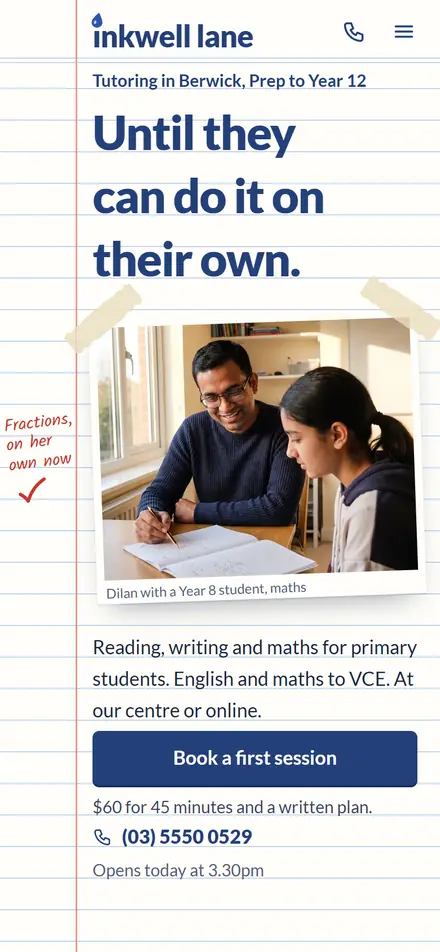
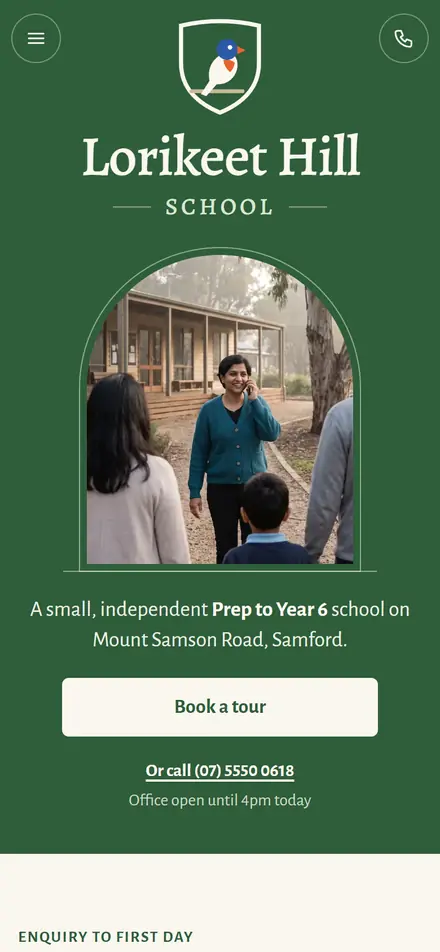
- First screen: who you teach (years), what (subjects and syllabus), where (suburbs or online), the next step (a free first meeting) and one trust line (qualification and check).
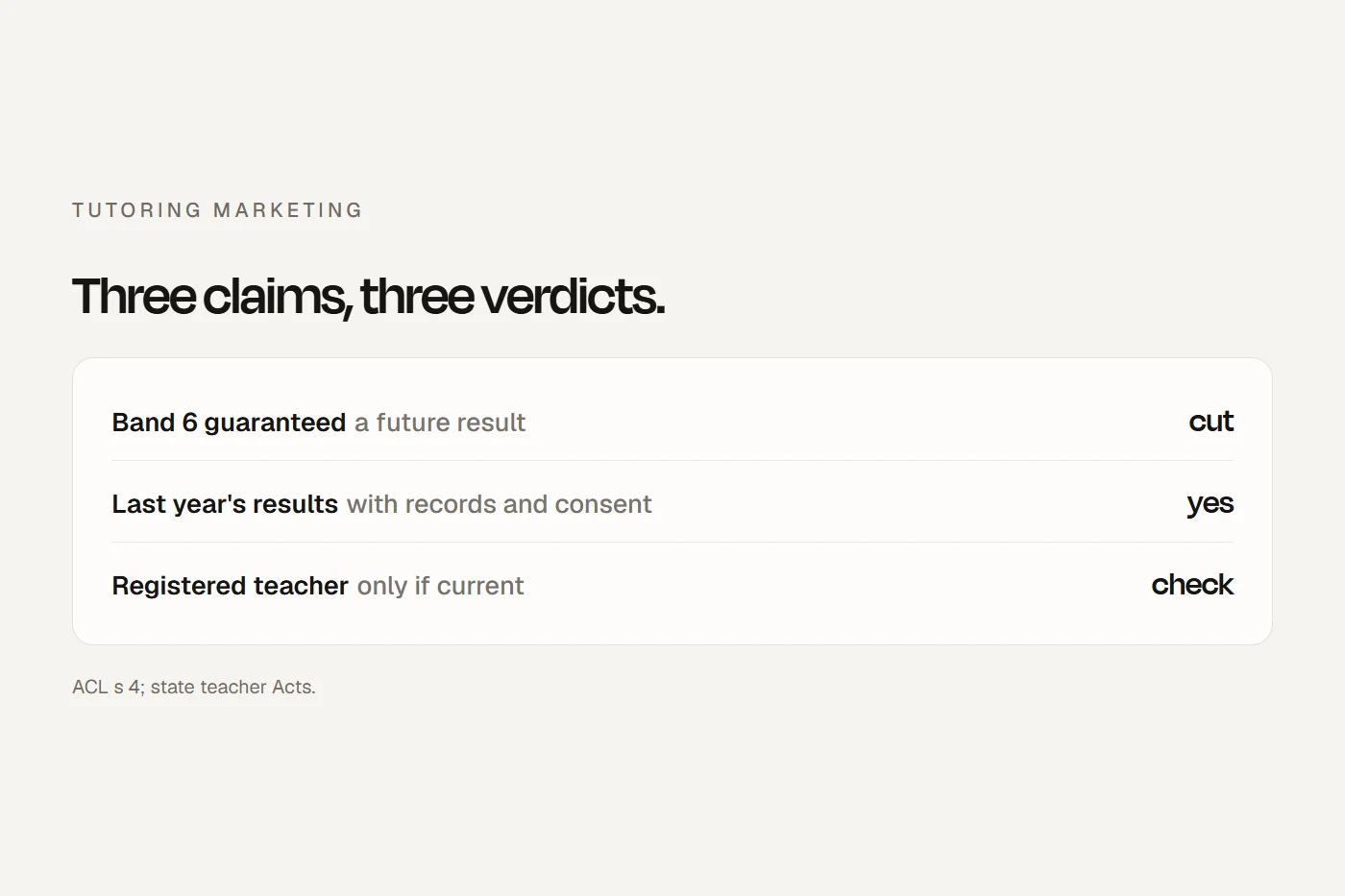
- No guarantees anywhere of marks, bands, ATARs, selective entry or NAPLAN results.
- One page per real offering: Years 7 to 10 maths, HSC Mathematics Advanced, reading support. No near-identical pages for every suburb.
- Exam names used descriptively: "VCE® Methods tutoring" is fine; exam-body logos and "NESA-approved" are not.
- Selective, scholarship and NAPLAN pages sell practice and familiarity, not entry or a better band.
- Exact qualifications for each tutor, and "registered teacher" only if current, with the regulator named.
- A link to the public register if you're registered (NSW and Victoria have one).
- A Working with Children Check line: "current check, details on request", with no date of birth online.
- A child safety page: your commitment, a code of conduct summary, where lessons happen, whether parents can watch, your photo policy and who to contact with a concern.
- Reviews shown with their count, and a one-line review policy.
- Testimonials genuine and consented, with a first name and year level only.
- Results, if shown, true and complete, with a defined base and each student's consent.
- A single-figure price per lesson including every compulsory fee, and the term total just as prominent.
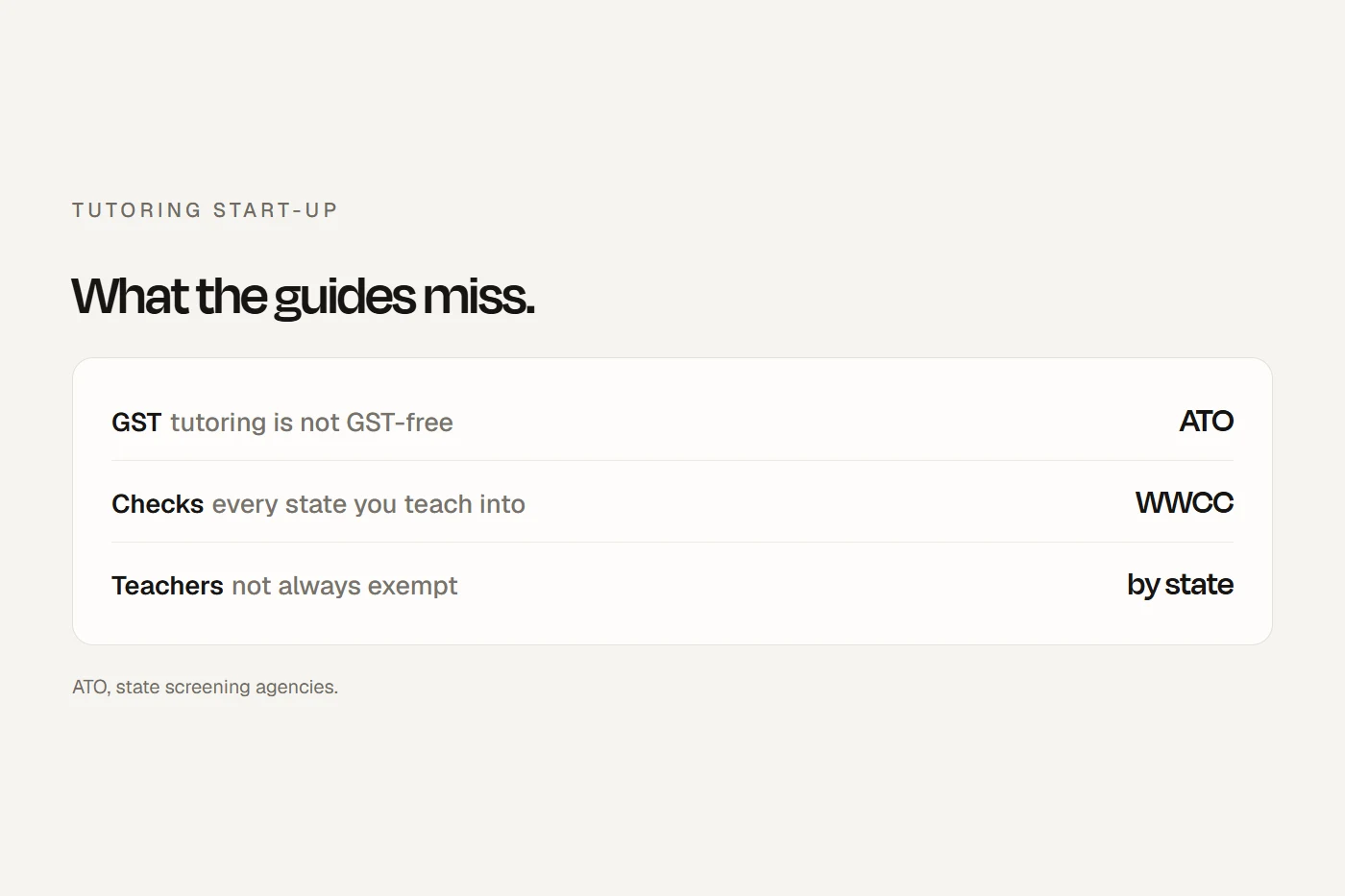
- GST-inclusive if you're registered for GST. Private tutoring isn't GST-free.
- No card surcharge. A discount for PayID or bank transfer is fine.
- Cancellation, make-up and refund rules beside the price. No "no refunds", and no auto-rolling terms without a clear way out.
- The free first step genuinely free: no card, no catch, called "free".
- Locations: the suburbs you really serve, where lessons happen, and whether parents can watch.
- Online lessons: your recording policy and how you get consent.
- A short enquiry form: parent's name and contact, child's first name, year, subject, goal and times. A separate tick for newsletters.
- A privacy policy in the footer, plus terms and the child safety page.
- Accessible: plain words, good contrast, labelled form fields. Many of your families have children who learn differently.
- No "vouchers accepted" for academic tutoring, and an association logo only while you're a current member.
Your Working with Children Check
No state requires you to put your check number on your website, and none forbids it. A 2025 policy analysis found there's no requirement to give it to families at all. But parents are told to ask: NSW says parents need to verify a self-employed tutor's number before they start, and WA says that if a tutor won't show their card, parents should consider finding someone else. Queensland requires a blue card for anyone who tutors children commercially.
Verifying in NSW needs the number, surname and date of birth, so a number on its own on a webpage lets nobody check, and your date of birth doesn't belong on a public page. The better line is "Current NSW Working with Children Check. I'll give you my details to check before our first lesson." A centre can say "All our tutors hold a current check, verified by us before they start". A Victorian teacher registered with VIT is exempt from the Victorian check, so say "VIT-registered teacher" instead.
"Teacher", "registered" and other credentials
- NSW and Victoria: claiming to be accredited or registered when you're not is an offence. Registered teachers can point parents to the public register.
- WA: an unregistered person must not claim to be a registered teacher, or claim to be qualified or entitled to teach at an educational institution. Home tutors don't need to register, but they shouldn't imply they could teach in a school.
- Everywhere: the consumer law covers any claim about your standard or qualifications. The Australian Tutoring Association asks members to keep "teacher" for people with completed university teacher training.
- If you're not a registered teacher, name your qualification and subject ("Bachelor of Engineering; I tutor Year 11 and 12 Physics") and call yourself a tutor. If you're a university student, say so: parents are told a uni student can be fine for homework help.
- "NESA-approved" isn't something a tutoring business can be. The only NESA process that approves tutors is a principal approving an outside tutor to deliver one course a school doesn't offer.
- Exam names are trade marks. The VCAA owns "VCE" as a registered trade mark and allows descriptive use with the ® symbol; ACARA owns "NAPLAN". "VCE® Methods tutoring" describes what you teach; "VCE" in your business name or logo needs the VCAA's agreement. Link to past papers on the exam body's site rather than re-hosting them.
Fill this in to draft the trust line for your homepage and footer.
Can I say this?
Tap a card to see the verdict.
The pricing page
The ACCC says businesses must show the total price "as a single figure", the minimum total cost including all unavoidable fees. If families have to buy a whole term, show the term total as clearly as the per-lesson price. If you're registered for GST, prices include it. Card surcharges are banned; you can offer a discount for PayID or bank transfer, as long as the full price is what you display.
Beside the price, put the lesson rules: how much notice to cancel, what happens when the student cancels, what happens when you cancel (a make-up or a credit), and how to stop at the end of term. The Australian Tutoring Association's code says members can't display "no refunds", and a free or discounted first period that rolls into paid lessons is a subscription under the consumer law, which needs the key terms up front and an easy way to cancel. Given parents are warned about large up-front payments, offer a per-term or per-month option, not only a year in advance.
Reviews, photos, privacy and online lessons
- Reviews. The ACCC says to show how many reviews a star rating is based on and to display your policy for publishing and removing reviews. Tutoring isn't a health service, so parent testimonials are fine, but keep the source and consent. Google won't show review stars in search for reviews of yourself on your own site, so embed or link your Google reviews instead.
- Photos. You rarely need student photos. Use your own photo, your teaching space, and hands and work without faces or names. If you do show a student, get written consent first. See photos of children on your website and socials.
- Enquiry forms. Ask only what you need to call back. Keep date of birth, school name and learning-support reports for enrolment, by a secure route. If the Privacy Act covers you, put a collection notice at the form. My website privacy policy guide covers who needs one.
- Online lessons. In NSW, SA and WA, recording a private conversation generally needs everyone's consent. If you record, say so on the online lessons page and at enrolment: who consents, who can watch, where it's stored and when it's deleted.
How many enquiries you need
No conversion benchmarks exist for Australian tutoring sites, so use your own numbers. The fee and cost fields start empty.
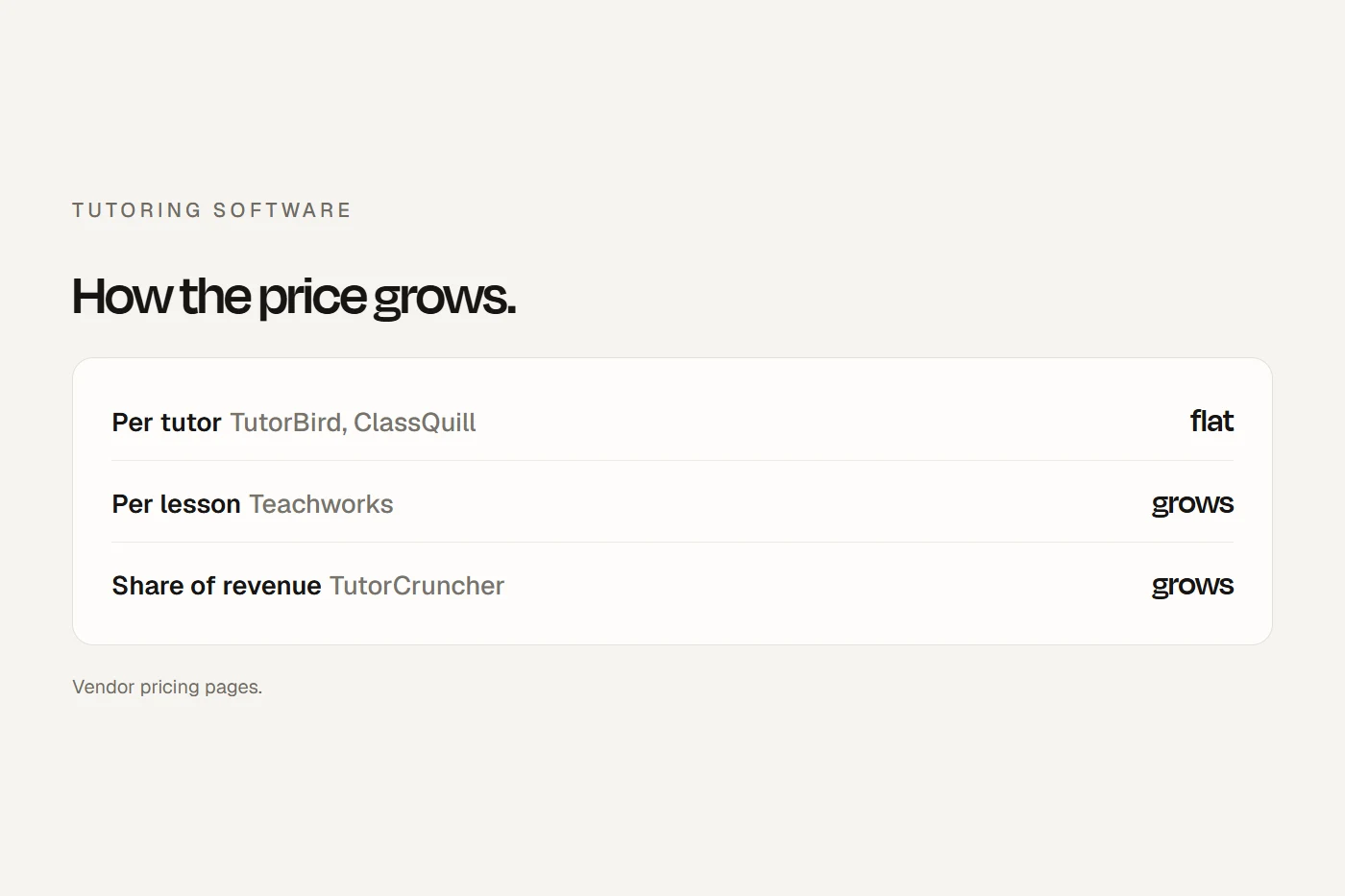
Play with the two rates. A faster reply and a better first meeting usually move new students more than more traffic does. If a student comes through a marketplace instead, its commission comes off every lesson for as long as they stay; my tutoring marketing guide compares the two.
My view
The best tutoring sites I see are plain and specific: who you are, what you teach, what it costs, what happens in the free first meeting, and how you report progress. They don't promise bands or selective entry, and they don't hide the price. Parents have been told exactly what to check. Answer it on the first screen and the site will do its job.
Questions I get asked
What should a tutoring website include?
Who you teach and what, where or online, your qualifications and Working with Children Check, a real price with your lesson rules, a free first meeting, reviews with their count, a child safety page, a privacy policy and a short enquiry form.
Should I put my Working with Children Check number on my website?
You can, but a number alone can't be verified and you shouldn't publish your date of birth. Say you hold a current check and give each family your details to verify before the first lesson.
Can I call myself a teacher if I'm a tutor?
Only say "registered teacher" if you're currently registered or accredited; in NSW, Victoria and WA claiming it falsely is an offence. Otherwise name your qualification and call yourself a tutor.
Can I advertise guaranteed results?
No. A guaranteed band, ATAR or selective place is a claim about the future you can't have reasonable grounds for. Describe what you do and, if you show past results, make them true and complete.
Should I show my prices?
Yes. If you show them, the total has to be a single figure including compulsory fees. Many big tutoring brands don't show prices, so a clear one helps you stand out.
About this guide
Written by Joseph Alzein, founder of bdog. bdog builds tutoring websites. The rules come from the ACCC, the NSW Office of the Children's Guardian, WA's Working with Children Check regulator, Queensland's blue card system, the state teacher registration laws, NESA, the VCAA and the QCAA. Sources were checked on 12 October 2026. This is general information, not legal advice.
Main sources:
- The Conversation: thinking of a tutor for your child
- NSW Office of the Children's Guardian: parents verifying a check
- WA Working with Children Check: parents and guardians
- NESA ACE Rules: outside tutors
- VCAA: copyright and trade marks
- QCAA: NAPLAN information for parents
- ACCC: price displays
- ACCC: online reviews
- ACCC: card surcharges