Underquoting rules by state: what agents’ ads and websites can say
State by state: what an ad, website, social post or text can say about price, the estimate behind it, the records to keep, and what regulators are doing. With a wording check, a price guide calculator and a listing checklist.
On This Page
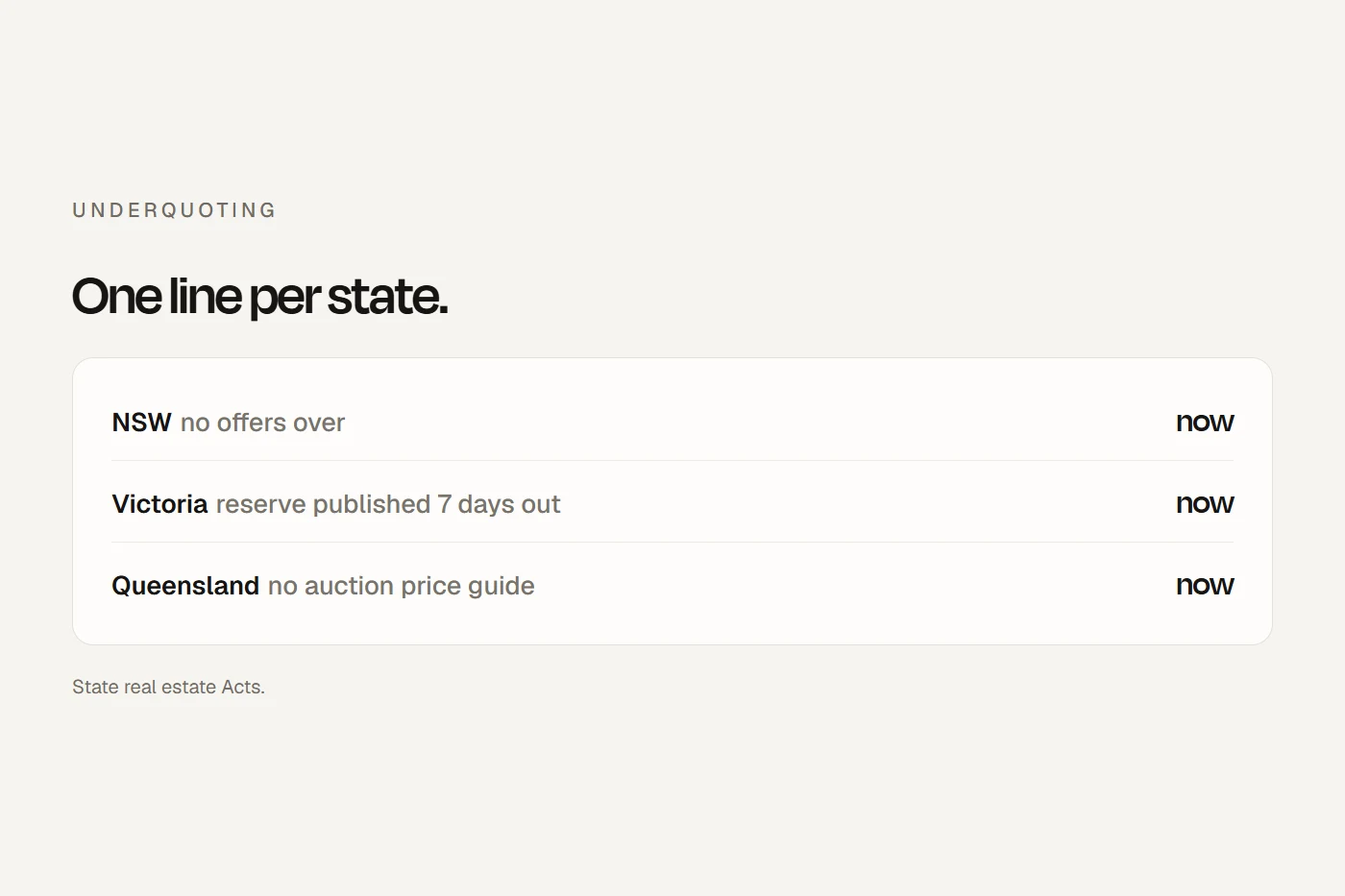
Underquoting is advertising or telling a buyer a price below what the property is likely to sell for. Every state handles it differently. Victoria now requires a price online and publishes the reserve before auctions. NSW bans "offers over" and has passed a law making a price compulsory in almost every ad. Queensland bans auction price guides altogether. SA caps ranges and makes the seller's price a floor. This guide is for agency principals and the people who write listings, websites, social posts and SMS. It sets out, state by state, what an ad can and can't say about price, the estimate behind it, the records to keep, and what the regulators are doing. It covers residential sales, with a short note on rentals. It's general information, not legal advice.
- Never below your estimateIn every state with specific rules, no ad, call or text can suggest a price below your estimate. Victoria and SA also count the seller's acceptable price, and Victoria the reserve and any offer rejected as too low.
- No "offers over" in NSW, Victoria or SAAnd in Victoria and SA, ranges stay within 10%. Queensland allows no price guide at all for auctions.
- Keep the evidenceComparable sales behind every estimate, and in NSW a record of every price you tell a buyer.
Why it matters to buyers
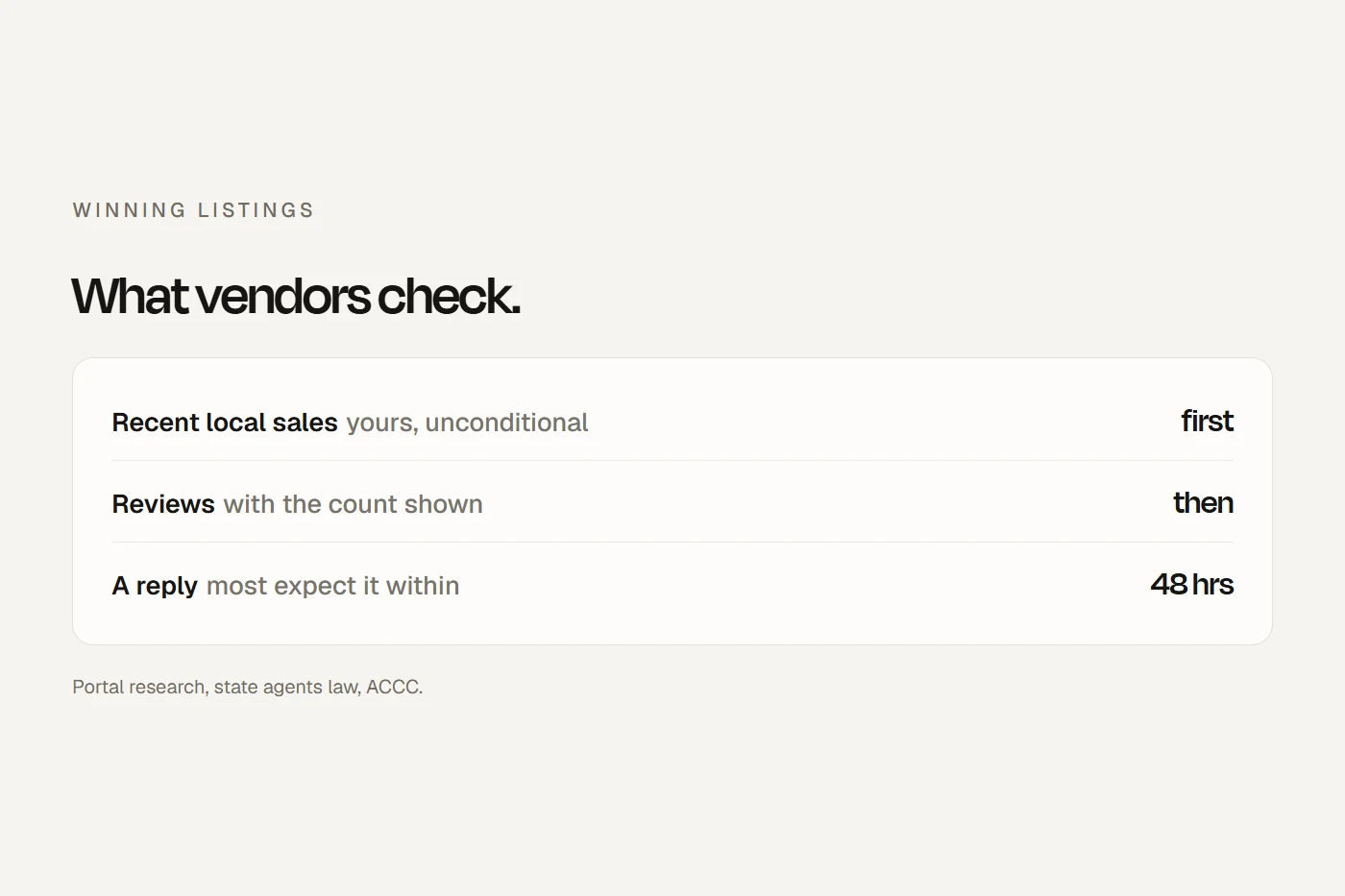
In a Victorian survey, about one buyer in four said they had been underquoted. A comparison site's count of Sydney and Brisbane listings found nearly two in three showed no price, and realestate.com.au's own research found most buyers skip listings without one. Regulators respond to that frustration: NSW Fair Trading says it is "taking a zero tolerance approach to underquoting".
The rules, state by state
| State | Ad price must not be below | Ranges | "Offers over" | No price at all? | Auctions |
|---|---|---|---|---|---|
| NSW (now) | Your estimate | Estimate within 10% | Banned | Allowed | A guide is allowed if not below the estimate |
| NSW (passed, not started) | Your estimate, the highest registered bid if passed in, any offer rejected as too low | Estimate within 10% | Banned | Not allowed, except a for-sale sign on the property | Price or range required |
| Vic | Your estimate, the reserve, any offer rejected as too low, and any price the seller said they'd accept | Within 10%, no qualifying words | Banned | Not online | Reserve published as one figure at least 7 days before |
| Qld | The minimum price the seller noted in the appointment form (Fair Trading's guidance) | No cap | Allowed if it's the seller's minimum | Allowed | No price guide anywhere |
| SA | The higher of your estimate and the seller's price | Top no more than 110% of the bottom | Banned (no qualifying words) | Allowed | Same rules |
| WA | The price the seller authorised | No cap | Not banned | Allowed | No specific rule |
| ACT | No dishonest estimate in an ad | No cap | Not banned | Allowed | No specific rule |
| Tas | A price you know the seller will accept, when first advertised | No cap | Not banned | Allowed | Vendor bids must be identified |
| NT | The price the seller authorised in writing | No cap | Not banned | Allowed | No specific rule |
Scroll the table sideways to see every column.
New South Wales
The agency agreement must include your estimate of the likely selling price, as a single figure or a range where the top is no more than 10% above the bottom, and it must stay reasonable. You give the seller evidence for it, and revise it in writing if it stops being reasonable (s 72A). No ad can suggest a price below the estimate (s 73(1)), and neither can anything you or your staff say to a buyer, by phone, email or text (s 73A). "Offers over" and "offers above" are banned in any language, and NSW Fair Trading says "$900,000+" is out too (s 73(2)). You must write down every price you tell a buyer, with the address, figure, date and time, and keep the record for three years (s 73B). If a property passes in on a vendor bid, say so (s 76A).
Today "contact agent", "price on application" and auction listings with no figure are legal in NSW. That will change. Parliament has passed a law, not yet started, that will:
- make a price or range compulsory in almost every residential sale ad, including websites, social media and email (a for-sale sign on the property is the exception);
- require a Statement of Information with comparable sales, linked in online ads and displayed at inspections;
- add the highest registered bid at a passed-in auction and any offer rejected as too low as floors;
- require online ads to be fixed within one business day.
Fair Trading says the start date will be announced. Build the price and Statement of Information fields into your listings now.
Victoria
Victoria's rules are the strictest. Your estimate is based on the three most comparable sales: within the last 6 months and 2 kilometres in metropolitan Melbourne, or 18 months and 5 kilometres elsewhere, using one or two if that's all there is. The Statement of Information has been renamed the property price statement. It includes the indicative selling price, the suburb median, the comparable sales and, once received, the seller's reserve as one figure.
- Online. Every online ad must show the indicative price, with the property price statement shown or linked on the first screen, "immediately adjacent to the advertised price". "Contact agent" isn't an option online.
- Print and signboards. Any physical ad that describes the property needs a web link or QR code to the statement.
- The floor. No ad or statement can show a price below your estimate, the reserve once received, a written offer the seller rejected as too low, or any amount the seller said they'd accept.
- Ranges. A range can be no wider than 10%, with no "from", "over", "starting at" or "+".
- Auctions and fixed-date sales. Expressions of interest with a deadline count. You request the reserve in writing, publish it as one figure at least 7 days before, and can't run the sale otherwise.
- Fixing ads. Online ads within one business day of a revised estimate or a rejected offer, and within one day of receiving the reserve.
- After the sale. Add the sale price to the statement within 7 days of going unconditional and keep it online for at least 18 months.
Queensland
For an auction, an agent must not disclose the reserve, a price likely to succeed, or a price guide to anyone except the seller's side, in any channel (s 216). That includes the website, social captions, texts and phone calls. A price can go to a portal only to place the listing in price searches, with the prescribed statement that the property "is being sold by auction or without a price and therefore a price guide can not be provided". If your own site filters by price, use the same words. Queensland's Office of Fair Trading also says an "offers over" price should be the minimum the seller will accept, as noted on the appointment form, and that advertising a price you know the seller won't sell for is misleading. For private sales where the seller said not to disclose a price, the same ban applies. If a seller asks what the property will sell for, you give them a comparative market analysis of at least three sales within 6 months and 5 kilometres, which can't be passed to buyers without the seller's written approval.
South Australia
The minimum advertising price is the higher of your estimate and the price the seller wants, both as written in the sales agency agreement. A single price is one figure with no qualifying words; a range is two figures, like "between $340 000 and $360 000", with the top no more than 110% of the bottom. The rules cover ads and anything you tell a buyer who hasn't started negotiating. The sting: an agent who breaches them can't demand, receive or keep their commission or expenses (s 24A(3)).
WA, Tasmania, the ACT and the NT
WA's code says you can't advertise at a price other than the one the seller authorised, and an opinion of market price must come in writing with reasons and, if available, similar sales. Tasmania's code is the closest to an underquoting rule outside the big states: an agent "must not initially advertise a property at a price lower than the property agent knows the client will consider as an acceptable offer", advertising applies to social media too, and a passed-in vendor bid must be identified. In the ACT, a dishonest estimate in an ad is an offence, and the agency agreement and sales inspection report record the offer price and your estimate. The NT's rules of conduct ban advertising at a price other than the one the seller authorised in writing, and any misleading ad. Everywhere, the Australian Consumer Law bans misleading statements about the price of land.
Check your listing copy
Paste a headline, description, caption or text. It flags the common problems and says which states they apply to.
It catches common patterns, not everything, and it can't see your estimate or the seller's price. Use the calculator for that.
Price guide check
Enter your estimate and the figures that set the floor. Leave a field at 0 if it doesn't apply yet.
In Queensland, any figure on an auction fails, and in WA and the NT the advertised price must be the one the seller authorised. Once you're 7 days from a Victorian auction or fixed-date sale, the reserve itself is the figure.
Rentals: a fixed price, no bidding
Every state and territory now requires a rental to be advertised at a single fixed rent, with no range, "from" figure or "make an offer", and bans landlords and agents from inviting offers above it. A for-rent sign on the property is usually exempt. The difference is what happens when a tenant volunteers more: in Victoria, Queensland and the NT the landlord can't accept it, while in NSW, WA, SA, Tasmania and the ACT a higher offer made freely can be accepted. NSW says a "make an offer" icon on a listing doesn't comply.
Every channel counts
- Your own website. It's an advertisement in NSW and the ACT, and "any Internet site" in Victoria. Build it so a price field can't hold "offers over" or "+", ranges over 10% are flagged for Victoria and SA, the Victorian property price statement link sits next to the price, Queensland auction listings hide the price, and price edits are logged. Fix the price once in the CRM that feeds the portals and the site.
- Portals. The same price rules apply. In Queensland, the hidden search price needs the prescribed statement.
- Social posts. A post that advertises a listing is an ad: NSW's definition covers electronic communication, and on my reading Victoria's "any Internet site" includes social posts, so a post with a price needs the statement link.
- SMS, email and phone. What you tell a buyer is covered in NSW, Victoria, SA and Queensland. In NSW, log every figure. SMS and email campaigns also need Spam Act consent.
- Signboards and flyers. In Victoria, a QR code or link to the property price statement. In WA, no sign without the seller's written consent.
What the regulators are doing
NSW Fair Trading runs an underquoting hotline and says it takes a zero tolerance approach, and its minister has said enforcement has been hampered by agents' inconsistent record-keeping. Consumer Affairs Victoria says it regularly inspects agencies, can demand the evidence behind estimates and comparables, has an online form for buyers to report underquoting with screenshots, and has taken agencies to court. South Australia's regulator audits sales files, and an agency has been charged under the Australian Consumer Law after advertising below the vendor's acceptable price. Remember that a final sale price above the advertised one doesn't by itself mean underquoting; the question is whether the advertised price was below the estimate when it was published.
Listing checklist
Your ticks save in this browser.
- A written estimate in the agreement, single or within 10%, with the comparable sales behind it.
- Record the seller's acceptable price, if they give one.
- In Victoria, prepare the property price statement before advertising.
- No "offers over" or "+" in NSW, Victoria or SA, and ranges within 10%.
- Check the floor with the calculator before publishing.
- Queensland auctions: no figure anywhere, and the prescribed statement if listings are filtered by price.
- Victoria online: indicative price with the statement link beside it; QR codes on print and signboards.
- Your licensee name on every ad.
- Log every figure you give a buyer by phone, text or email (NSW).
- When the estimate changes, tell the seller in writing and fix online ads within a business day.
- When a written offer is rejected as too low, lift the advertised price (Victoria).
- Victorian auctions and fixed-date sales: reserve requested in writing and published as one figure 7 days out.
- Passed in on a vendor bid: say so (NSW).
- After a Victorian sale: add the price to the statement within 7 days and keep it online for 18 months.
- Keep the records: NSW price quotes for three years, and every version of the Victorian statement.
My view
The direction is clear: Victoria already requires a price online, and NSW has passed a law to do the same. Agencies that build price discipline into their website and CRM now, with a floor check, a 10% range rule and a log of every figure quoted, won't need to scramble when NSW switches on. And buyers already skip listings without a price, so a real figure, backed by real comparable sales, is also better marketing. My guide to real estate marketing covers the rest of an agency's advertising.
Questions I get asked
What is underquoting?
Advertising or telling a buyer a price below what the agent reasonably expects the property to sell for. In Victoria and SA, below the seller's acceptable price too.
Can agents say "offers over" in NSW?
No. NSW bans "offers over" and "offers above", in any language, and Fair Trading says "$900,000+" is out too.
Can an agent give a price guide for an auction in Queensland?
No. Queensland agents can't disclose a price guide, the reserve or a likely selling price for an auction to buyers, in any channel.
Do Victorian agents have to publish the reserve?
Yes, for auctions and fixed-date sales: as one figure, at least 7 days before, or the sale can't go ahead.
Can a listing say "contact agent"?
In NSW today, yes, though a reform will require a price in almost every ad. In Victoria, not online. In Queensland, SA, WA, the ACT, Tasmania and the NT, yes.
About this guide
Written by Joseph Alzein, founder of bdog. bdog builds websites for real estate agencies. The rules come from each state's real estate Act, regulations and codes, NSW Fair Trading, Consumer Affairs Victoria, the Queensland Government, South Australia's regulator, WA Consumer Protection and the Australian Consumer Law. Data is from a Victorian consumer survey, a comparison site's listings count and realestate.com.au's research, described without dated figures. This is general information, not legal advice.
Main sources: