Marketing a wills and estates practice
Who you’re up against now (public trustees, online wills, charity programs), the rules specific to wills work (executor commission disclosure, gifts, probate pricing, safe custody, older clients), what a will client is worth over time, and the channels that bring them. With a value calculator, a can-I-do-this sorter and a 90-day plan.
On This Page
Search for wills and estates marketing and page one is marketing agencies, several of them American, and a Law Society of NSW kit written more than a decade ago. None of it deals with what's specific to wills work in Australia: who your cheap and free competitors are now, the written disclosure rule when you name your own firm as executor, what you can charge to release a stored will, and how to market to older clients without stepping into undue influence. This guide covers those, then the channels one by one. It's for a small practice or a solo lawyer doing wills, estate planning, probate and estate disputes. I build law firm websites, and everything below comes from the Solicitors' Conduct Rules, state probate and costs law, the law societies, the ACCC and the competitors' own pages.
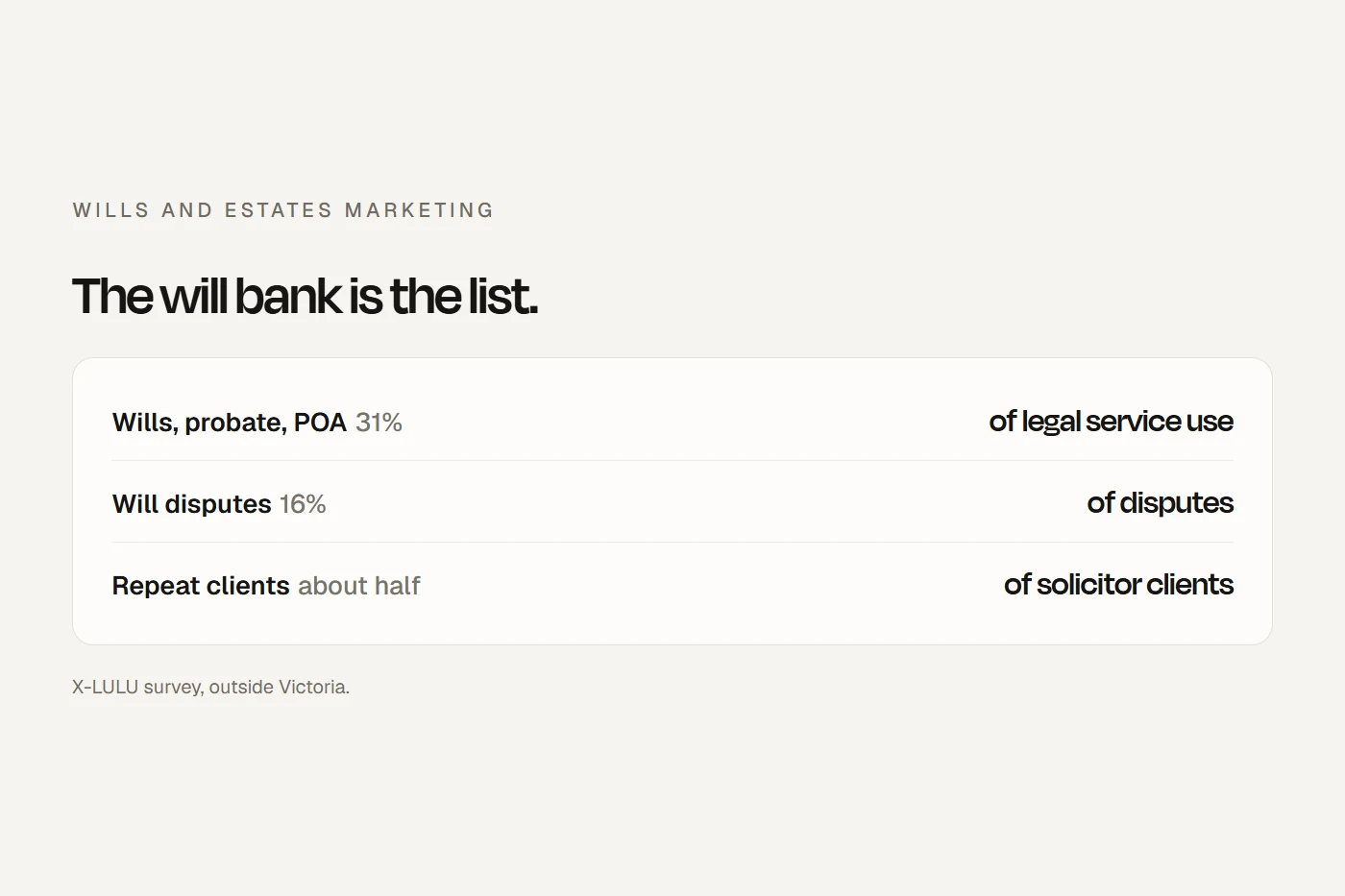
- Wills are the biggest reason people use a lawyerOutside Victoria, wills, probate and powers of attorney are almost a third of all legal service use, and about half of a solicitor's clients have used the firm before. Your past clients are the market.
- Your competitors are free or cheapPublic trustees make wills free for some or all clients, usually in exchange for being named executor. Online wills cost a flat fee, and one platform is free, funded by charities. Sell what they can't: advice.
- Naming your firm as executor needs writing, before signingRule 12 of the Solicitors' Conduct Rules requires a written disclosure about commission before the will is signed. In Victoria, a remuneration clause won't pay unless the will-maker gave written informed consent before signing.
The market you're in
The most recent national pilot survey of legal needs outside Victoria found wills, probate and powers of attorney made up 31% of all use of legal services, the single biggest category. About two-thirds of that was making or changing a will or power of attorney and one-third was probate. Disputes over wills, probate and powers of attorney were 16% of all the disputes people used lawyers for. And about half of the clients of the private solicitors followed up had used the same firm before.
The last national survey of will making found that about three in four will makers had their will drawn by a solicitor, and most said advertising wasn't what prompted them: they decided on their own, usually to get organised or after a life event such as having children. Nearly half had changed their will at least once. That survey is old, and it was before online wills. More recent research reported in the press suggests about half of Australian adults still don't have a will.
So wills marketing is less about persuading people they need a will and more about being the obvious choice when they decide to do it, and being remembered when their life changes.
Who you're up against
Public trustees
- What they offer
- Queensland's Public Trustee prepares wills free for every Queenslander, whether or not it's named executor. NSW Trustee and Guardian prepares wills free for full Age Pension holders and charges others. SA's Public Trustee only prepares wills for eligible concession holders who name it executor. WA's drafts wills naming it as executor or substitute executor. Tasmania's is free for pensioners who name it executor. The ACT's no longer prepares wills. Victoria's State Trustees sells a cheap online will and runs a free will registry.
- The trade-off
- Where the will names the public trustee as executor, its estate administration is charged later as commission or fees from the estate.
- Your angle
- Don't disparage them. Explain plainly what a lawyer adds, and if you compare costs, compare like with like, including what happens at administration.
Online will platforms
- What they offer
- A flat online fee for a template will, with yearly update subscriptions. One platform is free, funded by charities in return for the chance of a gift in the will. Each says it isn't a law firm.
- The twist
- Some platforms have an affiliated law firm, and at least one offers probate and estate administration through it, so the cheap will is also a lead source for the estate work later.
- Your angle
- Blended families, business owners, family trusts, superannuation death benefit nominations, testamentary trusts, people who may be contested. Say which situations a template doesn't fit, without fear lines.
Trustee companies
- What they offer
- Professional executor and trustee services, with commission limited by the Corporations Act. They prepared under 1% of wills in the last national survey.
- Your angle
- They court solicitors as a referral source, so they're as much a partner as a competitor. Any referral benefit either way needs disclosure.
Charity free-will programs
- What they offer
- Some charities fund a basic will through partner law firms for people who include a gift. Complex wills are charged at the firm's usual rates.
- Your angle
- A channel as well as a competitor. If you join one, disclose any payment either way, and act on the will-maker's instructions, not the charity's.
The rules that are specific to wills
When your firm is named executor
Rule 12 of the Solicitors' Conduct Rules says you don't breach the conflict rule merely by drawing a will that appoints you or an associate as executor, as long as you tell the client in writing before the will is signed:
- about any entitlement of you, your practice or associate to claim executor's commission;
- about any clause in the will letting you charge legal costs for administering the estate;
- if there's a commission entitlement, that they could appoint an executor who might not claim commission.
Victoria goes further in its Administration and Probate Act. An executor isn't entitled to payment under a remuneration clause unless the will-maker gave written informed consent to it before signing. Without a valid clause, an executor needs informed consent from each interested beneficiary, and an executor who wants to be paid must tell beneficiaries the basis, method and estimated value of the payment and their right to have the court review it, in plain language, or lose the entitlement.
So "free will if you name us executor" is a lawful offer, but only with the condition stated in the ad, the written disclosure before signing, and in Victoria the written consent. Disciplinary bodies have dealt with solicitors who took commission without an entitlement.
Gifts to you
Don't draft a will that gives you, your practice or an associate a substantial benefit beyond proper commission and fees. The rule's exception is narrow: the person instructing you is your own immediate family or your spouse's, or a solicitor colleague or their immediate family.
Probate prices
Fixed-fee probate on a website has to fit your state's rules. In NSW, the costs of obtaining a grant are fixed by regulation, scale with the estate's value and can't be contracted out of; estate administration after the grant is charged separately. In WA, a Legal Costs Committee determination sets maximum costs for probate and administration applications unless you have a written costs agreement. In Queensland, administration is charged by court scale or written agreement. Uniform Law costs disclosure applies in NSW, Victoria and WA, and in estate work the executor is your client, not the beneficiaries. Any "from" price must be a real minimum, including GST.
Storing wills
A will bank is a retention asset, with duties attached. The Law Society of NSW's journal says the seven-year destruction rule for client documents doesn't apply to safe custody documents. You must keep a register of them, separate from the documents. Require certified photo ID before releasing one. Any release charge has to be agreed, reasonable, reflect actual cost and contain no profit. Holding the will gives you no right to the estate work: the executor chooses who acts.
Older clients
The Queensland Law Society's tips on testamentary capacity, drawn from a NSW Supreme Court case, are a good intake rule: interview the client alone, use an interpreter who isn't family or a beneficiary, ask non-leading questions, take extra care if the client is over 70, cared for or in aged care, and keep full contemporaneous file notes indefinitely. The Law Society of NSW's guidance adds that any potential beneficiary shouldn't be within sight or hearing. Rule 34.2 bars seeking instructions in a way likely to oppress or harass someone at a significant disadvantage after recent trauma or other circumstances. A grieving family is the obvious case.
Estate disputes
The state advertising limits on lawyers apply to personal injury, not will disputes. "No win, no fee" means a conditional costs agreement in writing, with a cooling-off period. Under the Uniform Law, contingency fees (a percentage of what's recovered) are banned. WA's guidelines describe the slogan itself as potentially misleading, so spell out what the client pays if they lose. Don't post about a live dispute.
What a will client is worth
A will is usually the smallest fee in the relationship. Put your own numbers in to see what a year of will clients brings later. Fee fields start empty: use your own costs agreements.
The point isn't the total. It's that the will bank and the estate work are worth more than the will itself, which is why the low-cost competitors either name themselves executor or have an affiliated probate firm. Your edge is the relationship, so the marketing that matters most is the follow-up.
Can I do this?
Tap a card to see the verdict.
The channels, one by one
Google Business Profile and your website
For "will lawyer near me", Google's map results come first and favour the firms nearest the searcher, so a general suburban practice can outrank a wills specialist on the map. The website and reviews decide who gets the call. Give wills, estate administration and estate disputes a page each, with what's included, how fees work and who does the work. Answer the questions people ask Google: what a will costs with a lawyer, whether a lawyer is worth it, free wills for pensioners, whether you have to leave your children anything, and the common mistakes. My law firm website checklist covers the rest.
Your will bank and past clients
This is the channel with the best return. People change their will after life events: children, marriage, separation, a death, a business sale, retirement. With consent, write to stored-will clients once a year and when the law changes, and make updates easy to book. Free storage elsewhere and yearly update subscriptions on the online platforms mean your storage terms need to be clear on the website too.
Referral partners
Financial planners, accountants, funeral directors, aged care providers, trustee companies and charities can all send will clients. Two rules keep it clean. Any money or benefit either way needs disclosure: rule 12 requires you to disclose a benefit you receive and get the client's informed consent, and to disclose a payment you make before the client instructs you; accountants and planners have their own disclosure and conflicted remuneration rules. And the referrer isn't your client: see the will-maker alone.
Community talks
The Law Society of NSW once ran will awareness talks and suggested keeping them to 30 or 40 minutes on wills, with powers of attorney and guardianship covered as questions come up. Talks fit the way people actually decide to make a will: getting organised. Let the venue invite people, and book appointments at your office afterwards rather than signing anyone up on the spot.
Google Ads
I found no Australian cost data for wills keywords; the only published benchmark is American. Test small on "wills lawyer [suburb]" and "probate lawyer [suburb]", make sure every ad clearly comes from your firm, and put the conditions of any "free" offer in the ad itself. You can bid on a public trustee's or an online platform's name as a keyword, but an ad that reads as if it comes from a government body is asking for trouble. See what Google Ads costs in Australia.
A 90-day plan
Your ticks save in this browser.
- Google Business Profile named as on your sign, the right category, and a review request to every finished client.
- Website: separate pages for wills, estate administration and estate disputes, honest prices including GST, and "specialist" only for individually accredited lawyers.
- Executor paperwork: a written rule 12 disclosure letter, and in Victoria the written consent form, if your firm is ever named executor.
- Safe custody: a register, a photo ID release procedure, your storage terms on the website, and an annual audit.
- Count calls and forms by channel so you know where will clients come from.
- List your referrers, and write one disclosure paragraph for any money either way.
- Intake rule: see the will-maker alone, with file notes and a capacity checklist.
- Write to stored-will clients who've consented, about reviewing their will after life events.
- One community talk, booked by the venue, with appointments at your office afterwards.
- A small Google Ads test on wills and probate searches in your suburbs.
- Content answering the questions people ask about wills.
- Compare cost per new will client with what a will client is worth, and keep what pays.
My view
Don't try to win on price against a free public trustee or a flat-fee platform. Win on the relationship. Make it easy to see who'll draft the will and what's included, be scrupulous about the executor disclosure, and treat your will bank as your best marketing list. The firms I see doing well in wills aren't running clever campaigns; they write to their clients when life changes, they're easy to find on the map, and their website answers the cost question honestly.
Questions I get asked
How do wills and estates lawyers get clients?
Mostly through past clients and personal recommendations: about half of a solicitor's clients have used the firm before. Then local search, referral partners such as planners and accountants, and community talks.
Can a solicitor be the executor of a will they drafted?
Yes, if they tell the client in writing before the will is signed about any commission entitlement, any clause letting them charge legal costs, and that the client could choose an executor who might not claim commission. In Victoria, a remuneration clause also needs the will-maker's written informed consent before signing.
Can I offer free wills?
Yes, if the offer is honest: say what's free, what isn't, and any condition such as naming your firm executor, in the ad itself. The executor disclosure rules still apply before signing.
How long do solicitors have to keep wills?
The seven-year rule for destroying client files doesn't apply to wills held in safe custody. Keep them, with a register, until they're released properly.
Can I advertise a fixed fee for probate?
Check your state first. In NSW the costs of obtaining the grant are fixed by regulation and can't be contracted out of; in WA a costs determination applies unless you have a written costs agreement.
About this guide
Written by Joseph Alzein, founder of bdog. bdog builds law firm websites. The rules come from the Australian Solicitors' Conduct Rules, Victoria's Administration and Probate Act, state costs regulation, the Law Society of NSW, the Queensland Law Society and the ACCC; competitors' offers from their own pages. Sources were checked on 12 October 2026. This is general information, not legal advice; your law society and your state's rules apply.
Main sources:
- Legal Profession Uniform Law Australian Solicitors' Conduct Rules 2015 (NSW)
- Administration and Probate Act 1958 (Vic)
- WA Legal Costs Committee: non-contentious probate determination
- LSJ: management of safe custody documents
- LSJ: costs in probate matters
- QLS: tips in determining testamentary capacity
- QLS: will instructions, potential for conflict
- LSJ: avoiding elder financial abuse
- ACCC: telemarketing and door-to-door sales
- ACCC: funeral industry practices
- University of Queensland: national prevalence survey of will making
- Queensland Public Trustee: wills
- NSW Trustee and Guardian: fees
- State Trustees Victoria: wills