Advertising rules for acupuncture and Chinese medicine practitioners
The Chinese Medicine Board’s own worked examples, what evidence an ad needs, titles by division, “Dr”, “Professor” and “specialist”, advertising in Chinese, your own formulas and patent medicines under the TGA, testimonials, offers and health funds. With a wording checker that reads English and Chinese, a sorter and a 90-day checklist.
On This Page
- The rules that apply
- What the Board’s examples say
- Evidence: what an ad needs
- Titles: divisions, “Dr”, “Professor” and “specialist”
- Advertising in Chinese
- Herbs, formulas and the TGA
- Testimonials, offers and funds
- What regulators have acted on
- Channels
- Check your wording
- Can I say this?
- Your first 90 days
- Questions I get asked
Chinese medicine is one of the Ahpra-registered professions, so every ad for your clinic, on your website, Google profile, Instagram, WeChat or Xiaohongshu, falls under the National Law's advertising section. The Chinese Medicine Board has also done something most boards haven't: it has published worked examples of the claims it sees most often, each with a corrected version. This guide uses those examples, the Board's evidence guide and its title rules, and adds the parts that catch clinics out: "Dr" and "Professor", acupuncture-only registrants using herbal titles, Chinese-language ads, the TGA rules for herbs, and health funds. It's built with Ahpra's advertising guidelines in mind, and it's general information, not legal advice.
- Symptoms, not conditionsThe Board's corrected wording talks about managing pain, stress, fatigue and nausea, not treating diseases, and never lists conditions.
- Tradition isn't evidence for an adExperience-based evidence can't be the only support for an advertising claim. Each claim needs peer-reviewed evidence.
- The same rules in ChineseTitles and claims are covered in any language. Translate your compliant English copy; don't write a bolder Chinese one.
The rules that apply
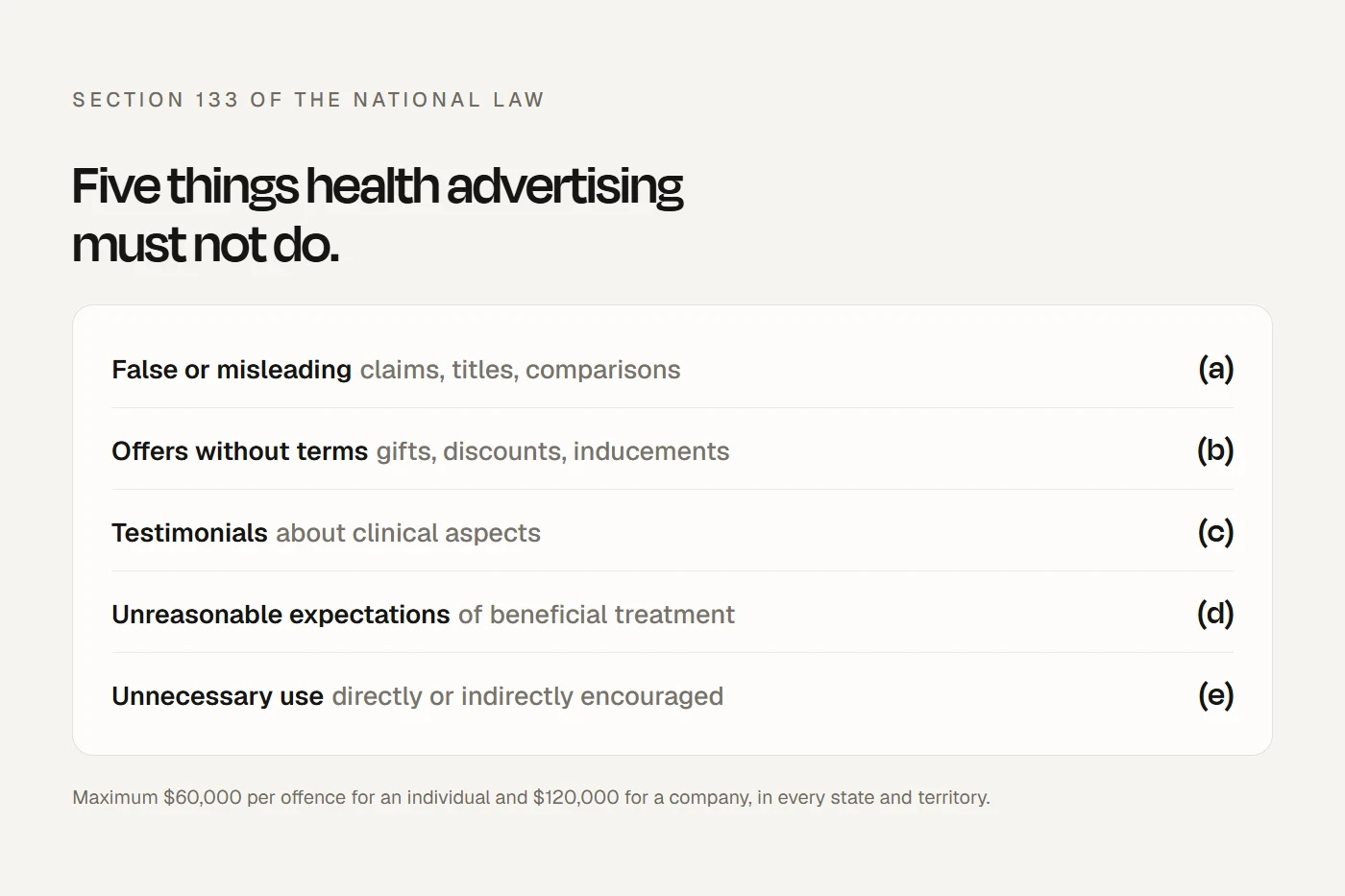
The National Law says advertising for a regulated health service must not be false or misleading, offer a gift or discount without stating the terms, use testimonials, create an unreasonable expectation of benefit, or encourage unnecessary use of health services. The Board points practitioners to Ahpra's advertising guidelines and to two documents of its own: the Chinese medicine examples and a quick reference guide on evidence. The Board's older position statement on advertising has been retired; those two documents replace it.
Most patients come by word of mouth, and the one national survey found medical practitioners were the second most common referral source for acupuncture. So your website has two readers: the friend's recommendation checking you out, and the GP deciding whether to refer.
What the Board's examples say
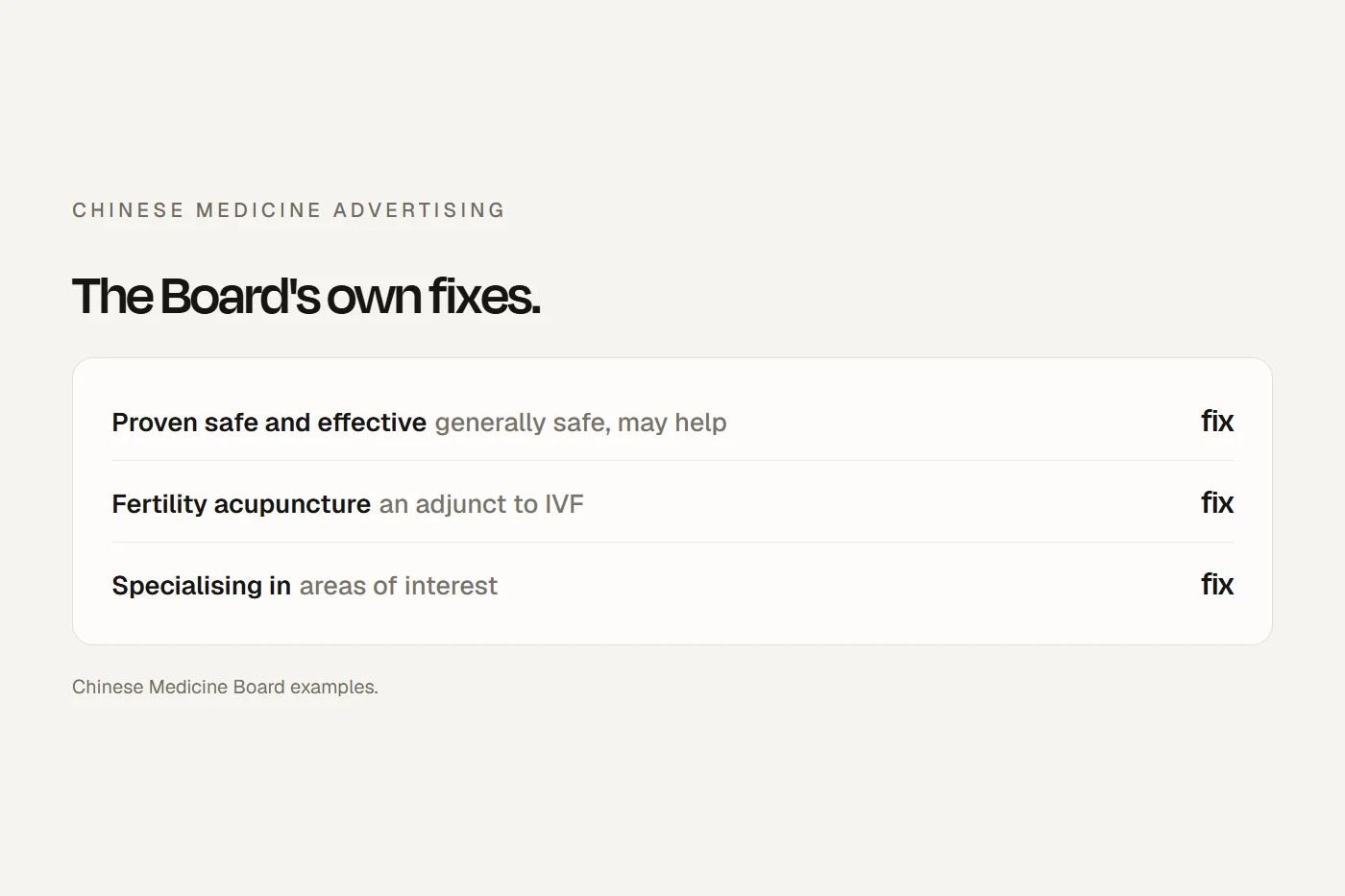
"Safe and effective." The Board's example of a non-compliant line is that Chinese medicine "has been proven to be a very safe and effective healthcare modality". Its fix says Chinese medicine may help patients manage symptoms such as pain, stress and fatigue, and that it's generally considered safe but, as with all treatments, adverse reactions can occasionally occur. The Board's own suggested answers to "Is acupuncture safe?" and "Does acupuncture hurt?" are a good model for an FAQ.
Lists of conditions. The Board says a list of health conditions "increases the likelihood that there will not be suitable supporting evidence and, therefore, is often false and misleading". Its red example lists depression, multiple sclerosis, Parkinson's, eczema, thyroid disorders and more. Its acceptable acupuncture line names three uses: non-specific lower back pain, osteoarthritis of the knee and tension-type headaches, with "may" in front.
Autoimmune conditions, chronic disease and cancer. Claim help with symptoms, not the condition. The Board's fix is "management of pain, stress and fatigue related to some autoimmune disorders, in consultation with other treating health practitioners", and for cancer, management of vomiting or nausea arising from chemotherapy.
Fertility and IVF. The Board says there is "insufficient evidence" for advertising that Chinese medicine treats infertility or improves fertility. Supporting a specific treatment like IVF can be advertised with context. Its corrected line says many health practitioners may recommend acupuncture as an adjunct that may assist with IVF treatment, that research is continuing, and that you should consult your treating practitioners. "Regulate your ovulation" and "improve your sperm count" are its red examples. No success rates and no "fertility acupuncture" headline.
Pregnancy. Preventing miscarriage, lowering the chance of a caesarean and turning a breech baby with moxibustion are all the Board's red examples. Its fix: Chinese medicine may be able to help pregnant women with pregnancy-related musculoskeletal pain, and nausea and vomiting.
In effect, the Board has written your "What we help with" page: symptom language, a few evidence-backed uses with "may", and "alongside your other treating practitioners".
Evidence: what an ad needs
The Board's quick reference guide says a higher standard of evidence is needed for advertising than for clinical decisions, because an ad is generic and you're not there to explain whether a treatment suits the individual. Experience-based Chinese medicine evidence "cannot be relied upon as the sole piece of evidence" for an ad claim unless it's backed by scientific or academic study, though it can still inform your clinical decisions. Evidence should be peer-reviewed, publicly available and in English, and a tiny trial doesn't count. If there's no acceptable evidence for a claim, the claim and any articles supporting it should come down.
That includes your blog and WeChat articles. "Used in China for over 2,000 years" describes the tradition; it can't carry "so it works for your insomnia".
Titles: divisions, "Dr", "Professor" and "specialist"
Divisions. The protected titles are Chinese medicine practitioner, Chinese herbal medicine practitioner, Chinese herbal dispenser, Oriental medicine practitioner and acupuncturist, and the law applies "whether in English or any other language". Anyone registered can call themselves a registered Chinese medicine practitioner. About one registrant in three is registered as an acupuncturist only. If that's you and you advise on herbs, the Board says you must not use "Chinese herbal medicine practitioner" or any equivalent in another language, your signage and advertising should make clear you're registered in the acupuncture division only, and you should tell patients when you prescribe herbs that you're not a registered herbal practitioner.
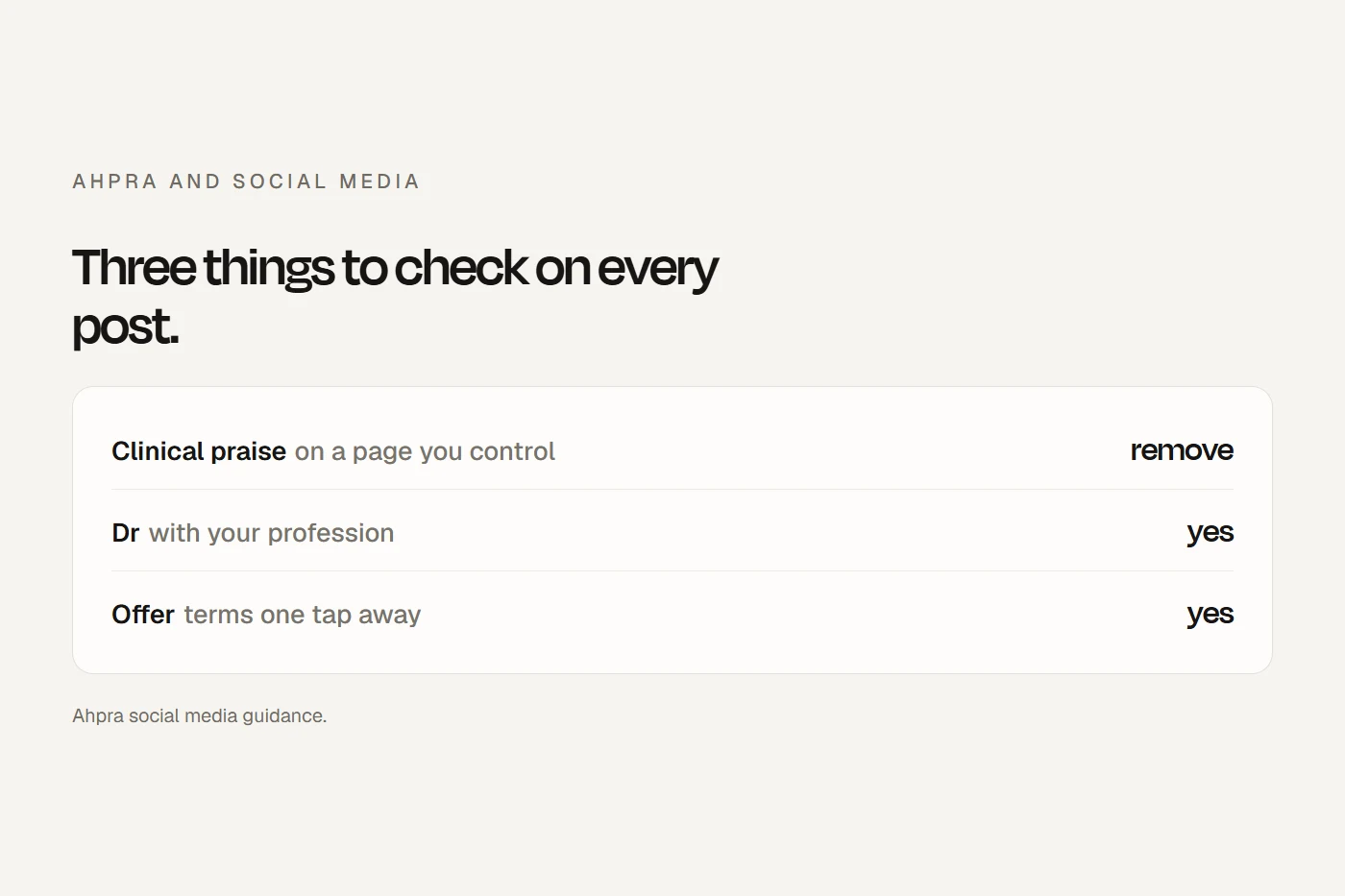
"Dr". Not a protected title, but the Board says a practitioner who uses it "should make clear that they are a doctor of Chinese medicine rather than Western medicine" whenever they use it. Its own acceptable example is "Dr Li, Doctor of Chinese medicine and registered acupuncturist", and the qualification in that example is a bachelor's degree. So "Dr Mei Chen (Chinese medicine practitioner)" works; "Dr Chen" alone in a header, a Google profile name or an ad doesn't. The same logic applies to a bare "doctor" in Chinese on a WeChat or Xiaohongshu profile: pair it with your registered division.
"Professor". The Board says not to use a professor title in private practice, as it's a conflict of interest. For an overseas visiting or honorary professorship, keep the prefix and give the institution's full name.
"Specialist". A flat no. There are no specialist categories in Chinese medicine, so you can't say you specialise even with years of training. The Board's fix is "I have over 10 years of experience providing antenatal care", and its acceptable profile uses "areas of interest include".
Your team. Laser acupuncture is still acupuncture, so it needs a registered practitioner. Other professions can use "acupuncturist" only with an endorsement or Chinese medicine registration. Don't advertise anyone as giving acupuncture unless they're registered, and don't run down "dry needling" by comparison.
Advertising in Chinese
No regulator page sets different rules for Chinese-language ads. The title law covers any language. Ahpra's social media guidance names WeChat and Weibo and says to be careful about what you post "regardless of where in the world the site is based or the language used". The TGA has fined a company over the Chinese-language section of its website after it had already dealt with the English version. And the Board's evidence guide asks for evidence in English, so a claim backed only by Chinese-language studies or classical texts is unlikely to meet the bar. WeChat Moments, official account articles and group broadcasts that promote the clinic are advertising; reposting a patient's thank-you note about their result is using a testimonial.
Herbs, formulas and the TGA
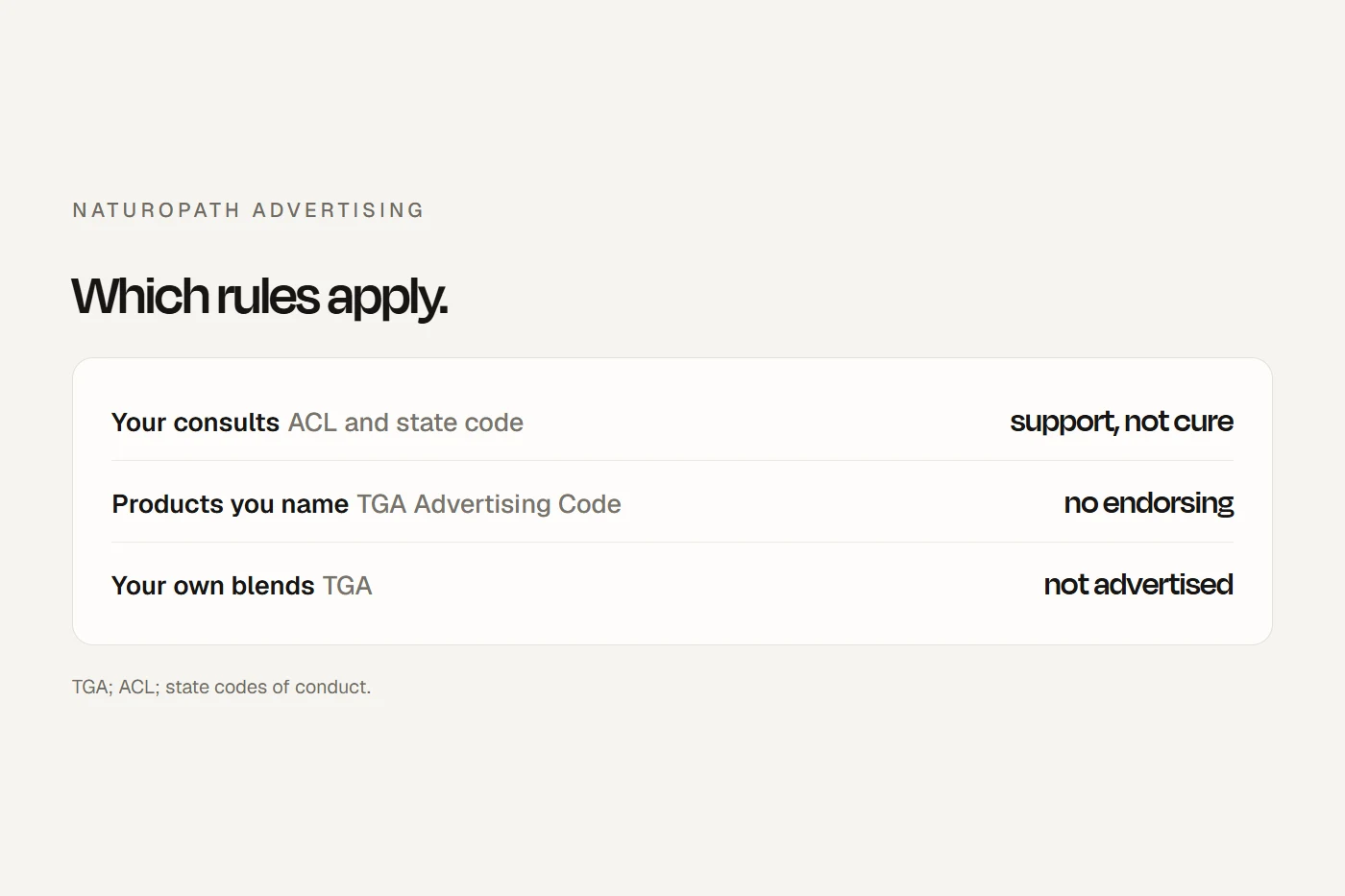
Your own formulas can't be advertised. You can make up formulas for a particular patient after consulting them. The TGA says "you cannot advertise compounded medicines to the public", but "you can advertise your compounding service". So "individual herbal formulas prescribed after your consultation" is fine; "our sleep formula, granules, DM to order" on Xiaohongshu isn't, and neither are pre-mixed packs made in advance.
Prescribing without a consult. The Board says prescribing herbs to someone you haven't consulted, based only on a questionnaire, text or email, isn't good practice, and acupuncture by virtual care is inappropriate. Real-time video consultations for herbal medicine can be advertised; "fill in our form and we'll post your herbs" and "online acupuncture" can't.
Patent medicines. A listed Chinese patent medicine can only be advertised with the claims on its register entry, worded like "Traditionally used in Chinese medicine to..." plus the mandatory label statement. And as a practitioner you can't endorse it: "the patent medicine I always recommend for colds" is out. Recommending a product to your own patient in the consult, or in a private message to them, is outside the advertising rules; the same recommendation in a WeChat group broadcast isn't.
Anything mentioning cancer, mental illness or COVID next to a product breaks the TGA rules as well as Ahpra's. Never name scheduled or endangered-species ingredients.
Testimonials, offers and funds
Testimonials are banned by law for a registered profession. A patient's words about a symptom, treatment or result can't appear in your ads, on your site or in a reposted review. Comments about parking, the staff or feeling calm about needles aren't testimonials, but I leave review quotes off health sites altogether. Ask for Google reviews the same way from everyone, and reply without confirming anyone is a patient.
Offers need their terms in plain language, and "free" must mean free. Packages are fine with terms, but not when they push more treatment than someone needs, and "use your extras before they reset" encourages unnecessary use.
Health funds. Acupuncture and Chinese herbal medicine were never part of the 2019 natural therapies exclusion. Funds generally recognise practitioners who are registered with the Board and belong to a recognised association. Say "health fund rebates available, depending on your fund and level of cover", never "all funds" or "no gap" without terms, and no fund logos without the fund's written consent. Rebates usually cover consultations, not herbs.
What regulators have acted on
The one prosecution of a registered Chinese medicine practitioner for advertising that Ahpra lists involved website articles about treating cancer and testimonials claiming a patient was treated for cancer entirely with Chinese medicine; the court noted the guidelines had been circulated for years, so ignorance was no excuse. Ahpra and the boards also called out claims that acupuncture boosts immunity against COVID. More often, advertising problems start with a letter and time to fix the content, and complaints often come from people who read clinic websites systematically.
Channels
Your website. A "What we help with" page in the Board's wording; a practitioner panel with name, division, register link, qualifications, association and languages spoken; a herbs page about individual formulas and how herbs are labelled; a fees page; and a link to the Board's own "What is Chinese medicine" page for patients.
Google Business Profile. "Acupuncture clinic" or "Chinese Medicine Clinic" for the clinic, "Acupuncturist" for an individual, and "Herbalist" only where you're in the herbal division. The profile name and description follow the same rules. My Google Business Profile checklist for clinics covers the setup.
Referrers. A one-page pack for GPs and IVF clinics explaining what you offer alongside IVF, in the Board's wording, and how you communicate with them. No gifts, fees or discounts for referrals.
Ads. The same rules in the ad and on the landing page. Meta bars lines that imply a health condition, such as "Struggling with infertility?".
Check your wording
Paste a page, a post or an article, in English or Chinese. It flags words that tend to cause trouble; it can't judge context, so read each flag.
Can I say this?
Tap a card to see the verdict.
Your first 90 days
Tick items off as you go; the list remembers your progress on this device.
- Month 1: claims rewritten, both languages "Safe and effective", cures, condition lists, fertility, pregnancy and cancer, using the Board's corrected lines.
- Month 1: testimonials removed And patient-result reposts; reviews switched off where you can't moderate them.
- Month 1: titles fixed Division-accurate in English and Chinese; "Dr" with the profession; no "Professor" or "specialist".
- Month 1: formula posts taken down Replaced with one line about individual formulas; questionnaire-only ordering stopped.
- Month 1: product endorsements removed Patent medicine posts checked against their register entry.
- Month 1: COVID, immunity and detox claims removed
- Month 2: a "What we help with" page Symptom language, a few uses with "may", alongside other practitioners.
- Month 2: a practitioner panel Name, division, register link, qualifications, association and languages.
- Month 2: fees and offers Total prices and package terms in plain language.
- Month 2: health fund line Neutral wording, checked against each fund's recognition.
- Month 2: Google profile The right category, the same service wording, no bare "Dr".
- Month 2: a referrer pack For GPs and IVF clinics, with no inducements.
- Month 3: an education plan Monthly posts on what to expect and safety, claims cited or left out.
- Month 3: ads only after the landing page passes the checker
- Month 3: a quarterly recheck Against the Board's examples page.
Questions I get asked
Can Chinese medicine practitioners call themselves doctors?
Yes, "Dr" isn't a protected title, but the Board says you should make clear you're a doctor of Chinese medicine, not Western medicine, every time you use it, for example "Dr Chen (Chinese medicine practitioner)".
Can I advertise acupuncture for fertility?
Not as treating infertility; the Board says the evidence is insufficient. You can advertise acupuncture as an adjunct alongside IVF, using the Board's wording about continuing research.
Do the advertising rules apply to Chinese-language ads?
Yes. The title law covers any language, and Ahpra's social media guidance applies to WeChat and Weibo whatever the language.
Can I use testimonials?
No. Testimonials about clinical aspects are banned for registered health professions, including on social media and in reposts.
Can I sell my herbal formulas online?
No. The TGA says compounded medicines can't be advertised to the public. You can advertise that you prescribe individual formulas after a consultation.
Is acupuncture covered by health funds?
Generally, yes, for registered practitioners who belong to a recognised association. It was never part of the 2019 exclusion. Benefits depend on the patient's fund and cover.
About this guide
Written by Joseph Alzein, founder of bdog. I build websites for clinics, built with Ahpra's advertising guidelines in mind. Sources were checked on 12 October 2026. This is general information, not legal advice. I've left out penalties and rebate amounts.
Main sources:
- Ahpra and the Chinese Medicine Board: Chinese medicine advertising examples
- Chinese Medicine Board: advertising a regulated health service
- Chinese Medicine Board: quick reference guide to acceptable evidence
- Chinese Medicine Board: registration FAQ, including "Dr" and "Professor"
- Chinese Medicine Board: protected titles FAQ
- Chinese Medicine Board: virtual care FAQ
- Ahpra: social media guidance
- TGA: compounded medicines
- TGA: permitted indications for listed medicines
- Chinese Medicine Board: what is Chinese medicine
- Department of Health: natural therapies review