How criminal and traffic lawyers get clients online
What clients are actually buying, the first call from custody, the conduct rules on outcomes, specialist titles and no win no fee, case studies and the publication bans, Google and Meta ad limits, and offence, court and traffic pages. With a cost per matter calculator, a wording sorter and a 90-day plan.
On This Page
- What criminal and traffic clients are actually buying
- The first call: custody and after hours
- What does a client from ads cost you?
- The rules for every ad, page and post
- Case studies, reviews and the publication bans
- Google and Meta ads
- Offence pages, court pages and traffic content
- Referrers
- Can I say this?
- A 90-day plan
- Questions I get asked
Criminal and traffic law is marketed differently from every other area of law. The first call often comes from a police station or a worried parent late at night. Most matters end in a plea, not a trial. You can't offer no win, no fee. Google won't let you remarket to your own visitors, and a case study can break three rules at once. This guide covers what clients are actually buying, the rules for each channel, and what works for a small criminal or traffic practice. It draws on the Solicitors' Conduct Rules, the costs provisions in each state's legal profession law, the accreditation schemes, the publication bans, ABS court data, legal aid policies, and Google's and Meta's own policies. It's general information, not legal advice; check anything you're unsure of with your law society's ethics line.
- Answer the phone, day and nightA person in custody can call a lawyer of their choice. Whoever answers first, clearly, is in the running.
- Sell the process, not winsAlmost every court judgement is a guilty outcome. Explain what you do at bail, plea, sentence and licence appeals, with fixed fees and what's included.
- Know the criminal-specific rulesNo "no win, no fee". "Specialist" only if accredited. No remarketing in Google Ads. No "Charged with...?" on Meta. No case stories that could identify a child or complainant.
What criminal and traffic clients are actually buying
There's no Australian survey of how people charged with an offence choose a lawyer. The court data says a lot, though. In the latest ABS figures, traffic and vehicle offences were the most common principal offence, at 38% of defendants nationally and 42% in both NSW and Victoria. And 97% of court judgements were a guilty outcome, which includes guilty pleas. Most of the market is pleas and sentencing, not trials, so a website built around "not guilty" wins describes a small share of what clients will get.
The national legal needs survey found people with crime problems mostly dealt with police, and used lawyers mainly when they were "charged, arrested or questioned". The risk of crime problems peaked between 15 and 24. In practice, that means the person searching is often young, on a phone, or a parent making the call for them. The large newer surveys on how people find lawyers barely touch criminal law, so be wary of general "how clients choose a lawyer" numbers.
Legal aid defines the rest. Legal Aid NSW funds Local Court criminal matters where jail is a possible penalty, and helps with driving offences only "in very limited circumstances". Victoria Legal Aid gives information only to adults facing charges where a fine is the most severe penalty, and in-court help on matters like a first drink-driving charge depends on an income test. So a first drink-driving charge, a licence appeal or a demerit problem is mostly private work. That's the traffic market.
The first call: custody and after hours
In NSW, before any investigative procedure, police must tell a detained person they may contact "an Australian legal practitioner of the person's choice", and give them reasonable facilities to do it, out of earshot "so far as is practicable". Victoria has a similar right. When that call comes, the person needs a lawyer, not voicemail.
- A tap-to-call number at the top of every page on mobile. For a criminal firm, the call is the enquiry.
- An after-hours number that reaches a lawyer. If you use an answering service, the conduct rules allow disclosure to someone engaged by your practice to deliver your services. Put confidentiality in writing, and keep the script to name, number, where they are and how urgent it is. The service must never give advice, and you must supervise it.
- Count your calls by hour. It tells you whether after-hours answering pays, which the calculator below works out.
Google's local results for criminal lawyers show firms listed as "Open 24 hours". Only show those hours if a lawyer really does answer around the clock. Otherwise it's a misleading claim under the conduct rules and the consumer law, as well as a Google problem.
What does a client from ads cost you?
I found no Australian cost-per-click or cost-per-lead figures for criminal or traffic searches, so use your own numbers. The figures below are made up.
On those made-up numbers: 250 clicks, 25 enquiries, about six new clients, $80 an enquiry and $320 a client, against about $13,750 in fees. If 40% of enquiries come after hours and you'd lose half of them unanswered, answering saves about $2,750 a month in fees for $300 of cost. Your own counted calls will tell you whether that's true for you.
The rules for every ad, page and post
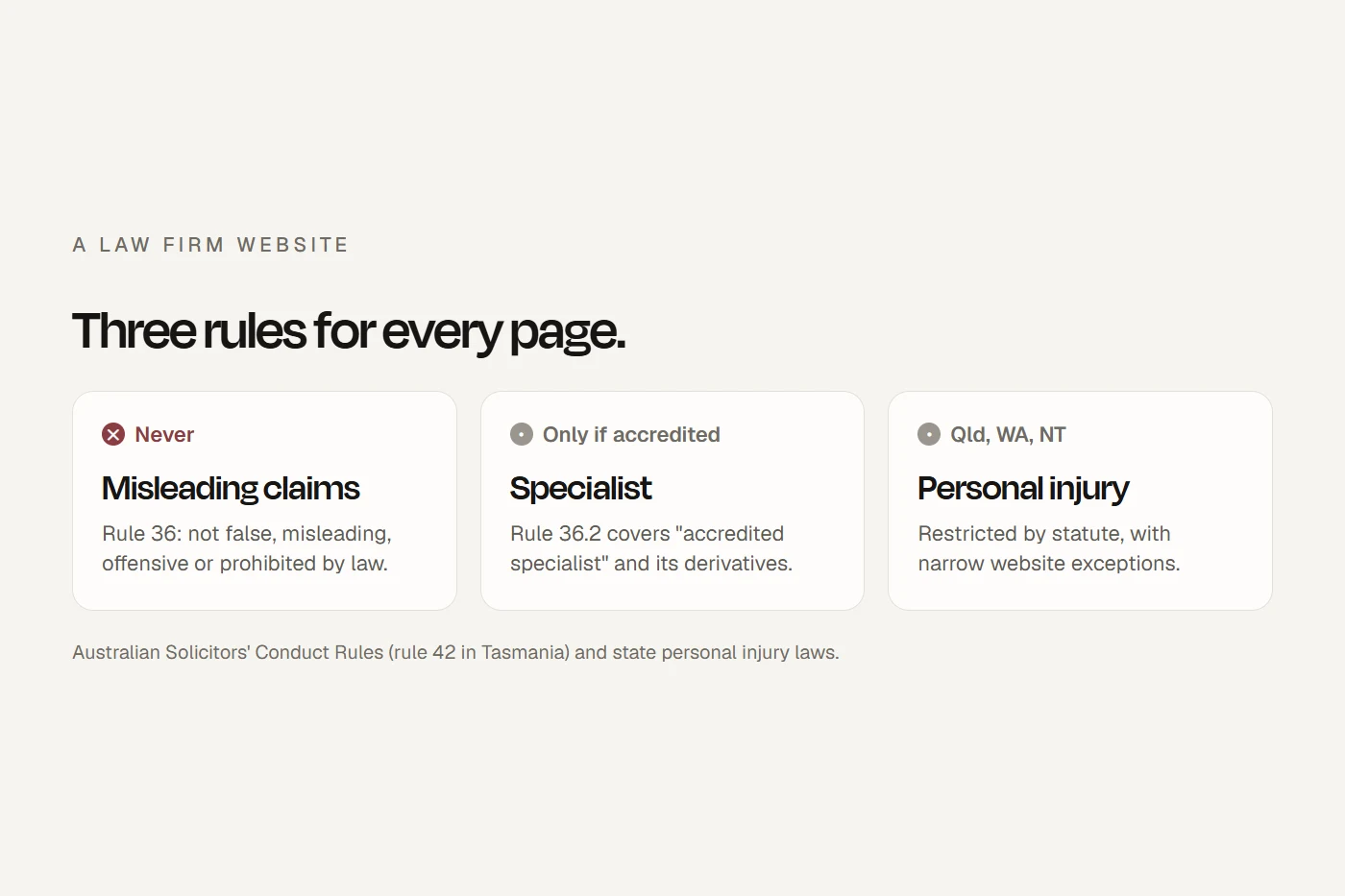
Rule 36 of the Solicitors' Conduct Rules applies to all of it: advertising "in connection with the solicitor or law practice" must not be false, misleading or deceptive, offensive, or prohibited by law. The consumer law applies on top. An agency may write your ads, but the principal answers for them. My guide to law firm marketing covers the general rules. These are the ones that hit criminal and traffic practices hardest.
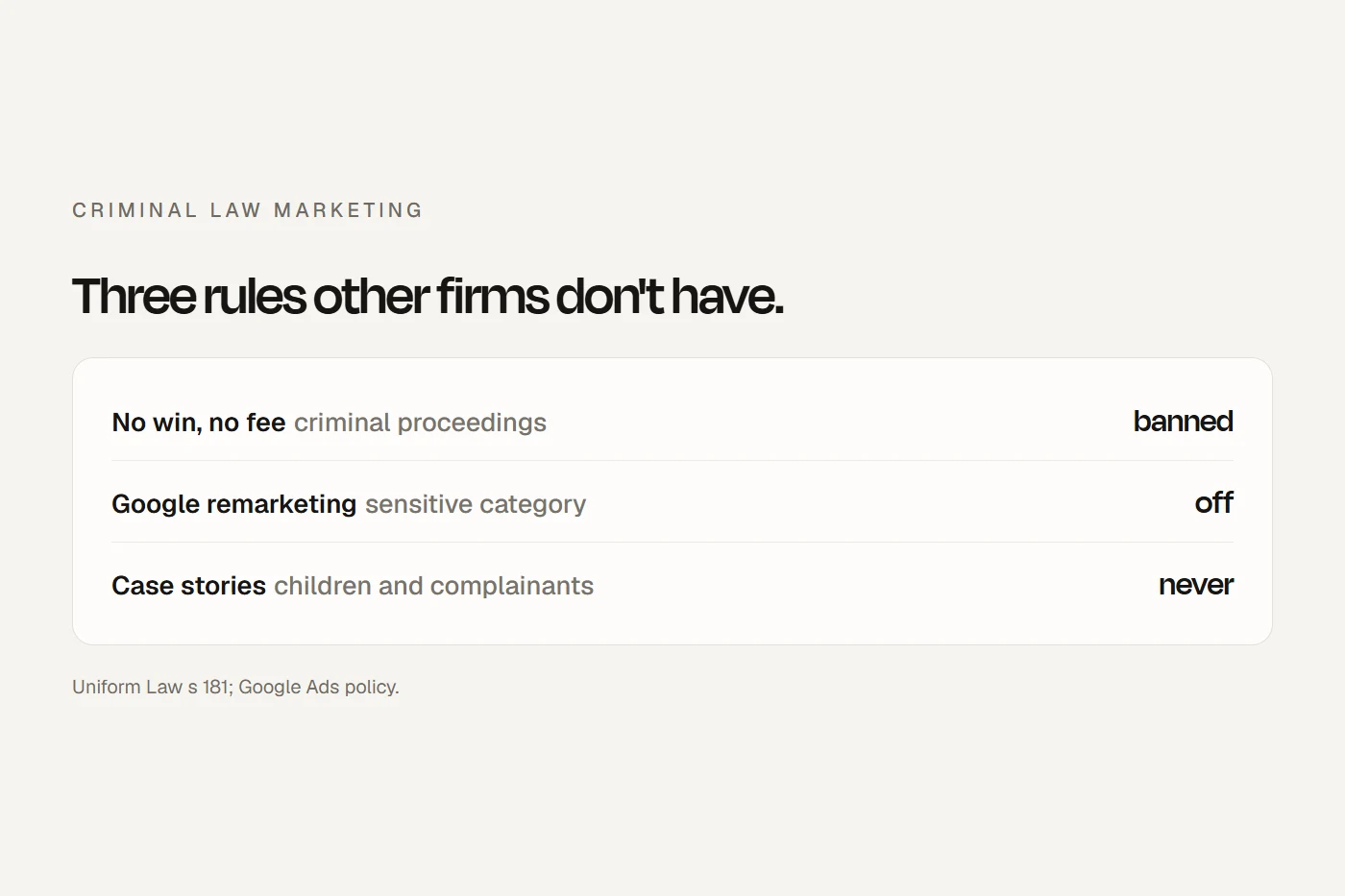
Outcomes. No law society has published guidance written specifically for criminal outcome claims, so they're judged under rule 36 and the consumer law. The closest written guidance, from the WA Law Society (now under review), says success rates "can imply to consumers that future cases will have the same chance of success and are likely to be misleading". With 97% of judgements ending in a guilty outcome, a results page made only of acquittals and withdrawn charges gives a picture most clients won't get. "Section 10 guaranteed" or "keep your licence guaranteed" promises a court's discretion. If you show results, show them de-identified, consented, accurate and with context, such as "one of several charges", and never as a rate or a promise. Rule 28.1 also bars publishing anything about current proceedings that may prejudice a fair trial, so nothing about a matter still under appeal.
"Specialist". Rule 36.2 bars a "false, misleading or deceptive impression of specialist expertise" and the words "accredited specialist" unless you're accredited. NSW and Queensland run criminal law accreditation; their titles include "Accredited Specialist in Criminal Law", and Victoria's scheme covers criminal law too. Accreditation belongs to the person, not the firm, so "we are accredited" is wrong. No scheme accredits traffic law, so nobody is an accredited traffic law specialist. The NSW and Queensland branding guides treat plain "specialist" as outside their schemes, but Queensland's Legal Services Commission treats "specialist" as covered by the rule. The safe default is to use "specialist" only for accredited lawyers, in the accrediting body's exact wording.
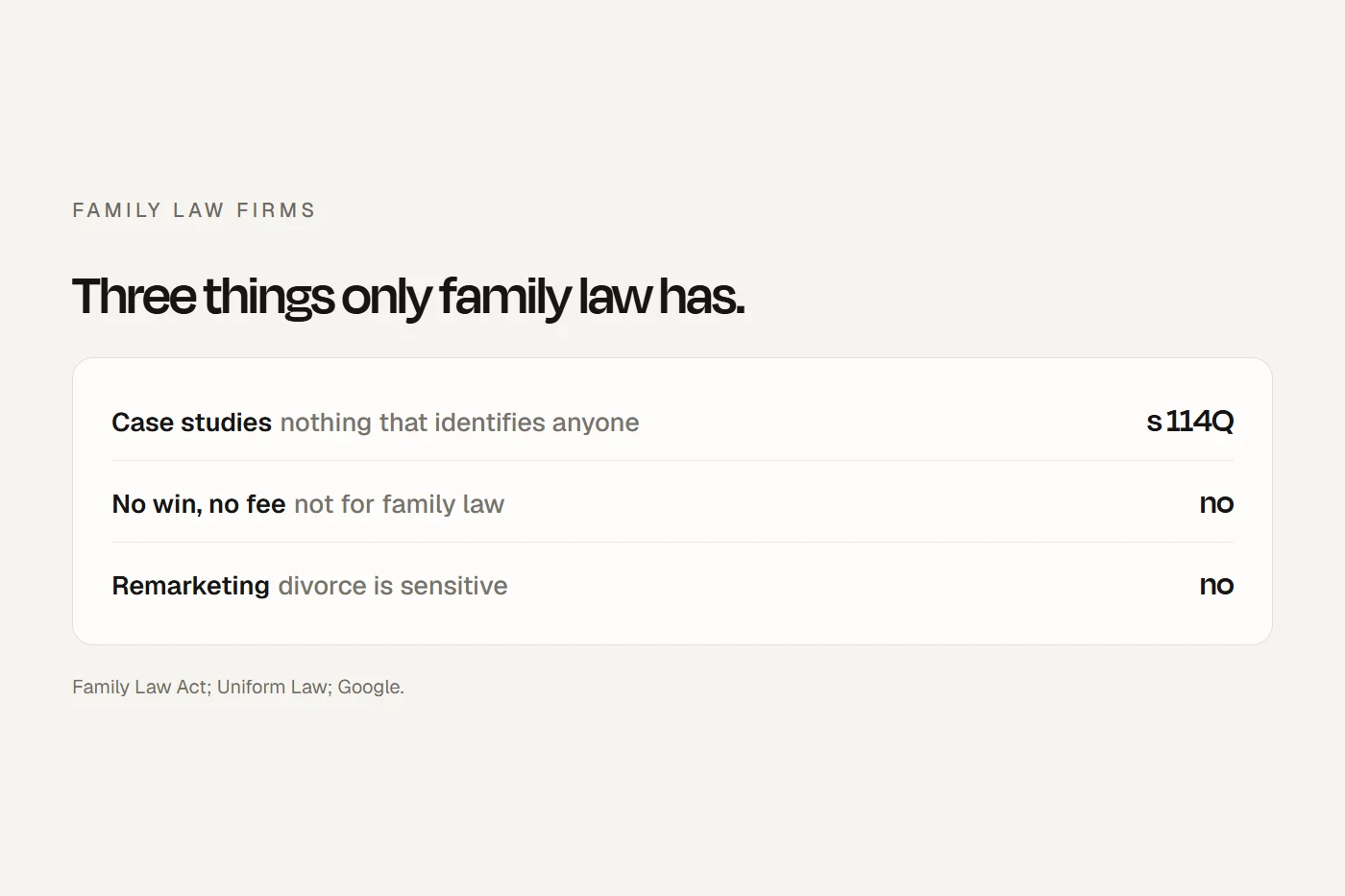
No win, no fee. It's banned in criminal matters. The Uniform Law in NSW, Victoria and WA says a conditional costs agreement may relate to any matter "except a matter that involves criminal proceedings", and Queensland and the NT say the same. The Queensland Law Society says "You should not advertise 'no win no fee' for criminal law". People still search for "traffic lawyer no win no fee", so answer it honestly on your fees page: you can't act that way in criminal or traffic matters because the law doesn't allow it, and here's what you charge instead.
Fixed fees. They're allowed and they work. Say what's in the fee (one court appearance, references, the sentencing hearing) and what isn't (a barrister, adjournments, a defended hearing). A price on your website is advertising, and it doesn't replace costs disclosure once you're instructed. A free first consultation is fine if it's genuinely free and the terms are spelled out.
Case studies, reviews and the publication bans
In criminal law, one case study can break three things at once. The first is confidentiality: rule 9.1 bars disclosing client information unless the client authorises it. The second is a statutory publication ban, and the bans cover websites:
- NSW, children. A person's name must not be published in a way that connects them with criminal proceedings if they were a child at the time of the offence, and that still applies "even if the person is no longer a child". "Name" includes any material "likely to lead to the identification of the person".
- NSW, sexual offence complainants. Nothing may be published that identifies the complainant, even after the proceedings end.
- Queensland, children. "A person must not publish identifying information about a child."
- Victoria, and suppression orders everywhere. Victoria has similar restrictions, and court suppression and non-publication orders bind anyone who publishes.
The third is current proceedings. Safe content describes the type of matter and what happens at each step, not the person. It never involves a child, a complainant, or anything on appeal. Young drivers are a big share of traffic work, so strip the suburb, school and dates from anything about one.
Reviews. Ask every finished client for a Google review the same way, with no incentive and no suggested wording, and not while an appeal is live. A reviewer may name their own charge, but your reply must not confirm they were a client, the charge or the outcome. A criminal record is sensitive information under the Privacy Act, and the Queensland Law Society says you can't use client information to rebut criticism on a review site. Google also shows outcome phrases from reviews in its results, whatever your own pages say. My guide to getting more Google reviews has the reply wording.
Google and Meta ads
Google Ads. Google lists "Criminal defense lawyers" as an example of its "Commission of a crime" sensitive interest category, which covers "criminal allegations, or criminal charges". You can't use advertiser-curated audiences, so no remarketing to your website visitors and no uploading past clients through Customer Match. Keyword search ads are unaffected: "drink driving lawyer" plus a suburb is fine. Ad text should carry no unaccredited "specialist", no "no win no fee", no guarantees, and no fear lines like "Facing jail? Call now before it's too late". Google treats "suggesting negative outcomes for users if they don't take specific actions" as sensitive too. And nothing should look like a court, police or Legal Aid page. My guide to what Google Ads cost in Australia covers the setup.
Meta. Meta lists "criminal record" among the personal attributes ads can't assert or imply. "Charged with drink driving?" implies something about the reader, so it risks rejection. "Drink driving charges: what happens at your first court date" talks about the service instead.
Google Business Profile. Use your real-world name only. Google bans adding "Open 24 hours", service keywords or locations to the name. Lawyers are individual practitioners under Google's rules, so set up practitioner profiles the way Google describes. Virtual offices aren't eligible, which matters if you rent a suite near every court. The category criminal firms show in local results is "Criminal justice attorney".
Offence pages, court pages and traffic content
Write one page for each type of matter you actually run, such as drink driving, drug possession, assault, apprehended violence orders, bail and licence appeals. Each page should say what happens at court and what you do. Have a second lawyer review it, and keep it current.
A page for each court you actually appear at is fine if it's genuinely about that court: where it is, what happens at a first mention there, the duty lawyer arrangements, what to bring, and who from your firm goes there. Fifty near-identical "Criminal Lawyer [Suburb]" pages with the suburb swapped is what Google calls doorway abuse.
Traffic clients search before they call, so explain your state's licence choices in plain words and link to the transport authority. In NSW, an immediate licence suspension can be appealed to the Local Court within 28 days, and so can Transport for NSW licence decisions where the letter says you have the right to appeal. In Victoria, VicRoads sends a demerit point notice, and Victoria Legal Aid says that if you don't reply within 21 days your licence is suspended. In Queensland, open licence holders choose between a suspension and a good driving behaviour period, and a magistrate can grant a special hardship order in some cases. Leave out point counts, fines and suspension periods; they change, and the state pages have them. Legal Aid NSW runs a free online traffic tool that ranks on Google, so your page should say what a lawyer adds at court, and be honest about when someone doesn't need one.
Referrers
Other firms that don't do crime, barristers, and past clients' families all send work. If you pay a referrer per client, the conduct rules require you to disclose it to the client first, in writing. Never approach people outside a court or police station: rule 34.2 bars soliciting people who are at a significant disadvantage after "recent trauma".
Can I say this?
Tap a card to see the verdict.
A 90-day plan
Tick items off as you go; the list remembers your progress on this device.
- Month 1: every "specialist" and "expert" checked On the site, Google profile, ads and LinkedIn. Accredited wording only for accredited people.
- Month 1: "no win, no fee" removed And a fees section added with fixed fees and what they include.
- Month 1: Google Business Profile fixed Real name, real hours, practitioner profiles.
- Month 1: tap-to-call and an after-hours line That reaches a lawyer.
- Month 1: answering service in writing A confidentiality term and a no-advice script.
- Month 1: counting calls by channel and hour You'll need the numbers for the calculator.
- Month 2: one page per matter type you run Each reviewed by a second lawyer.
- Month 2: a traffic section Your state's licence choices in plain words, linked to the transport authority, with no points or fines.
- Month 2: every case study audited Consent on file, no child, no complainant, nothing on appeal, context given.
- Month 2: reviews asked for the same way With a reply template that confirms nothing.
- Month 2: ad pixels off the enquiry pages And the enquiry form asks only what's needed.
- Month 3: Google search campaigns On matter and suburb or court keywords, with no remarketing or customer lists.
- Month 3: ad copy checked No fear lines, no guarantees, nothing that looks official.
- Month 3: court pages for courts you attend And thin suburb pages deleted.
- Month 3: the calculator run with your own numbers Decide whether after-hours answering pays.
Questions I get asked
Are lawyers allowed to advertise in Australia?
Yes. The Solicitors' Conduct Rules allow advertising as long as it isn't false, misleading or deceptive, offensive or prohibited by law. Personal injury advertising is restricted in some states, but criminal and traffic advertising isn't, beyond these general rules and the criminal-specific ones in this guide.
Can a criminal lawyer offer no win, no fee?
No. Conditional costs agreements can't be used in criminal proceedings under the Uniform Law in NSW, Victoria and WA, or in Queensland and the NT. The Queensland Law Society says not to advertise it for criminal law.
Can I call myself a criminal law specialist?
Only if you're accredited by your state's scheme, and then in its exact wording. NSW and Queensland accredit criminal law specialists, and Victoria's scheme covers criminal law too. No scheme accredits traffic law.
Can criminal law firms use Google Ads remarketing?
No. Google treats criminal defence as a sensitive interest category, so you can't use remarketing, customer lists or lookalike audiences. Keyword search ads are fine.
Can I publish client results?
Carefully. You need the client's consent, the matter must be final, and it must never identify a child or a sexual offence complainant. Give context, and never present results as a success rate or a promise.
How much does a traffic lawyer cost?
Each firm sets its own fees, and I don't print figures. Many traffic lawyers offer fixed fees for a plea; the useful thing to check is what the fee includes, such as references, one appearance and the sentencing hearing, and what it doesn't.
About this guide
Written by Joseph Alzein, founder of bdog. I build websites for law firms, including criminal and traffic practices. Sources were checked on 12 October 2026. This is general information, not legal advice. I've left out penalties, fines, demerit point counts and fee figures.
Main sources:
- ABS: Criminal Courts, Australia
- Law and Justice Foundation: Legal Australia-Wide Survey
- Legal Aid NSW: Local Court crime policy
- Victoria Legal Aid: duty lawyers for criminal charges
- Queensland Law Society: can I advertise no win no fee
- Queensland Law Society: the rules about solicitors' advertising
- Google Ads: commission of a crime in personalised advertising
- Meta: personal attributes
- Google: guidelines for representing your business
- Google Search spam policies
- NSW Government: licence suspension and disqualification
- Victoria Legal Aid: demerit points
- Queensland Government: special hardship orders