Starting a dietitian private practice: the website and marketing side
Why Ahpra’s advertising rules still apply to APDs, the state codes of conduct, how clients find a dietitian, Medicare, DVA, health funds and the NDIS, winning GP referrals, your website and Find a Dietitian, and product claims. With a caseload calculator, a wording sorter and a 90-day checklist.
On This Page
- Why aren’t dietitians registered with Ahpra?
- The state codes of conduct
- How clients find a dietitian
- How many new clients do you need?
- Medicare, DVA, health funds and the NDIS
- Winning GP referrals
- Your website, Google profile and Find a Dietitian
- Supplements, meal replacements and weight claims
- Can I say this?
- Your first 90 days
- Questions I get asked
Most of what ranks for "how to start a dietitian private practice" is American, full of state licences and insurance contracting that don't exist here. This guide covers the Australian side of going out on your own, with the focus on being found and getting referrals: why Ahpra's advertising rules still apply to you, the state codes of conduct, Medicare, DVA, health funds and the NDIS, GP referrals, Find a Dietitian, your website and Google profile, and the limits on supplements, meal replacements and weight-loss medicine wording. It draws on Dietitians Australia's Code of Conduct and marketing standards, the National Law, the state codes, Services Australia, the MBS, the TGA, FSANZ and the national private practice dietetics survey. It's general information, not legal or financial advice.
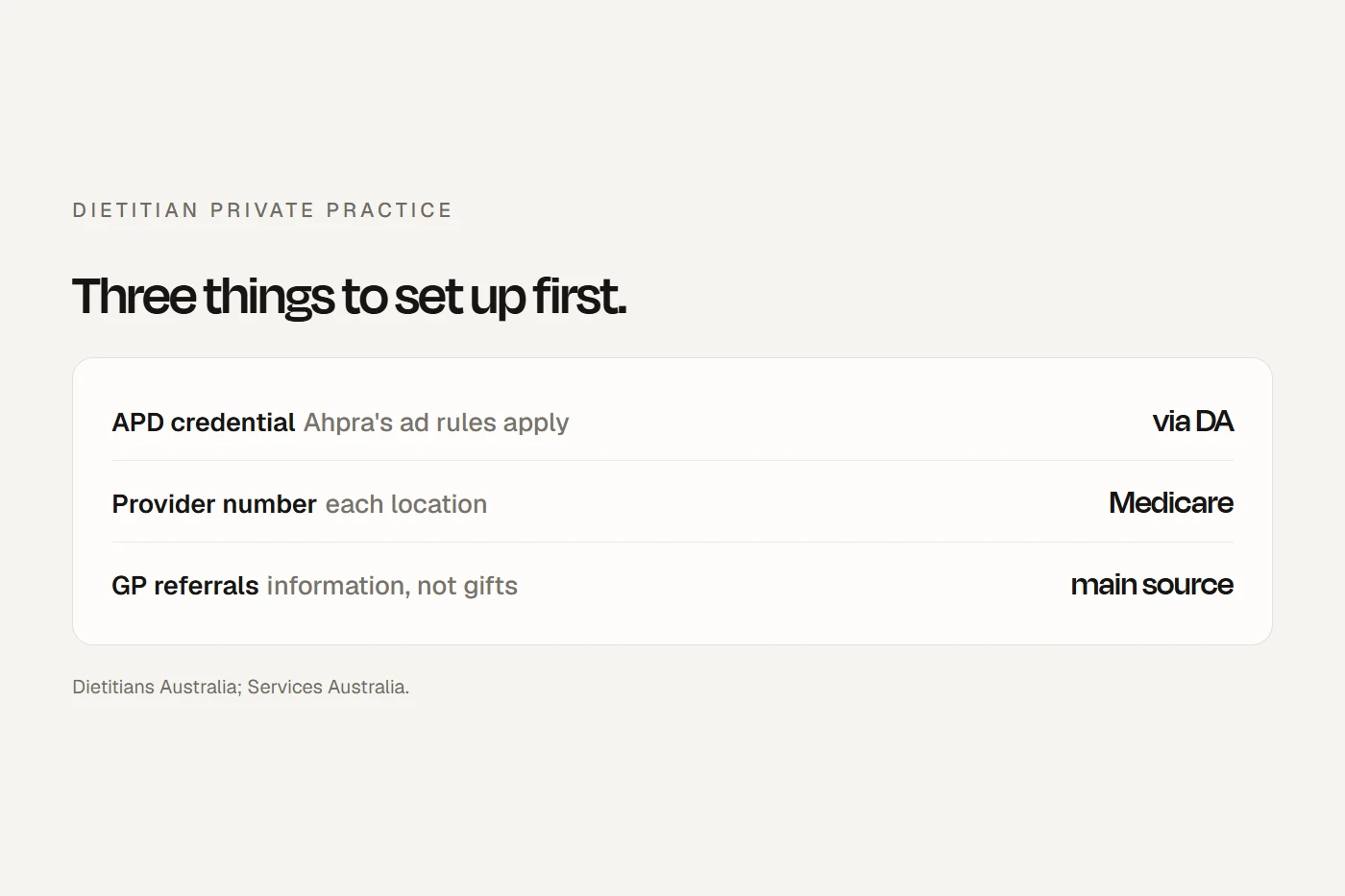
- Write as if Ahpra's rules applyDietitians aren't registered with Ahpra, but Dietitians Australia's Code makes APDs follow its advertising rules, including no testimonials.
- Get your provider number firstA Medicare provider number for each location unlocks Medicare, DVA and recognition by the major health funds.
- GPs are your main sourceReferral letters don't name you, so be easy to find for patients and reception staff, and visit nearby GPs with information, never gifts.
Why aren't dietitians registered with Ahpra?
Dietetics isn't one of the professions in the National Law, so there's no Ahpra board for dietitians. The profession is self-regulated: Dietitians Australia (DA) runs the Accredited Practising Dietitian (APD) credential and the Code of Conduct, under the standards of the National Alliance of Self Regulating Health Professions. As DA puts it, nutritionists aren't regulated at all, and "all dietitians are nutritionists, but nutritionists without a dietetics qualification can't call themselves a dietitian".
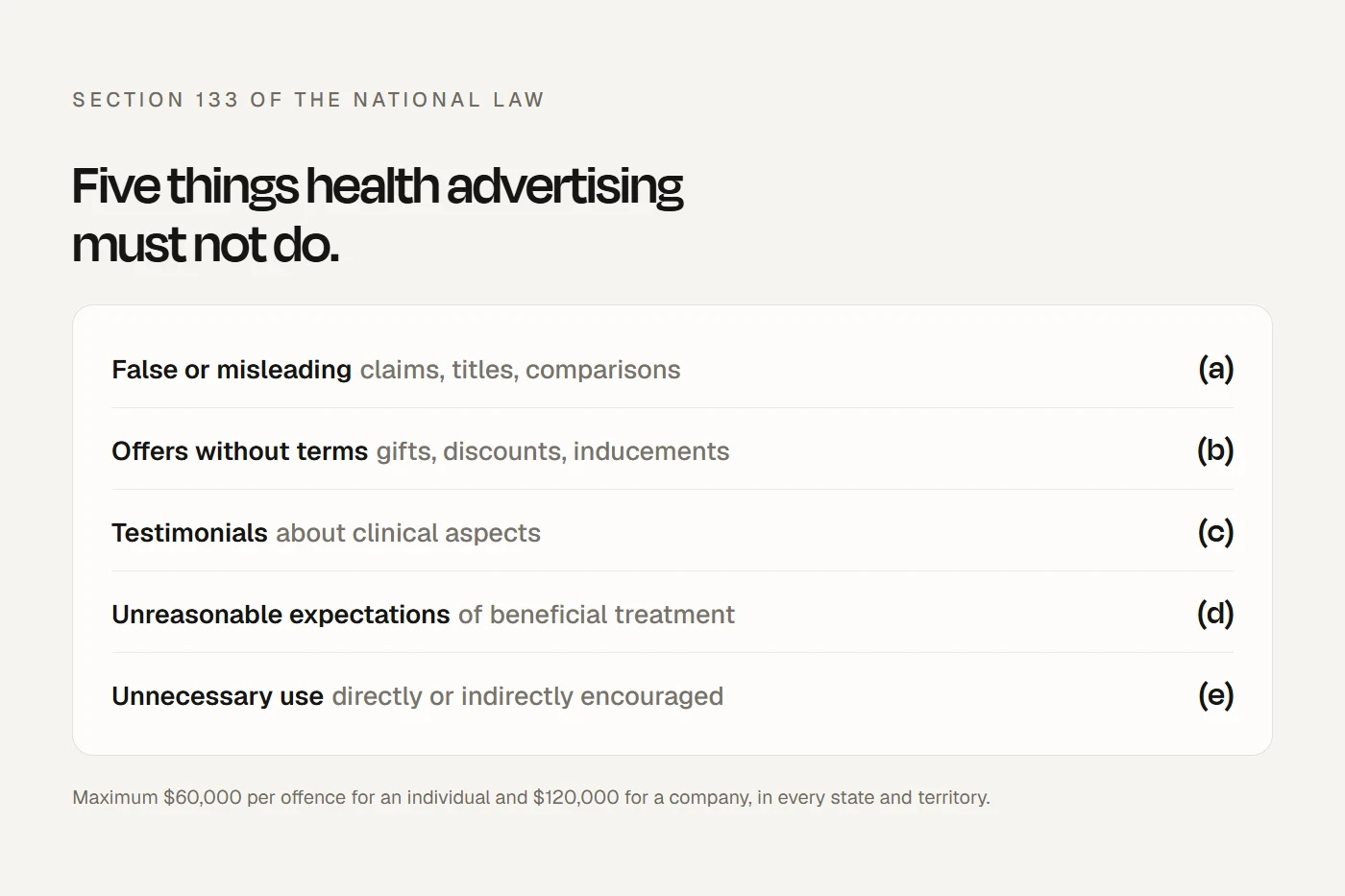
That doesn't free you from Ahpra's advertising rules. DA's current Code says APDs must comply with the National Law's advertising requirements "as if the dietitian were bound by the National Law". DA has approved a new Code, and once it takes effect it says the same thing more directly: comply with the requirements for health professionals, "including non-use of testimonials". So the practical answer is to write as if section 133 applies.
Does section 133 itself reach you? On its words, it covers a "regulated health service", which means a service usually provided by a practitioner in one of the registered professions. My reading, not legal advice:
- A stand-alone dietetics practice probably isn't covered by section 133 itself, though DA's Code brings in the same standard.
- A dietitian inside a clinic that also offers physio, psychology or GP services is covered, because section 133 also covers advertising "a business that provides a regulated health service".
- A dietitian who is also registered as a nurse or pharmacist is covered for everything they advertise; Ahpra says the rules extend "to all services provided by the practitioner".
The state codes of conduct
Because you're not registered with Ahpra, the code of conduct for unregistered health workers applies to you in most of Australia. It's in force in NSW, Queensland, Victoria, South Australia, WA, the ACT and Tasmania; the NT hasn't adopted it. NSW names dietitians in its definition of a health service. The parts that touch marketing:
- No unsupported claims. You must not make claims "about the efficacy of treatment or services provided if the claims cannot be substantiated", and you can't claim to cure terminal or incurable illness.
- No misleading qualifications. No misinformation about your qualifications, training or professional affiliations.
- No referral inducements. You must not offer "financial inducements or gifts in return for client referrals from other health practitioners".
- Insurance. Appropriate indemnity insurance must be in place.
- Display. The code and information on how to complain must be displayed where you practise. In NSW, the rule says "at all premises where the practitioner practises" or, if you have a website, "on the website". If you practise in NSW, especially by telehealth, put both on your site.
Tasmania's code covers services provided "in and into Tasmania", so a telehealth dietitian with Tasmanian clients is covered there too. Check the wording in each state you see clients from.
How clients find a dietitian
There's no Australian survey of how clients first find a private dietitian. The research points one way: GPs. In the national private practice survey, 90% of practices that offered consultations accepted Medicare-referred clients, 80% private health insurance, 78% NDIS and 47% DVA, and the authors found that "establishing effective and robust referral streams is critically important" because Medicare programs rely on GPs to start care. Earlier research found dietitians' relationships with GPs were the main thing influencing referrals.
The same survey found most practices were sole traders, most offered online consultations, and the challenges owners named included "attracting new clients" and clients cancelling or not turning up. A separate survey of the public in Australia and New Zealand found doctors were the most trusted source of dietary information and cost was the most common factor in choosing a dietitian. So a dietitian's website should make two things obvious: how to come via your GP, and how each funding option works.
How many new clients do you need?
Put in your own week. The times are examples; the most common initial consultation in the survey was 60 minutes and the most common review 30. Fees are left at zero for you to fill in.
On the example times, each new client takes about three and a quarter hours over their initial and three reviews, so 20 hours a week holds about six new clients, about 25 consultations, and needs about 12 enquiries. If your diary isn't full, the gap is an enquiry problem, and that's what the rest of this guide is about. The survey also found that practices that reviewed their performance regularly tended to earn more, so count where every enquiry comes from.
Medicare, DVA, health funds and the NDIS
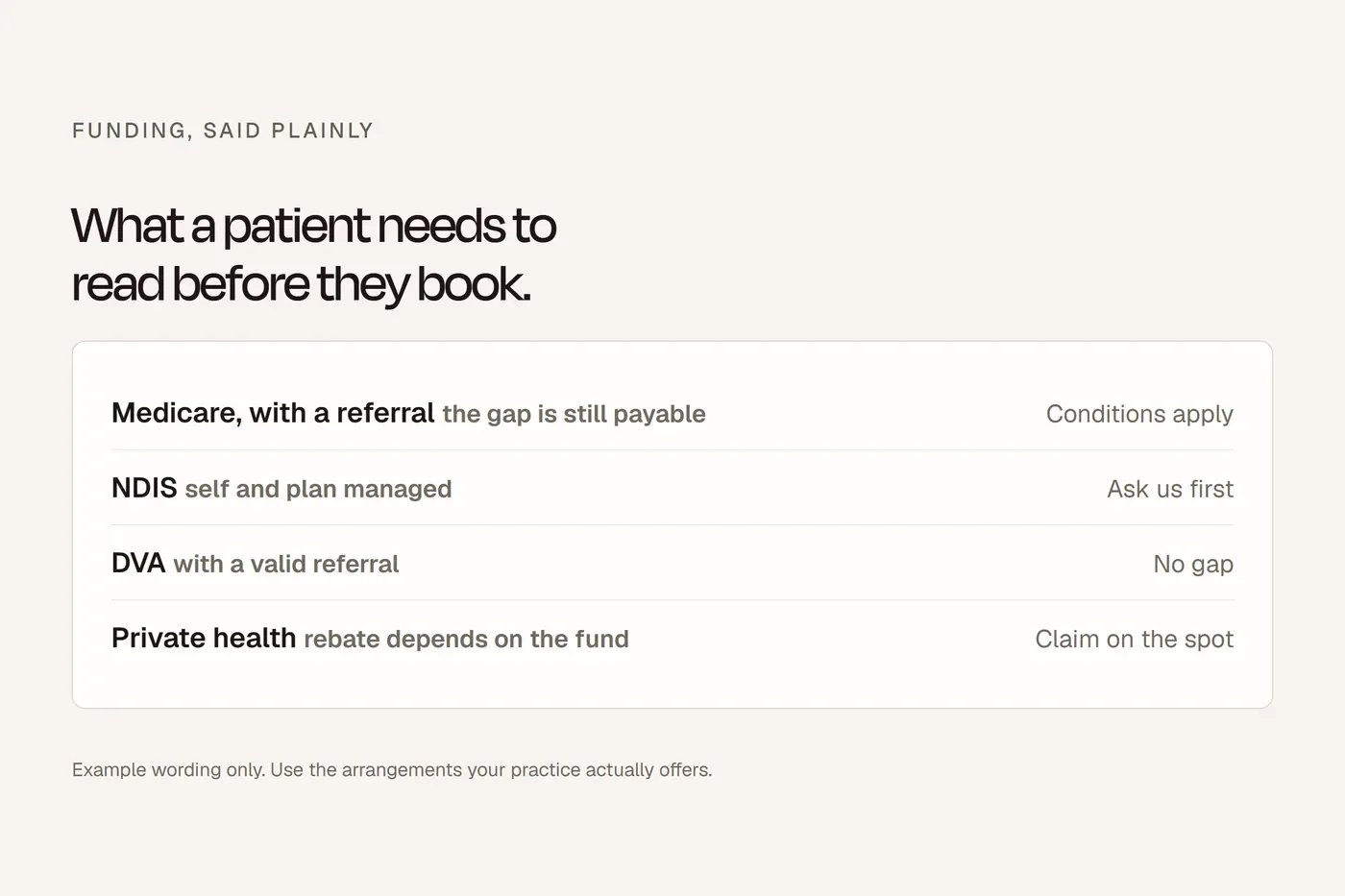
Medicare. Only an APD can provide the Medicare dietetics items: the law says a person is eligible "if the person is accredited by Dietitians Australia as an 'Accredited Practising Dietitian'". You need a Medicare provider number for each practice location, through HPOS or the HW093 form, with evidence of your APD credential. Think before using your home address: Services Australia warns that provider number addresses "may be publicly available", including on referrals. Patients need a GP chronic condition management plan and a written referral, and the visits are capped each year across all allied health. Referral letters don't need to name you: "The patient can take the referral to any eligible health professional of the same profession/type". There are also items for eating disorders and type 2 diabetes groups, and telehealth items. You must send the referring GP a written report after the first and last service. My guide to showing Medicare, NDIS and DVA on a clinic website covers the wording.
DVA. Only an APD with a Services Australia provider number can treat entitled veterans, and some items need prior approval.
Health funds. Bupa and Medibank both recognise a dietitian once Medicare has issued a provider number; Medicare passes the number on to them. Agree to each fund's provider terms, and ask the other funds directly. A patient can't claim Medicare and their fund for the same visit.
NDIS. Most practices in the survey accepted NDIS clients, but few were registered providers. If you're unregistered, you can see self-managed and plan-managed participants only, so say so plainly. My guide to registered and unregistered NDIS providers has the detail.
On your website, say what's true without dollar amounts: "Medicare rebates may apply with a GP referral under a chronic condition management plan", "Health fund rebates may apply, depending on your extras cover". Say "bulk billed" only if you bulk bill those services, and never "free with Medicare" if there's a gap.
Winning GP referrals
Since the referral doesn't name you, both the GP and the patient still choose. What works within the rules is information, not inducements:
- A one-page referral guide for nearby practices: the areas you see, telehealth, how quickly you can see people, how you report back, and how to refer.
- In-person visits to the practices within your radius. Research with dietitians found meeting GPs in person was seen as the most effective way to build those relationships.
- Prompt, useful reports. The report you must send after the first and last service is a regular touchpoint with every referring GP. Keep it short and on your letterhead.
- A referral page on your website with your provider details and a downloadable referral template.
- No gifts. No vouchers, lunches or rewards for referrals: the state codes and DA's Code both rule them out.
DA has said any prescription of weight-loss medication should come alongside a referral to an APD. That's a real referral stream to talk to GPs about. Keep it off public ads, though: the TGA says terms like "weight loss injections" can advertise prescription medicines. "Nutrition support alongside medical weight management" promotes your consultation without naming a medicine.
Your website, Google profile and Find a Dietitian
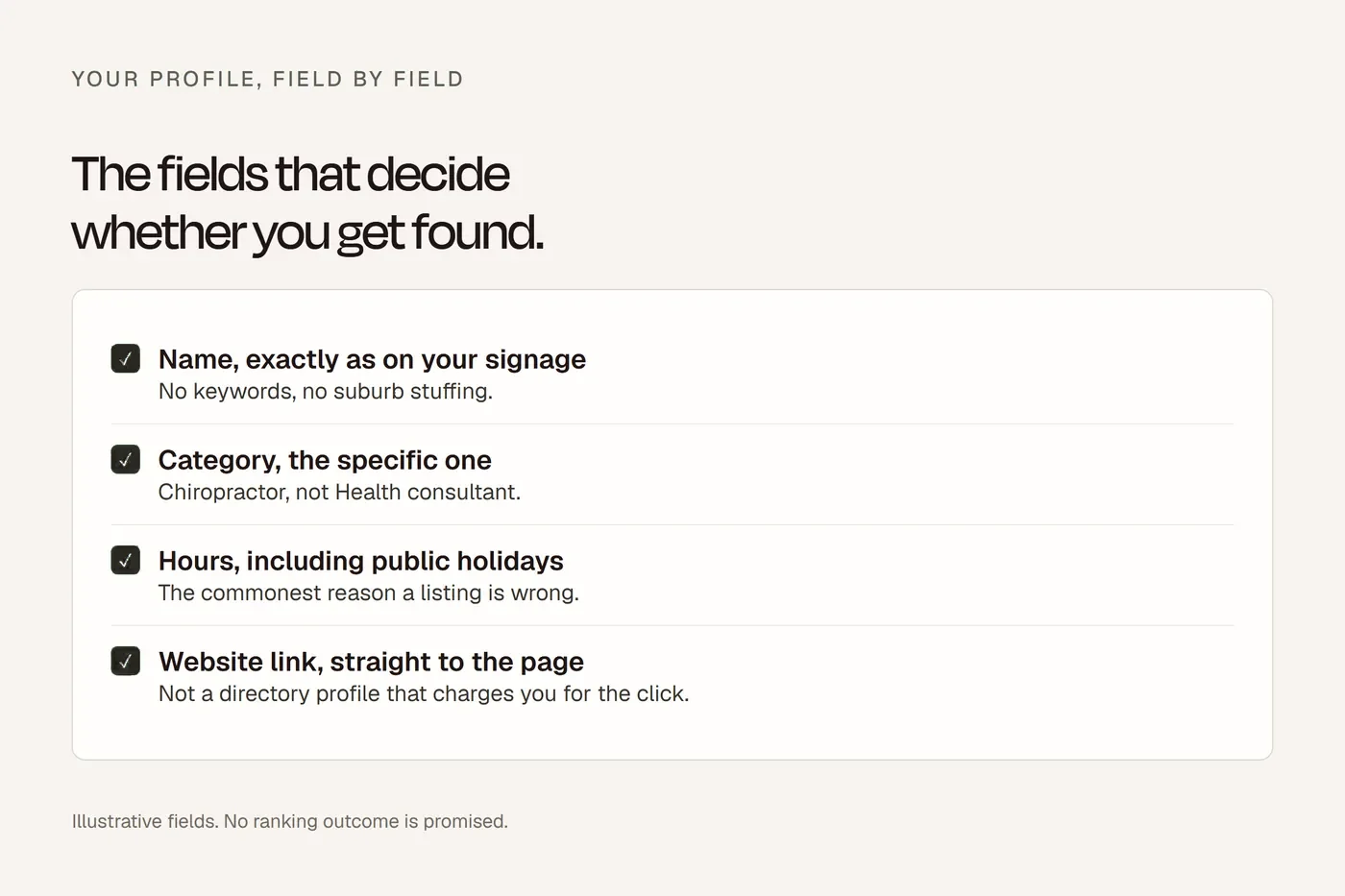
Find a Dietitian. DA's directory ranks first for "dietitian private practice". The public can filter by suburb, distance, about 50 "Help me with" areas and appointment type, including telehealth. Tick every area you really work in, and link to a matching page on your site. Wording rules apply to directory listings too.
Your website. One page for each area you see (for example IBS and FODMAPs, type 2 diabetes, PCOS, eating disorders, sports nutrition, NDIS and telehealth), a "How to see us" page explaining GP referrals and each funding option, full fees (DA's Code requires you to discuss "all fees and charges"), your booking system linked, your privacy policy, and in NSW the code and complaints information. Health service providers are covered by the Privacy Act whatever their turnover, so keep enquiry forms short and keep health details out of tracking.
Your credential, exactly. Use "Accredited Practising Dietitian (APD)", or "Advanced Accredited Practising Dietitian (AdvAPD)" if you hold it, and the APD logo only while you're credentialed. Never "Ahpra registered" or "registered dietitian". Avoid "specialist": there's no specialist credential. If you have a PhD, make the profession clear: "Dr Jane Lee (Accredited Practising Dietitian)".
Google Business Profile. Choose "Dietitian" as your primary category. Local results for dietitian searches also show listings labelled "Nutritionist", so you're competing with unregulated providers; your APD credential is the difference, so say it clearly. None of the main Australian practice systems I checked is a Reserve with Google partner, so add your own booking page as the booking link. My Google Business Profile checklist for clinics covers the setup.
Reviews and testimonials. DA's marketing page says to avoid client testimonials "that refer to clinical care", before-and-after photos, "guaranteed results" and unverified research. It lists reviews about location, parking, easy booking and friendly staff as "okay to share". I go further on health websites and leave reviews and testimonials off entirely. When you reply to a review on Google, never confirm that the person is a client: that discloses health information.
DA's new Code adds three things. Use "size-inclusive, non-stigmatising images and language". Acknowledge "the type and purpose of artificial intelligence used" in promoting your services. And declare paid partnerships on social media.
Supplements, meal replacements and weight claims
About one practice in ten in the survey sold supplements, and a few sold meal replacements. The rules are tight. The TGA's advertising code bars "a current or former health practitioner, health professional" and anyone who presents as trained to treat or prevent disease from endorsing therapeutic goods, so don't recommend a supplement brand in an ad or a post. Meal replacements are foods, and FSANZ decided "not to permit" claims linking a food directly to weight loss; only limited energy-based claims are allowed for formulated meal replacements. Use the manufacturer's permitted claims only, and tell clients about your commercial interest.
For your own services, "lose 10 kg in 12 weeks" fails several ways at once: an unreasonable expectation, an unsupported claim, stigmatising framing, and Meta's ban on timeframe promises in weight ads. Describe the service instead: "Dietitian support for weight management, built around your health goals".
Can I say this?
Tap a card to see the verdict.
Your first 90 days
Tick items off as you go; the list remembers your progress on this device.
- Month 1: APD status current And your CPD and practice hours up to date.
- Month 1: ABN, and GST checked with an accountant Dietetic services can be GST-free, but confirm yours.
- Month 1: professional indemnity insurance Required by the state codes and DA's Code.
- Month 1: Medicare provider number for each location Through HPOS or HW093. Think before using a home address.
- Month 1: health funds and DVA Check Bupa and Medibank picked up your number, read their terms, ask the others. Note which DVA items need approval.
- Month 1: NDIS decision Registered or unregistered, and say which on your site.
- Month 1: privacy policy and a short enquiry form
- Month 1: code and complaints information displayed At your premises, and on your website in NSW.
- Month 2: Find a Dietitian listing Every area you see, telehealth if you offer it, linked to matching pages.
- Month 2: Google Business Profile "Dietitian" as the primary category and your own booking page as the booking link.
- Month 2: website A page per area, a "How to see us" page, full fees, and your booking system linked.
- Month 2: wording check No testimonials, no before-and-after, no guarantees, exact APD wording, AI use acknowledged.
- Month 2: products checked No supplement endorsements; permitted meal replacement claims only; interests disclosed.
- Month 3: GP visits The practices in your radius, with your one-page referral guide. No gifts.
- Month 3: GP reports Prompt, short and useful, every time.
- Month 3: count your enquiries Calls, forms and bookings by source, then run the calculator with real numbers.
Questions I get asked
Why are dietitians not registered with Ahpra?
Dietetics isn't one of the professions in the National Law. It's self-regulated through Dietitians Australia and the APD credential. DA's Code still requires APDs to follow Ahpra's advertising rules, including no testimonials.
How do I start a dietitian private practice in Australia?
Keep your APD credential current, get an ABN and professional indemnity insurance, apply for a Medicare provider number for each location, check health fund and DVA recognition, decide on NDIS registration, then list on Find a Dietitian, build your website and Google profile, and visit nearby GPs.
Does private health insurance cover dietitians?
Most funds cover visits to APDs in private practice under extras cover, depending on the policy. Bupa and Medibank recognise dietitians once Medicare has issued a provider number. Patients can't claim Medicare and their fund for the same visit.
Can dietitians use testimonials?
Not about clinical care. DA's Code requires APDs to follow the National Law's ban on testimonials, and its marketing page says to avoid client testimonials, before-and-after photos and "guaranteed results". Reviews about parking, booking or friendly staff are allowed, though I leave them off health websites.
Can I call myself a registered dietitian?
No. Dietitians aren't registered under the National Law, so "registered" or "Ahpra registered" misrepresents your qualifications. Use "Accredited Practising Dietitian (APD)".
How much do private practice dietitians charge?
DA doesn't set fee guidelines, so each practice sets its own, and I don't print figures. What drives the fee is the length of the consultation, the admin and reports involved, and whether Medicare, a fund, DVA or the NDIS is paying part of it. Put your full fees on your website.
About this guide
Written by Joseph Alzein, founder of bdog. I build websites for dietitians and allied health practices, with Dietitians Australia's marketing standards and Ahpra's advertising guidelines in mind. Sources were checked on 12 October 2026. This is general information, not legal or financial advice. I've left out Medicare, DVA, NDIS and fund amounts and other figures that change.
Main sources:
- Dietitians Australia: marketing your practice
- Dietitians Australia: Code of Conduct
- Dietitians Australia: dietitians and nutritionists
- Dietitians Australia: help with costs
- Dietitians Australia: Find a Dietitian
- Health Practitioner Regulation National Law
- NSW Health: code of conduct for unregistered health practitioners
- Tasmanian Health Complaints Commissioner: code of conduct
- Services Australia: HW093 provider number application
- MBS: item 10954
- Bupa: dietitian providers
- Medibank: dietitian providers
- TGA: testimonials and endorsements
- TGA: advertising health services that involve therapeutic goods
- FSANZ: meal replacements and body weight
- Kirkegaard et al.: the business of dietetics, national private practice dataset