Getting referrals for an occupational therapy private practice
How families and referrers find an OT, the title and credential rules, testimonials and paediatric claims, Ahpra’s conflicts of interest guidance, each referral channel from GPs to NDIS, aged care, workers’ comp, DVA and driving assessments, and honest capacity claims. With a referral capacity calculator, a wording sorter and a 90-day plan.
On This Page
- How families and referrers find an OT
- Titles and credentials
- Testimonials and outcome claims
- Conflicts of interest and referral arrangements
- Referral channels, one by one
- Free offers and capacity claims
- How many referrals can you take?
- Your website and Google profile
- Can I say this?
- A 90-day referral plan
- Questions I get asked
An occupational therapy practice lives on referrals: from GPs and paediatricians, NDIS support coordinators, schools and early childhood partners, aged care providers, insurers and families. Each referrer finds and judges an OT differently, and each comes with its own rules about what you can say and what you can't give them. This guide covers how families and referrers look for an OT, the title and credential rules that trip OTs up, conflicts of interest, each referral channel in turn, and how to keep your capacity claims honest. It draws on the Occupational Therapy Board and Ahpra, the MBS, the NDIA, DVA, the Support at Home program manual, WorkSafe Victoria, Austroads and Occupational Therapy Australia. It's general information, not legal advice.
- Never "specialist"The OT Board says it's unlawful for OTs to call themselves specialists. "Experience in" or "predominantly practise in" is fine.
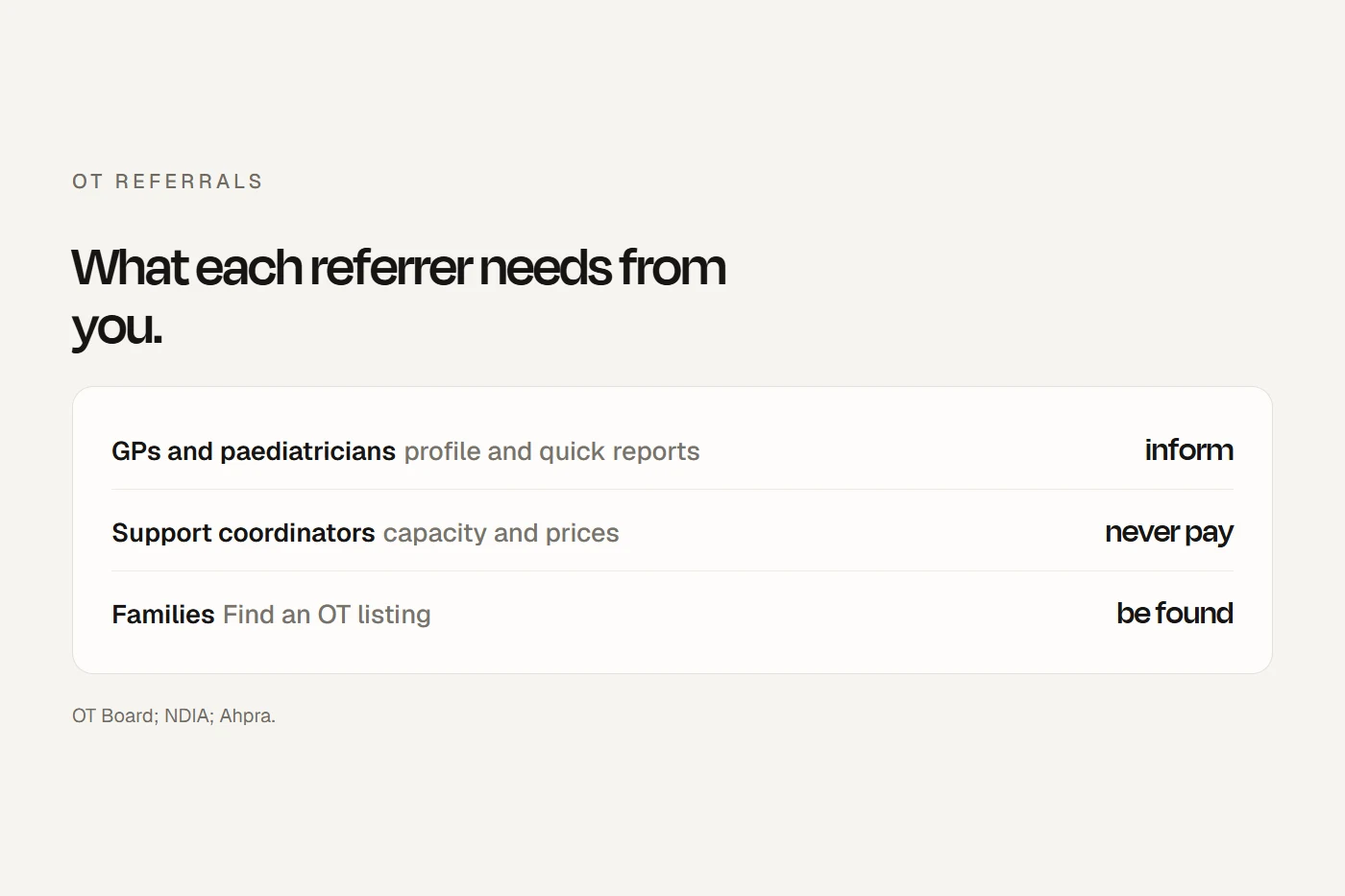
- Inform referrers, never reward themA practice profile, quick reports and an honest start date win referrals. Gifts and referral payments are out, and Ahpra says a website disclosure of conflicts isn't enough.
- Be findable where referrers lookOTA's Find an OT is where healthdirect, a children's hospital and Austroads send people. Keep your areas, funding and languages accurate.
How families and referrers find an OT
There's no Australian survey of how families choose an OT, or how GPs, paediatricians or support coordinators pick one. What the public is told is clear, though. healthdirect says your doctor can refer you to a specific OT, "You can also ask your family and friends", "Occupational Therapy Australia has a Find an OT service", and you can search healthdirect's Service Finder. It also says "A referral is not needed to see an occupational therapist", except to claim through a government scheme, and that you should call and ask about the cost first.
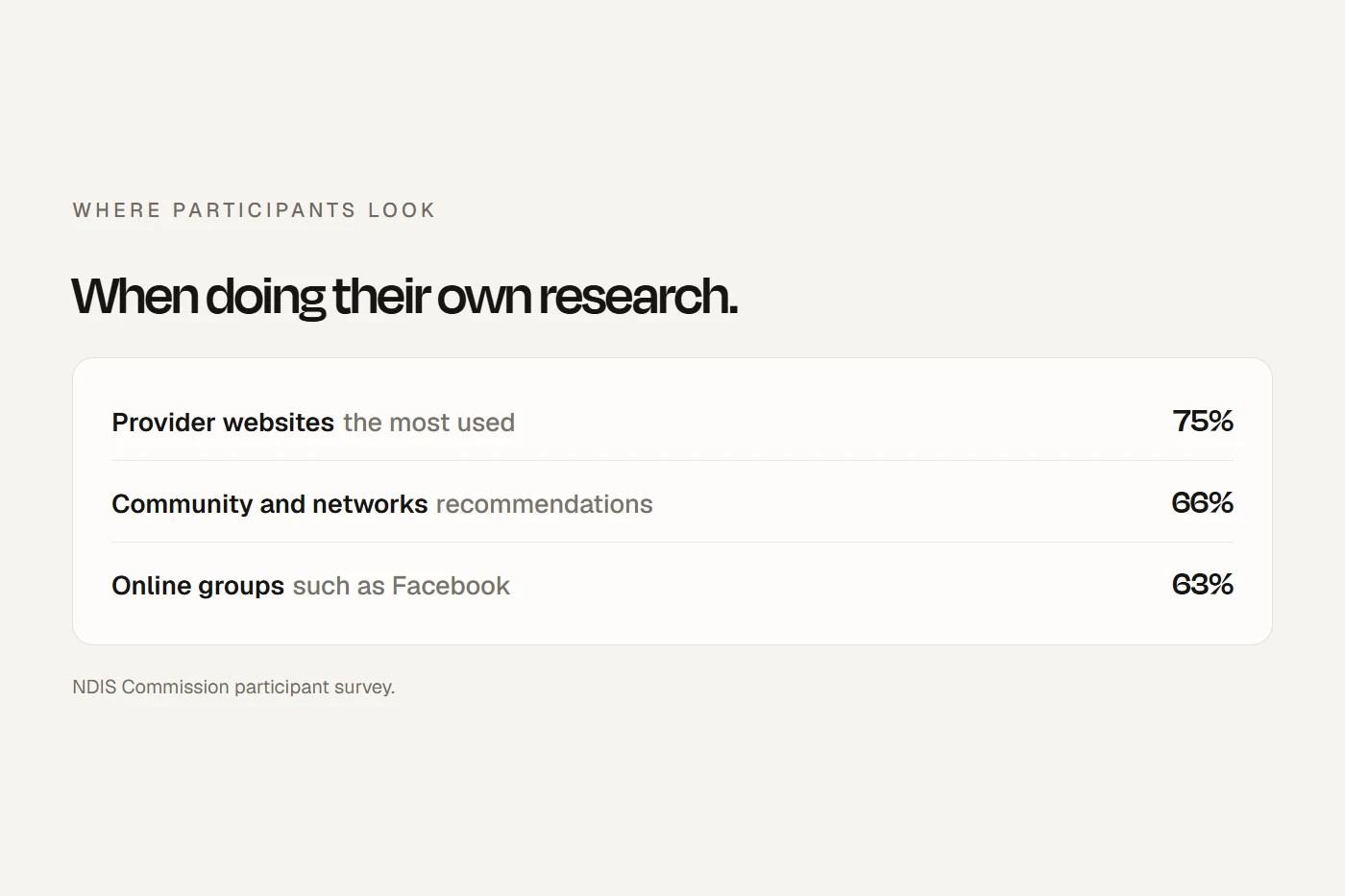
The Royal Children's Hospital in Melbourne sends families to OTA's Find an OT rather than its own list. NDIS participants are told to ask their my NDIS contact or support coordinator, ask people they trust, research providers and check reviews. In the NDIS Commission's own survey, provider websites were the most-used source when participants researched providers. Support coordinators keep their own provider lists. And many families and coordinators meet waitlists, so a practice that can honestly say when it can start, and keeps that current, stands out.
Titles and credentials
"Specialist". The OT Board's guidance is blunt: "There is no specialist registration for occupational therapists, and the title 'specialist' is restricted; it is unlawful for occupational therapists to call themselves specialists or imply that they are specialists. However, an occupational therapist could reasonably say they have an 'interest', 'experience' or 'predominantly practise' in an area of clinical practice." Ahpra's guidelines add "specialises in", "specialty" and "specialised", and give a paediatric example of the fix: not "a specialist in paediatric care" but "substantial experience working with ... children". Business names count too.
Descriptive terms are fine when true: "paediatric occupational therapist", "hand therapist", "mental health OT", "occupational therapy driving assessor". "Paediatric specialist", "specialist hand therapist" and "specialised sensory clinic" are not.
Driving assessors. Austroads' national guidelines head an appendix "Specialist driver assessors", but an OT still can't use the word. Use "occupational therapy driving assessor", the term Austroads uses in its main text.
Mental health endorsement. OTs have no Ahpra endorsements at all. OTA's mental health endorsement is a professional association credential, though Medicare relies on it. Name the source: "endorsed by Occupational Therapy Australia for mental health practice". A bare "endorsed occupational therapist" can be read as an Ahpra endorsement that doesn't exist, and claiming one you don't hold breaches the National Law.
Hand therapy. The Accredited Hand Therapist credential comes from the Australian Hand Therapy Association, and AHTA writes it as "Accredited Hand Therapist, as awarded by the AHTA". It must be renewed every five years, so drop it from your site if it lapses.
"Dr". An OT with a PhD writes "Dr Sam Lee (Occupational Therapist)", never "Dr Lee" alone.
Testimonials and outcome claims
Ahpra's guidelines name "patient stories and experiences, success stories" as testimonials, and the OT Board says using them in advertising "is an offence under the National Law". So a "Meet Ava: how OT helped her start school" story, a parent's quote about their child's progress, an NDIS participant's video, or a support coordinator's "they transformed my client" quote all become clinical testimonials once you use them to advertise. You're not responsible for reviews on sites you don't control, but don't encourage testimonials on your own pages. I leave them off health websites entirely.
Paediatric claims need the most care. Avoid "school-ready in 10 sessions", "fix sensory processing", "improve handwriting guaranteed" and "reduce autism symptoms". Avoid early-years fear lines like "the window closes at 5" or "don't wait until it's too late". Describe what you do and who it's for: "We work with children who find dressing, handwriting or play hard, and with their families and teachers." The NDIS guidance adds that providers must not make claims about the effectiveness of supports "that cannot be substantiated independently".
Conflicts of interest and referral arrangements
Ahpra published interim guidance on financial and commercial conflicts of interest, and the OT Board links to it. A conflict is "when you, your employer or someone connected to you stands to benefit financially or commercially from an assessment, treatment, referral, product or health service you recommend or provide", and the benefit doesn't have to be money. The key lines for marketing:
- "Declaring a conflict of interest on your website, in advertising or on social media is not sufficient disclosure." It belongs in informed consent, in person and in writing.
- Good practice includes "refusing gifts or other incentives", and discussing options "including those not provided by you or your organisation".
- If you employ practitioners, don't set targets that put "benefit to the business ahead of their professional obligations to patients".
The NDIA's conflicts fact sheet for allied health uses an OT as its example: one paid a gift for recommending a wheelchair after a short showroom trial. Providers should "declare any connections and relationships with other providers" and "where possible provide at least 3 or more support or service options". A practice page that answers that up front, such as "We don't sell equipment, and we'll give you at least three options", is a trust signal that matches the NDIA's own checklist.
Referral channels, one by one
GPs. GP chronic condition management plans cover a small number of OT sessions a year, shared across allied health. The referral doesn't need to name you, and you must send the GP a written report. "Medicare rebates may apply for eligible patients with a GP chronic condition management plan" is accurate. Make the report letter prompt and useful; it's your best GP marketing.
Mental health referrals. Better Access is open only to OTs with OTA mental health endorsement; Medicare's own note says so. Only an endorsed OT should say "Medicare rebates available under a Mental Health Treatment Plan". GPs, psychiatrists and paediatricians can refer, and you send a report at the end of treatment. A local Mental Health Professionals' Network is a good way to meet GPs.
Paediatricians. Paediatricians and psychiatrists can refer young people under 25 with a suspected or diagnosed complex neurodevelopmental disorder or eligible disability, for assessment and treatment. A separate referral letter must go to each allied health practitioner, and your report should include advice for parents and teachers. That report is also how schools hear about you. A short sheet for paediatric practices covering what you assess, how fast, and what your report looks like is the right pitch.
Schools and early childhood. Teachers often suggest OT to families, so anything you give a school is advertising and follows the same rules. Get written consent before sharing anything about a child. NDIS early childhood partners are people to inform about your ages, funding and availability, never people to reward. Paediatric pathways are changing: the government's Thriving Kids program is rolling out supports for young children with developmental delay or autism, including OT delivered through the states. For families without an NDIS plan, keep it simple: "Ask us about other ways to get support."
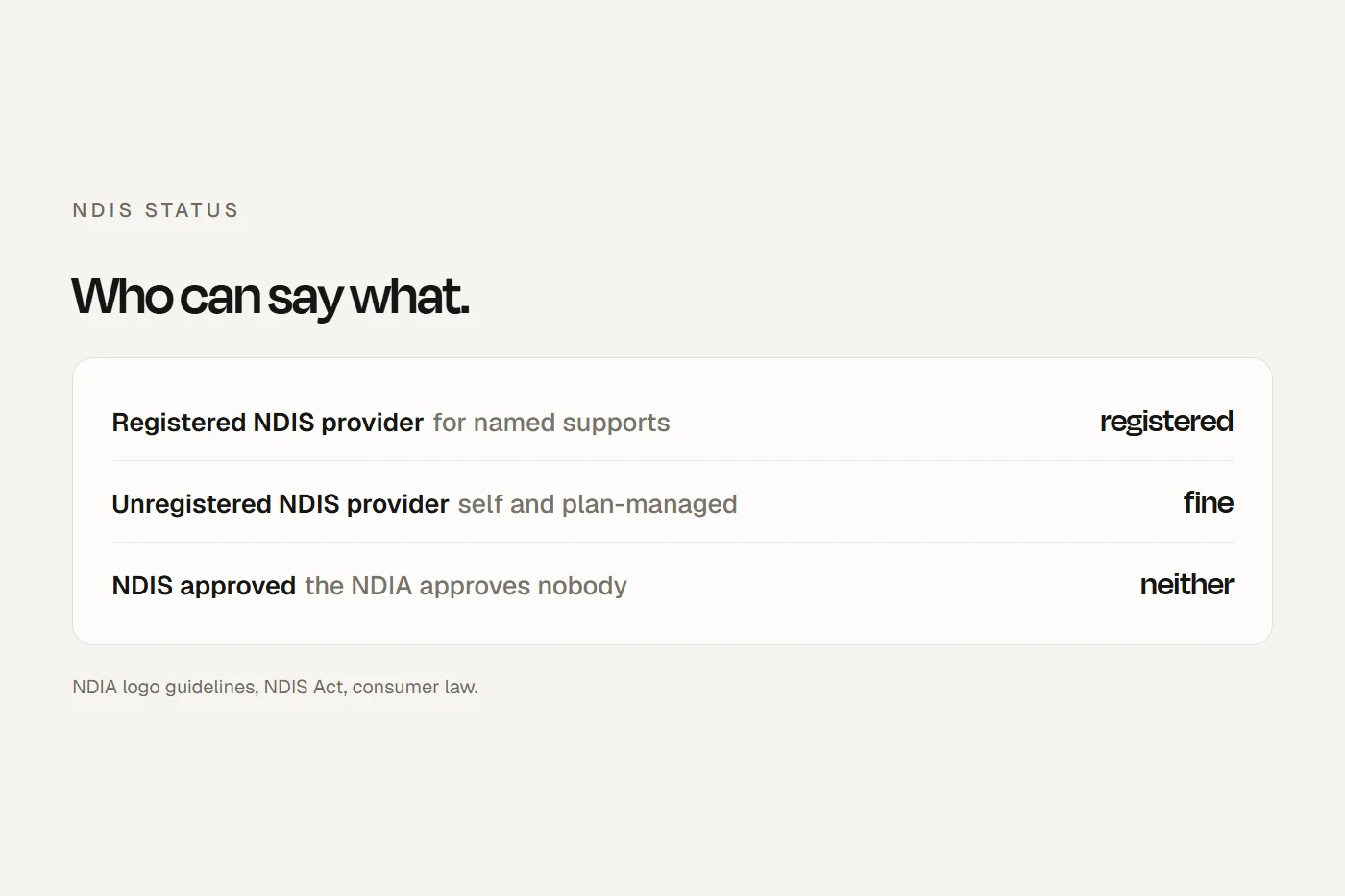
NDIS support coordinators and plan managers. Give them your service area, ages, supports, registration status in plain words, current capacity, how fast you send quotes and reports, and a price list that's the same for NDIS and private clients. Never give them a payment, gift or referral fee: the NDIA has warned of a "strong link between providers making 'incentive' or 'referral' payments and fraud". Say "registered NDIS provider" only for the registration class you actually hold. Support coordination itself is being redesigned.
Aged care. Under Support at Home, OT is a clinical support with no client contribution, and most OTs work as associated providers of a registered provider, which stays responsible. So your real customer is the provider's care partners: fast equipment and home modification prescriptions, clear quotes, and reports that fit their paperwork. Say "We work with your Support at Home provider", not "Free OT for Support at Home clients". Home Care Packages no longer exist, so don't lead with that label.
Workers' compensation. WorkSafe Victoria treats OT as a referred service, approved by the agent before treatment. Its hand therapy registration needs the Accredited Hand Therapist credential, and mental health OT registration needs OTA endorsement. Say "WorkSafe claims welcome" only once you're registered, and market to GPs, employers and rehab consultants rather than cold to injured workers. NSW and other schemes have their own approval processes.
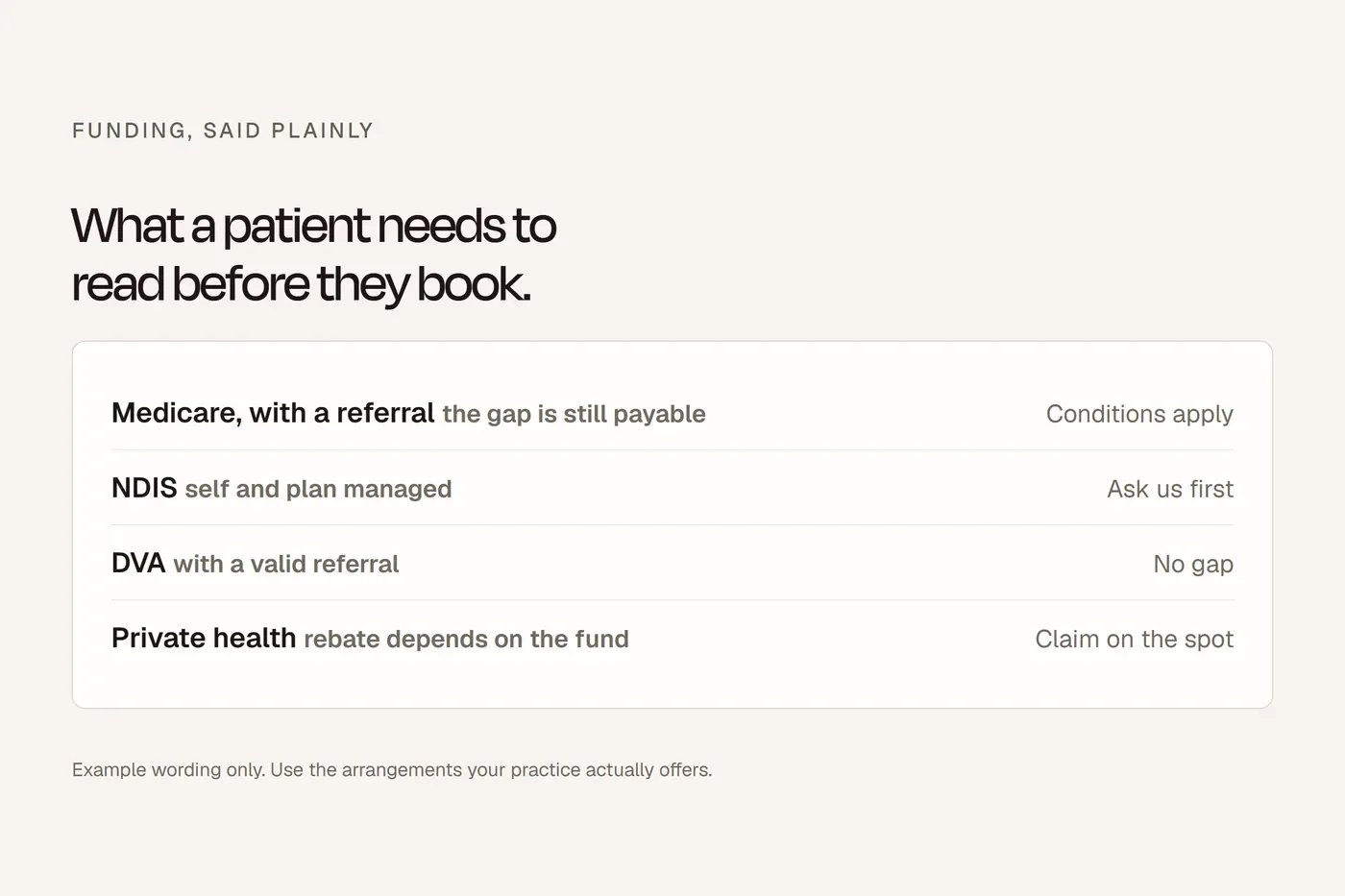
DVA. General OTs registered with Services Australia are automatically registered with DVA. Veterans need a referral, and by accepting a Veteran Card you agree to accept DVA's fee as full payment, with no gap. DVA's advertising rules ban "free", "fully funded", "complimentary", "No Fees" and "DVA Pays", the Australian Government logo, and card images without permission. The only words you can use without asking are: "We welcome DVA clients, DVA Veteran Cards (Gold and White) are accepted as payment upon a GP referral".
Driving assessments. Austroads says practical driving assessments "should be conducted by suitably qualified occupational therapy driving assessors", and points referrers to the licensing authority and OTA. In Victoria, being on the licensing authority's list and OTA's driving filter matters more than ads. Don't promise "get your licence back"; the licensing authority decides.
Find an OT. OTA says its full-time, part-time and new graduate members "are automatically added" to Find an OT. Its filters cover face-to-face or telehealth, area of practice, funding scheme and language, including Auslan. Keep yours accurate, because these are exactly the filters referrers and families use. Directory listings are advertising, so the same title rules apply.
My guide to showing Medicare, NDIS and DVA on a clinic website covers the funding wording, and my guide to registered and unregistered NDIS providers covers the NDIS side.
Free offers and capacity claims
Free offers. A "free initial assessment" is the riskiest offer, because the assessment is the clinical service itself, and DVA bans "free" outright. A "Free 15-minute phone chat to see if we're the right fit (no obligation, one per family)" isn't a clinical service, and its terms are stated. That's the safest free offer.
Capacity. Availability claims are advertising and must be true. "Taking new paediatric clients on Tuesday and Thursday afternoons", kept current, is fine. "Only 2 spots left, book now" is a pressure line that Ahpra's guidelines and the NDIA both warn against. A waitlist form should say roughly how waits are managed, and must not take a deposit without terms.
How many referrals can you take?
Put in one referral source at a time. The numbers are examples; your fee starts at zero.
On the example numbers, six paediatrician referrals a month need about 62 hours, about 58% of a 25-hour week, and you could take about eight new clients a month from sources like it. Add a second busy source and you'll be over capacity: then either pause a source, add hours, or tell referrers your real start date. Report time differs by funder, so count it honestly.
Your website and Google profile
Build pages that match how referrers filter: one per service line (paediatrics, NDIS, mental health if endorsed, hand therapy, home modifications and equipment, driving, aged care, work injury). Add a funding page with DVA's exact sentence and plain NDIS registration wording, a referrer page with your referral form and report turnaround, an availability line you keep current, and a price list. "Occupational therapist" appears in Google's category lists as the primary category. Ask clients for reviews the same neutral way, and never confirm in a reply that someone is a client. My Google Business Profile checklist for clinics covers the setup.
Can I say this?
Tap a card to see the verdict.
A 90-day referral plan
Tick items off as you go; the list remembers your progress on this device.
- Month 1: "specialist" wording gone Site, Google profile, directories, business name.
- Month 1: credentials named with their source OTA endorsement, AHTA credential, "Dr" with your profession.
- Month 1: testimonials and progress stories removed
- Month 1: paediatric claims rewritten What you do and who it's for, with no fear lines.
- Month 1: conflicts disclosed properly In writing at intake, with at least three options offered.
- Month 1: funding page DVA's exact sentence and plain NDIS registration wording.
- Month 2: Find an OT listing checked Areas of practice, funding schemes, languages, telehealth.
- Month 2: referrer page Referral form, report turnaround, current availability.
- Month 2: GP and paediatrician one-pagers Who you see, how fast, what your report looks like.
- Month 2: support coordinator pack Service area, ages, supports, registration, capacity, price list.
- Month 2: aged care providers contacted As an associated provider, with fast prescriptions and clear quotes.
- Month 3: scheme registrations WorkSafe, DVA, driving assessor lists, where you're eligible.
- Month 3: reports reviewed Prompt, short and useful, for every referrer.
- Month 3: the calculator run for each source And referrers told your real start date if you're over capacity.
Questions I get asked
How do I get more OT referrals?
Give each referrer what they need: a short practice profile for GPs and paediatricians, quick useful reports, an accurate Find an OT listing, a clear pack for support coordinators, and an honest start date. Never offer gifts or payments for referrals.
Can occupational therapists call themselves specialists?
No. There's no specialist registration for OTs, and the OT Board says it's unlawful to call yourself a specialist. Say you have experience in, an interest in, or predominantly practise in an area.
Can OTs provide Better Access mental health sessions?
Only OTs endorsed by Occupational Therapy Australia for mental health practice and registered with Services Australia. Everyone else shouldn't imply Medicare mental health rebates.
Can I use client stories on my website?
Not as advertising. Ahpra treats patient stories and success stories as testimonials, which the National Law bans for regulated health services, including NDIS participant and parent stories.
What can I say to veterans?
Without DVA's permission, only: "We welcome DVA clients, DVA Veteran Cards (Gold and White) are accepted as payment upon a GP referral". No "free", "fully funded" or "DVA Pays".
Do I need a referral to see an OT?
No, unless you're claiming through a scheme such as Medicare, DVA, workers' compensation or some NDIS pathways, which need their own referral or approval.
About this guide
Written by Joseph Alzein, founder of bdog. I build websites for occupational therapy and allied health practices, with Ahpra's advertising guidelines in mind. Sources were checked on 12 October 2026. This is general information, not legal advice. I've left out Medicare, NDIS, DVA and scheme amounts.
Main sources:
- Occupational Therapy Board: newsletter on titles and testimonials
- Ahpra: managing financial or commercial conflicts of interest
- MBS: item 10958
- NDIA: conflicts of interest for allied health
- DVA: occupational therapists
- DVA: notes for allied health providers
- Department of Health: Support at Home
- WorkSafe Victoria: occupational therapy services policy
- WorkSafe Victoria: hand therapy services policy
- Austroads: Assessing Fitness to Drive
- Occupational Therapy Australia: Find an OT
- Occupational Therapy Australia: mental health endorsement
- Australian Hand Therapy Association: Accredited Hand Therapist
- healthdirect: occupational therapy