A real estate agency website that wins listings
For independent agencies: what the site is for now the portals own the buyer, what each state requires on it, how listings get there and who owns the website, the risk in instant valuation widgets, reviews, sold and record claims, and the property management fee page. With state tabs, a can-I-say-this sorter, an appraisal-value calculator and a checklist.
On This Page
- What the site is for
- What your state requires on the site
- How listings get to your site
- Appraisal forms and “instant valuation” widgets
- Reviews, sold results and records
- The property management page
- Suburb pages, privacy, alerts and accessibility
- What an appraisal request is worth
- Website checklist
- My view
- Questions I get asked
Buyers find homes on the portals. realestate.com.au says it has more than twelve million visitors a month, and about half of them use no other property site. So an agency website isn't really for buyers. It's where a vendor or a landlord checks you out before they pick up the phone, and it has jobs the portals won't do for you: the appraisal request, your agents and their real sales, your suburb knowledge, and your property management offer. This guide is for the principal of an independent agency with one to three offices. It covers what each state requires on the site, how listings get there, who owns what, the risk in "instant valuation" widgets, and how to show reviews and sold results. I build real estate websites, and the rules come from each state's agents law, the Australian Consumer Law, the portals' own developer terms and Google.
- Your website is an advertisement in lawEvery state's rule on naming the licensee applies to the footer and every listing page. SA also wants "RLA" and the registration number next to the agent's name on sale listings.
- Build it for vendors and landlordsAn appraisal request, agent pages with their own sales, real suburb pages and a clear management fee page. The portals already have the buyers.
- Call it an estimate, not a valuationThe data companies say their automated figures aren't valuations. In Queensland "valuation" is a regulated word, and giving a seller a price means giving a comparative market analysis.
What the site is for
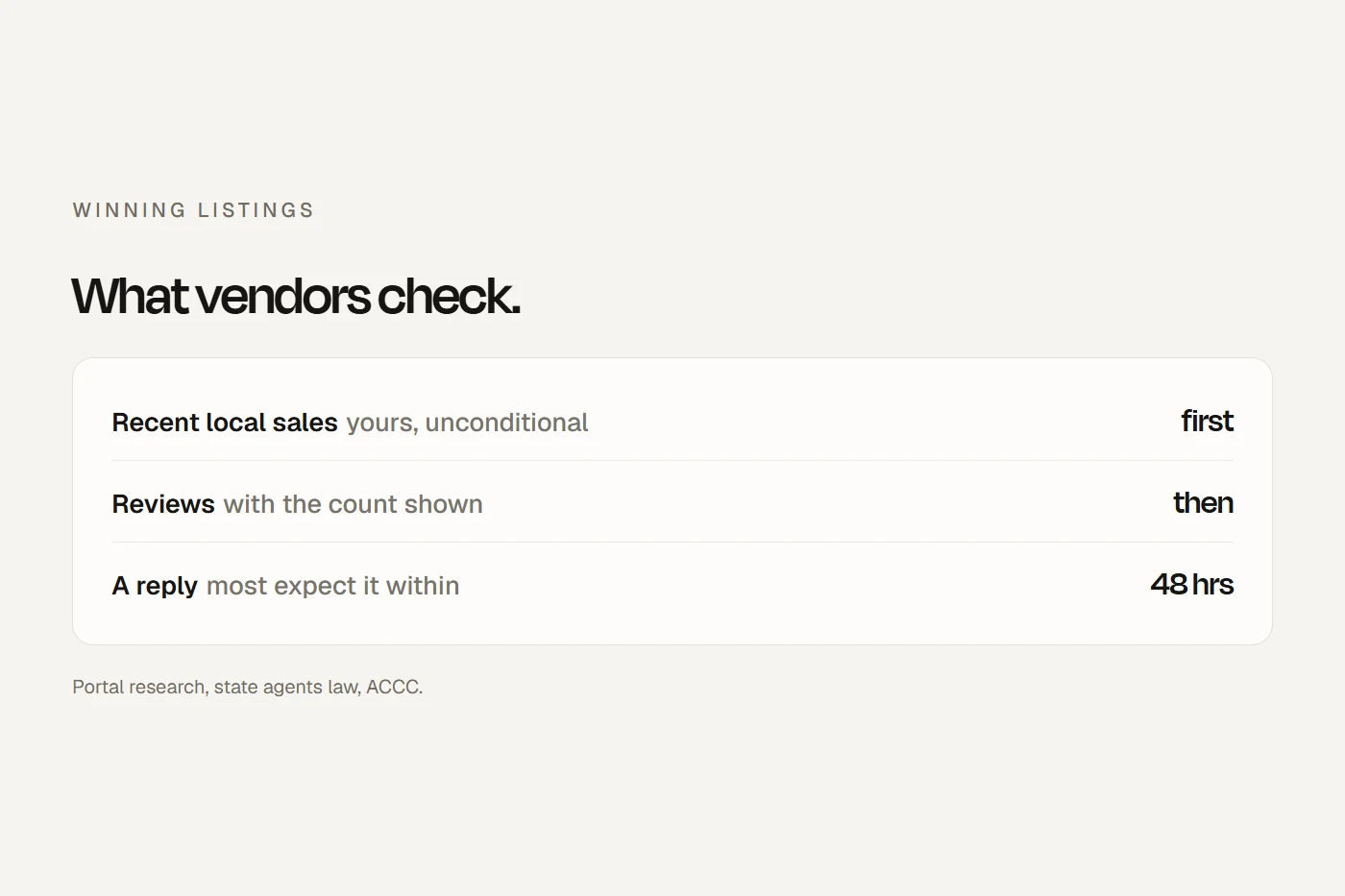
The portal owns the buyer search, and increasingly the owner too: realestate.com.au says millions of owners follow their home's value on it, and it sells the resulting seller leads to agents. When sellers choose an agent, they look for local knowledge, recent comparable sales and reviews, and REA's own seller research found most expect a reply within 48 hours. An agency group's survey found local expertise was the top factor in choosing an agent.
So the site's jobs, in order:
- The appraisal request. A short form, a separate marketing tick box, and a reply you actually send within two days.
- Agent pages. Photo, correct title, suburbs worked, the sales each agent made, reviews with their count.
- Sold results. Your own unconditional sales only.
- Suburb pages. Only for suburbs you really work, each with its own sales and local knowledge.
- Property management. The offer, the full fee schedule with a worked total, how to switch, and a rental appraisal form.
- Current listings, fed from your CRM, following your state's price rules.
Listing pages are the same text the portals have, so they rarely outrank the portals. The pages that can rank are the ones the portals don't have: your suburb knowledge, sold results with commentary, agent pages and your management offer.
What your state requires on the site
NSW, the ACT and Tasmania say in their laws that a website is an advertisement, and Victoria's price rules cover "any Internet site". Treat the site as an advertisement everywhere.
New South Wales
- Name
- The licensee's name, or the registered business, partnership or corporation name (s 50).
- Your own property
- If the agency or a principal owns a property it's listing, the ad must disclose the interest.
- Prices
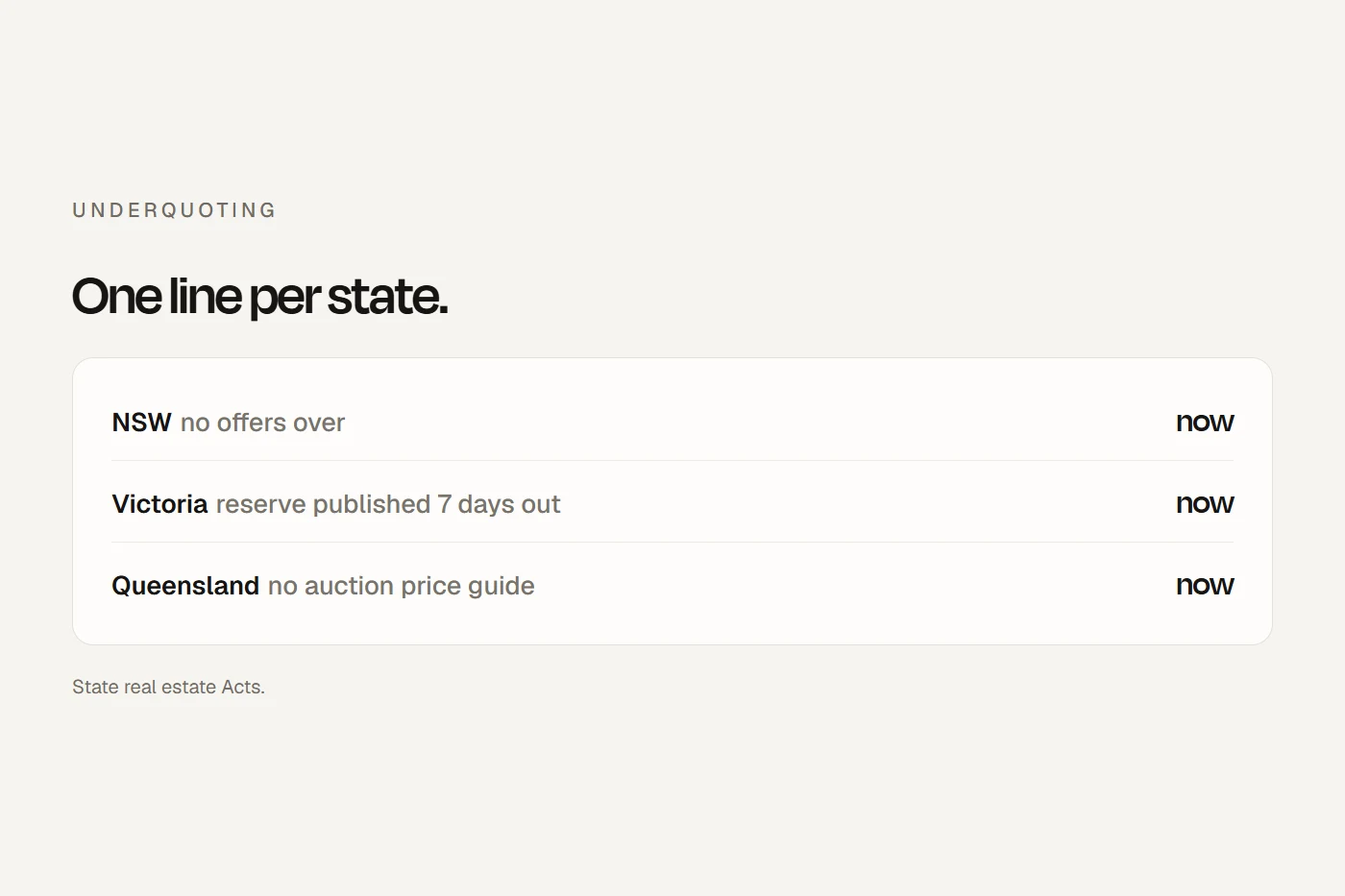
- The underquoting rules apply to listing pages, and "offers over" isn't allowed.
Victoria
- Name
- The name under which the agency carries on business (s 42(1)). Licences are displayed at the office, not online.
- Prices
- A link to the property price statement next to the price on each listing page, and an indicative price online.
- After the sale
- The property price statement with the sale price stays online for 18 months.
Queensland
- Name
- Section 95 requires prescribed particulars in business ads; I found none prescribed, so in practice show the business name.
- Prices
- No price guide or estimated value on auction listings (s 216(2)).
- Appraisals
- If you give a seller price information, you must give a comparative market analysis with it (s 215). "Valuation" is a regulated word under the Valuers Registration Act.
Western Australia
- Name
- Details sufficient to identify the agent (s 62(2)). The regulator says that means the registered business name on your triennial certificate and the office phone.
- Titles
- Sales representatives can't describe themselves as "agent", "principal" or "licensee".
South Australia
- Registration number
- On any ad for the sale of land or a business, "RLA" and the registration number next to the agent's name or contact details (s 48A). That's every sale listing page, not just the footer.
- Prices
- A single figure or a range within 10%, with no qualifiers.
Tasmania, the NT and the ACT
- Tasmania
- The agent's name and the address of the authorised place of business on every ad, social posts included. A PO box isn't that.
- Northern Territory
- That the agent is licensed, and a business address (s 119).
- ACT
- No general name rule found, but auction ads need the auctioneer's name and licence number, and no false statements about the agency's business.
One footer covers every state: the licensed business name, the street address and phone of each office, the word "Licensed", and "RLA [number]" if you sell in SA. No state requires trust account details or complaints information on the website. Don't publish your trust account details; instead put one line on the contact page: we never change bank details by email, so call us on this number before you pay.
How listings get to your site
Australia has no MLS or IDX feed; those are American systems. Your CRM sends each listing to the portals and to your own site. realestate.com.au only accepts listings from approved providers or CRMs, in its REAXML format. Domain's listings API is free for agencies and their providers. realestate.com.au also has a free export service that lets a provider you authorise read your active and sold listings back.
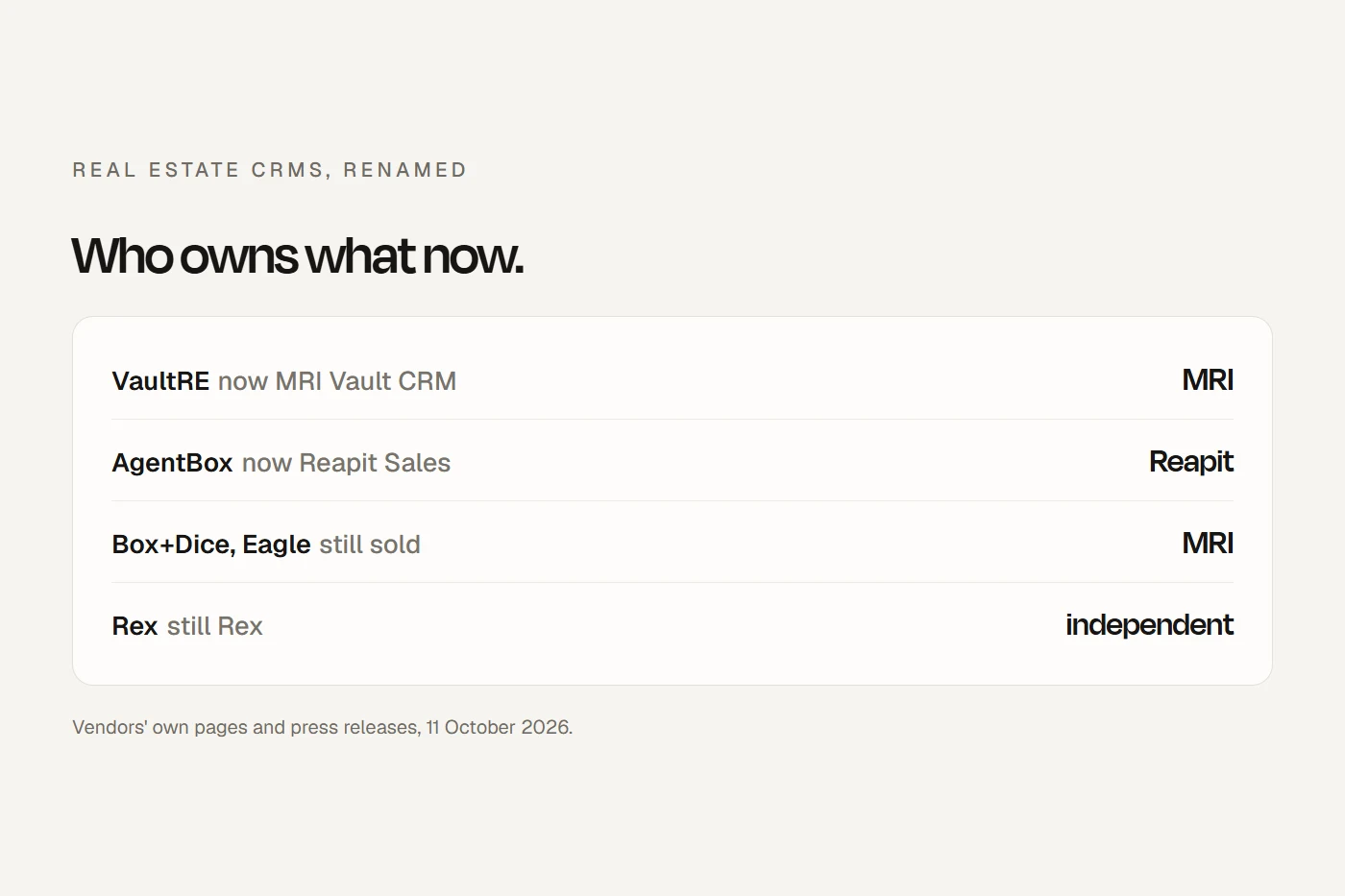
So the question isn't technical. It's whether your CRM will feed a website you choose, and what it charges. VaultRE (now MRI Vault CRM) has an open API that names agency websites as a use, through an approved integrator. Rex's website product accepts an REAXML feed from other CRMs. Of the CRM vendors, only PropertyMe publishes its website prices; the others quote on request.
Who owns what
The CRM contracts say your listing data is yours. But a CRM vendor's website product stays the vendor's: Rex's terms keep the intellectual property in its services, websites included. So with a CRM-vendor site you own your words, your data and the photos you hold rights to, while the design and code stay with the vendor, and changing CRM usually means rebuilding the website. Check your photographer's licence covers a sold archive on your site, too. My guide on who owns your website covers the domain, content and design layers.
Appraisal forms and "instant valuation" widgets
Automated estimate widgets are lead forms, and the companies behind the figures say so plainly. Cotality (formerly CoreLogic) says its estimated value "isn't a professional valuation" and comes with a confidence level from high to low; it can be too high or too low where data is thin. property.com.au calls its estimates "indicative guidelines" and recommends a local agent for a precise appraisal.
The appraisal itself is regulated: NSW wants evidence of the reasonableness of an estimated selling price, Victoria sets how the estimate is based on comparable sales, WA's code wants reasons and comparable sales, and Queensland requires a comparative market analysis whenever an agent gives a seller price information. A figure shown under your brand to a seller looks like your appraisal. So:
- Call the button "Get an appraisal" or "Estimate my home's value", never "Free valuation". In Queensland, the Valuers Registration Board says an agent's estimate "is not a property valuation".
- If you show an automated figure, name the provider, show its confidence level, say it's not a valuation or an appraisal, and follow up with a written appraisal and comparable sales.
- Keep estimate widgets off your own listing pages. In Queensland an estimate on an auction listing reads as a price guide, and elsewhere a figure below your own estimate is an underquoting risk. See the underquoting rules.
Reviews, sold results and records
- Reviews from realestate.com.au can be shown on your site through its ratings and reviews API, with its logo, a verified emblem on each review, a link back to the profile, and the number shown with the stars. The API can filter by star rating. Showing only five-star reviews beside an average is the kind of suppression the ACCC says misleads, so show the true average and total.
- Google reviews shown through Google's API must credit each author, link each review to Google Maps and say how reviews are ordered and filtered. Pasting them as text skips those rules. Google also won't show review stars in search for reviews of yourself on your own site.
- Sold results: your own unconditional sales only, each credited to the agent who made it. Victoria makes it an offence to falsely represent that you've sold a property.
- Records and statistics: a "street record" or "98% sold under the hammer" is a factual claim. Say what record, where, over what period, on what data, and keep the evidence.
- Sale prices: outside Victoria's 18-month rule, get the vendor's permission before publishing a price you learned as their agent, if it isn't already public.
Tap a card to see the verdict.
The property management page
The Australian Consumer Law's single price rule says that if you show parts of a price, you must also show the total as a single figure, at least as prominently, including GST. Whether landlord services count as household services under that rule isn't settled, but many landlords are individuals with one investment property, so assume it applies. A percentage fee isn't a dollar amount until the rent is known, so the safest page shows the full fee schedule (management, letting, lease renewal, inspections, statements) and a worked total for an example rent, GST included. A "from 5%" headline that few landlords actually get is a misleading price risk. The fee page isn't the agreement: the fees still go into the management agreement in your state's form. In Queensland, a landlord switching agencies gives 30 days' written notice, which is worth saying on a "switch to us" page.
Suburb pages, privacy, alerts and accessibility
- Suburb pages: Google's spam policy calls pages "targeted at specific regions or cities that funnel users to one page" doorway abuse, and mass-produced AI pages "scaled content abuse". One page per suburb you really sell in, with your sales, your agents and local knowledge, is the opposite.
- Privacy: most agencies now need a privacy policy anyway. The anti-money laundering reforms bring real estate agencies under the Privacy Act once they're reporting entities, and every appraisal form collects personal information. If you're paid a referral fee for passing details to a broker, get consent on the form.
- Property alerts: a sign-up for alerts is consent to those alerts, not to appraisal marketing or a "sold in your street" newsletter unless the form says so.
- Accessibility: alt text on listing photos, a text alternative for floor plans, pause controls on carousels, a list alternative to map search, and an appraisal form with labels and no inaccessible CAPTCHA.
What an appraisal request is worth
Use your own figures. Commission, rent and fee fields start empty.
The point is the break-even: pay more than that figure for a lead and the average lead loses money before staff costs. It's also why answering appraisal requests fast matters more than almost anything else on the site.
Website checklist
Your ticks save in this browser.
- The licensed business name in the footer and on every listing page.
- Each office's street address and phone in the footer, plus "Licensed" and, in SA, "RLA" next to agents' names on sale listings.
- A privacy policy, and a collection notice on every form.
- A separate, unticked marketing box on appraisal and alert forms, and an unsubscribe in every alert.
- Listing prices that follow your state's rules, fed from your CRM.
- Sold pages with your own unconditional sales, each credited to the right agent.
- Reviews with their true count and average, displayed under the platform's rules.
- "Appraisal" or "estimate", never "valuation".
- Estimate widgets labelled as third-party automated figures, and kept off your listing pages.
- Suburb pages only for suburbs you work, each with its own content.
- A management fee page with the full schedule and a worked total including GST.
- A line about bank details and scams on the contact page.
- Accessible: alt text, labelled forms, carousel controls, a list alternative to the map.
- Your CRM contract checked: who owns the website, and what happens if you leave.
My view
Stop building the agency site to compete with the portals for buyers; you won't win, and you don't need to. Build it for the vendor deciding which agent to call and the landlord deciding whether to switch. That means agents with real sales, suburb pages written by people who know the streets, an appraisal request answered the same day, an honest management fee page, and a footer that meets your state's rules. And before you sign up for a CRM's website, read who owns it.
Questions I get asked
What must a real estate agency website show?
Your licensed business name on every page, and depending on your state, your office address and phone, the word "licensed" (NT), or "RLA" and your registration number on sale listings (SA). Listing prices must follow your state's underquoting rules.
How do listings get onto an agency website?
Your CRM sends them, the same way it sends them to realestate.com.au and Domain. Australia has no MLS or IDX feed. Ask your CRM whether it will feed a website of your choice, and what it charges.
Can I put an instant valuation tool on my website?
You can use an automated estimate as a lead form, but don't call it a valuation, name the provider and its confidence level, follow up with a written appraisal, and keep it off your own listing pages. In Queensland, a seller given price information must also get a comparative market analysis.
Do I own my real estate website?
You own your listing data and content, but if the website comes from your CRM vendor, the design and code usually stay with the vendor. Changing CRM can mean rebuilding the site.
Can I show realestate.com.au reviews on my website?
Yes, through its ratings and reviews service, with its logo, a verified emblem on each review, a link back and the number of reviews shown with the stars. Don't filter out the lower ratings.
About this guide
Written by Joseph Alzein, founder of bdog. bdog builds real estate agency websites. The rules come from each state's agents legislation, the Australian Consumer Law, Queensland's Valuers Registration Act, the Privacy Act and Spam Act, realestate.com.au's and Domain's developer documentation, Google's spam and Places policies, and the CRM vendors' own terms. Sources were checked on 12 October 2026. This is general information, not legal advice.
Main sources:
- realestate.com.au: Listing Upload API
- realestate.com.au: Listing Export API
- realestate.com.au: ratings and reviews branding guidelines
- Domain: Listings Management API
- VaultRE API
- PropertyMe pricing
- Cotality: what is an estimated value
- property.com.au: how value estimates are calculated
- Valuers Registration Board of Queensland: valuation v appraisal
- Consumer Protection WA: advertising requirements
- Google: spam policies
- Google: Places API policies