Chiropractic marketing within the Ahpra rules
Most new patients come through someone they know. Here’s how to make that easier, and the Chiropractic Board’s own rules on spinal screenings, children, wellness care, X-rays and offers, with a wording check, a cost calculator and a 90-day plan.
On This Page
Search for chiropractic marketing and most of page one is American software companies and agencies. A couple of them recommend sharing patient testimonials and paying patients for referrals, neither of which works here, and the "ideas" lists push free spinal checks at health fairs, which the Chiropractic Board has a whole fact sheet about. Chiropractic is one of only three professions Ahpra has written its own advertising examples for, in red and green, and the Board has its own statements on children, screenings, frequency of care and X-rays. This guide puts the channels that bring a small clinic its patients next to those rules, in the Board's and Ahpra's own words. It's general information, not legal advice. Ahpra won't pre-check an ad, but your association, insurer or a lawyer can.
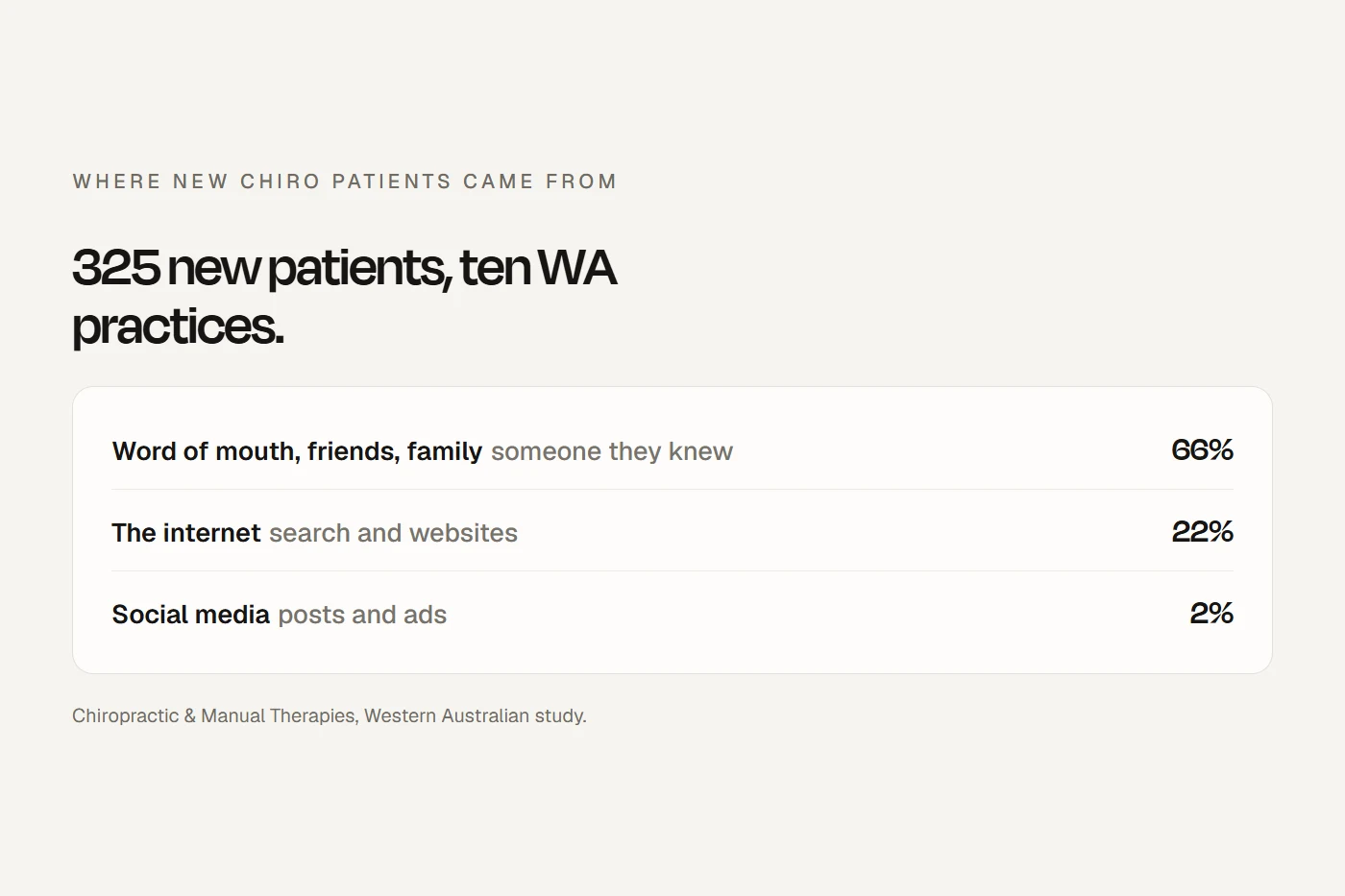
- Most new patients come through someone they knowIn the one Australian study that asked new chiropractic patients how they found the clinic, two in three came by word of mouth or a friend or family member.
- Fix the words before you spend on adsCondition lists, "spine specialists", a bare "Dr", wellness check-ups and kids' claims are where chiropractic advertising most often goes wrong.
- The shopping-centre spinal check is outThe Board's fact sheet uses it as the example of what not to do: no branding, no bookings, no contact details and no follow-up at a public screening.
How patients find a chiropractor
There isn't much Australian data, and what there is is old, but it points one way. A study of 325 new patients at ten Western Australian practices found that two in three came by word of mouth or a recommendation from family or friends. About one in five found the clinic on the internet. Social media, print ads and referrals from medical practitioners were each about two in a hundred. A survey of NSW chiropractors found nearly all of them named word of mouth as the main way patients heard about them.
The government's own health information service, healthdirect, tells people what to ask a chiropractor before they start:
- Why do you recommend this treatment, and what are the potential benefits?
- What are the potential risks or side effects?
- What is the evidence for its effectiveness?
- How long will treatment take, and how many sessions will I need?
- Should I discuss this treatment plan with my doctor first?
A "Your first visit" page that answers those five plainly is about the best page a chiropractic website can have. It's what careful patients have been told to look for, and it's the kind of content the rules favour. healthdirect also lists what people commonly see a chiropractor for: low back pain, neck pain and some types of headache. That's a safe anchor for your "what we help with" page.
The rules, applied to chiropractic marketing
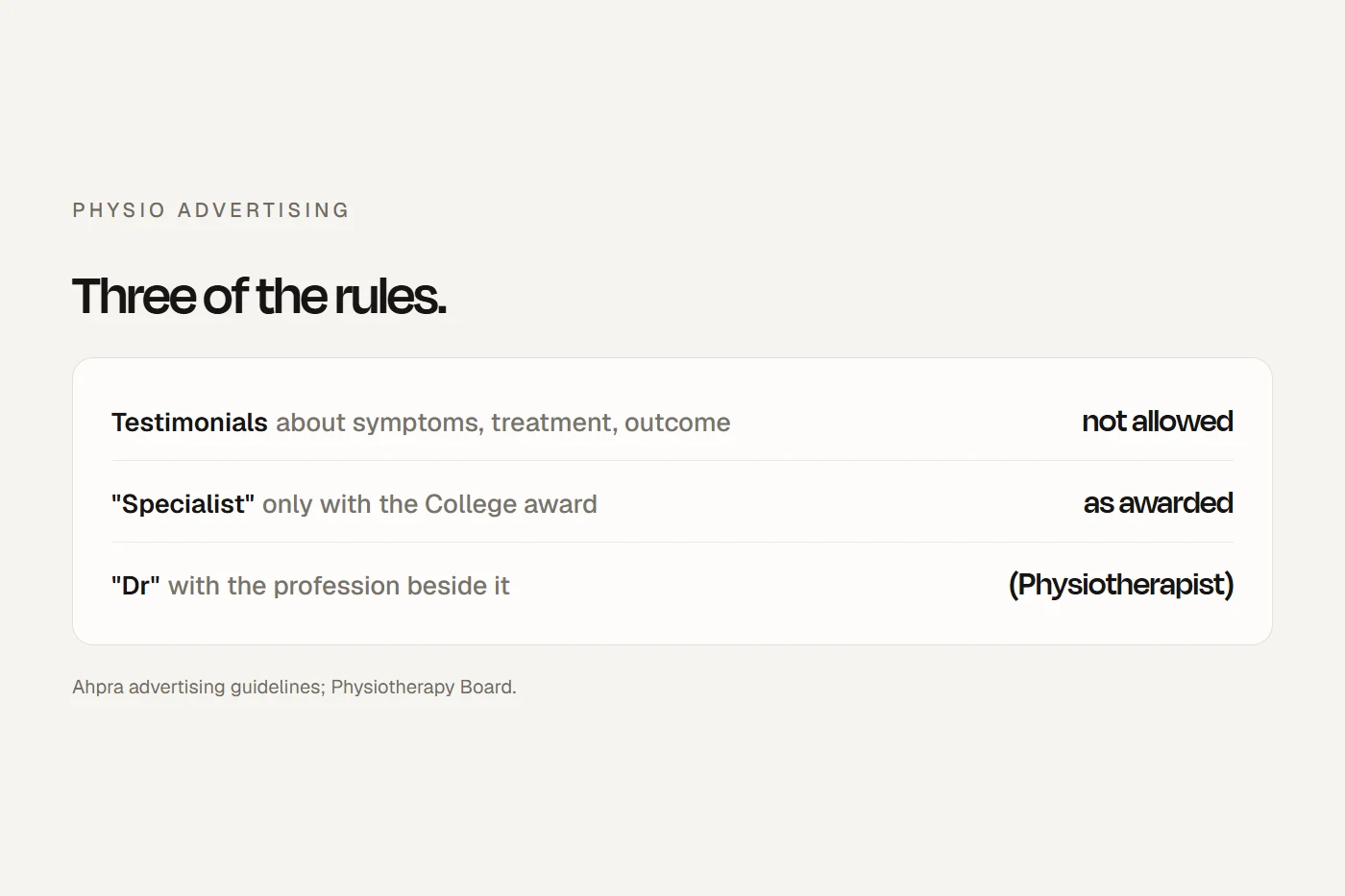
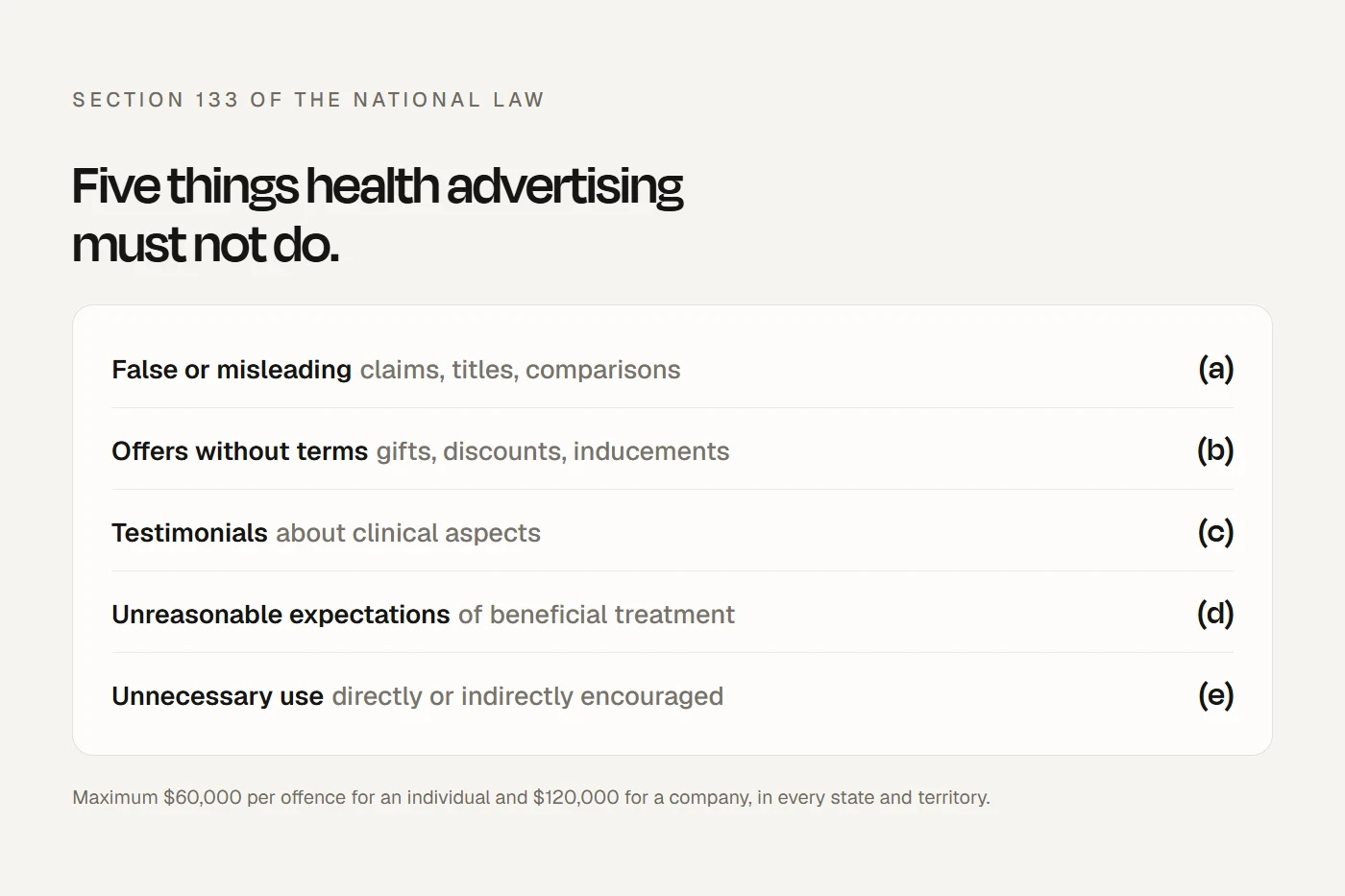
Chiropractors work under the same advertising guidelines and the same section 133 of the National Law as every registered health profession: no testimonials, no misleading claims, terms on every offer, and nothing that encourages people to use health services they don't need. What's different is how much chiropractic-specific guidance sits on top. An audit of Australian chiropractors' websites and Facebook pages found most had at least one breach, and that belonging to an association made no difference. So it's worth checking, whoever wrote your site. Here's what the guidance says.
What you say you help with
Ahpra's chiropractic examples say the research "is not supportive of practitioners making advertising claims that they can effectively treat non-musculoskeletal conditions". If you mention one, make clear you're treating the parts of it that respond to manual therapy, and don't overstate it. Ahpra's red example lists back pain and neck pain alongside asthma, indigestion, ear infections, behaviour disorders and "boosting immune functions". The corrected version keeps the musculoskeletal items and changes asthma to "managing symptoms such as muscular tension often associated with asthma". Ahpra also flags calling chiropractic "very safe" without acknowledging that people respond differently and all treatment has some risk.
Children, babies and pregnancy
This is the area the Board watches most closely. Its current Statement on paediatric care strongly advises chiropractors not to use spinal manipulation on children under two, and expects you to explain the evidence, get documented consent, and talk to the child's GP or paediatrician. Ahpra's red example for children lists colic, ADHD, autism, bedwetting, ear infections, digestive problems, brain development and immunity, and says that kind of advertising "cannot be corrected and must be removed". So does its example about checking newborns' spines for subluxations to prevent illness later: advertising shouldn't encourage chiropractic care with no link to a specific condition or symptom.
For pregnancy, back pain, pelvic pain and other musculoskeletal pain are fine. Breech positioning, shorter labour, an easier or more natural birth, morning sickness, hormones and fertility are not. The Board says chiropractic care "must not be represented or provided as treatment to the unborn child".
"Dr" and "specialist"
If you use "Dr" and you're not a medical practitioner, make your profession clear every time, in the Board's own format: "Dr Lin (chiropractor)". There's no specialist registration for chiropractors, so "spine specialists" and "specialises in" are out. Ahpra's green versions: "spine experts", "a specific interest in", "substantial experience working with". "Sports chiropractor" is fine, because it describes your area of practice rather than a specialty. And check your Google profile categories: a "doctor" category on a clinic with no medical practitioner risks the same problem.
Wellness, maintenance and regular adjustments
The Board's fact sheet on duration and frequency of care says a care plan should be based on clinical need, with measurable outcomes, a reasonable timeframe and review points. A patient may choose ongoing care, and that's their right, but only after you've given them "a balanced, evidence-based view". What you can't do is advertise it: Ahpra's examples rule out "come in for regular check-ups, ideally every month" and "periodic check-ups with us prevent illness". Its green version is "come in for check-ups as soon as symptoms arise". The same applies to recall texts and "wellness memberships".
Care plans and prepaid packages
There's no current Board statement on prepaid plans. The shared Code of conduct expects informed financial consent and honest, transparent financial arrangements, and the advertising guidelines warn that contracting for future services without a clinical reason may be unlawful. The Board's old chiropractic code, retired in 2022, spelt out more: a cooling-off period, a pay-as-you-go alternative, a fair refund policy, the same care whether prepaid or not, and a review every three months or 12 visits. Those aren't current rules, but they're a safe floor. Health funds add their own: Bupa's provider terms bar using benefits as a deposit and claiming before the service is given in full.
X-rays
The Board's imaging fact sheet says X-rays should only be used with "sufficient clinical justification", and that X-rays for low back pain without red flags provide little diagnostic benefit. No rule names "free X-rays" in an offer, but promising imaging before anyone has decided it's justified sits badly with that. My suggestion: "If you need imaging, we'll explain why."
Spinal screenings and health talks
The Board's fact sheet on health activities in a public setting covers spinal screenings directly. A genuine health activity must:
- charge no fee;
- not collect contact details or make appointments on the day, though you can give your details if someone asks;
- make clear it's an overview of posture, not a full examination;
- involve no follow-up contact afterwards;
- carry no clinic branding, brochures, business cards or merchandise.
The Board's own case study is a Saturday stand at a shopping centre with free spinal checks and clinic brochures, and its conclusion was that the main purpose was advertising. A workplace talk you promote is fine, but it's advertising, so the same rules on claims apply.
Vaccination
The Board says chiropractors shouldn't display or share anti-vaccination material or comment publicly discouraging vaccination, and should refer patients with questions to an appropriately qualified health professional. That covers your social media shares too.
Check your wording
Paste an ad, your Google profile description, a web page, a directory profile or a recall text, and I'll flag the phrases that cross the lines above.
It catches the common patterns, not everything. Read anything it passes once more against the rules above.
The channels
Word of mouth and referral offers
Two in three new patients in the WA study came through someone they knew, so making it easy to recommend you is the first job: a clear Google profile, a website that answers the five questions, and an easy way to book. Ahpra's own example of a compliant referral offer is a discount for friends and family introduced by existing patients, with the terms stated, for example that it's only for new clients. A reward paid to the referring patient for each referral is a different thing: the guidelines warn against incentives that encourage people to use services regardless of clinical need. Never tie a reward to a review, and never pay GPs, trainers or other practitioners for referrals; the Code of conduct bars inducements to colleagues.
New patient offers
The Board's FAQ says you can advertise discounts, with terms that are clear, accurate and easy to find. "Free" must mean absolutely free. Time limits are risky when they create urgency tied to someone's health; the Board names "don't delay", "act now", "don't miss out" and "for a limited time only". Two health fund points: a free visit can't be claimed, because nothing was charged, and funds such as HCF and HBF expect the same price for insured and uninsured patients. So a new patient price is the same for everyone, and the receipt shows the discount.
Google Business Profile and your website
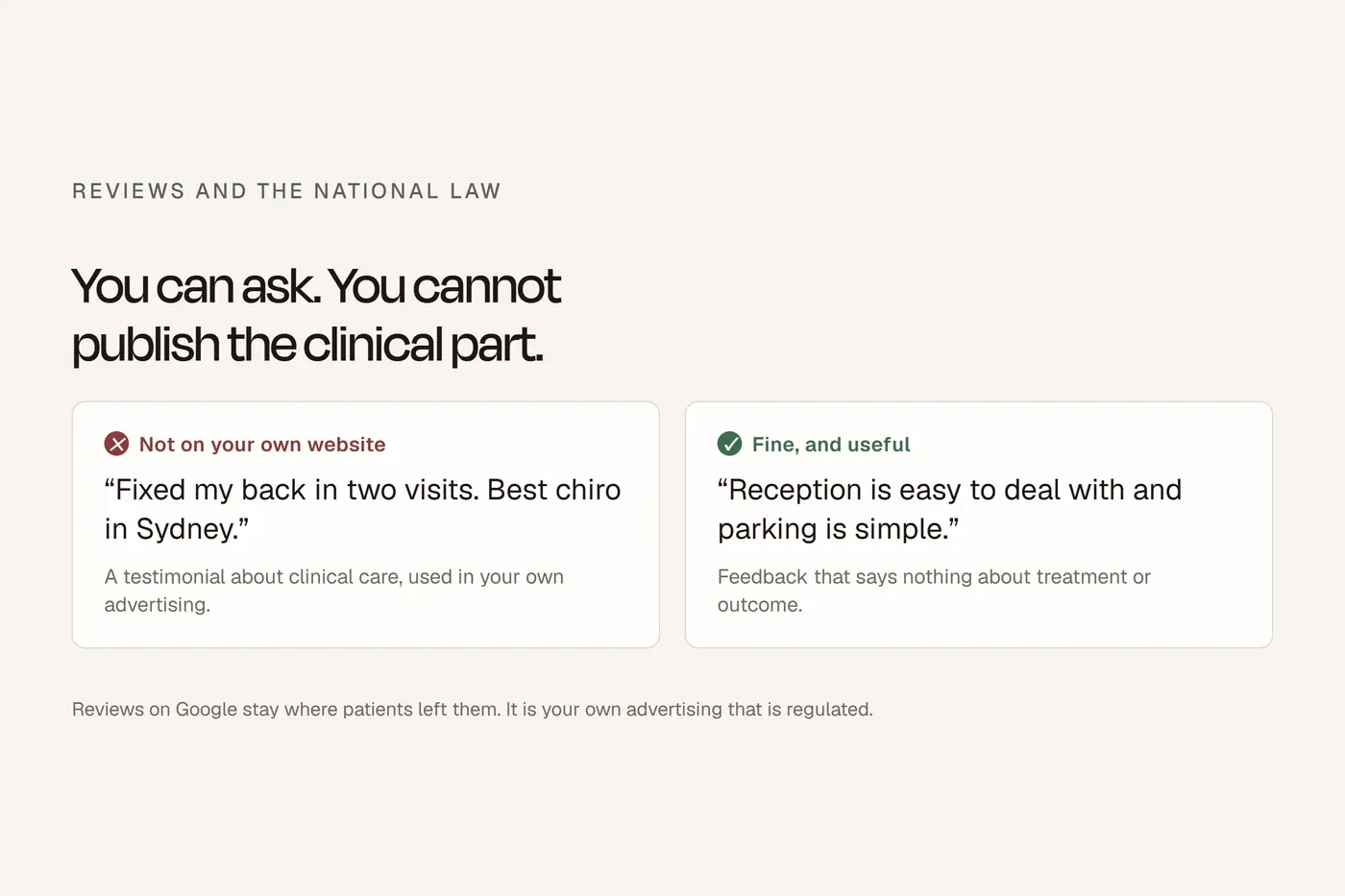
Your Google profile and website carry most of the "someone told me about you" traffic, because that's where people check. Set the booking link, ask every patient for a review with the same neutral message and no incentive, and never republish reviews on your site. More in local SEO for small business and can I ask patients for Google reviews?. On your site, add a page on when you refer on. Patients search "what is a red flag in chiropractic?", and answering it honestly is both useful and compliant.
Health funds
Chiropractic is an extras service with the major funds, and three run networks you can apply to join: Bupa Members First, Medibank Members' Choice, and HCF's More for Backs, which HCF shares between chiropractors and osteopaths. Network membership gets you into the fund's provider search in exchange for agreed pricing. Two rules on using fund names. Bupa's provider terms let you call yourself a "Bupa Recognised Provider", but need its written approval for any other use of its name, and bar bidding on "Bupa" as a keyword or using it for search engine optimisation without approval. That applies to chiropractors exactly as to physios, so add Bupa terms as negative keywords in Google Ads. And don't put a row of fund logos on your site without each fund's permission.
Association directories
The Australian Chiropractors Association has a public Find a Chiropractor directory at chiro.org.au with filters for techniques and services. Chiropractic Australia's Find A Chiro directory lists its members, and healthdirect sends the public to Chiropractic Australia to find a chiropractor. A directory profile is advertising, so the technique and service ticks are claims: tick only what's accurate.
Facebook, Instagram and Google ads
Meta's ad policies don't allow lines that assert or imply personal attributes, so "Do you have back pain?" and "Are you pregnant?" are out on Meta. Ahpra's red examples open with the same kind of headline. Use suburb and service wording instead: "Chiropractor for back and neck pain in [suburb]". Chiropractic Australia gives members ready-made social assets for its "Get Your Back... Back!" campaign, and the ACA runs annual awareness campaigns you can tie posts to. Either way you're still the advertiser, so check the words. More in Meta ads for small business and what Google Ads cost.
Recall and reactivation
A message reminding a patient of a review their care plan set is clinical follow-up. A blanket "time for your maintenance adjustment" campaign to lapsed patients is advertising, and runs into the frequency rules above. If it's promotional, the Spam Act also applies: consent, your business name and a working unsubscribe.
Workers compensation
Advertise "WorkCover welcome" only once you're registered or approved in your state. WorkSafe Victoria and SIRA in New South Wales each run their own provider registration for chiropractors.
Can I do this?
Tap a card to see the verdict. General information, not legal advice.
What a new patient costs you, by channel
Put in one channel's numbers for a month, then the next. Use your own fees and your real average visits from your software; the starting numbers are an example, not a benchmark.
Count calls, forms and online bookings by channel, or none of this works. And don't nudge the visits figure up to make a channel look better. The Code of conduct warns against targets and quotas that are inconsistent with it.
A 90-day plan
Your ticks save in this browser.
- Run every page, profile, directory listing and live ad through the wording check.
- Rewrite the kids and pregnancy pages: musculoskeletal only, consent, working with the GP, no birth or breech claims.
- Remove testimonials, review feeds and success stories.
- Rewrite your offers: terms one click away, no urgency, no bundled X-rays, one price for everyone.
- Review care plans and packages: based on assessment, with review points and a pay-as-you-go option.
- Start counting calls and bookings by channel.
- Google Business Profile: booking link, accurate categories, and one neutral review request to every patient.
- Write a "Your first visit" page that answers healthdirect's five questions.
- Set up a refer-a-friend offer for the new patient, with stated terms.
- Weigh the fund networks and use "Bupa Recognised Provider" in plain text, with no logos.
- Check your ACA and Chiropractic Australia profiles for accurate technique and service ticks.
- Register for workers compensation in your state before you advertise it.
- Run a small Google Ads test on suburb searches, with Bupa terms as negative keywords.
- Run Meta ads with suburb and service wording, not questions about people's pain.
- Write one condition page a fortnight for a musculoskeletal complaint, with "may help" wording and when you refer on.
- Tie posts to the ACA's awareness campaigns, and run any public screening as a genuine health activity or not at all.
- Compare cost per new patient by channel and cut the worst.
My view
The clinics that do well here do two things. They make it easy for the people who already like them to send someone, and they write like a careful clinician rather than a supplement ad. The rules for chiropractors are stricter than for most professions, but they're also unusually clear: Ahpra has written the red and green versions for you. Sweep your wording first, because every ad, profile and page you build after that inherits it.
Questions I get asked
How do I market my chiropractic practice?
Start with the people who already know you: most new patients come through word of mouth. Make your Google profile and website easy to check and book, sweep your wording against Ahpra's chiropractic examples, then add fund networks and small paid tests.
Can chiropractors do free spinal screenings?
Only as a genuine health activity: no fee, no bookings or contact details collected, no clinic branding and no follow-up. A branded stand that takes bookings is advertising.
Can a chiropractor call themselves Dr?
Yes, if the profession is clear every time, in the Board's format: "Dr Lin (chiropractor)".
Can chiropractors advertise treating children?
Only for musculoskeletal problems. Claims about colic, ADHD, ear infections, development or immunity must be removed, and the Board strongly advises against spinal manipulation for children under two.
Can chiropractors use testimonials?
No. Section 133 of the National Law bans testimonials in health advertising, including reviews you republish on your site.
About this guide
Written by Joseph Alzein, founder of bdog. bdog builds chiropractic websites with Ahpra's advertising guidelines in mind. The rules come from Ahpra, the Chiropractic Board of Australia, the health funds and healthdirect, read on 12 October 2026. This is general information, not legal advice.
Main sources:
- Ahpra: chiropractic advertising examples
- Chiropractic Board: advertising FAQ
- Chiropractic Board: Statement on paediatric care
- Chiropractic Board: health activities in a public setting
- Chiropractic Board: statement on advertising
- Chiropractic Board: Code of conduct
- healthdirect: chiropractors
- Western Australian new-patient study
- Audit of chiropractors' and physiotherapists' advertising
- Bupa ancillary provider terms
- HCF: More for Backs
- ACA: Find a Chiropractor