Marketing an exercise physiology practice in Australia
How clients find an AEP, the rules ESSA and the state codes set, when testimonials are allowed, titles and wording, describing Medicare, DVA, funds, NDIS and workers’ comp, keeping clinical work and fitness classes apart, and winning referrals. With a caseload calculator, a wording sorter and a 90-day checklist.
On This Page
- How clients find an AEP
- The rules that apply to your marketing
- Testimonials: it depends who you work with
- Titles and wording
- Medicare, DVA, health funds, NDIS and workers’ comp
- Keep clinical work and fitness classes apart
- One-to-one and group sessions: what fits your week
- Winning GP and physio referrals
- Your website and Google profile
- Can I say this?
- Your first 90 days
- Questions I get asked
Exercise physiologists have an awareness problem. The AEPs in a recent Australian study put it in the paper's title: "So many people don't understand what exercise physiology is." GPs refer to AEPs far less than they could, and personal trainers are moving into health-condition work. This guide covers how to market an exercise physiology practice in Australia: the rules ESSA, Medicare, DVA and the state codes set, the title and wording traps, how funding should be described, keeping clinical work separate from gym-style classes, and how to win GP and physio referrals. It draws on ESSA's Code and advertising guidelines, the National Law, the MBS, DVA's notes for providers, the workers' compensation schemes, the fitness industry codes and Australian research on AEP referrals. It's general information, not legal or tax advice.
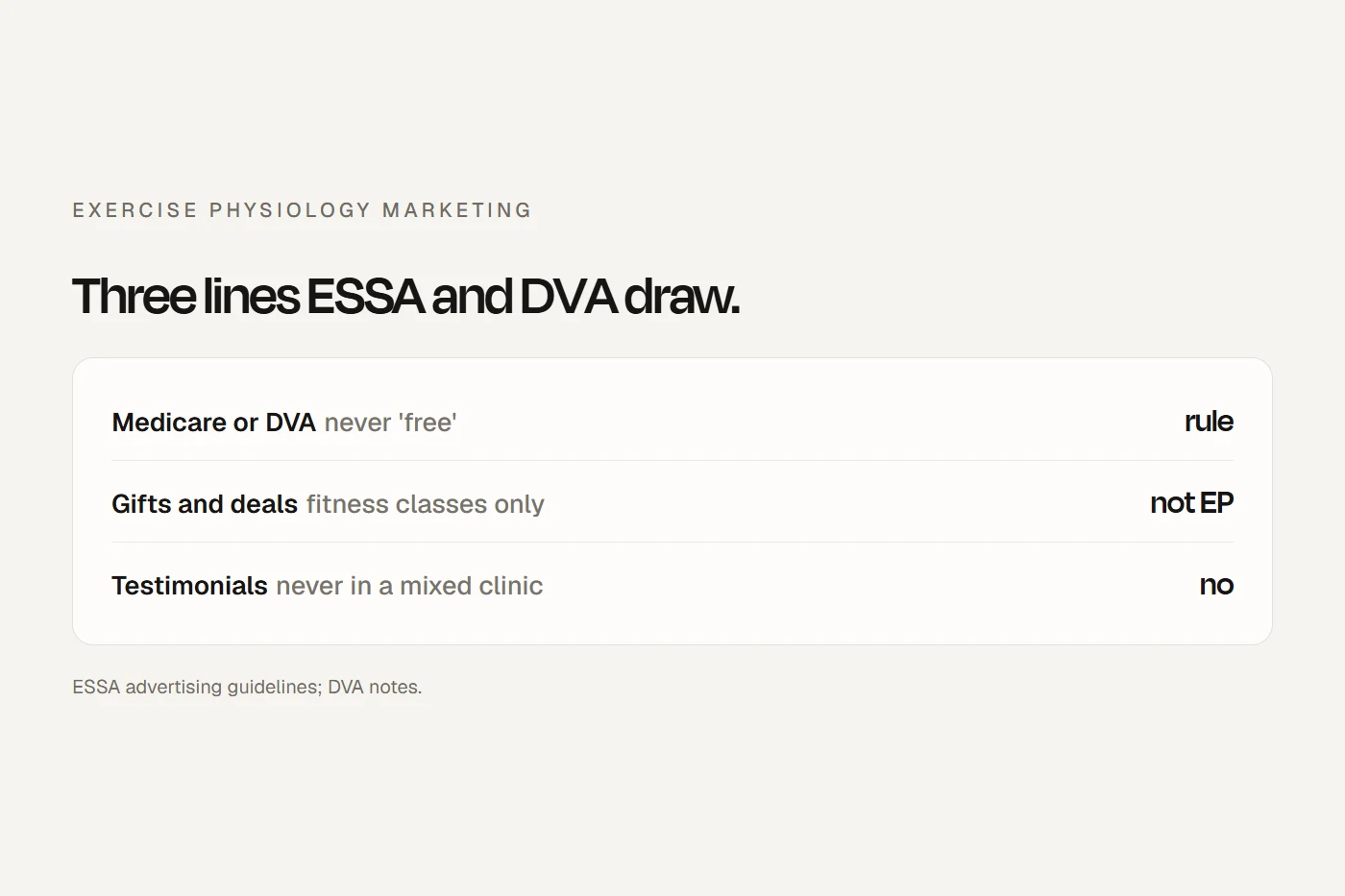
- Explain what an AEP does, firstMost clients and many referrers don't know. Lead with who you help and how, in plain words.
- Never call a funded service "free"ESSA says advertising a Medicare or DVA service as free is misleading. DVA allows one form of words only.
- Keep clinic and gym apartClinical sessions get no gifts or deals. Fitness classes can, with clear terms, and in some states they may fall under a fitness code.
How clients find an AEP
There's no Australian survey of how clients first find an exercise physiologist. The research is about GPs. A study of hundreds of thousands of GP consultations found GP referrals to exercise physiologists rose over the period but stayed low. Patients aged 45 to 64 were the most likely to be referred. A third of referrals were for metabolic problems like obesity and diabetes, and very few were for mental health. Patients from non-English-speaking backgrounds were referred at less than half the rate.
The qualitative study of AEPs found three themes holding back referrals: understanding of the role among the public and other health professionals, communication between AEPs and referrers, and systemic factors like cost and access. It found value in AEPs being co-located with GPs. So a website's first job is to explain what an AEP does and who it's for, before selling anything. The gaps in referral patterns are opportunities too: mental health, other conditions, and pages in the languages your community speaks.
The competition is shifting. AUSactive, the fitness industry body, says some health fund extras covers now pay towards sessions with its approved personal trainers for health-condition programs, with a health practitioner's approval form. Your difference is clinical. ESSA describes AEPs as university-qualified allied health professionals for people "with acute, sub-acute or chronic medical conditions, injuries or disabilities". AEPs are the exercise profession that can bill Medicare, DVA and workers' compensation, and you report back to the GP. Say that plainly, without running down trainers.
The rules that apply to your marketing
Self-regulated, not Ahpra-registered. ESSA is "the peak professional body and sole accrediting authority" for AEPs, and AEPs aren't registered with Ahpra. "Exercise physiologist" isn't a protected title, but "physiotherapist" and "physical therapist" are. Never put "physio" in your clinic name or Google profile name unless a physiotherapist works there.
ESSA's Code of Professional Conduct and Ethical Practice binds every member and accredited professional. On marketing, it bans false or misleading claims about your "qualifications, ESSA accreditation status, competencies, or scope of practice", and about "services, products, or outcomes". It bans "indiscriminate or unnecessary services", and financial inducements "in referral or promotional arrangements with healthcare providers". It requires professional indemnity insurance, ESSA's permission to use its logo, fees explained before services, and complaint information that's "easily accessible". You must also disclose when AI significantly affects people.
ESSA's advertising guidelines go further than most AEPs realise. ESSA's overall advice is "if in doubt, leave it out". The guidelines say:
- Never "free" for funded services. "To advertise a Medicare or DVA service as 'free' is misleading". Funded services, including fund, workers' comp and other scheme services, must not be advertised as free or discounted. The acceptable Medicare wording is "bulk-billed", and only if you bulk bill.
- No gifts or deals with exercise physiology services. "Gifts and other inducement discounts should not be offered with exercise physiology services". A lower rate for later sessions on the same condition is acceptable.
- No "instead of medication". No claims that exercise can be used "in place of medications" where best-practice evidence recommends medication.
- No fear lines. Don't make a consumer "feel their health would unduly suffer" without evidence.
- Care with "Dr" and "specialist", to avoid confusion with medical use.
- All costs up front, including no-show and late-cancellation fees.
- Reviews handled honestly. No selectively removing or editing negative reviews, and remove posts that are misleading or dangerous, such as a comment telling people to stop their diabetes treatment.
Your state's code of conduct for unregistered health workers covers AEPs too, everywhere except the NT. It bans claims about the effectiveness of your services that can't be substantiated, cure claims for terminal or incurable illness, and inducements for referrals, and it requires insurance and the code on display. In NSW you can display it on your website. The NSW Health Care Complaints Commission has issued a prohibition order against an exercise physiologist under it.
Testimonials: it depends who you work with
ESSA's rule is unusual. AEPs "who work in a multi-disciplinary environment that includes regulated health professions are, under law, not permitted to use testimonials". But AEPs "who are sole traders or who work in a business that does not include regulated health services or dietitians may use testimonials as long as they comply with all relevant legislation". ESSA's example: "An AEP who works with a physiotherapist, dietitian, and a personal trainer may not use testimonials to advertise their business." That's because a clinic with registered practitioners advertises "a business that provides a regulated health service", which brings in section 133 of the National Law, and dietitians follow the same rule through their own code.
I leave testimonials and review widgets off all health websites, including sole-trader AEPs'. One new hire of a physio or dietitian changes the answer overnight, and ESSA's own "if in doubt, leave it out" points the same way. Ask clients for Google reviews the same neutral way, with no incentive, and never confirm in a reply that someone is a client.
Titles and wording
- "Accredited Exercise Physiologist" or "AEP" only while you're accredited. An Accredited Exercise Scientist who isn't an AEP can't use either.
- "Dr": with a PhD, write "Dr Sam Lee (Accredited Exercise Physiologist)", never "Dr Lee" alone.
- "Specialist": there's no specialist AEP accreditation. "AEP with a special interest in cancer rehabilitation" says it accurately.
- Scope: don't list massage, dry needling or diagnosis as AEP services unless you hold another qualification and say which.
- No AEP-versus-physio content. ESSA's Code bars undermining other practitioners. Describe what you do: assessment, exercise prescription, education and reporting to the GP.
- Conditions, carefully. "Exercise can help manage blood glucose; we work with your GP" is fine. "Reverse type 2 diabetes without medication" fails ESSA's guidelines, the state codes and Meta's rules all at once. "Don't wait until you can't walk" is a fear line.
- Weight-loss medicines: the TGA says terms like "weight loss injections" can advertise prescription medicines. "Exercise support alongside medical weight management" promotes your service instead. Talk to GPs about co-referral, not to the public by drug name.
Medicare, DVA, health funds, NDIS and workers' comp
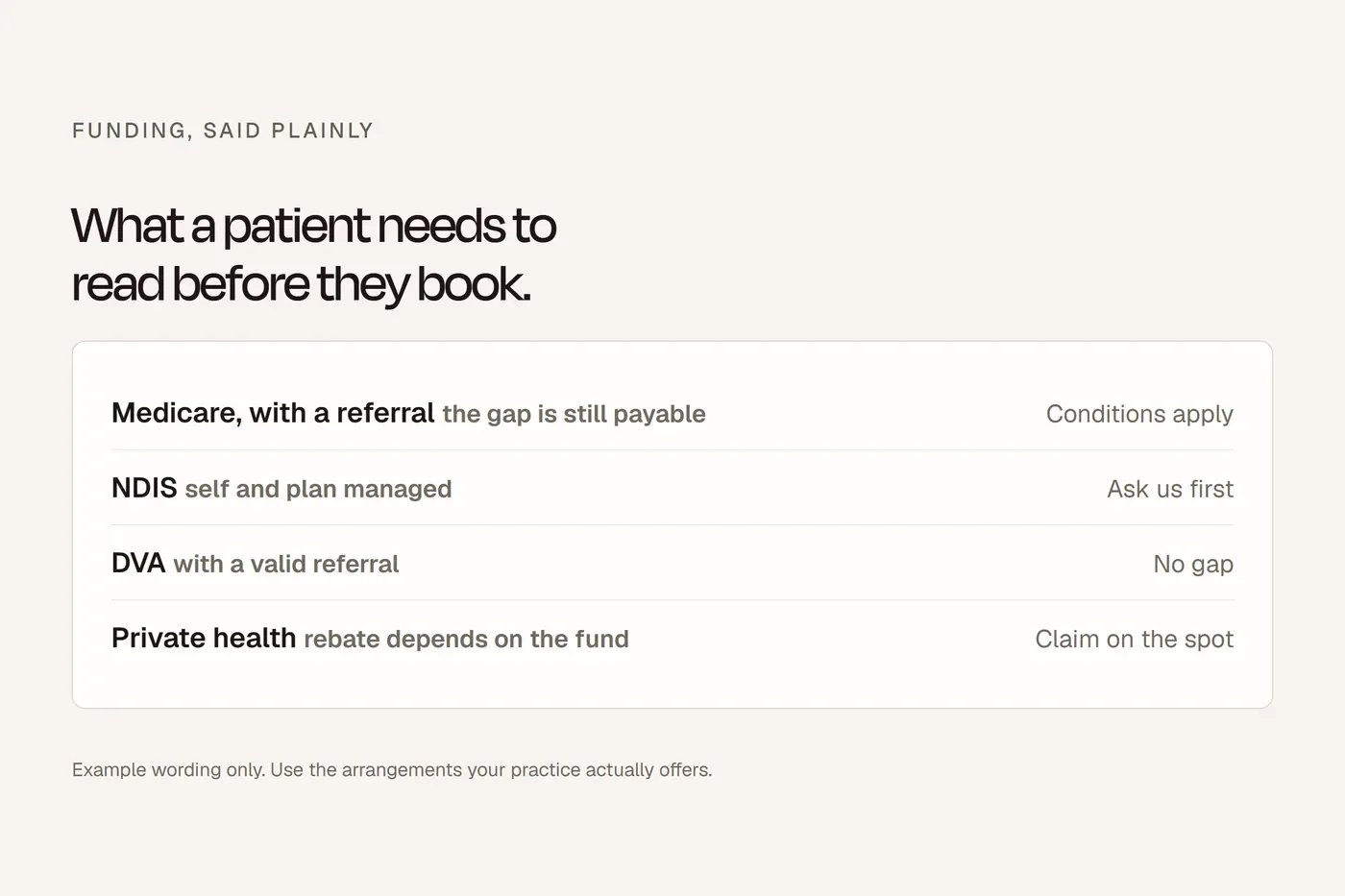
Medicare. The law makes eligibility simple: an AEP is a person "accredited by Exercise & Sports Science Australia as an 'Accredited Exercise Physiologist'". You need a provider number for each location. Patients need a GP chronic condition management plan and a referral for individual sessions, and there are separate items for type 2 diabetes group programs: an assessment, then group sessions of 2 to 12 people, in person, at least an hour. The GP's referral doesn't need to name you, so be easy to find and book. On your website: "Medicare rebates may apply with a GP chronic condition management plan and referral". Never "free with Medicare" or "5 free sessions".
DVA. DVA's notes for providers are the tightest advertising rule any funder sets. You must not advertise services as free to DVA clients or use phrases like "fully funded", "complimentary", "No Fees" or "DVA Pays", the Australian Government logo, or images of DVA cards without permission. The only words you can use without asking DVA are: "We welcome DVA clients, DVA Veteran Cards (Gold and White) are accepted as payment upon a GP referral". DVA's exercise physiology FAQ adds that words like "veterans" or "ex-service personnel" can imply endorsement, and "Gym membership included" must not be used. A "veterans' strength program" page or a Meta ad aimed at veterans needs DVA's approval. DVA also doesn't fund general gym programs or ongoing exercise for adherence.
Health funds. Bupa, Medibank and nib recognise exercise physiologists once Medicare has issued a provider number. Write "Health fund rebates may apply, depending on your extras cover", never "all funds accepted".
NDIS. Say whether you're registered, in words, with no prices. Unregistered providers can serve self-managed and plan-managed participants only. My guide to registered and unregistered NDIS providers covers the wording.
Workers' compensation. WorkSafe Victoria, NSW's scheme and WorkCover Queensland all require ESSA accreditation, and each has its own approval process. WorkSafe Victoria won't pay for services "provided to a worker without the worker requesting an appointment", so market to employers and GPs, not cold to injured workers.
GST. Exercise physiology isn't on the GST-free health services list, so ESSA says AEPs registered for GST must apply it to most services. ESSA is lobbying to change that. Until then, advertised prices to private clients must include GST. Check with your accountant.
My guide to showing Medicare, NDIS and DVA on a clinic website has more on the wording.
Keep clinical work and fitness classes apart
ESSA draws the line itself. Gifts and discounts don't belong with exercise physiology services, but "Promotional activities in a general fitness setting that include gifts and discounts can be offered" with clear terms. So a "bring a friend free" week can run on your fitness class timetable, never on clinical sessions or anything funded by Medicare, DVA, the NDIS or workers' comp.
Funded group programs aren't memberships either. Medicare's diabetes groups have their own size and reporting rules, DVA says group items aren't for "general gym programs", and WorkCover Queensland caps group sessions. Give your clinical programs and your fitness classes separate pages, wording and terms.
If you sell gym-style memberships or class passes, check the fitness codes. Queensland's and WA's codes exempt doctors and physiotherapists by name, and services for "the sole purpose of medical rehabilitation", but not exercise physiologists, and the ACT's code also names doctors and physios only. Clinical rehab is likely outside them, but a general fitness membership in Queensland, WA or the ACT may need the code's cooling-off, written fee statements and prepayment limits. Ask your state's fair trading office before you sell memberships. Everywhere, "no lock-in contracts" must mean no exit conditions. My guide to martial arts marketing covers membership rules in detail.
One-to-one and group sessions: what fits your week
Put in your own week. The times are examples; fees are left at zero for you to fill in.
On the example times, 30 hours with a fifth on groups gives 24 one-to-ones and about four and a half groups a week, so about 56 client contacts, against 30 if it were all one-to-one. Groups let you see more people. Funded group programs have their own rules on size, eligibility and reporting, so check those before you build your week around them.
Winning GP and physio referrals
- A one-page referral guide for GPs: the conditions you see, the Medicare items and diabetes groups, telehealth, and how you report back.
- A page for physios on when to hand over a client for the post-rehab or chronic phase, and how you'll keep them informed. No comparison claims.
- In-person visits to the practices within your radius, and short education sessions on when to refer to an AEP. ESSA's own campaigns gave GPs education, not gifts.
- Reports that sell themselves. The reports you must write anyway, for Medicare diabetes groups, DVA care plans and workers' comp plans, are your best referral marketing. Make them prompt, short and useful.
- Gyms and trainers. The adult pre-exercise screening system that AUSactive, ESSA and Sports Medicine Australia developed flags people who need guidance from a health professional. A written referral pathway with a local gym is fine. A payment per referral isn't.
- No gifts. No gift cards or lunches for referrers: ESSA's Code and the state codes rule them out.
Your website and Google profile
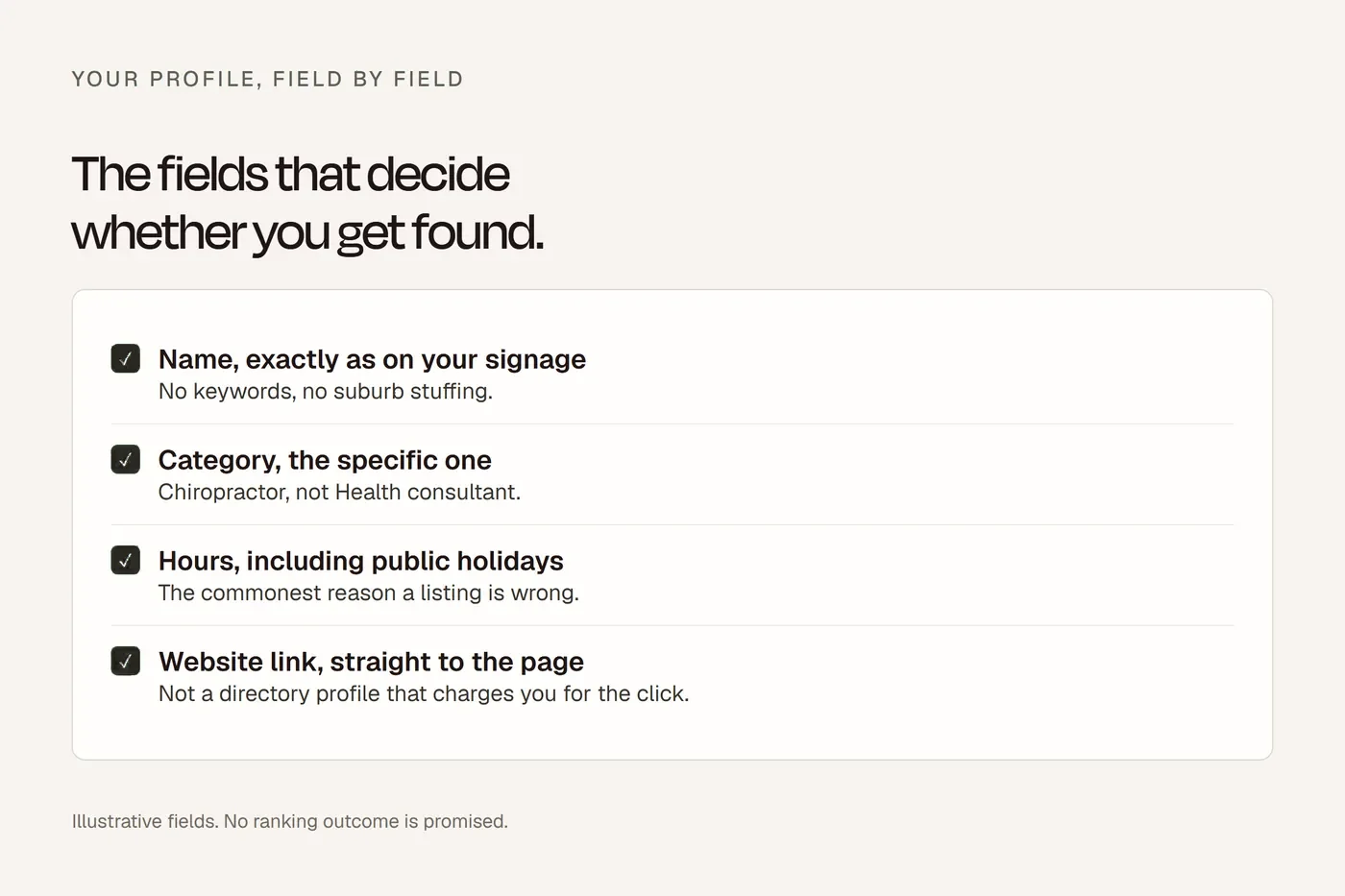
Put the "What an exercise physiologist does" page first. Then one page for each condition group you really see: type 2 diabetes, heart and lung, cancer, osteoarthritis and joint replacement, back pain, mental health, NDIS and disability, older adults and falls. Add a "How to see us" page covering GP plans, Medicare, health funds, DVA in its exact words, NDIS status, workers' comp and private clients. You also need a classes page with full terms if you run them, a fees page with GST-inclusive totals and cancellation fees, a referral page for GPs and physios, your state's code and complaints information, and your booking system linked. For your Google Business Profile, pick the most accurate category, never "Physiotherapist", and add your own booking page as the booking link. My Google Business Profile checklist for clinics covers the setup.
On Meta, ads for weight or health services must target people 18 and over, though general fitness services are exempt. No "Do you have arthritis?" questions, no cure claims and no timeframe promises.
Can I say this?
Tap a card to see the verdict.
Your first 90 days
Tick items off as you go; the list remembers your progress on this device.
- Month 1: accreditation, CPD, first aid and insurance current
- Month 1: know your advertising regime Stand-alone, or a mixed clinic where section 133 applies too.
- Month 1: Medicare provider number for each location And check the funds picked it up.
- Month 1: DVA's exact sentence on the funding page No other veteran wording without approval.
- Month 1: workers' comp registration For your state's scheme.
- Month 1: NDIS status worded accurately
- Month 1: GST checked with your accountant Prices shown including GST where it applies.
- Month 1: code and complaints information displayed At your premises, and on your website in NSW.
- Month 2: website "What an AEP does" first, condition pages, "How to see us", fees, referral page.
- Month 2: clinic and classes separated Separate pages and terms, and the fitness code checked in Qld, WA or the ACT.
- Month 2: wording check No "free" on funded services, no testimonials, no "physio", no "specialist", no cure or fear lines.
- Month 2: Google Business Profile and ESSA listing Accurate category, booking link, and ESSA's permission before using its logo.
- Month 2: count your enquiries Calls, forms and bookings by source.
- Month 3: GP and physio visits With your one-page referral guide. No gifts.
- Month 3: reports prompt and useful Every time.
- Month 3: neutral review requests To every client, no incentives.
Questions I get asked
How do exercise physiologists get more clients?
Explain clearly what an AEP does and who you help, make funding options easy to understand, visit nearby GPs and physios with a referral guide, write useful reports to referrers, and keep your Google profile and ESSA listing accurate. GP referral is the main documented pathway.
Can exercise physiologists use testimonials?
ESSA allows genuine testimonials for sole traders whose business doesn't include registered health practitioners or dietitians. In a clinic with a physio, GP, psychologist or dietitian, testimonials aren't allowed. I leave them off all health websites.
Can I advertise free sessions with Medicare?
No. ESSA says advertising a Medicare or DVA service as free is misleading. Use "bulk-billed" only if you bulk bill, or "Medicare rebates may apply with a GP chronic condition management plan".
Are exercise physiologists registered with Ahpra?
No. AEPs are accredited by ESSA, which is the sole accrediting body. ESSA's Code and advertising guidelines, your state's code of conduct and consumer law apply, and Ahpra's rules apply too if you work in a clinic with registered practitioners.
Do exercise physiologists charge GST?
Exercise physiology isn't on the GST-free health services list, so ESSA says AEPs registered for GST must apply it to most services. Check with your accountant.
What can I say to veterans?
Without DVA's approval, only: "We welcome DVA clients, DVA Veteran Cards (Gold and White) are accepted as payment upon a GP referral". No "fully funded", "complimentary", "No Fees", government logos or card images.
About this guide
Written by Joseph Alzein, founder of bdog. I build websites for exercise physiologists and allied health practices, with ESSA's advertising guidelines and Ahpra's advertising guidelines in mind. Sources were checked on 12 October 2026. This is general information, not legal or tax advice. I've left out Medicare, DVA, NDIS, workers' comp and fund amounts.
Main sources:
- ESSA: what is an Accredited Exercise Physiologist
- ESSA: Code of Professional Conduct and Ethical Practice
- ESSA: advertising guidelines
- DVA: exercise physiologists FAQ
- Bupa: exercise physiologist providers
- Medibank: exercise physiologist providers
- nib: ancillary providers
- NSW Health Care Complaints Commission: non-registered practitioners
- NSW Health: code of conduct for unregistered health practitioners
- Health Practitioner Regulation National Law
- TGA: advertising health services that involve therapeutic goods