Speech pathology practice software, compared
Halaxy, splose, Zanda, Nookal, coreplus and Cliniko for a speech practice: which can claim from the NDIS in bulk, what each costs for your caseload, Medicare referrals and report letters, and keeping children’s records until they turn 25. With a cost calculator, a shortlist quiz and a switching checklist.
On This Page
- What a speech practice needs that others don’t
- The six systems, side by side
- What it costs for your caseload
- NDIS claiming, agreements and the price list
- Medicare referrals and report letters
- Records, privacy and reviews
- Which should you trial?
- Before you switch
- Online booking on your website
- My view
- Questions I get asked
Search for speech pathology practice software and page one is vendor pages, guides written by vendors, and software directories that lead with American products. None of them answers the three questions a speech practice actually has: which systems can claim from the NDIS in bulk, what each one costs for your caseload once text messages, video and Medicare claims are added, and how long you have to keep a four-year-old's file. That's what this page does. I build websites for allied health practices and have no relationship with any of these vendors. Everything below comes from their own pages, the NDIA, Medicare and Speech Pathology Australia. For the general allied health comparison, see Cliniko vs Halaxy vs Nookal vs Zanda; this one is only about what's different for speech pathologists.
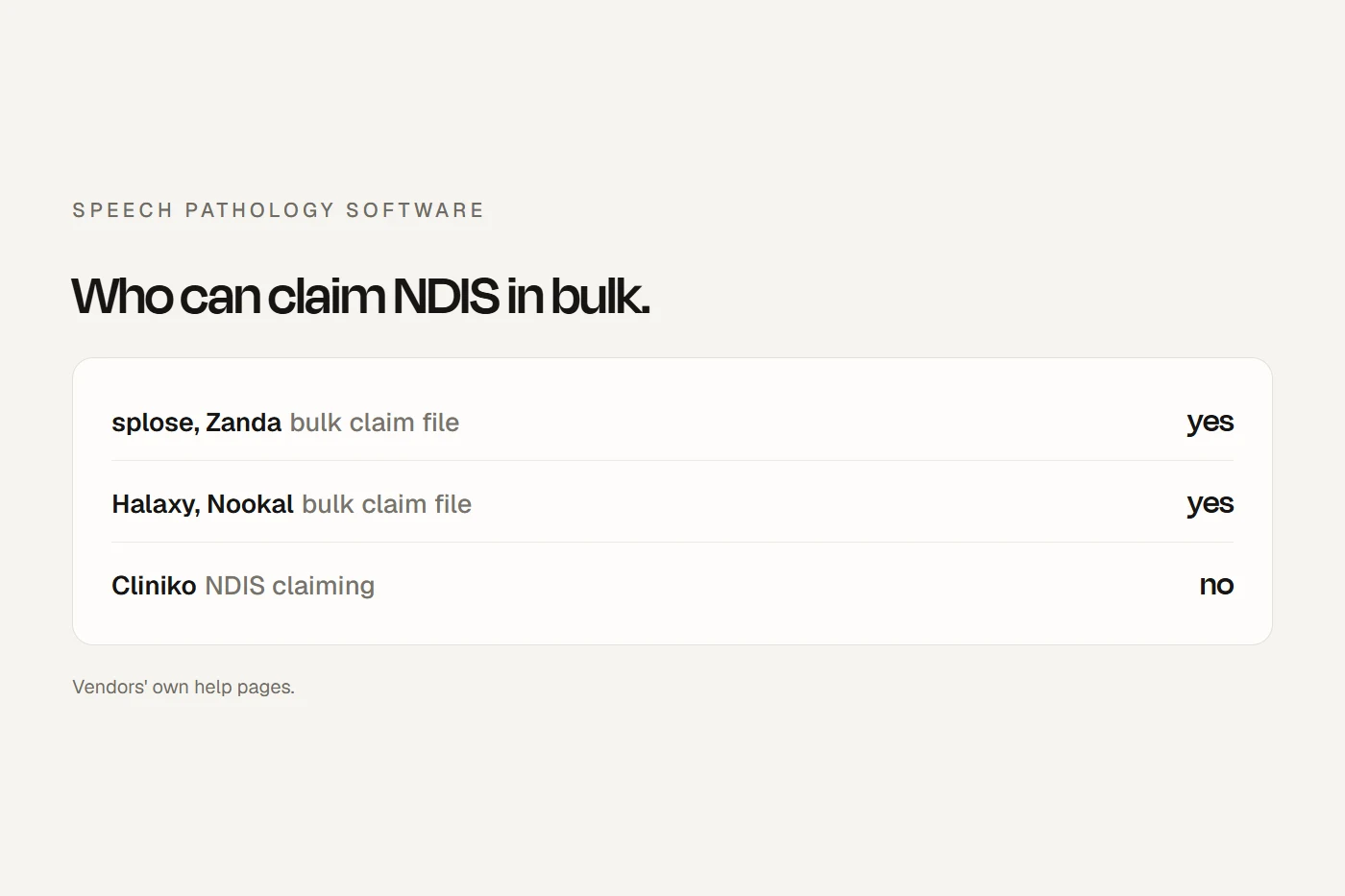
- NDIS claiming is the dividing linesplose, Zanda, Halaxy and Nookal produce a bulk claim file for the NDIS portal. Cliniko says plainly that you can't make NDIS claims through it. I couldn't find a bulk file described for coreplus.
- A solo practice pays $0 to $59 a month before usageHalaxy's core is free, then text messages, video and claims cost credits. The subscriptions run from Zanda's $29 to Nookal's $59, before GST.
- Your records outlive your subscriptionIn NSW and Victoria a child's health record is kept until they turn 25. Whatever you choose, plan how you'll read old files after you leave it.
What a speech practice needs that others don't
Every system here books appointments, sends reminders, takes notes and invoices. For a speech pathology practice, especially one with a lot of children and NDIS participants, six things separate them:
- NDIS bulk claiming. The NDIA says you must use the bulk payment request to claim for participants whose plans are on its new computer system. That means a file your software builds and you upload to the provider portal. Without it, every NDIA-managed claim is typed in by hand.
- The new NDIS line items. The NDIS pricing schedule now splits each therapy item into separate lines for the direct service, cancellations, non-face-to-face work, provider travel, NDIA-requested reports and telehealth. Your software has to carry those codes and keep them current when the NDIA republishes.
- CPSP on the invoice. The pricing schedule says speech pathology supports are delivered by a Certified Practising Speech Pathologist, and Speech Pathology Australia suggests showing CPSP status on invoices to help avoid rejected claims. Set it per clinician, not per practice. Provisional CPSP counts.
- Referrals and report letters. Medicare work comes from a GP's chronic condition plan or a paediatrician's referral for a child with a complex neurodevelopmental disorder or disability. Both need report letters back to the doctor, and you need to know how many services a referral has left.
- School, kindy and home visits. If you see children where they are, a waitlist on a map and travel lines on the invoice save hours a week.
- Long records. Children's files are kept for decades, not years. More on that below.
The six systems, side by side
| Halaxy | splose | Zanda | Nookal | coreplus | Cliniko | |
|---|---|---|---|---|---|---|
| Solo price a month, before GST | $0 plus credits | $30 monthly, $27 on an annual plan (rise announced) | $29 (Starter) | $49 (Essentials), $59 (Professional) | $35 (Core), $49 (Plus) | $45 |
| NDIS bulk claim file for the portal | Yes, plus single claims through HICAPS Digital Claims at a credit each | Yes | Yes | Yes | Not described | No, claims go in by hand |
| NDIS price list built in | Yes | Yes | Yes | Not found | Not found | No, you enter the codes |
| Service agreements | Built from the plan, sent as a form | Built from the price list, e-signature | Template, signed online | Plans and quotes sent to clients | Listed | Not found |
| Medicare claiming | A credit per claim | Through Tyro Health | Direct, no claim fee | From 10c a claim | Free on Plus | Through Tyro Health |
| Built-in video | Yes, in credits | No, Meet, Teams or Zoom | Four free sessions a month, then $9 | No, Coviu, Zoom or Doxy.me | Yes, 1c a participant a minute | Yes, included |
| Text message | 1 credit | 10c | 15c | From 7c | 15c (Core), 10c (Plus) | 10c |
| School and home visits | Named | Map view of the waitlist | Not named | Not named | Named | Not named |
| Data held in Australia | Yes | Yes | Yes, Sydney | Yes, Sydney | Yes, Sydney and Melbourne | Yes |
Scroll the table sideways to see every column.
As each vendor describes it on its own pages. "Not found" means I couldn't find it, not that it can't be done; ask on the demo. Halaxy credits cost 15c to 22c each including GST, depending on the pack. In a national allied health survey, Cliniko and Halaxy were the two most used systems, but too few speech pathologists answered for a breakdown of the profession, so I can't tell you what your peers use.
Halaxy
The core is free with no credit card. Credits pay for the rest: one per text message, two per 15 minutes of video per client, one per successful Medicare or DVA claim, and one per NDIA-managed claim lodged through HICAPS Digital Claims straight from the invoice. It also builds an NDIS bulk upload report, imports NDIS items from its own price list, shows plan spending against the budget including booked appointments, and turns the schedule of services into a service agreement sent as a form. Its speech pathology page names group therapy, assessments, and school and home visits. Data is stored in Australia. A full review is in my Halaxy guide.
splose
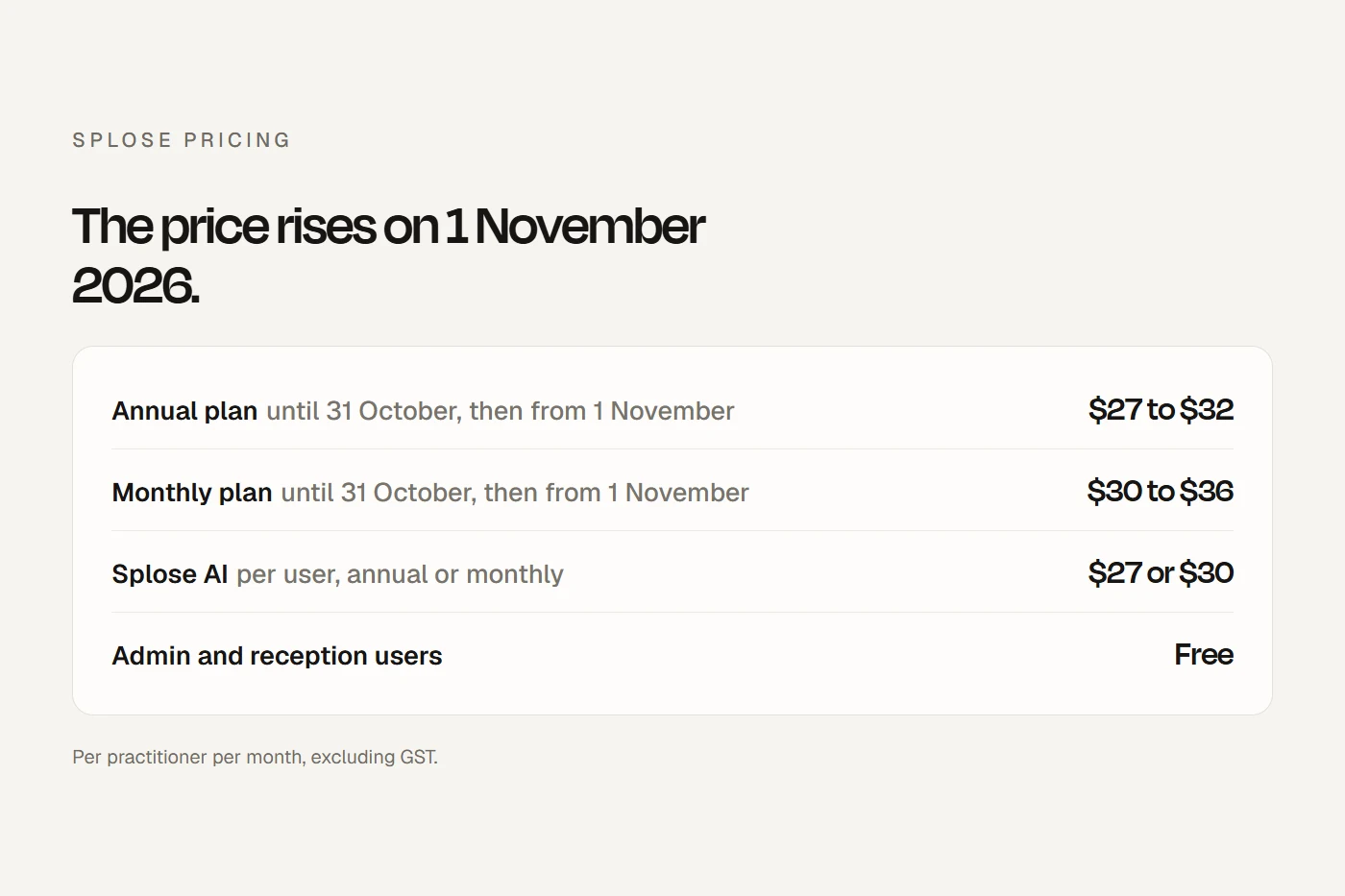
splose is $30 a practitioner a month on a monthly plan, or $27 on an annual plan, before GST, with admin roles free. It has announced a rise to $36 monthly and $32 annual for new and existing customers; the $27 on its pricing page is the annual rate. The NDIS side is its strength: the price list is built in, service agreements carry a schedule of supports and go out for e-signature, funding periods roll over automatically with overbooking warnings, and the bulk upload file goes straight into the portal, with rejected lines coming back with the reason. Its waitlist has a map view for planning mobile visits. Medicare goes through Tyro Health and video through Meet, Teams or Zoom. More in my splose guide.
Zanda (formerly Power Diary)
Starter is $29 a month for one practitioner and includes 1,000 appointments; Zanda doesn't say whether that's a month, a year or for good, and a busy solo clinician gets through 1,000 appointments inside a year, so ask. Growth is $59 plus $29 for each extra practitioner, with unlimited appointments. Medicare claiming is direct with no fee. For the NDIS it generates the bulk upload file, keeps session packs against approved funding, sends statements to plan managers and has a service agreement template to sign online. Video gives each practitioner four free sessions a month, then $9 a month for unlimited, or you can use Zoom. Data is hosted in Sydney, and Zanda says you can export your data at any time.
Nookal
Essentials is $49 a practitioner a month and Professional $59, before GST, with no lock-in. Text messages start at 7c and Medicare claims at 10c. The NDIS export tool builds a file named NDIS_Export ready for the portal and keeps a history so you don't lodge the same item twice. One tip from its help pages: if you open the file in Excel before uploading, keep the dates in the YYYY-MM-DD format. Video is through Coviu, Zoom or Doxy.me. I couldn't find a speech pathology page on Nookal's site.
coreplus
Core is $35 a user a month and Plus $49, before GST, with no contracts and free data migration. Plus adds free Medicare and DVA claiming and secure messaging, so paediatricians and GPs can send referrals and receive your reports without email or fax. Its speech pathology page covers schedules across schools, clinics and homes, NDIS service agreements, plan budgets and invoices to plan managers. I couldn't find an NDIS bulk upload file described anywhere on its pages, so if most of your participants are NDIA-managed, ask to see one before you sign.
Cliniko
One flat price per band of practitioners: $45 for one, $95 for two to five, $145 for six to eight, before GST, with video included and no minimum term. Its own help centre says you cannot make NDIS claims through Cliniko; it suggests setting up cases with a maximum invoiceable amount to watch each funding period, and says itself that this is a workaround. That's fine if your NDIS clients are plan-managed or self-managed, because you're only sending invoices. If they're NDIA-managed, every claim goes into the portal by hand. Medicare claims go through Tyro Health. More in my Cliniko pricing guide.
Others you'll see. Brevity and Lumary are NDIS platforms built around support workers, rostering and shift notes; worth a look only if you also run support work. Practice Better prices in US dollars and Jane in Canadian dollars, and I found no Medicare or NDIS claiming for either. I found no Australian system built only for speech pathology: the speech pages are landing pages on general allied health systems.
What it costs for your caseload
The base price is only part of it. This adds text messages, video and Medicare claims at each vendor's published rates for a month of your practice. NDIS bulk claim files carry no listed fee on the systems that make them. All before GST.
What this shows. Halaxy's credits grow with your caseload, mostly through video, so the free system costs more the busier you get. Cliniko gets cheaper per head from two to five clinicians because the price is flat across that band, but the hours spent lodging NDIS claims by hand aren't in the sum. coreplus Plus looks dearest for a solo practice, though Medicare and secure messaging are both included. The splose figure uses its announced monthly price; the annual plan is cheaper.
NDIS claiming, agreements and the price list
How your participants manage their funding decides how much the NDIS side of your software matters.
NDIA-managed
- How you get paid
- You lodge a payment request in the provider portal. For plans on the NDIA's new system, that has to be a bulk payment request file, and you need to be recorded as the participant's "my provider" first.
- What the software must do
- Build the bulk file with the right line items, take the payment results back in, and show you which lines were rejected and why.
- Systems that do it
- splose, Zanda, Halaxy and Nookal. Halaxy can also lodge single claims through HICAPS Digital Claims.
Plan-managed
- How you get paid
- You invoice the plan manager, who claims from the NDIA. The invoice needs a valid ABN.
- What the software must do
- Send clean invoices and statements a plan manager can read, with the right item codes and your CPSP status.
- Systems that do it
- All six. splose and Zanda both mention statements for plan managers.
Self-managed
- How you get paid
- You invoice the participant or their family, who claim from the NDIA themselves.
- What the software must do
- Send an invoice with the support item and dates on it, and take payment by card or direct debit.
- Systems that do it
- All six.
Four other things to set up properly whichever system you choose:
- Claim quickly. The government has legislated a much shorter window for claiming NDIS supports, so claims have to go in soon after the session. Weekly bulk claiming is a good habit.
- Use the current line items. When you switch systems, rebuild your NDIS services from the current pricing schedule rather than copying old codes across. Cancellations, travel, reports and non-face-to-face time each have their own line now.
- Service agreements. The NDIA says a written agreement is only mandatory for specialist disability accommodation, and recommends one every time anyway. Its pricing rules have expected travel, short-notice cancellations and non-face-to-face work to be agreed with the participant in advance, and a signed agreement built from the price list is the simplest record of that.
- GST. Most NDIS supports are GST-free. Set the tax rate on each service, and check with your accountant.
If you're deciding whether to register at all, see registered vs unregistered NDIS providers.
Medicare referrals and report letters
Two kinds of Medicare work reach a speech practice, and both put more weight on paperwork than on the claim button.
- Chronic condition plans. A GP refers a patient with a chronic condition and complex care needs under a care plan. Sessions must run at least 20 minutes, and a CPSP is the eligible provider.
- Complex neurodevelopmental disorder and disability services. This is the Medicare group that replaced the programs once called Helping Children with Autism and Better Start. A paediatrician or other eligible doctor refers a young person under 25 for help with assessment, then for treatment once there's a diagnosis. Treatment sessions are individual and at least 30 minutes, and a written report goes back to the referring doctor at the end of the course.
What the software should handle:
- Referral dates. Unless the referral says otherwise, it lasts 18 months from the first service. Store the date and the period so the system warns you before it lapses.
- Service counts. There are limits on how many services a referral or a child can use. Your system only sees your own services, so ask families at intake whether the child has used any at another practice.
- Report letters. Medicare expects a written report to the referring doctor after the first and last service under a referral, and whenever something comes up they'd want to know. Keep those letters at least two years. Templates that pull in assessment results and recommendations save the most time.
- Secure messaging. If paediatricians send referrals that way, coreplus Plus includes it, Halaxy charges a credit a message and Nookal sells an add-on.
Records, privacy and reviews
Speech pathology isn't regulated by Ahpra: there's no national board for it. Speech Pathology Australia sets the standards and certifies CPSPs, and its Code of Ethics asks members to keep current, accurate and complete records and to store files securely. The Privacy Act covers every health service provider whatever its turnover, allied health included.
The retention rules are what make speech different. Take a four-year-old seen under both the NDIS and Medicare:
- NSW and Victoria: a health record collected while the person was under 18 is kept until they turn 25, so that child's file is kept for more than 20 years. Adults' records are kept seven years from the last service. NSW also expects a record of what you deleted and when.
- NDIS: records relating to a claim are kept seven years from the claim.
- Medicare: documents an item requires, such as report letters, are kept at least two years.
- Other states and territories: the Privacy Act's principles apply; check your state's health records law.
The age-25 rule is the one that bites. You'll probably use three or four systems over 20 years, so every time you leave one you need an export you can still open years later. Cliniko and Zanda both describe full exports as CSV files and ZIP folders of attachments. For the others, ask on the demo what you get when you cancel.
One setting to check on day one. Many systems can send an automatic review request after an appointment. Speech Pathology Australia's Code of Ethics says members don't solicit or accept testimonials, so switch that off, or limit it to private feedback about your service.
Which should you trial?
Before you switch
Your ticks save in this browser.
- Export everything before you cancel: clients, notes, reports, assessments, attachments and invoices. Store the export somewhere you can open it until your youngest client turns 25.
- Keep a record of what you delete and when.
- Keep NDIS claim records for seven years from each claim, and Medicare report letters for at least two years.
- Rebuild your NDIS services from the current pricing schedule, including the separate cancellation, non-face-to-face, travel, report and telehealth lines.
- Put each clinician's CPSP status on their profile and invoice template.
- Set GST on each service: most NDIS supports are GST-free.
- Re-create your service agreement template with travel, cancellation, non-face-to-face and report terms.
- Re-enter referral dates and periods, and the services already used against each referral.
- Confirm you're recorded as each NDIA-managed participant's "my provider" before your first bulk claim.
- Check where the new system stores data, and turn on two-step login for everyone.
- Switch off automatic review requests that ask for testimonials.
- Update the booking button on your website and test it on a phone.
- Tell plan managers and families about the new invoice format and payment details.
Online booking on your website
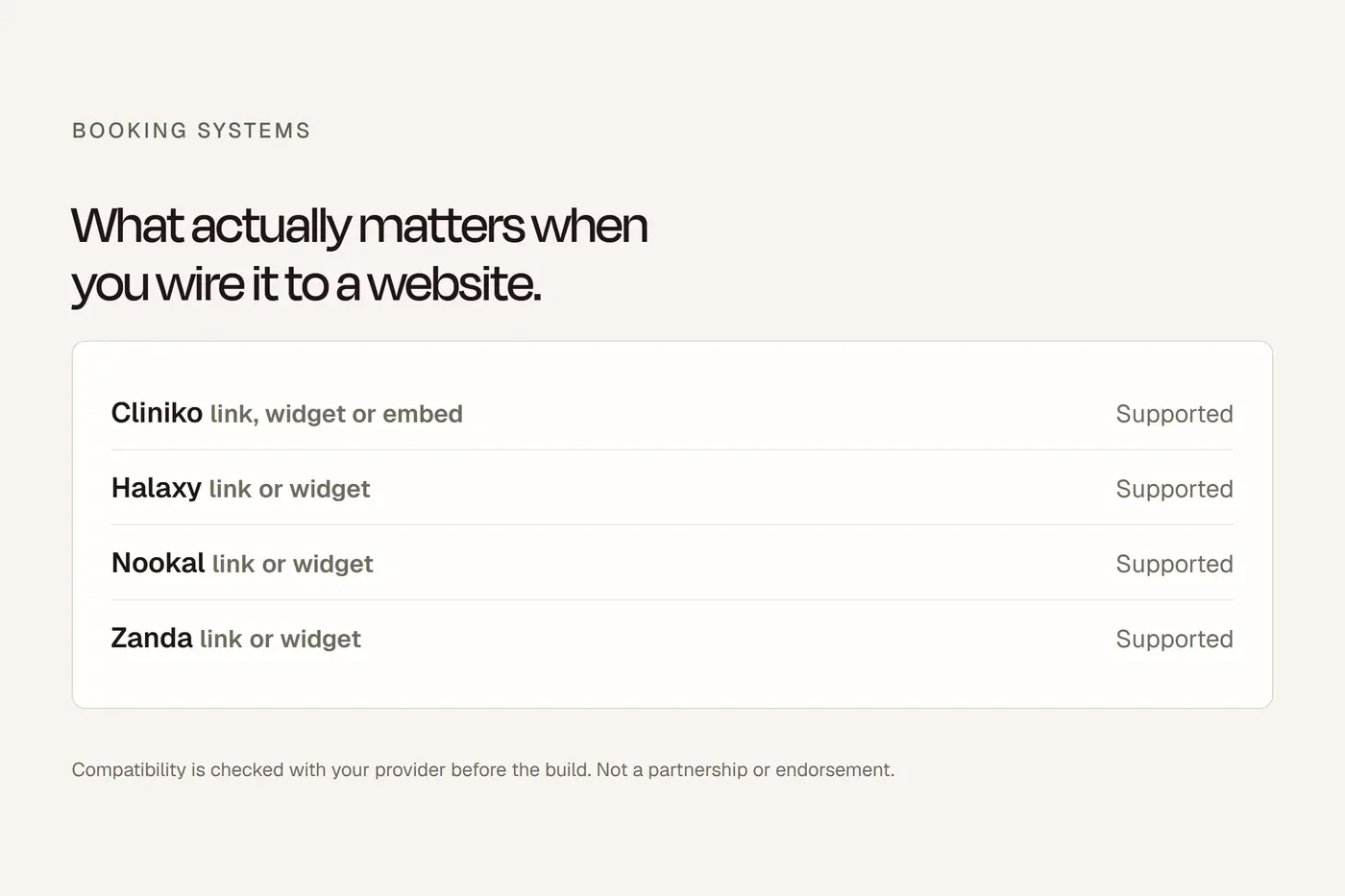
Every system here can put a book-now on your site, as an embed, a button or a link. For a speech practice, the more useful thing on the website is often the intake form rather than the booking calendar: new families usually need a call and a waitlist spot before a first appointment. splose and Zanda both have forms you can embed on your own site, and splose names speech pathology referral forms specifically. Embedded forms and booking keep people on your site, which is better for counting how many enquiries it brings in. How to add online bookings to your clinic website walks through each system.
My view
Pick on NDIS claiming first. If most of your participants are NDIA-managed, shortlist from splose, Zanda, Halaxy and Nookal, because typing claims into the portal by hand is the most expensive thing on this page and it doesn't show up on any price list. Then weigh Medicare: if you do a lot, Zanda and coreplus Plus include claiming. If your NDIS clients are mostly plan-managed and you're growing towards five clinicians, Cliniko's flat price is hard to beat. Whatever you choose, test the export before you need it, because a child you see this year will still have a file when you're three systems on.
Questions I get asked
What is the best practice software for speech pathologists in Australia?
For an NDIS-heavy practice, one that builds a bulk claim file for the NDIS portal: splose, Zanda, Halaxy or Nookal. For Medicare-heavy work, Zanda and coreplus Plus include claiming. For a small team with plan-managed NDIS clients, Cliniko's flat price is good value.
Can Cliniko claim from the NDIS?
No. Cliniko's help centre says you cannot make NDIS claims through Cliniko. You can invoice plan-managed and self-managed participants, but NDIA-managed claims go into the portal by hand.
How much does splose cost?
$30 a practitioner a month on a monthly plan, or $27 on an annual plan, before GST, with admin roles free. splose has announced a rise to $36 monthly and $32 annual. splose AI is $27 a user a month and text messages 10c each.
Is there free software for speech pathologists?
Halaxy's core is free. Text messages, video, Medicare claims and HICAPS NDIS claims cost credits, 15c to 22c each including GST. Its NDIS bulk upload report has no listed credit cost.
How long do speech pathologists keep children's records?
In NSW and Victoria, until the child turns 25. Adults' records are kept seven years from the last service. NDIS claim records are kept seven years from the claim, and Medicare report letters at least two years.
About this guide
Written by Joseph Alzein, founder of bdog. bdog builds websites for allied health practices and has no relationship with any software vendor here. Prices and features were read from each vendor's own pages, and the rules from the NDIA, Medicare, Speech Pathology Australia and state health records regulators. Sources were checked on 12 October 2026. Prices change, so check before you sign. This is general information, not legal or financial advice.
Main sources:
- Halaxy pricing
- Halaxy: guide to credits
- Halaxy: NDIS billing
- splose pricing
- splose: pricing update
- splose: NDIS bulk upload
- Zanda pricing
- Zanda: NDIS
- Nookal pricing
- Nookal: export for NDIS portal
- coreplus pricing
- coreplus: speech pathology
- Cliniko pricing
- Cliniko: NDIS claiming
- Cliniko: export your data
- Tyro Health pricing
- NDIS: how to make a payment request
- NDIS: pricing arrangements
- NDIS: making a service agreement
- Speech Pathology Australia: Code of Ethics
- Speech Pathology Australia: NDIS therapy supports guideline
- MBS: chronic condition speech pathology item
- MBS: complex neurodevelopmental disorder treatment item
- Health Complaints Commissioner (Vic): health records
- OAIC: small business and the Privacy Act
- Ahpra: National Boards