What the best dental websites in Australia do differently
We checked the homepages of 6,039 Australian dental practices and read the best of them page by page. Most don’t publish prices, a third run review widgets, and very few tell you what to do after hours. Here’s what the best ones do instead.
On This Page
Most "best dental websites" lists are a page of screenshots chosen for the photography. Pretty, but no help to a practice owner deciding what their own site needs, and no use at all on the question that matters in Australia: whether the site would pass Ahpra's advertising rules.
So we did it differently. In October 2026 we checked the homepages of 6,039 Australian dental practices for the things patients look for, and the things the advertising rules restrict. Then we read about forty of the better ones page by page. This is what the best of them do, what most of them don't, and the numbers behind it.
We haven't named the practices. The point is the patterns, and every one of them can be copied.
What we looked at
We started from a list of about 7,000 Australian dental practices not identified as part of a corporate group, and fetched the homepage of every one that loaded: 6,039 sites. For each, an automated check looked for specific signals in the homepage and any linked fee page: prices, item numbers, a tappable phone number, an online booking system, hours, mentions of emergencies, after-hours care, parking, accessibility and languages, registration numbers, review widgets, testimonial wording, before-and-after galleries, offers, and words like "best" and "painless".
Keyword checks are blunt. A page that says "we don't offer painless dentistry" counts as mentioning "painless". Booking systems that load late may be missed, so that figure is a minimum. Some practices on the list are medical centres with a dentist. Treat the numbers as a picture of the market, not a verdict on any one site. The examples further down come from reading sites in full, in a browser, across every state and territory except the Northern Territory.
The numbers
| On the homepage or a linked fee page | Share of 6,039 sites |
|---|---|
| A tappable phone number | 82% |
| Opening hours | 63% |
| Mentions emergencies | 60% |
| An online booking system we could detect | 44% (at least) |
| Mentions the Child Dental Benefits Schedule | 25% |
| Mentions parking | 23% |
| Says it's a preferred or participating provider for a health fund | 19% |
| Mentions HICAPS | 18% |
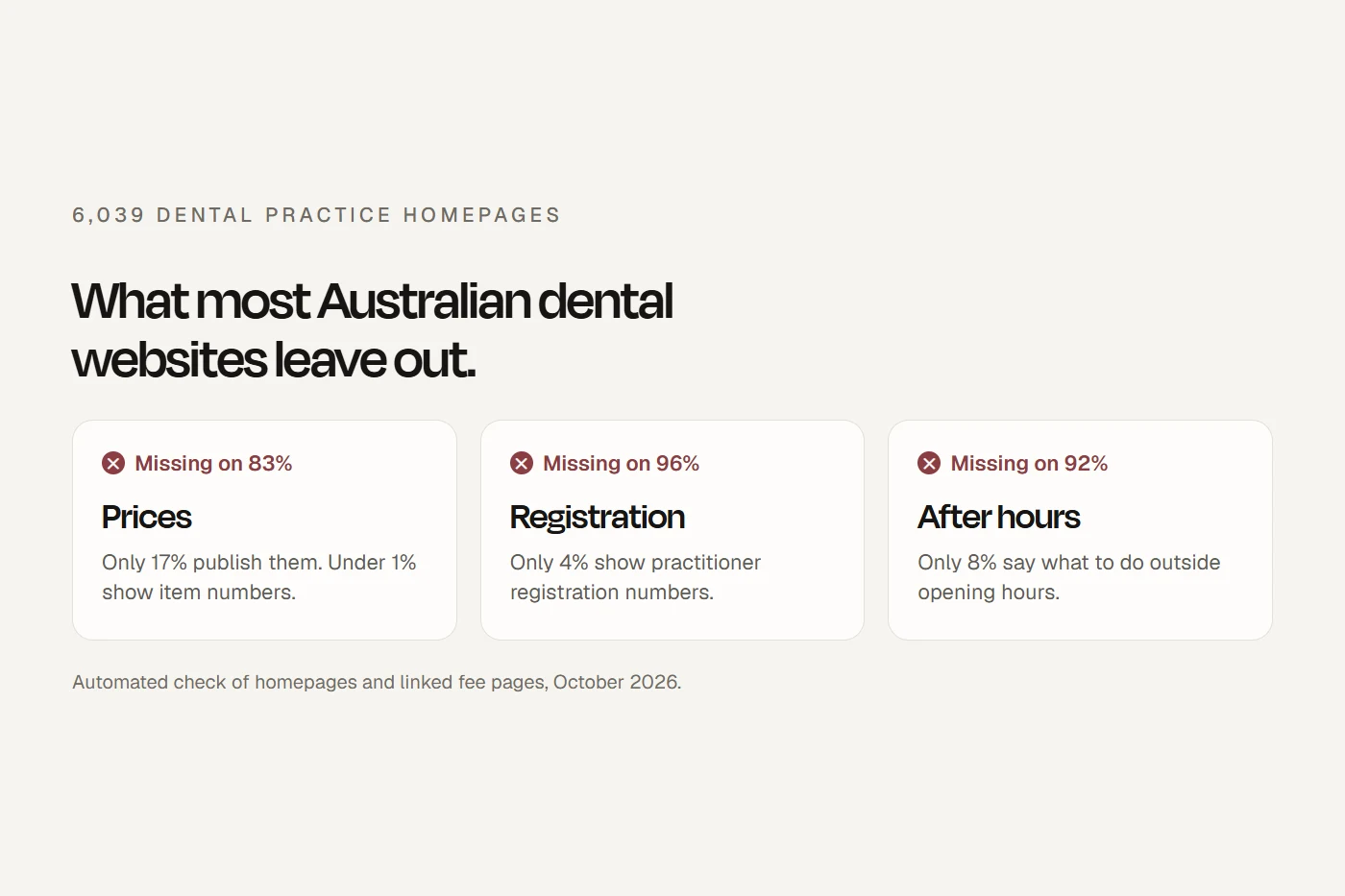
| Published prices (three or more dollar figures) | 17% |
| Names a payment plan provider | 16% |
| Mentions after-hours care | 8% |
| Mentions physical access, such as wheelchairs or steps | 7% |
| Shows practitioner registration numbers | 4% |
| Mentions languages spoken | 2% |
| Prices with ADA item numbers beside them | under 1% |
Scroll the table sideways to see every column.
And the things Ahpra's advertising rules restrict or attach conditions to:
| Signal | Share of sites | Why it matters |
|---|---|---|
| Offers or specials | 35% | Allowed, but the terms and conditions have to be stated |
| A review widget or testimonial wording | 31% | Testimonials about clinical care are banned in your own advertising |
| A before-and-after or smile gallery | 20% | Allowed with strict conditions, tighter still for veneers |
| "Painless" or "pain-free" | 14% | Ahpra treats it as minimising risk; for veneers it isn't allowed at all |
| "Best dentist" or "best dental care" | 12% | A claim nobody can substantiate |
| At least one of the above | 64% | Not all of these are breaches. All of them need checking |
Scroll the table sideways to see every column.
The review widgets we found most often were Trustindex (421 sites), Birdeye (199), Podium (179), Elfsight (143) and the Google Reviews Widget plugin (138). If your web designer added one, it's worth reading our reviews and Ahpra guide before you leave it there.
What the best ones do
The best sites we read weren't the prettiest. Several had dated designs. What they had in common was that a patient could find out, without ringing, what it would cost, who they'd see, how to get there and what would happen. Ten things stood out.
1. They publish prices
Only 17 per cent of sites publish prices, and fewer than 1 per cent put ADA item numbers beside them. The ones that do are the most useful dental sites in the country.
A general practice in Canberra lists every common item as a range and explains why it varies: an examination $95 to $120, a scale and clean from $170 for adults and $110 for children, fillings from $220 to $695 depending on size, root canal treatment $1,200 for one canal and $1,600 for two, with small add-on charges footnoted. A family practice in Melbourne's north publishes a table of item number, description and fee, so a patient can ring their fund with "011, 114 and 121" and get an exact answer. A specialist orthodontist in Canberra publishes the consult fee ($195, an hour, photos and x-rays included, not credited against treatment), the treatment range ($3,200 to $11,750), the deposit, the payment plan terms, and exactly what the quote includes, down to retainers and two years of reviews.
2. When they can't publish prices, they explain the quote
Some practices don't list prices because treatment varies too much. The good ones say so and explain what happens instead. A family practice in Perth answers "When will I know the cost?" with four numbered steps: examination, written quote with item numbers, time to check with your fund, then treatment. A cosmetic-leaning practice in Sydney's west gives a fixed new-patient fee and promises an itemised written quote that includes a "leave it for now" option.
3. They say where they stand with health funds
Patients want to know whether they'll get the preferred-provider rebate. The best sites answer directly either way. A practice in Hobart says it isn't a preferred provider for any fund and uses the ADA's schedule of items on every invoice and estimate. A practice on the Sunshine Coast says the same and explains why. A regional practice in Victoria names the two funds it is contracted with. Most mention on-the-spot HICAPS claiming, and the good ones explain CDBS eligibility in plain words, including what it doesn't cover.
4. They put registration on the page
Only 4 per cent show registration numbers. A Hobart practice shows each dentist on the homepage as "Registered Dentist, General Registration" with their number. A Perth practice prints the number beside every dentist's name. It costs nothing, it tells patients the people are real, and when veneers are advertised with a named dentist, Ahpra's cosmetic guidelines require it.
5. They're precise about who is a specialist
"Specialist" is a protected title in dentistry. The best sites are scrupulous about it. A Sydney practice says of its principal, in one plain sentence, that he's a general dentist rather than a registered specialist. A children's practice in Melbourne labels every person on its team page by role: specialist paediatric dentist, dentist, or oral health therapist, with the days each one consults at each location.
6. Their before-and-afters follow the rules
One in five sites has a before-and-after or smile gallery. Of the galleries we read closely, one stood out for doing it properly. The page opens by saying every photo is published with the patient's written consent and isn't retouched, and that differences in lighting, angle or framing are noted on each case. Every case is captioned as an individual outcome, with results varying, and each treatment links to its risks. That's what Ahpra's conditions look like in practice. Our before-and-after guide has the full list.
7. They tell you what to do in an emergency, after hours
Sixty per cent of sites mention emergencies. Only 8 per cent say anything about after hours. The best do. A practice in Adelaide puts its after-hours emergency mobile number in the site header. A children's practice in Melbourne has a block in every footer: for facial swelling or trauma, go to the Royal Children's Hospital, with the number; for anything else, the Royal Dental Hospital, with that number.
8. They tell you how to get in the door
Fewer than a quarter mention parking, 7 per cent mention physical access, and 2 per cent mention languages. The good ones are specific. A Hobart practice adds which street the entrance is on. A Sunshine Coast practice says it's wheelchair and pram accessible, with wide doorways and step-free entry. A Canberra practice gives walking directions from the nearest car park, and a specialist practice in Melbourne's CBD explains how to get discounted valet parking, with the rates.
9. They tell you what will happen
A Hobart practice lists the ten things a first examination covers and asks new patients to arrive fifteen minutes early. A regional practice has a library of short post-operative videos, each with its length and the key steps written underneath. A practice in Adelaide publishes its appointment policy in full: the booking deposit, the late-cancellation fee, and exactly when its reminder texts go out.
10. They make it easy to act
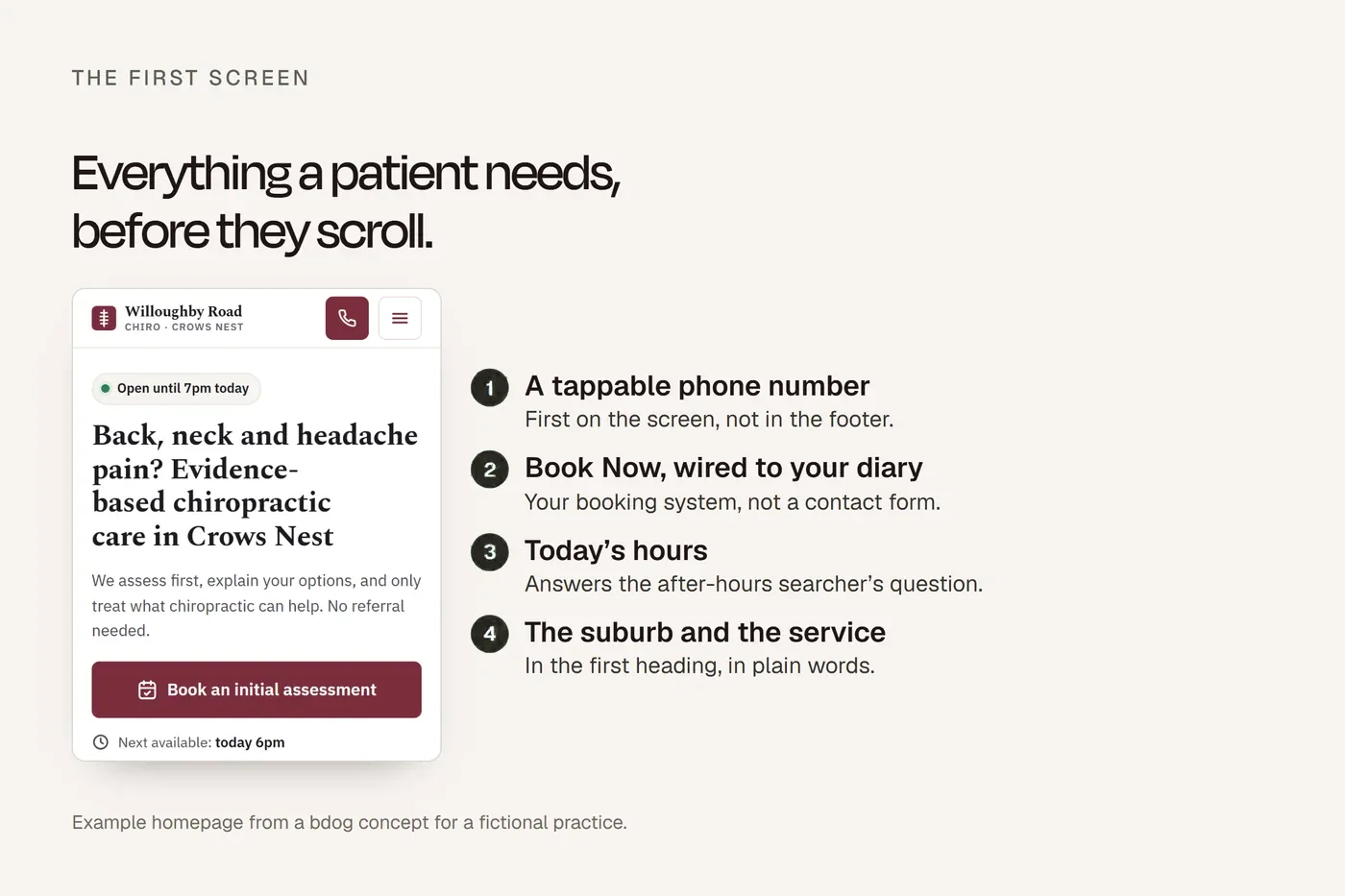
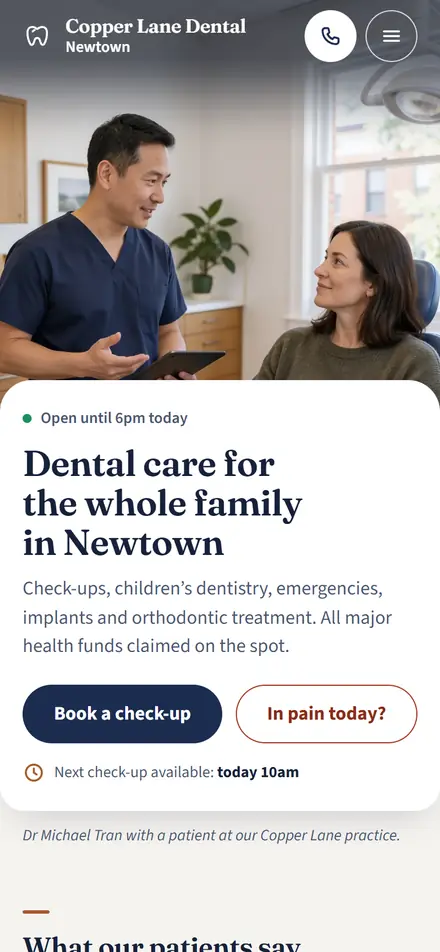
Eighteen per cent of sites have no tappable phone number on the homepage at all, which on a phone means the patient has to copy it out. The best sites put the number and a Book button in the first screen, and the online booking system on the site itself. Of the booking systems we could detect, the most common were Centaur's D4W (806 sites), Dental Hub (401), HealthEngine (400), Praktika (251), Core Practice (221), portal.dental (198), HotDoc (144), CareStack (144), HSOne (107) and Zavy (86).
What to leave off
The sites we excluded from the examples above weren't excluded for being ugly. These are the things that kept coming up.
A star rating and review count in the first screen. Common on the sites we read, often with a review widget underneath quoting patients on their treatment. Ahpra says a star rating on its own is not likely to breach the rules. The quotes are the problem.
"Best", "leading" and "painless". "Best dentist in" a city, "one of Australia's leading", "pain-free care" in the headline. None of it can be substantiated, and patients have seen it on every other site.
Offers without terms. A third of sites have specials. The ones that work state who's eligible, what's included and when it ends. A "free consultation" that's recovered elsewhere isn't free in Ahpra's eyes.
"Transparent pricing" with no prices. We found sites that promised clear pricing and showed none.
Things nobody has checked since 2021. COVID-19 banners still on the homepage, template placeholder text like "Add Your Heading Text Here", and hours in the hero that disagree with the hours in the footer.
Early release of superannuation. 192 sites name SuperCare. The Dental Board lists advertising compassionate release of super as a warning sign for patients, and the ADA's advertising policy says not to advertise it. Our guide to getting more dental patients within the rules covers the alternatives.
What the best Australian dental websites have bdog.com.au · From 6,039 homepages, October 2026
Cost
- Prices for common items, as ranges with reasons, ideally with item numbers
- Or a plain explanation of how quotes work
- Your health fund position stated, either way
- HICAPS, CDBS and payment plans explained, with the total cost for plans
People
- Every dentist named, with qualifications and registration number
- "Specialist" only for registered specialists, and general dentists described as general dentists
Getting there and getting help
- Tappable phone and a Book button in the first screen
- Hours that match everywhere they appear
- After-hours and emergency instructions, with numbers
- Parking, entrance, step-free access and languages
- What happens at the first visit
Leave off
- Review widgets and patient quotes about treatment
- "Best", "leading", "painless" and "pain-free"
- Offers without terms
- Before-and-afters without consent, captions and risk information
- Early-release super advertising
- Old COVID banners and template text
Questions we get asked
What makes a good dental website?
A patient can find out what it will cost, who they'll see, how to get there and how to book, from their phone, without ringing.
Should a dental website show prices?
We think so. Only 17 per cent of the 6,039 sites we checked do, and fewer than 1 per cent show item numbers, so it sets you apart.
Can I show Google reviews on my dental website?
Not reviews that mention treatment, symptoms or results. Ahpra says a star rating on its own is not likely to breach the rules.
Can I have a before-and-after gallery?
Yes, with written consent, matched and unedited photos, captions saying results vary, and risk information. Veneers have extra rules.
Should I put registration numbers on my website?
It's good practice and only 4 per cent of sites do it. For veneers advertised with a named dentist, it's required.
Which booking system do most dental practices use?
Of the sites where we could detect one, Centaur's D4W was most common, followed by Dental Hub, HealthEngine, Praktika and Core Practice.
How much does a dental website cost?
Our clinic website cost guide compares DIY, freelancer, agency and subscription options over three years.
Why don't you name the practices?
Because the patterns matter more than the practices, and every one of them can be copied by any dental practice in the country.
About this guide
Written by bdog, a web studio that builds websites for Australian dental and allied health practices. The figures come from an automated check of 6,039 dental practice homepages and linked fee pages in October 2026, matched on keywords, with the limits described in the method section. The examples come from reading about forty sites in full. This is general information, not legal advice.
Main sources for the rules mentioned: